North Carolina
First Look: Edgecamp Pamlico Station Arrives on Hatteras Island, North Carolina


Hatteras Island, the southernmost of North Carolina’s Outer Banks, has a long legacy as a destination for kitesurfing, beach combing, and generally unplugging (complete with notoriously spotty cell service). Historically, lodging options included a smattering of inns, motels, campgrounds, and vacation rentals. Opening this month, the Edgecamp Pamlico Station hotel, designed by celebrity interior designer and potter Jonathan Adler, ushers in a new level of accommodations.
Pamlico Station owner Richard Fertig first came to the area in 2018 to learn to kiteboard. “I instantly found the island remarkable. The natural beauty, the wetlands—everything about it was so unique. I continued coming back year after year and found there were such limited places to stay,” he says. “I had the idea to create a hospitality experience that would open up this incredible destination to more travelers but also something that matched the Outer Banks’ world-class caliber.” The result is a residential-style hotel that offers a certain barefoot elegance along with wellness-focused amenities, concierge service, and easy access to nature. Each of the fourteen suites comes with an outdoor living space and water views of the Pamlico Sound.
Inside, the suites are cozy and upscale. “Our initial inspiration was Mother Nature—she’s the world’s best designer—and the environment surrounding Pamlico Station,” Adler says. “The hotel is alongside one of the largest preserved parcels of the Outer Banks’ shoreline, which is so beautifully remote and majestic, and we infused elements of it in the colors we used.” The interiors capture Adler’s signature upscale midcentury style, with a mix of ceramic tiles, organic textures such as mohair and bouclé, and cool metals.
“Design has the power to reflect back your most interesting and glamorous self,” Adler says. “And who doesn’t want to feel especially glamorous on vacation?”
Photo: Courtesy of Edgecamp Pamlico Station
Anchoring the bedrooms is the Adler-designed Riviera Wave Bed, featuring sand-colored bouclé and curved natural reeds that evoke the shape of water coming on shore. “I feel it’s important to design with a sense of place,” says the designer, noting that the colors of the surrounding landscape flow through the hotel’s living spaces in pops of green and blue.

Courtesy of Edgecamp Pamlico Station
“We mixed rattan and lacquer for a polished yet rustic look,” Adler says. Some suites come with a Malm fireplace in Bengal orange, perfect for warming up after a day out in the wind and waves.
Courtesy of Edgecamp Pamlico Station
Wellness is a theme at Edgecamp Pamlico Station, says Fertig, evidenced by a cold plunge and sauna for guests to use on demand. “We wanted to create a place where you can relax after a day of outdoor exploration. I like to say, ‘Play hard but recover intentionally.’ The wellness center was the perfect complement to the active lifestyle the Outer Banks offers,” he says. Suites come stocked with yoga mats, a Therabody massage gun, resistance bands, and a foam roller.

Photo: Courtesy of Edgecamp Pamlico Station
The building, formerly a retail center, has been thoughtfully designed to offer exterior access, which means guests can come and go as they please without having to traipse through a lobby. Railings and banisters are clad in organic material to blend into the landscape.
Courtesy of Edgecamp Pamlico Station
In the spa bathroom, floors and walls are covered in white and navy penny tile, and rain showers, stocked with Jonathan Adler grapefruit-scented amenities, stand ready to wash away sand and sunscreen.
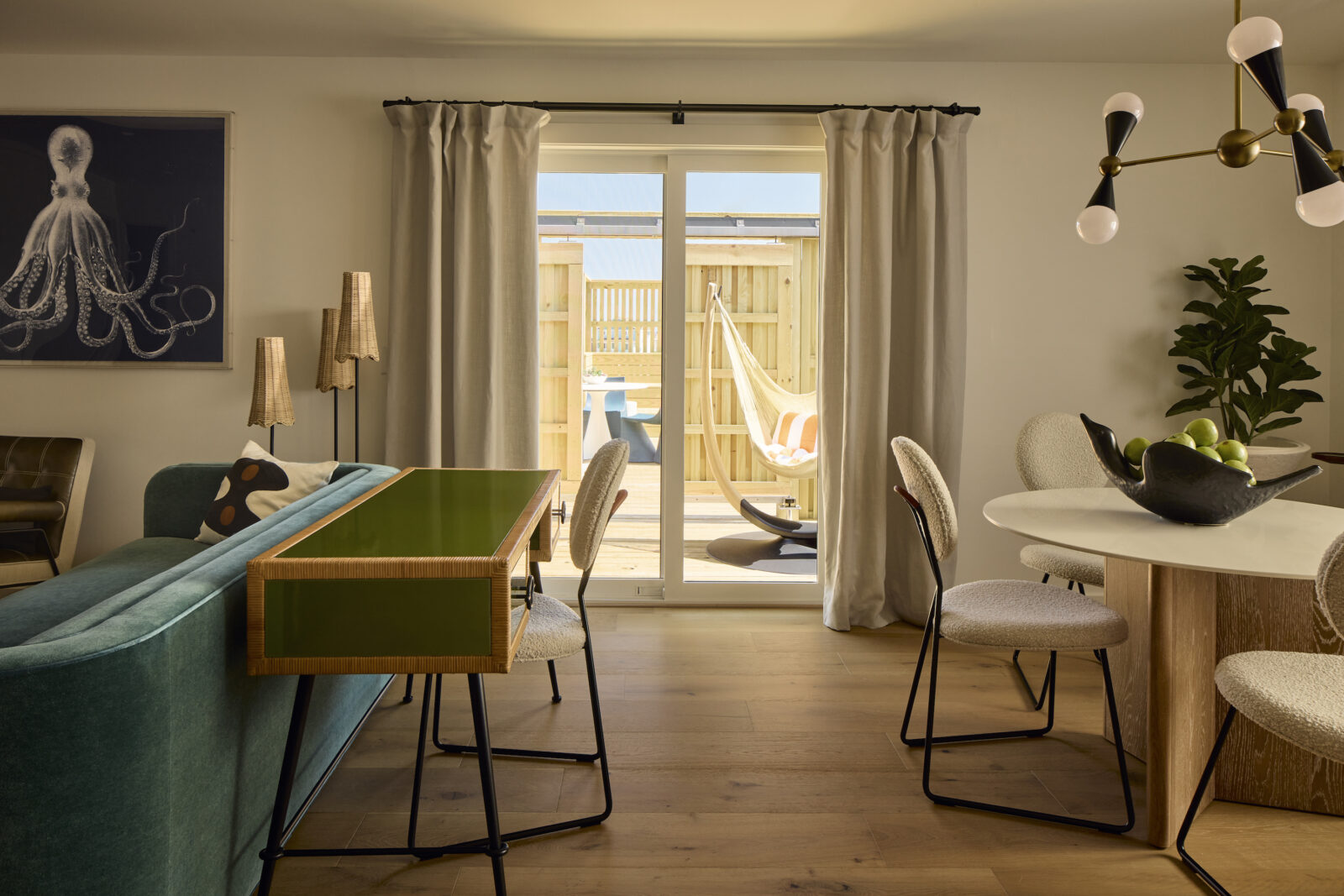
Photo: Courtesy of Edgecamp Pamlico Station
Each of the hotel’s fourteen suites comes with a dining area suited for four guests and a full kitchen, which visitors may choose to have pre-stocked with their favorite groceries. The concierge team can also arrange for a private chef to prepare in-room meals. “We’ve reimagined luxury by blending standout design, personalized and private service, and unparalleled access to outdoor adventure, creating an experience that’s really unlike anything else on the islands,” Fertig says.

Photo: Courtesy of Edgecamp Pamlico Station
For the suite living rooms, Adler commissioned custom rugs made of 100 percent recycled materials. He says sustainability can also be about longevity and durability. “In everything I design, whether it’s products or places, I want them to be of extraordinary quality so that you can appreciate them for years and years without having to throw away or adjust a thing,” Adler says. “My motto has always been, ‘If your heirs won’t fight over it, we won’t make it.’”
Courtesy of Edgecamp Pamlico Station
Adler, who considers himself “first and foremost a potter,” took pride in selecting artful ceramics and tile. The bedrooms are accented with his sculptural Grenade Column lamps and Soleil Tile Art, crafted from colorful ground recycled glass and stoneware.
Courtesy of Edgecamp Pamlico Station
A circa-1968 photograph of a paraglider in Acapulco, by society photographer Slim Aarons, is the nostalgic centerpiece of a suite living room. Beyond taking inspiration from the Outer Banks, Adler says, “We drew upon other glamorous beachside locales, like the French and Italian Rivieras in the fifties and sixties.”



North Carolina
North Carolina’s Charming Raleigh Suburb Is A Fast-Growing Town With River Views And A Historic Downtown – Islands

As North Carolina’s capital, Raleigh attracts no shortage of visitors each year for its downtown museums, historic sites, and restaurants. But about 20 miles southeast of downtown Raleigh, there’s another destination travelers might not think to explore: Clayton. With a thriving historic downtown and access to the scenic Neuse River, this often-overlooked Raleigh suburb is growing rapidly, its population increasing by nearly 27% since 2020 (according to World Population Review).
Downtown Clayton centers around Main Street, where restored commercial buildings now house restaurants, bars, and entertainment venues. Visitors can also follow the town’s outdoor sculpture trail, take a stroll through the Clayton River Walk on the Neuse, or get out on the river for some kayaking. With enough to see and do for a full day, Clayton makes an easy road trip from Raleigh and remains accessible to those coming from farther away.
Travelers visiting Clayton from outside the immediate region can fly into Raleigh–Durham International Airport (RDU) or take an Amtrak train to Raleigh Union Station. Overnight options within town are limited to places such as the Clayton Magnolia Inn, a bed-and-breakfast offering seven guest rooms in a restored 1885 home, and the budget-friendly Comfort Suites Clayton–Garner, a practical hotel with free breakfast. However, travelers looking for a wider selection of hotels can stay in Raleigh or along the I-40 corridor near Garner.
The Clayton River Walk provides the town’s best river views
Begin your trip to Clayton by exploring the Clayton River Walk on the Neuse, a 4-mile trail open to walkers and cyclists, with the trailhead located just a five-minute drive from downtown. Much of the trail passes through forested areas along the Neuse River. You can expect to see wildlife, such as ospreys, along the route, which adds to the trail’s appeal for nature lovers. However, one Google reviewer notes that locals have also spotted bears in the area, making it worth reviewing what to do in the event of an encounter before hitting the trail. You can never be too sure, after all.
The main trailhead for Clayton River Walk includes a parking lot for visitors and is also near a boat access ramp for paddlers. If you’d like to enjoy the calm, peaceful waters but don’t have a personal canoe or kayak, you can rent one or book a group river excursion with Neuse Adventures Canoe & Kayak Rentals, located a 10-minute walk from the parking lot. The company’s FAQ recommends bringing essentials such as water, sunscreen, and extra clothes for the best experience on the river. For another underrated Neuse River destination in North Carolina, consider adding Smithfield to the itinerary.
Clayton’s historic downtown is filled with art and local landmarks
After spending time along the Neuse River, travelers can explore the Clayton Historic District, which is listed on the National Register of Historic Places. Along East Main Street, you’ll find preserved 19th- and 20th-century buildings that now hold locally owned businesses. Fare Game, an arcade and bar known for its inventive pizzas, occupies the ground floor of the restored Carroll Building, a former family-owned dry goods store which dates back to 1915. A few doors down, Revival 1869 serves craft cocktails and hosts live jazz shows inside a restored commercial building.
In addition to historic buildings, a must-see while exploring downtown is the Clayton Sculpture Trail. This free outdoor art exhibition features more than a dozen works, most of which are located along East Main Street, with additional pieces on East Front Street and at the Clayton Community Center. Travelers can use the town’s online sculpture map to identify each installation and follow the recommended route. If you’re interested in viewing more public art in North Carolina, Rocky Mount is another town with artsy vibes you’ll want to visit.
Travelers should also check out the schedule at The Clayton Center, a former school complex just one block from Main Street that now serves as a 600-seat entertainment venue. Visitors can purchase tickets to a wide range of events, including comedy shows, live concerts, and theater. In addition to visitors praising the center’s friendly staff, one Google reviewer highlighted the building’s “beautiful architectural details” and the way its vintage auditorium contrasts with the “modern loft-like reception space.”

How to protect yourself against a shark
A safety diver calmly pushes away a shark, explaining how to stay safe if approached. (Credit: @mermaid.kayleigh/@andriana_marine via Storyful)
Claire Hardwick, Storyful
The Atlantic Ocean’s largest tagged great white shark in history recently resurfaced off the coast of North Carolina near the Outer Banks, scientists said.
At nearly 14 feet long, the big fish named “Contender” appears to be heading toward Cape Cod and the eastern coast of Canada, according to a OCEARCH, a global non-profit marine research group tracking shark sightings and migration.
Researchers first tagged the massive great white shark on Jan. 17, 2025 off the Florida-Georgia coast, according to online data from the non-profit.
Most recently Contender breached the surface just before 2 p.m. ET on July 10.
Prior to that, the shark had pinged several times including on April 14 and on April 23.
A ping means the Smart Position and Temperature Transmitting tag attached to the fish’s dorsal fin was spotted above the surface for a brief period as it swam, transmitting a near-live location signal to the OCEARCH shark tracker.
The visit comes at the time of year when great white sharks start migrating north to warmer waters for a larger food supply, as previously reported by USA TODAY.
How much does the largest great white shark tagged weigh?
According to OCEARCH’s shark tracker page, Contender weighs 1,653 pounds.
An adult male, the shark believed to be just over 30 years old.
“Contender’s name is in honor of Contender Boats, a longtime OCEARCH partner, whose industry-leading sport fishing and pleasure boats enable our research missions,” the non-profit wrote on its website.
See live view of tagged sharks that are tracked:
To track Contender and other tagged marine life online, download the OCEARCH Global Shark Tracker App, available on iOS, Android, and on desktop at ocearch.org.
Natalie Neysa Alund is a senior reporter for USA TODAY. Reach her at nalund@usatoday.com and follow her on X @nataliealund.

BUNCOMBE COUNTY, N.C. (WLOS) — Copper theft is becoming a growing problem across North Carolina, with AT&T officials warning that the crime can leave entire neighborhoods without phone or internet service and, in some cases, disrupt emergency communications.
According to AT&T, the company has recorded 215 copper theft incidents across North Carolina so far this year. Buncombe County alone has seen about 40 incidents over the past two years. Thieves often cut down or dig up communication lines, strip the copper from the wire and sell the metal for scrap.
“It’s problematic, largely from a public safety standpoint,” said Trey Rabon, president of AT&T North Carolina. “If folks need to call emergency services, need to call 911, they’re not able to access the infrastructure necessary to complete that call.”
“Sometimes we see instances where emergency communications are disrupted, communications between public safety agencies are disrupted,” Rabon added. “It has become an acute challenge, particularly in western North Carolina.”
5 CHARGED AFTER AT&T WIRE THEFTS CAUSED WIDESPREAD OUTAGES IN BUNCOMBE COUNTY
Rabon said thieves frequently target both residential and commercial communication lines, taking advantage of remote mountain locations where utility poles are often out of sight from nearby homes.
“In the mountains, oftentimes personal property is not in line of sight for other neighbors,” Rabon said. “Would-be thieves have the ability to climb a pole, disconnect a line, drive to the next pole and disconnect that line.”
In May, five people were charged in connection with multiple copper thefts across Buncombe County that investigators said caused widespread outages. Law enforcement also discovered several wire-stripping sites in Swannanoa and Leicester.
The thefts have also impacted local businesses.
SWANNANOA PIZZA SHOP SAYS INTERNET WIRES WERE STOLEN, FORCING A DAY CLOSURE
In early June, thieves cut and stole internet lines serving Good Pizza Company. Owner George Peyton said the outage forced the restaurant to close because employees could not access essential business systems.
“Nobody could clock in, couldn’t print tickets, couldn’t take phone orders, and that’s about 80 to 85% of the business,” Peyton said.
AT&T officials say one of the most effective ways to prevent copper theft is for communities to remain vigilant and report suspicious activity.
“They don’t like to operate in the light of day, and they certainly don’t want to operate with a hyper-aware and vigilant community,” Rabon said.
Anyone who suspects someone is stealing communication wire is encouraged to contact local law enforcement.
-

 Virginia5 minutes ago
Virginia Tech HC James Franklin Gives High Praise For Clemson’s Dabo Swinney
-

 Washington11 minutes ago
Will air quality be even worse in Washington DC on Friday?
-

 Wisconsin17 minutes ago
LIVE UPDATES: Wisconsin air quality, wildfire smoke blankets region
-

 West Virginia23 minutes ago
Repair work on busiest bridge in West Virginia to happen in phases to “minimize disruptions”
-
Wyoming30 minutes ago
Wyoming Rodeo Stars Set for National High School Finals
-

 Crypto35 minutes ago
New law protects consumers from cryptocurrency kiosk/ATM fraud | Maui Now
-

 Fitness47 minutes ago
‘This works’: Fitness icon Suzy Jalowsky, 60, shares the simple exercise formula she swears by
-

 Movie Reviews59 minutes ago
Movie Review: “The Odyssey”

