Georgia
This Georgia Election Official Faked Refusing to Certify an Election


On the day they gathered to certify results of the November municipal election last year, three members of the Spalding County Board of Elections and Registration met in the elections office, an hour south of Atlanta, to look over the results.
Normally a routine matter, the vote on certification that day became anything but — part of a phenomenon happening across the country in recent years, as local election officials have gone rogue and refused to certify election results, largely based on Donald Trump’s constant lies about widespread election fraud.
One of the Spalding County election board members, Roy McClain, publicly voted against certification of results — a notable act in itself. Curiously, though, McClain quietly signed an official government document approving the very same results that he publicly refused to certify.
It’s a bizarre wrinkle in the mounting drama over election certification. While certification has historically been a “ministerial” task — not a discretionary one — states around the country have seen a wave of refusals as Trump’s lies about 2020 have consumed the Republican Party down to the local level. Nearly 70 election deniers in six swing states are now working as local election officials, Rolling Stone and American Doom previously found.
The certification issue has come into greater focus in Georgia, after the new MAGA majority on the State Election Board recently passed two rules giving local election officials like McClain more power to arbitrarily deny certification, based on belief in or allegations of election fraud. As the 2024 election approaches, local officials refusing to certify results appears to be a key strategy for the Trump campaign and his allies, and it could help delay the results of the election or buttress the former president’s effort to challenge another loss.
On Nov. 14, 2023, the day McClain voted against certification, he claimed that he needed more time to hand count results. The board had implemented automatic hand recounts of all elections but McClain wanted more time to compare his hand count with results from voting machines. The board was still able to certify the results, with a Republican and Democrat voting in favor.
But McClain’s “no” vote was merely for show: At some point that same day, McClain signed a document called a “Certification of Returns,” officially approving the results of the election even though he had publicly voted against it. While votes at public meetings like McClain’s are the acts that get reported in the press, in Georgia, the Certification of Results is what officially approves those results. Election board members sign the document, and it’s then sent to the secretary of state.
“We, the undersigned Board of Elections/Registrars, Superintendent/Supervisor of Elections and designees, do jointly and severally certify that the attached Election Results Summary is a true and correct count of the votes cast in this County for the candidates in the General Election,” the Certification of Returns document states.
Underneath the statement — Roy McClain’s signature.
McClain’s “no” vote on certification was reported by multiple media outlets, and became one of dozens of examples of rogue local election officials refusing to do what Democrats and election experts contend is a purely ministerial duty — certifying election results. But McClain nor Spalding County appears to have attempted to correct public reporting about his “no” vote and his ensuing approval of election results.
In response to questions about McClain’s contradictory actions, Spalding County election supervisor Kim Slaughter says that although McClain “voted against certifying the election at the time the vote was taken, the election was certified with a majority of the votes cast and therefore, all board members signed the certification documents.”
In other counties, instances of certification refusal have played out differently. Certification of Returns forms show that election board members in Gwinnett and DeKalb counties who voted against certification did not sign the documents. Their public vote lines up with their official act, in other words.
So why did McClain publicly vote against certification only to privately approve it that same day? Slaughter says nothing was hidden from the public because the Certification of Returns was physically displayed at the Spalding County elections office in the small town of Griffin.
Others wonder whether McClain was trying to appease powerful election denier factions of the Georgia Republican Party while simultaneously shielding himself from legal liability. Election officials who fail to certify results by statutory deadlines can face fines and even jail time for their actions.
“It’s performative — they’re playing to their base,” Jim O’Brien, a Democratic member of the Spalding County election board, tells Rolling Stone and American Doom.
Cathy Woolard, a former Democratic member of the Fulton County election board, says McClain may have been concerned about legal action, so he “did something symbolic and then complied with the law.”
While McClain appears to have complied with Georgia law requiring county election officials to certify results, an election board member could theoretically do the opposite: publicly vote for certification and then refuse to sign the Certification of Returns. One expert suggested such a move would come with legal risk.
“I suspect there would be a real danger for anyone who votes to certify an election but then refuses to sign off on the official documentation,” says Anthony Michael Kreis, a constitutional law professor at Georgia State University. “To me, that would constitute a potential criminal election interference if a majority of a board refused to sign off.”
The revelations about McClain’s contradictory actions have not been previously reported, and were discovered in emails obtained by Rolling Stone and American Doom. They’re the latest oddity to come from Spalding County, where the elections office has become a hotbed of denier activity since 2020. Starting with a state law that allowed for a Republican takeover of the board in 2021, the election board has become a proving ground for what elections administration looks like under the authority of election conspiracists.
The board’s chair is a QAnon adherent and voting machine conspiracy theorist who once attended a screening of the debunked election conspiracy documentary 2,000 Mules with McClain. The county’s election supervisor got sucked into false claims on election night in 2020 that election workers had discarded ballots for Trump in a dumpster. Then, as Joe Biden’s inauguration approached, the election deniers in Spalding County discussed illegally accessing election equipment with an Atlanta IT firm that had helped the Trump campaign break into voting machines elsewhere in Georgia.
Now, there’s McClain’s bizarre certification contradiction. The emails obtained by Rolling Stone and American Doom show McClain privately disputing a recent report from a watchdog group that mentioned his “no” vote on certification. McClain wrote to his colleagues that “lies” are being told, and attached a copy of the Certification of Returns document that he had signed.
If McClain was trying to correct the record about his “no” vote, his actions following the November 2023 election are even more curious.
Following his public refusal to certify the results of the election, McClain received a letter from a lawyer representing the Democratic Party of Georgia. The letter — which was sent to two other counties whose Republican election board members refused to certify results — admonished McClain for his actions, saying they were “improper regardless of any purported justification given.” The letter was sent on January 3 to Spalding, DeKalb, and Cobb counties.
A month later, at a meeting of the Spalding County election board, McClain addressed the letter, saying he felt that Democrats were trying to “intimidate” him.
“I think everybody here knows that if you’re going to try to bully or intimidate somebody, I’m probably not the good candidate for that (sic),” McClain said. “So, I’ll take it for information, but I’m not going to put up with it, and if I feel that my oath says I have to do something, that’s what I’ll do, regardless of someone’s interpretation of what they think might’ve been in the law.”
At no point did McClain publicly clarify that he had privately certified the results of the November 2023 election. Further, Democrats and election experts contend that the law is clear: Certification is a mandatory duty, based on 100 years of precedent established by Georgia court cases.
McClain is not the only local election official who complained about the letter from Democrats. The day after the letter was sent to Spalding, DeKalb, and Cobb counties, David Hancock, an election denier who serves on the Gwinnett County elections board — and who coordinated with a pro-Trump member of the State Election Board on its new, controversial certification rules — forwarded the letter to a well-known election denial activist. Hancock apparently received the letter from fellow election officials in Cobb County, according to emails obtained by Rolling Stone and American Doom.
“When you have a moment, I would really appreciate your opinion on this incredible letter from an attorney for the Democratic Party of Georgia regarding voting to certify an election,” Hancock wrote to Garland Favorito, an “election integrity” activist who is one of the state’s most prominent election deniers, and who has pressured the State Election Board to investigate unfounded claims of widespread voter fraud and implement rules based on his conspiratorial beliefs. “I don’t see how this stands — if the [county board of elections] has no choice but to certify an election, then why require them to vote to certify the election?”
The answer, say Democrats and election experts, is that certification is a ceremonial task — part of what Democratic lawyer Marc Elias calls “the pageantry of democracy.” Other avenues exist for candidates and parties to investigate irregularities and claims of fraud, from lawsuits to recounts and audits, but the act of certification — carried out by political appointees on county election boards like McClain and Hancock — are not the proper venue to investigate those claims, Georgia courts have ruled.
Still, McClain, Hancock, and a handful of other county election board members throughout Georgia have used certification as an opportunity to make their own claims about fraud. Their actions are part of a broader pattern of pro-Trump local election officials across the country holding up certification based on bogus accusations of widespread voter fraud.
Since 2020, 35 local election officials have delayed or attempted to deny certification in eight states, according to a report last month from the watchdog Citizens for Responsibility and Ethics in Washington.
Since November, when McClain and election board members in DeKalb and Cobb counties voted against certification, county election board members in Georgia have refused to certify election results three times. The first came in March, when Hancock voted against certifying results of the 2024 presidential primary. He was joined by his fellow Gwinnett County election board member, Alice O’Lenick, also a Republican. In May, Fulton County’s Julie Adams abstained from voting to certify results of this year’s primary elections for state and local races.
She then sued with the help of lawyers from the Trump-aligned America First Policy Institute, demanding the power to refuse to certify results if Fulton County doesn’t provide a lengthy list of documents and materials for her to review prior to certification. That lawsuit is pending.
Since then, Adams has gone on to join the push for rules that give more to county election officials to refuse to certify results. Adams and other election denial activists have successfully convinced the State Election Board to pass those rules. In June, Adams again abstained from certifying the results of a local runoff election.
Certification is shaping up to be one of the most important tactics of a Trump campaign that is hyper-focused on questioning the results of November’s election. Trump has signaled that he’ll refuse to accept any result that doesn’t show him winning, and he has local election officials, state politicians, and, of course, members of Congress to back up these claims.
The question is becoming whether the system can hold when Trump challenges the election results this year — and whether local election officials like McClain will continue complying with the law and certifying results, even if they won’t say so publicly.
This story is being published in partnership with American Doom, a newsletter that focuses on right-wing extremism and other threats to democracy.



Georgia
How Georgia’s economy drew the World Cup—and how the World Cup will strengthen Georgia’s economy

Illustration by Dan Matutina
It’s the $1 billion dollar question: What prompted FIFA to choose Atlanta as one of the host cities for this summer’s FIFA World Cup 2026™? The answer is the same one that lures companies from all over the world to Georgia: the state’s robust economy, strong infrastructure, and cooperative culture.
Since the Olympics, Georgia has positioned itself as the Gateway to the South for global business. It has built a diverse industry base in fields such as agriculture, manufacturing, logistics, film and television, technology, and aerospace. Direct foreign investment is strong here: Atlanta is home to more than 70 foreign consulates, trade missions, and bi-national chambers of commerce.
One of Georgia’s biggest assets is global connectivity—by air, rail, road, and waterways, says Pat Wilson, commissioner of the Georgia Department of Economic Development. Eighty percent of the U.S. population is within a two-hour direct flight from Hartsfield-Jackson Atlanta International Airport, the world’s busiest passenger hub. Georgia’s interstate system provides 20,000 miles of federal and state highways, and the Port of Savannah is the fastest-growing container terminal on the East Coast. All of this allows sports fans, foreign dignitaries, and corporate executives to get in and out of Atlanta very easily. “And business follows connectivity,” Wilson says.
These factors, combined with Georgia’s long history of cooperation between the private and public sectors, helped seal its position as a host city. And that, in turn, will pay dividends.
Courtesy of Georgia Ports Authority
Courtesy of Stone Mountain
Photograph by GenePage/ AMC


Take, for example, tourism. Explore Georgia, the state’s tourism arm, is betting big that FIFA World Cup 2026™ could potentially catapult the state’s visitor numbers to unprecedented levels. To maximize the possibilities, it has launched a global marketing campaign in conjunction with the tournament, including ads on stadium and railway-station billboards in the United Kingdom. “We want visitors to make Georgia their home-away-from-home during the World Cup,” Wilson says.
Katie Kirkpatrick, president and CEO of the Metro Atlanta Chamber, is similarly bullish. Much like after the Olympics 30 years ago, she expects the city and state to leverage the global soccer tournament’s effects for decades to come. Economic-impact estimates range from $500 million to over $1 billion. “Atlanta does ‘big’ well,” she says. “And I’m confident that we will see increased foreign direct investment and show the world once again that here in Georgia, business culture and innovation naturally converge.”
Advertisement

Georgia leaders from both political parties are paying tribute to longtime U.S. Sen. Lindsey Graham following the South Carolina Republican’s death at age 71, remembering him as a dedicated public servant whose influence stretched far beyond his home state.
U.S. Sen. Jon Ossoff said he joined others across the country in mourning Graham’s passing.
“I join in mourning Senator Lindsey Graham and extend my deepest condolences to the Senator’s family, friends, and staff,” Ossoff said.
Ossoff praised Graham’s military service and lengthy congressional career.
“Senator Graham dedicated his life to the United States, from his service in the U.S. Air Force to his representation of the State of South Carolina in the U.S. House and Senate. Lindsey was an energetic leader who loved South Carolina. May Lindsey’s memory be a blessing.”
Sen. Raphael Warnock also shared condolences, calling Graham a man of faith who served his state with determination.
“I am deeply saddened by the passing of my colleague, Senator Lindsey Graham,” Warnock wrote on X. “He was a man of great faith who served the people of South Carolina with passion and tenacity. I am praying for his family and his loved ones as they mourn this tremendous loss.”
Gov. Brian Kemp described Graham as a patriot and a friend whose impact reached across Washington.
“Senator Lindsey Graham was a patriot, an impactful public servant, and a friend,” Kemp said. “His love of this nation, unyielding belief in its possibilities, and defense of its values made him a true force to be reckoned with in Washington.”
Kemp added that he, First Lady Marty Kemp and their family were praying for Graham’s loved ones and for South Carolina during what he called a difficult time.
Republican U.S. Rep. Mike Collins, who is challenging Ossoff in November’s U.S. Senate election, also reflected on Graham’s legacy.
“Leigh Ann and I are praying for Senator Graham’s loved ones during this time of immeasurable grief and reflecting upon his many years of public service,” Collins said.
Collins added that while he did not know Graham well personally, he admired the senator’s defense of Supreme Court Justice Brett Kavanaugh during his 2018 confirmation hearings, calling it “a commitment to our nation and the truth that should be admired.”
Graham served South Carolina in the U.S. Senate for more than two decades after previously representing the state in the U.S. House. Throughout his career, he became one of Senate Republican’s leading voices on national security, foreign policy and immigration, while emerging as one of the Republican Party’s most influential lawmakers.
His death has prompted an outpouring of tributes from leaders across the country.

Numerous to widespread thunderstorms capable of producing damaging wind gusts, large hail, frequent lightning, localized flash flooding, and dangerous heat are expected across much of north and central Georgia today and tonight, according to the National Weather Service. A Heat Advisory is also in effect for portions of east central Georgia from noon until 8 p.m., with heat index values up to 106 degrees expected.
The National Weather Service issued a hazardous weather outlook for north and central Georgia for Sunday, July 12, 2026.
Bonus for the more weather-curious among you … To read an article about interpreting a weather news report with some of the typical terminology defined, follow this link.
What is in the Hazardous Weather Outlook?
The hazardous weather outlook states the following:
558 AM EDT Sun Jul 12 2026
This Hazardous Weather Outlook is for north and central Georgia.
.DAY ONE…Today and Tonight…
A few thunderstorms will remain possible through the morning,
capable of producing lightning and brief heavy rainfall.Numerous to widespread thunderstorms are likely this afternoon and
evening. Some storms may become strong to severe and capable of
producing gusty to damaging winds, frequent lightning, large hail,
and localized flash flooding concerns.A Heat Advisory is in effect for portions of east central Georgia
from noon to 8PM. Heat index values up to 106 are expected..DAYS TWO THROUGH SEVEN…Monday through Saturday…
Numerous to widespread thunderstorms are likely on Monday and
Tuesday. Some storms may become strong to severe and capable of
producing gusty to damaging winds, frequent lightning, and
locally heavy rainfall.Scattered afternoon thunderstorms are likely each day through
Saturday.
Counties included in the alert
- Baldwin
- Banks
- Barrow
- Bartow
- Bibb
- Bleckley
- Butts
- Carroll
- Catoosa
- Chattahoochee
- Chattooga
- Cherokee
- Clarke
- Clayton
- Cobb
- Coweta
- Crawford
- Crisp
- Dade
- Dawson
- DeKalb
- Dodge
- Dooly
- Douglas
- Emanuel
- Fannin
- Fayette
- Floyd
- Forsyth
- Gilmer
- Glascock
- Gordon
- Greene
- Gwinnett
- Hall
- Hancock
- Haralson
- Harris
- Heard
- Henry
- Houston
- Jackson
- Jasper
- Jefferson
- Johnson
- Jones
- Lamar
- Laurens
- Lumpkin
- Macon
- Madison
- Marion
- Meriwether
- Monroe
- Montgomery
- Morgan
- Murray
- Muscogee
- Newton
- North Fulton
- Oconee
- Oglethorpe
- Paulding
- Peach
- Pickens
- Pike
- Polk
- Pulaski
- Putnam
- Rockdale
- Schley
- South Fulton
- Spalding
- Stewart
- Sumter
- Talbot
- Taliaferro
- Taylor
- Telfair
- Toombs
- Towns
- Treutlen
- Troup
- Twiggs
- Union
- Upson
- Walker
- Walton
- Warren
- Washington
- Webster
- Wheeler
- White
- Whitfield
- Wilcox
- Wilkes
- Wilkinson
What is meant by “isolated” and “scattered”?
The NWS defines “isolated” as follows:
A National Weather Service convective precipitation descriptor for a 10 percent chance of measurable precipitation (0.01 inch). Isolated is used interchangeably with few.
“Scattered” has the following definition:
When used to describe precipitation (for example: “scattered showers”) – Area coverage of convective weather affecting 30 percent to 50 percent of a forecast zone(s).
Isolated thunderstorms and scattered thunderstorms are two terms used to describe different distributions of thunderstorm activity within a particular area. The main difference lies in the extent of coverage and how the thunderstorms are spatially distributed:
- Isolated Thunderstorms:
- Isolated thunderstorms are relatively rare occurrences that happen sporadically and are generally confined to a limited area.
- These thunderstorms are often characterized by being few and far between, with significant gaps between individual storm cells.
- Typically, isolated thunderstorms cover less than 20% of the forecast area.
- Despite their isolated nature, these storms can still be intense and may produce heavy rain, lightning, gusty winds, and possibly hail.
- Scattered Thunderstorms:
- Scattered thunderstorms are more widespread than isolated thunderstorms and cover a larger portion of the forecast area.
- In a scattered thunderstorm scenario, numerous individual thunderstorms develop, but they are not continuous or widespread enough to be classified as a “line” or “cluster” of storms.
- Scattered thunderstorms generally cover between 30% to 50% of the forecast area.
- Although scattered thunderstorms are more widespread, they still leave considerable gaps between storm cells, and not everyone within the forecast area will necessarily experience a thunderstorm.
In summary, isolated thunderstorms are fewer in number and more localized, covering a smaller area with significant gaps between storms, while scattered thunderstorms are more widespread, covering a larger area with numerous individual storms occurring somewhat randomly across the forecast area.
About the National Weather Service
The National Weather Service (NWS) is a part of the National Oceanic and Atmospheric Administration (NOAA).
The NWS describes its role as follows:
The National Weather Service (NWS) provides weather, water, and climate forecasts and warnings for the United States, its territories, adjacent waters and ocean areas, for the protection of life and property and the enhancement of the national economy.
These services include Forecasts and Observations, Warnings, Impact-based Decision Support Services, and Education in an effort to build a Weather-Ready Nation. The ultimate goal is to have a society that is prepared for and responds to weather, water and climate events.
-

 New York57 minutes ago
How a Family of 5 Lives on $46,000 a Year in Wakefield
-

 Los Angeles, Ca1 hour ago
Southern California braces for 110-degree heat, thunderstorms this week
-
 Detroit, MI1 hour ago
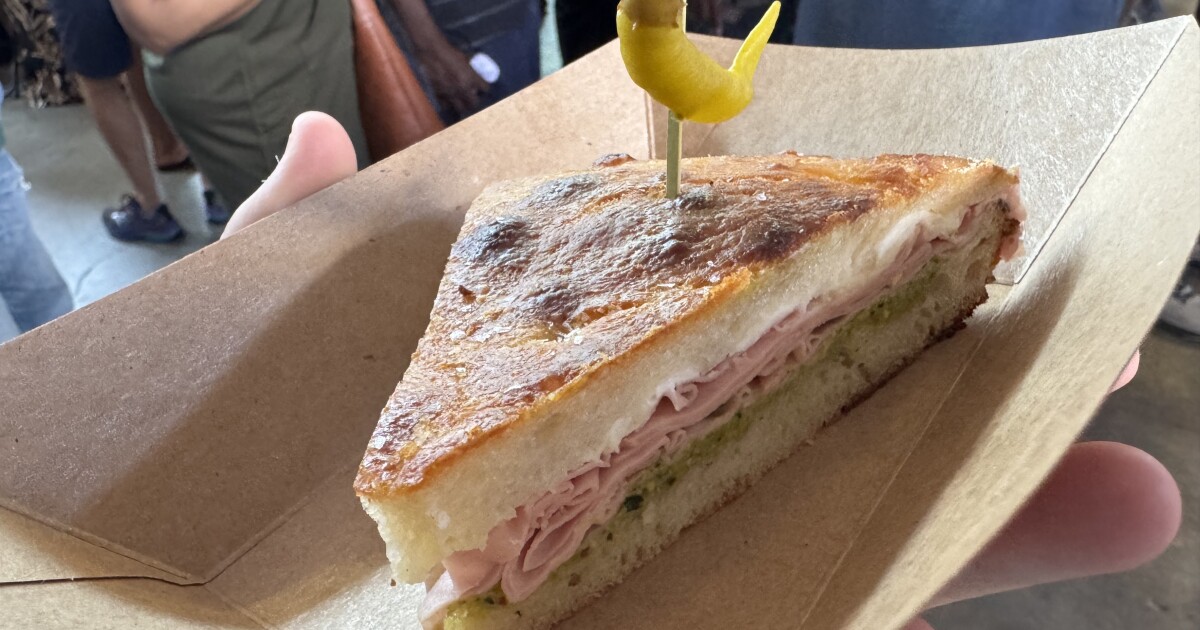
Detroit Sandwich Party returns to Eastern Market on Sept. 6
-

 San Francisco, CA2 hours ago
A Leak of San Francisco Police Drone Footage Exposes the New Reality of Urban Surveillance
-

 Dallas, TX2 hours ago
Viral East Dallas coffee shop fears major sales drop amid six-week road closure
-

 Miami, FL2 hours ago
3 hurt in fire on Lincoln Road that started underground
-

 Boston, MA2 hours ago
Rideshare driver charged in Logan airport passenger assault to appear in court
-

 Denver, CO2 hours ago
Denver area events for July 13

