Georgia
Georgia First in the Nation to Require Police Training in Election Law

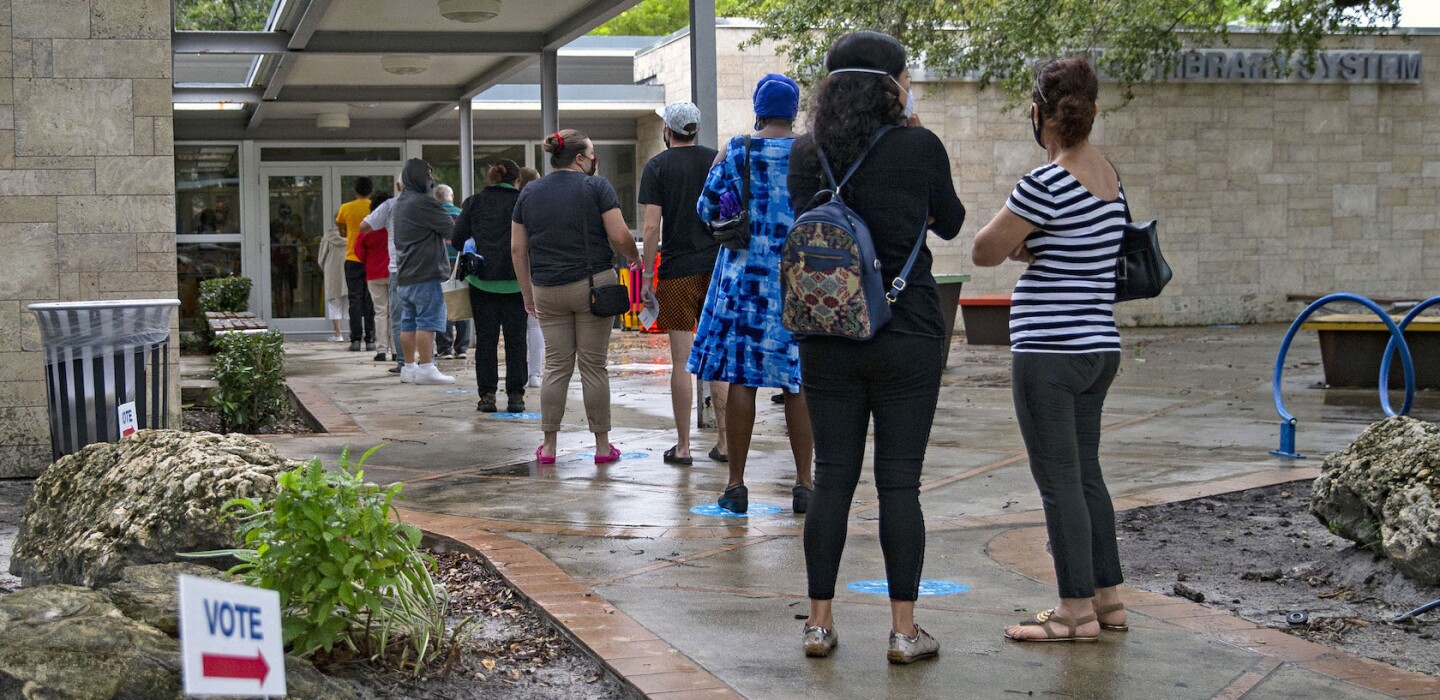
Chris Harvey had worked in law enforcement for decades and been an investigator for Georgia’s secretary of state when he was asked to take the post of chief election official back in 2015. After holding the job during what he calls the “craziest six years in Georgia’s election history,” he returned to the realm of law enforcement. He’s using what he learned to help police and election officials prepare for November.
In his new role as deputy director of the Georgia Peace Officer Standards and Training Council, Harvey has implemented training that outlines the obligations and duties of law enforcement under the state’s election codes. Last month, the council made Georgia the first state to require such curriculum as part of mandatory police training.
The controversies that arose during and after the 2020 election are still alive, and threats and harassment have increased as the 2024 contest approaches. A recent survey of local election officials by the Brennan Center found that more than half are concerned about the safety of their staff and colleagues; 90 percent have worked to increase security over the past four years.
Harvey is a member of the Committee for Safe and Secure Elections (CSSE), a group created to build closer working relations between election administrators and law enforcement. He wanted to be sure that officers in his state were well-versed in their authority around elections, including dealing with poll watchers, self-appointed observers and election officials, as well as their limits.
“The worst thing that can happen is for a police officer to respond to a scene, not know what their authority is, and not know what the laws are regulating that incident,” Harvey says. For example, Georgia law allows unpermitted, concealed carry of handguns, but forbids bringing a gun into a polling place.
The first step in making similar training possible in other states is pulling together the relevant sections of their election codes, a project CSSE and its partners have undertaken.
(Erich Schlegel/TNS)
Reference Guides
Law enforcement responsibilities regarding elections vary from state to state. For the most part, they are almost unknown to police. Harvey says he can guarantee those in his state have never read the statutes in the state’s election code that are specific to law enforcement.
This mattered less before elections and election officials operated under a cloud of manufactured distrust. Responding to the altered situation, CSSE has been distributing pocket reference guides for each state that describe the key penal provisions in its election laws, as resources for law enforcement and election officials alike.
Kathy Boockvar, who served as Pennsylvania’s secretary of state during the 2020 election, has been leading the creation of the guides, crosschecking them with lawyers and state officials. Only a handful remain to be completed, and she expects them all to be done sometime in August.
“The demand for these guides has been phenomenal,” Boockvar says. “Whether it’s law enforcement, election officials, district attorneys or nonprofits, folks who become aware of them have reached out to ask if their state is done, and if it isn’t, can their state be next.”
Georgia was among the first states to have a reference guide, and Harvey sees it as the “textbook” for his course. The International Association of Directors of Law Enforcement Standards and Training has asked him for a white paper that could help other states to develop their own training.
CSSE members are also available to fly out to jurisdictions to provide training assistance. This is a critical window for this kind of activity, says Tina Barton, CSSE vice chair. By September, election offices will begin to move completely into election mode. “We are working against the clock right now, and the clock is not our friend,” she says.
Shifting Scenarios
CSSE’s “Five Steps to Safer Elections” can facilitate conversations between election officials and local law enforcement, says Boockvar. These include guidelines and scenarios for tabletop exercises that give them opportunities to practice how they would respond to events such as threats to election workers or protests that threaten to boil over at polling places or counting rooms. “I wish none of this were necessary,” Boockvar says.
New scenarios for these exercises are being developed on an ongoing basis, Barton says, taking into account what’s being reported in the media or developments on the ground. “We’ve added in swatting, we’ve added in unknown substances,” Barton says. There’s a scenario in which a disruption breaks out when a non-citizen attempts to vote.
Barton knows what it’s like to be traumatized in the line of duty. She received numerous threats while serving as the city clerk for Rochester Hills, Mich., in 2020, including one serious enough to prompt federal prosecutors to charge the man who made it. On July 9, he was sentenced to 14 months in prison, to be followed by two years of supervised probation.
The fact that CSSE members are available to fly out to help with training and tabletop exercises has been reassuring to those who feel vulnerable, Boockvar says. Federal resources are also available, including the FBI’s election threats task force. Election security advisers are stationed in each of the 10 regions covered by the Cybersecurity Infrastructure and Security Agency (CISA).
“If people are not in touch with their CISA regional advisers, that’s something they should absolutely do that could have impact between now and November,” Boockvar says. “Those folks can help identify gaps in their security — if they don’t know who their CISA rep is, they can contact CSSE and we can connect them.”
Maricopa County Sheriff Paul Penzone, chair of the Committee for Safe and Secure Elections, offers an overview of its “Five Steps to Safer Elections.”
The Role Police Can Play
Harvey, the Georgia official, is aware that historically the presence of law enforcement at polling places hasn’t always been a positive, sometimes associated more with intimidation of voters than their security. He recognizes there are also practical limits preventing police from having a presence in every precinct. “Nobody thinks that’s a good idea,” he says. “Frankly, there aren’t enough cops to do that even if they wanted to.”
But it makes sense for election officials to have stronger relations with law enforcement, and not just because of safety issues. Harvey sees a lot of similarities between the two groups.
“They’re underappreciated, they’re underpaid, there aren’t enough of them, people take them for granted and only notice them when they do something wrong,” he says. “The funny thing is, both are generally fine with that — they don’t want to be front and center.”


They were designed to hold a drink, but cups produced in Rome, Georgia, have become one of the FIFA Men’s World Cup’s most unexpected souvenirs.
Inside the Top Cup plant in Rome, millions of cups were created to celebrate the world’s biggest sporting event.
“We made 10 million over 70 different graphics for the World Cup,” said Rome native and Top Cup General Manager Zach Dixon.
The plant in north Georgia produces up to 750,000 cups a day.
“We’ve always been really proud of the cup … but the World Cup has obviously taken it to another level,” said Top Cup CEO David Cuthbert.
Fans have been taking them home from matches. Some have even been listed for sale online.
“We’ve always been really proud of the cup… but the World Cup has obviously taken it to another level,” said Cuthbert.
Dixon said they begin the process with massive coils of aluminum, each weighing about 30,000 pounds. The metal is stamped, stretched, washed, and moved down the line.
The plant produces about 1,100 cups every minute.
Ricardo Marques, the senior vice president of marketing for Michelob ULTRA, said that there have been venue-specific, match-specific, and Finals-specific stadium cups for the World Cup. There are also three separate red, white, and blue designs available for fans at bars and restaurants around the U.S.
“We’ve seen an incredible response to the collection. Together, these commemorative cups give fans a unique keepsake and a lasting reminder of an unforgettable FIFA World Cup experience and the moments that brought millions of people together through the world’s game,” Marques said.
Cuthbert said his company has seen how the World Cup has done wonders for metro Atlanta businesses.
“Our team in Rome, Georgia takes tremendous pride in helping bring this fan experience to life for one of the world’s biggest sporting events,” he said.
So when soccer fans celebrate the surprise victory or mourn their last-minute loss, they’re doing so with a little piece of Georgia.


Athlon Sports projected the best SEC games for each week of the 2026 regular season.
The conference features some of the most compelling matchups in all of college football, from opening weekend through rivalry week. The selections emphasize games anticipated to have the biggest impact on the SEC championship race and College Football Playoff picture.
Florida’s annual clash with Georgia was tabbed as one of the SEC’s premier fixtures. The game has grown in national significance since it began in 1904, continuing as a battle of blue-blood programs that routinely produces iconic results. The game temporarily moves to Mercedes-Benz Stadium in Atlanta during the Jacksonville stadium renovations.
The Jon Sumrall era carries with it an increasing sense of belief — many experts see the Gators as a dark-horse CFB playoff contender. Regardless of its final win-loss record, UF will play a part in shaping the season’s narrative as they face several post-season favorites in Texas, Georgia and Oklahoma.
Noted in the article is the SEC’s depth and newly implemented nine-game conference schedule. Georgia, Texas, Alabama and LSU appear multiple times on this list, with Georgia facing Alabama in Week 6 and Ole Miss in Week 10 while LSU hosts Clemson in Week 1 and will see Texas in Week 11 take on Alabama.
Many contenders from the SEC face multiple nationally relevant foes over the course of the season.
Athlon Sports’ Best game for every week of the 2026 season
- Week 1: Clemson at LSU (Sept. 5)
- Week 2: Ohio State at Texas (Sept. 12)
- Week 3: LSU at Ole Miss (Sept. 19)
- Week 4: Oklahoma at Georgia (Sept. 26)
- Week 5: Auburn at Tennessee (Oct. 3)
- Week 6: Georgia at Alabama (Oct. 10)
- Week 7: Alabama at Tennessee (Oct. 17)
- Week 8: Ole Miss at Texas (Oct. 24)
- Week 9: Florida vs. Georgia (Atlanta) (Oct. 31)
- Week 10: Georgia at Ole Miss (Nov. 7)
- Week 11: Texas at LSU (Nov. 14)
- Week 12: Texas A&M at Oklahoma (Nov. 21)
- Week 13: Texas at Texas A&M (Friday) (Nov. 27)
Follow us @GatorsWire on X, formerly known as Twitter, as well as Bluesky, and like our page on Facebook to follow ongoing coverage of Florida Gators news, notes and opinions.
-
Kansas46 seconds ago
Kansas Lottery Powerball, Pick 3 winning numbers for July 15, 2026
-

 Kentucky7 minutes ago
Cyclosporiasis spreads across Kentucky
-

 Louisiana13 minutes ago
Louisiana pastor ordered to stay away from home of man he attacked
-

 Maine19 minutes ago
In Maine, Bobby Charles vs. Hannah Pingree is the race that matters | Opinion
-

 Maryland25 minutes ago
Maryland confirms 5 new measles cases, bringing year’s total to 9 – WTOP News
-

 Michigan31 minutes ago
Michigan health expert talks impact of Canadian wildfire smoke: There’s really a long list of who is at risk”
-

 Massachusetts37 minutes ago
The science behind Massachusetts’ wildfire smoke-darkened skies
-

 Minnesota43 minutes ago
Minnesota United Statement on International Friendly | Minnesota United FC

