Georgia
Georgia First in the Nation to Require Police Training in Election Law

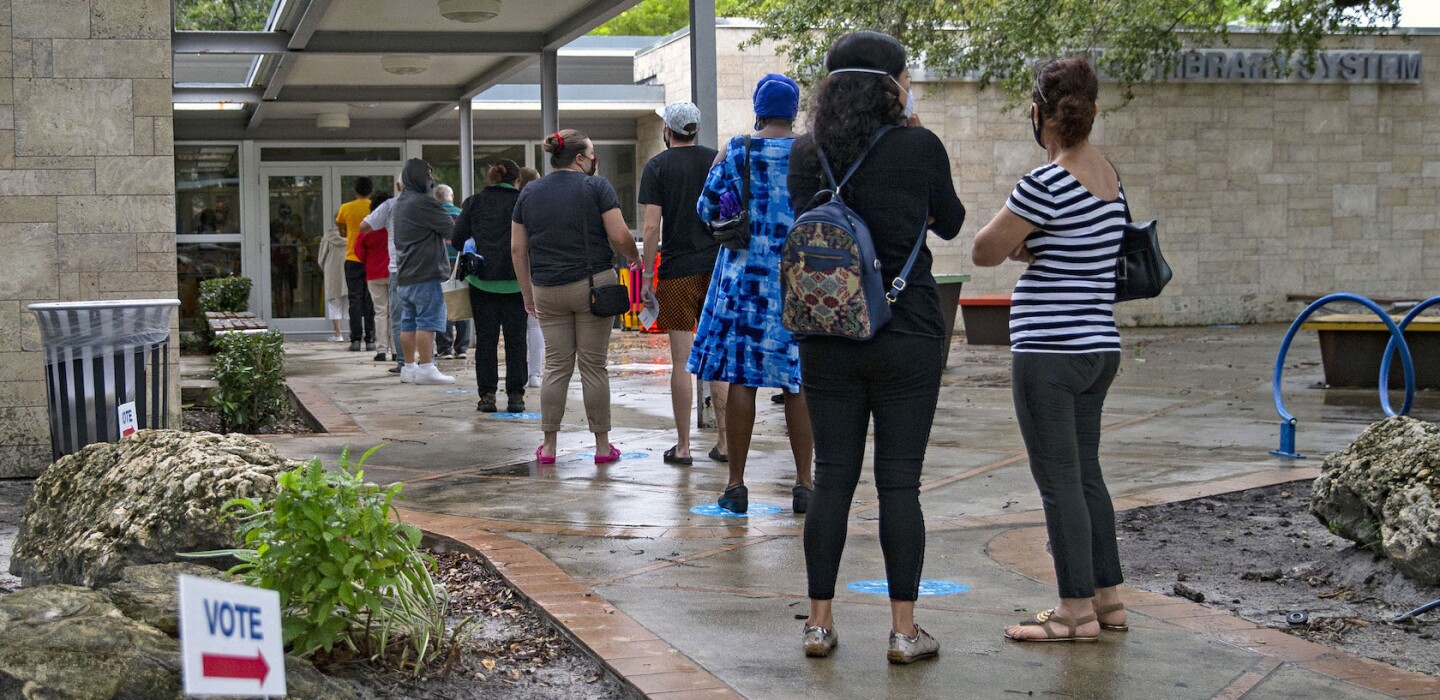
Chris Harvey had worked in law enforcement for decades and been an investigator for Georgia’s secretary of state when he was asked to take the post of chief election official back in 2015. After holding the job during what he calls the “craziest six years in Georgia’s election history,” he returned to the realm of law enforcement. He’s using what he learned to help police and election officials prepare for November.
In his new role as deputy director of the Georgia Peace Officer Standards and Training Council, Harvey has implemented training that outlines the obligations and duties of law enforcement under the state’s election codes. Last month, the council made Georgia the first state to require such curriculum as part of mandatory police training.
The controversies that arose during and after the 2020 election are still alive, and threats and harassment have increased as the 2024 contest approaches. A recent survey of local election officials by the Brennan Center found that more than half are concerned about the safety of their staff and colleagues; 90 percent have worked to increase security over the past four years.
Harvey is a member of the Committee for Safe and Secure Elections (CSSE), a group created to build closer working relations between election administrators and law enforcement. He wanted to be sure that officers in his state were well-versed in their authority around elections, including dealing with poll watchers, self-appointed observers and election officials, as well as their limits.
“The worst thing that can happen is for a police officer to respond to a scene, not know what their authority is, and not know what the laws are regulating that incident,” Harvey says. For example, Georgia law allows unpermitted, concealed carry of handguns, but forbids bringing a gun into a polling place.
The first step in making similar training possible in other states is pulling together the relevant sections of their election codes, a project CSSE and its partners have undertaken.
(Erich Schlegel/TNS)
Reference Guides
Law enforcement responsibilities regarding elections vary from state to state. For the most part, they are almost unknown to police. Harvey says he can guarantee those in his state have never read the statutes in the state’s election code that are specific to law enforcement.
This mattered less before elections and election officials operated under a cloud of manufactured distrust. Responding to the altered situation, CSSE has been distributing pocket reference guides for each state that describe the key penal provisions in its election laws, as resources for law enforcement and election officials alike.
Kathy Boockvar, who served as Pennsylvania’s secretary of state during the 2020 election, has been leading the creation of the guides, crosschecking them with lawyers and state officials. Only a handful remain to be completed, and she expects them all to be done sometime in August.
“The demand for these guides has been phenomenal,” Boockvar says. “Whether it’s law enforcement, election officials, district attorneys or nonprofits, folks who become aware of them have reached out to ask if their state is done, and if it isn’t, can their state be next.”
Georgia was among the first states to have a reference guide, and Harvey sees it as the “textbook” for his course. The International Association of Directors of Law Enforcement Standards and Training has asked him for a white paper that could help other states to develop their own training.
CSSE members are also available to fly out to jurisdictions to provide training assistance. This is a critical window for this kind of activity, says Tina Barton, CSSE vice chair. By September, election offices will begin to move completely into election mode. “We are working against the clock right now, and the clock is not our friend,” she says.
Shifting Scenarios
CSSE’s “Five Steps to Safer Elections” can facilitate conversations between election officials and local law enforcement, says Boockvar. These include guidelines and scenarios for tabletop exercises that give them opportunities to practice how they would respond to events such as threats to election workers or protests that threaten to boil over at polling places or counting rooms. “I wish none of this were necessary,” Boockvar says.
New scenarios for these exercises are being developed on an ongoing basis, Barton says, taking into account what’s being reported in the media or developments on the ground. “We’ve added in swatting, we’ve added in unknown substances,” Barton says. There’s a scenario in which a disruption breaks out when a non-citizen attempts to vote.
Barton knows what it’s like to be traumatized in the line of duty. She received numerous threats while serving as the city clerk for Rochester Hills, Mich., in 2020, including one serious enough to prompt federal prosecutors to charge the man who made it. On July 9, he was sentenced to 14 months in prison, to be followed by two years of supervised probation.
The fact that CSSE members are available to fly out to help with training and tabletop exercises has been reassuring to those who feel vulnerable, Boockvar says. Federal resources are also available, including the FBI’s election threats task force. Election security advisers are stationed in each of the 10 regions covered by the Cybersecurity Infrastructure and Security Agency (CISA).
“If people are not in touch with their CISA regional advisers, that’s something they should absolutely do that could have impact between now and November,” Boockvar says. “Those folks can help identify gaps in their security — if they don’t know who their CISA rep is, they can contact CSSE and we can connect them.”
Maricopa County Sheriff Paul Penzone, chair of the Committee for Safe and Secure Elections, offers an overview of its “Five Steps to Safer Elections.”
The Role Police Can Play
Harvey, the Georgia official, is aware that historically the presence of law enforcement at polling places hasn’t always been a positive, sometimes associated more with intimidation of voters than their security. He recognizes there are also practical limits preventing police from having a presence in every precinct. “Nobody thinks that’s a good idea,” he says. “Frankly, there aren’t enough cops to do that even if they wanted to.”
But it makes sense for election officials to have stronger relations with law enforcement, and not just because of safety issues. Harvey sees a lot of similarities between the two groups.
“They’re underappreciated, they’re underpaid, there aren’t enough of them, people take them for granted and only notice them when they do something wrong,” he says. “The funny thing is, both are generally fine with that — they don’t want to be front and center.”



Trump proposes privatizing TSA screening operations
President Donald Trump proposed to begin privatizing airport security operations handled by the Transportation Security Administration, in an effort to save money.
Transportation Security Administration officers from the country’s busiest airport are catching a break after weeks of uncertainty during a partial government shutdown.
Federal funding for the Department of Homeland Security lapsed in February, leaving TSA officers across the nation’s airports working without pay. Congress was gridlocked as they debated appropriations for ICE, and the shutdown dragged on. Lines to get through security at major airports got longer and longer, and TSA officers began calling out of work as the financial burden became too great.
In the weeks since, ICE officers were deployed to airports to help the staffing shortages, and the president passed an order to pay TSA officers while the shutdown continues. TSA officers are largely back to work as normal and they have been receiving paychecks, but backpay from prior weeks won’t come until the shutdown is over.
Now, public service officials in Georgia are trying to make sure TSA officers can keep the lights on as the shutdown has no clear end in sight.
Georgia commission stops utility cutoffs
On Monday, the Georgia Public Service Commission announced an order had been filed to “ensure TSA agents who are living in Georgia will not have their utility service cut off for nonpayment and will not pay late fees for missed utility bills until the partial government shutdown ends,” according to a news release.
The motion was approved unanimously after being put forward by Commissioner Tricia Pridemore.
“Georgia is home to the world’s busiest airport and many regional airports where TSA agents work to keep us safe,” Pridemore said in the release. “During the partial shutdown, many TSA agents are taking up second jobs driving Ubers and utilizing other gig-economy jobs just to make rent or mortgages and to put food on the table. I’m hoping this order will give them one less thing to worry about.”
How can TSA officers get support?
TSA officers can qualify for the utility protection by verifying their employment with the TSA, then making sure the balances are paid once the shutdown is over.
“Their past-due balances must be paid within 30 days after the shutdown ends and TSA agents’ back pay is restored,” according to the commission. “Although many agents received a paycheck Friday, the U.S. Department of Homeland Security has cautioned TSA agents that future pay remains in limbo as the partial government shutdown continues.”
The order only applies to utilities that fall under the jurisdiction of the Georgia Public Service Commission. This includes Georgia Power and Atlanta Gas Light. There are several natural gas marketers in the state, but the commission said Atlanta Gas Light is still responsible for the pipelines and connecting and disconnecting service.
“TSA officers at Hartsfield-Jackson are showing up every day to keep Georgia safe, even as they go without a paycheck,” Commissioner Peter Hubbard said. “They shouldn’t have to worry about coming home to a dark house.”
When will the shutdown be over?
It’s unclear when the partial government shutdown may come to an end as Congress appears locked in debate over funding for immigration enforcement, also under the purview of DHS.
The shutdown could end Tuesday as the House returns from a recess, and they will be back in session at noon on April 14. Voting on the funding is not currently listed on the House weekly schedule, according to reporting from USA TODAY, but it could possibly be included in a section noted “additional legislative items.”
The Senate passed a bipartisan plan to fund DHS before the House went on recess, but some conservative House members have made it clear they wouldn’t support the plan that excludes funding for immigration and border control operations.
Irene Wright is following the partial government shutdown’s impact on TSA at Hartsfield-Jackson Atlanta International Airport. Find the Atlanta Connect reporter on X @IreneEWright or email her at ismith@usatodayco.com.

A McDuffie County man is facing multiple felony charges after Georgia authorities say he trafficked and sexually exploited a 17-year-old girl.
Georgia Attorney General Chris Carr announced Monday that Jimmy Mance, 40, of Thomson, has been charged with trafficking a minor for sexual servitude and sexual exploitation of a child.
According to the Attorney General’s Office, the case stems from allegations that the teenager was sold for sex, with the victim later recovered in December 2025.
“This is yet another step in our ongoing efforts to combat human trafficking in every corner of this state,” Carr said in a statement. “If you buy or sell a child for sex, we will find you, arrest you and prosecute you to the fullest extent of the law.”
Charges filed
Authorities say Mance is facing several charges, including:
- Trafficking of persons for sexual servitude (harboring a minor)
- Trafficking of persons for sexual servitude (providing a minor)
- Two counts of sexual exploitation of a child involving explicit material
Warrants were taken out on April 13 by the Attorney General’s Human Trafficking Prosecution Unit.
Multiple agencies assisted in the investigation and arrest, including the Georgia Bureau of Investigation, McDuffie County Sheriff’s Office, Thomson Police Department, and sheriff’s offices in Columbia and Bibb counties.
Statewide crackdown on trafficking
The case highlights Georgia’s ongoing efforts to combat human trafficking, particularly involving minors.
The Attorney General’s Human Trafficking Prosecution Unit — created in 2019 — has secured more than 70 convictions and helped rescue or assist over 200 children, according to state officials.
Carr expanded the unit last year to include additional prosecutors and investigators serving Augusta and surrounding counties, part of a broader push to target trafficking networks statewide.
Officials say the unit works alongside local and state law enforcement to investigate and prosecute cases involving sexual exploitation and forced labor.
What happens next
Authorities emphasize that the charges are allegations, and Mance is presumed innocent unless proven guilty in court.
The case remains under investigation.

Hurst’s development could go in two distinct directions. If he emphasizes precision, refines his routes, and adds a little muscle to his frame, Hurst could become an aspiring A.J. Green – a big-play primary receiver who can defeat press-man coverage and run the full route tree.
If Hurst bulks up further and his route tree is limited, he could become a big-play possession option like Tee Higgins who isn’t asked to run as full of a route tree and wins with his size at the boundary.
There’s reason for optimism that Hurst will become a weekly contributor in the league. It’s probably a stretch to believe Hurst will become a top-end primary receiver, but others with his athletic gifts have done it before.
Hurst has a medium-high floor with a high ceiling. That’s worth the investment.

Video: Designer Fashion Hits the 2026 WNBA Draft

Godzilla Minus Zero stomps through New York in first teaser trailer

Trump blasts close ally Meloni, says she’s failing US on Iran

Dem fundraising giant in the hot seat as GOP lawmakers demand answers over dodged subpoena

Weight gain in certain decade of life may be more dangerous, study suggests

Florida High School Football Rankings: Top 25 teams – Oct. 21

How old is Bo Nix? What to know about Oregon quarterback ahead of 2024 NFL Draft

Cleary's 21 help Le Moyne down Central Connecticut State 69-64 in OT

99th annual Pony Swim held in Virginia

Indiana Members Credit Union announced as new anchor tenant at Bottleworks District
Dem fundraising giant in the hot seat as GOP lawmakers demand answers over dodged subpoena

Fifth woman accuses former US lawmaker Eric Swalwell of sexual misconduct

Commercial Ships Transit Strait of Hormuz as U.S. Blockades Iran’s Ports

Video: How Stephen Miller Is Adjusting Trump’s Immigration Agenda

Biden DOJ weaponized FACE Act against pro-life Americans, 882-report alleges
-

 Atlanta, GA1 week ago
1 teenage girl killed, another injured in shooting at Piedmont Park, police say
-

 Georgia1 week ago
Georgia House Special Runoff Election 2026 Live Results
-

 Arkansas4 days ago
Arkansas TV meteorologist Melinda Mayo retires after nearly four decades on air
-

 Pennsylvania1 week ago
Parents charged after toddler injured by wolf at Pennsylvania zoo
-
 Milwaukee, WI1 week ago
Potawatomi Casino Hotel evacuated after fire breaks out in rooftop HVAC system
-

 Ohio9 hours ago
‘Little Rascals’ star Bug Hall arrested in Ohio
-

 Austin, TX7 days ago
ABC Kite Fest Returns to Austin for Annual Celebration – Austin Today
-

 World1 week ago
Zelenskyy warns US-Iran war could divert critical aid from Ukraine