Florida
Lawsuit seeks to push DeSantis to call special elections for Florida Legislature seats


TALLAHASSEE, Fla. – Accusing Gov. Ron DeSantis of violating “his mandatory statutory duty,” the American Civil Liberties Union on Thursday filed a lawsuit asking a judge to order DeSantis to set special elections for two legislative seats that opened as part of a political shakeup after President-elect Donald Trump’s win in November.
Former Rep. Joel Rudman, R-Navarre, stepped down from the state House District 3 seat last week, and state Sen. Randy Fine, R-Brevard County, will exit his Senate District 19 seat on March 31 as they run in special elections for congressional seats.
The lawsuit filed in Leon County circuit court Thursday argued that DeSantis not setting special elections for the legislative seats will leave voters in Rudman’s district without representation “for the entirety of the 2025 session” and voters in Fine’s district without representation for about half of the 60-day legislative session, which begins March 4.
Voters “have a clear legal right to have the governor fix the date of a special election for each vacancy,” and the governor “has a clear legal duty to fix the dates of the special elections,” attorneys for the American Civil Liberties Union Foundation of Florida wrote in the lawsuit.
Plaintiffs in the case are Christina Forrest, a voter in House District 3, and Janet Laimont, a voter in Senate District 19.
“When a vacancy arises in legislative office, the people have the right to fill that vacancy in a special election,” the lawsuit said, pointing to a Florida law. “The reason is obvious: No Floridian should be deprived of representation because of the death, resignation, or removal of their representatives. But left to his own devices, the governor would deprive the residents of SD 19 and HD 3 of their constitutionally protected voice in the Capitol.”
The lawsuit said DeSantis “clear legal duty is ministerial and nondiscretionary in nature.” It seeks what is known as a “writ of mandamus” ordering DeSantis to set the special election dates.
“Each resident of the state has the right to be represented by one senator and one representative. These legislators are their voice in the halls of the Capitol,” the ACLU lawyers wrote. “The vacancies in these districts arose over 40 days ago. No other governor in living memory has waited this long to schedule a special election.”
Mark Ard, a spokesman for the Florida Department of State, said in an email that the agency “continues to work with the supervisors of elections to identify suitable dates for special elections” in the legislative districts.
“The election dates will be announced soon,” Ard wrote.
Fine and Rudman announced their plans to run for Congress in late November, as Trump began to fill out his administration.
Rudman is seeking to replace former U.S. Rep. Matt Gaetz, who resigned in Congressional District 1 after being tapped by Trump to serve as U.S. attorney general. Gaetz later withdrew his name from consideration for attorney general amid intense scrutiny related to a congressional ethics report.
Fine is running to replace U.S. Rep. Mike Waltz, who will serve as Trump’s national security adviser. Waltz will step down in Congressional District 6 on Jan. 20, the day Trump is sworn into office.
DeSantis quickly ordered special elections to fill the vacancies created by Gaetz and Waltz, the lawsuit noted. Special primary elections for the congressional seats will be held on Jan. 28, and special general elections will take place on April 1.
Rudman’s former state House district is made up of parts of Okaloosa and Santa Rosa counties, while Fine’s Senate district consists of part of Brevard County. DeSantis’ delay in setting special election dates in the districts also has drawn attention because they are in areas dominated by Republicans.
Previous governors’ “routine practice” was to “quickly call a special election for the resigning legislator’s seat and hold it concurrently with the special election for the higher office,” the lawsuit said, referring to the congressional seats as being the higher office.
In the two decades before DeSantis took office, 15 legislative vacancies occurred because a state lawmaker resigned to run for another office, according to the lawsuit. DeSantis’ predecessors set special elections to fill the resigning legislators’ seats on the same dates as the elections in which the legislators resigned to run, or earlier.
“But lately, Governor DeSantis has more often chosen to deviate from Florida’s longstanding practice of timely special elections, in violation of his mandatory statutory duty,” the lawsuit said.
As an example, the ACLU lawyers pointed to DeSantis’ drawn-out response to the 2021 death of U.S. Rep. Alcee Hastings, a Broward County Democrat.
DeSantis “failed to call a special election for 30 days — longer than any Florida governor had ever taken to call a special election in at least the prior 22 years, and possibly ever in the history of the state” to fill Hastings’ seat, the lawsuit argued.
DeSantis ultimately ordered a special election to fill Hastings’ seat — more than nine months after the congressman died.
DeSantis in 2021 also waited more than 90 days to order special elections to fill three seats vacated by legislators who sought to replace Hastings.
“The governor did not call special elections until he was forced to — after residents of the districts petitioned this court for mandamus relief,” Thursday’s lawsuit said. “Following months of inaction, the governor called elections within days of this court ordering him to show cause why the writ should not issue.”
In 2023, DeSantis waited 38 days to set a special election for a legislative vacancy.
“Yet again, the governor did not call the election until he was forced to — after this court ordered the governor to show cause why mandamus should not issue in a lawsuit brought by a district resident,” the ACLU’s lawyers wrote.
Get today’s headlines in minutes with Your Florida Daily:



POMPANO BEACH, Fla. (WFLA) — Body camera footage shows the moment deputies saved a woman after her car plunged into a Pompano Beach canal on Monday.
Officers arrived at the canal and spotted the car, which was rapidly taking on water with the driver trapped inside, according to the Broward Sheriff’s Office.
Video shows officers jumping into the canal and swimming toward the sinking car.

Deputy Zachary Kerin shattered a window, allowing rescuers to pull the woman through the water to safety.
“An elderly woman is alive today thanks to the quick actions of BSO Detective Robert Rutkowski, Deputy Zachary Kerin and off-duty Fort Lauderdale Fire Rescue Captain Keith Costa, who raced against time,” BSO said.

The vehicle disappeared beneath the water’s surface moments after the woman reached the shore, BSO said.

The CBS News Miami NEXT Weather Team is tracking the return of drier air for the upcoming weekend with only a few stray showers in the mix.
Scattered showers and isolated storms will be possible on Friday, but mostly in the Keys.
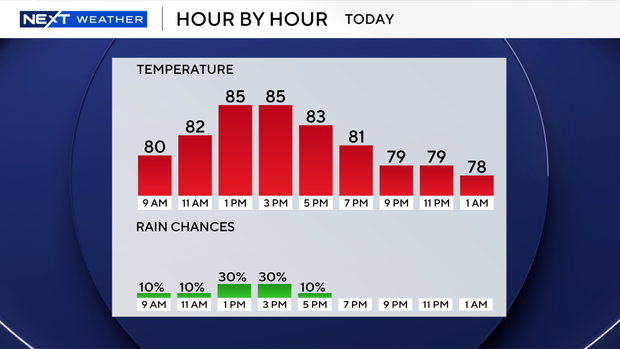
Drier air continues to move into South Florida over the weekend with only 10-20% stray shower chances.
As rain chances go down, temperatures go up over the next several days.
Mostly cloudy skies will keep highs in the mid-80s on Friday, but more sunshine arrives for the weekend and will cause highs to climb into the upper 80s.
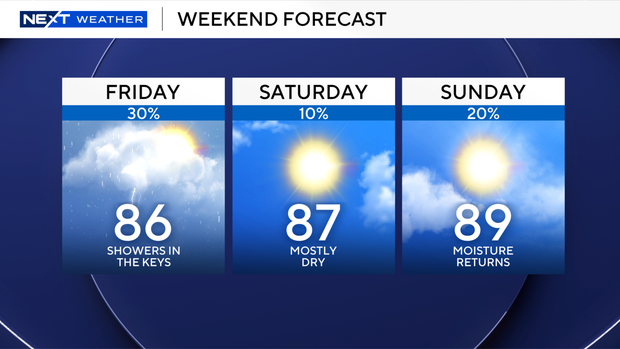
Beachgoers should be aware of a high rip current risk at the coast for Friday through Sunday due to the easterly breeze.
Tropical moisture slowly starts to return on Sunday, leading to warmer and wetter conditions for the upcoming workweek.
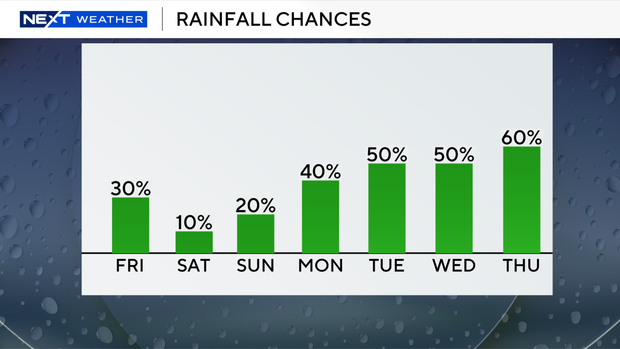
Afternoon highs peak around 90 for Monday as scattered shower and storm chances linger through the first half of the workweek.

If you need help with the Public File, call (407) 291-6000
At WKMG, we are committed to informing and delighting our audience. In our commitment to covering our communities with innovation and excellence, we incorporate Artificial Intelligence (AI) technologies to enhance our news gathering, reporting, and presentation processes. Read our article to see how we are using Artificial Intelligence.
-

 Sports3 minutes ago
Broncos star Jonathan Cooper arrested on domestic violence charges
-

 Technology10 minutes ago
Will a four-armed robot replace astronauts in space?
-
 Business13 minutes ago
SoFi Stadium workers vote to authorize strike with World Cup days away
-
 Entertainment18 minutes ago
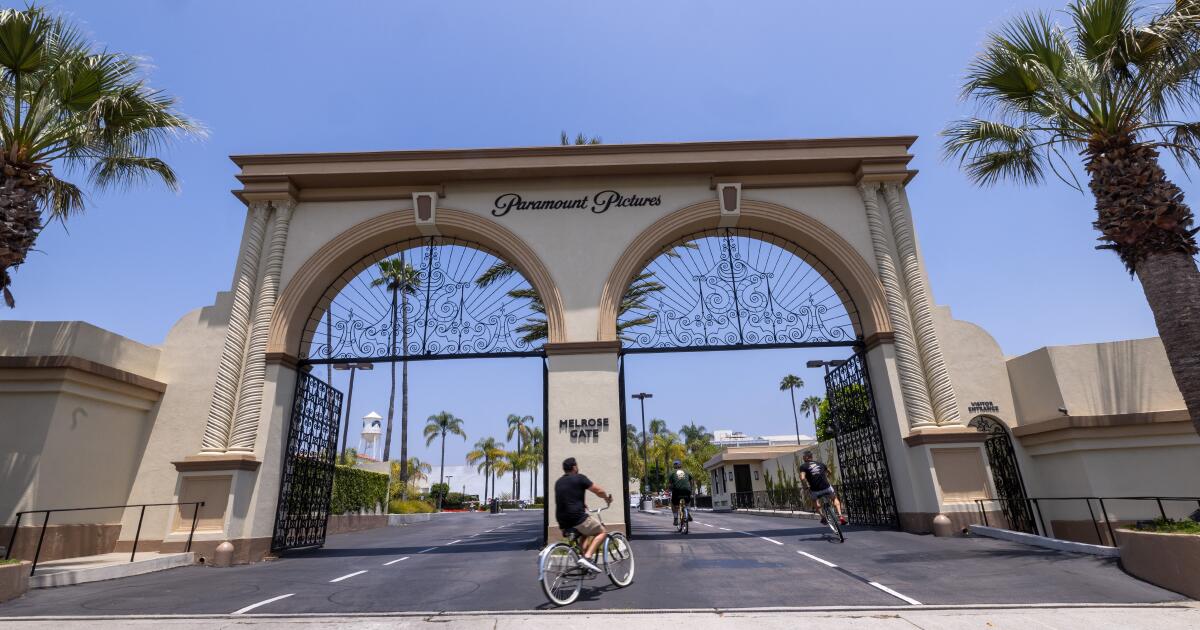
California and other states may sue to block Paramount-Warner Bros. deal
-
 Lifestyle25 minutes ago
For its first L.A. women’s show, Hermès touches down in Bel-Air — Birkin bags everywhere
-
 Politics28 minutes ago
How a simple mix-up fueled false conspiracies about L.A. vote count
-
Science33 minutes ago
Scientists probe cosmic visitor from deep space, come up empty in search for alien life
-
 Sports40 minutes ago
Alison Lee moves into prime position to challenge for U.S. Women’s Open title


