Dallas, TX
EPA test fish to see how pollution from Dallas concrete batch plants affects people’s health


Fish Trap Lake, five miles west of downtown Dallas, glowed with sunlight, ducks and geese swam, and a man with a fishing rod cast his line on a warm January morning. On the trail that loops around the 10-acre lake located inside a park, mothers with strollers walked to the sounds of rippling water and birds chirping.
Across the street from the park stands a row of industrial companies, including plants that turn sand, water and cement into concrete to build highways and subdivisions and high-rises in fast-growing Texas.
While fish is in the lake’s name, Janie Cisneros, 41, a mother and digital researcher who grew up nearby, says it’s common knowledge in the area to “catch them, don’t eat them.” Locals believe the lake is polluted from wastewater runoff from the nearby plants.
Cisneros, the director of the neighborhood association Singleton United/Unidos, said many residents who live nearby have long complained about pollution from the plants, and suspect that it’s contributing to health problems ranging from asthma to bronchitis to throat cancer. They also say the thousands of concrete batch plants located across Texas disproportionately impact low-income communities like theirs.
Desiree Rios
/
for The Texas Tribune
West Dallas’ Zip Code 75212, where 27,000 people live, is 68% Hispanic and 25% Black. Cisneros, wearing her signature cherry lipstick and black neighborhood association shirt, said that for decades a relentless stench has infiltrated the homes of residents in her working-class neighborhood.
Residents have long complained to the state’s environmental agency about pollution from the plants and say their concerns have been brushed off. But now their efforts have caught the attention of the U.S. Environmental Protection Agency.
The agency has found that the air pollution and particulate matter from concrete batch plants can increase the risk of asthma and cardiac arrest if people inhale too much of it.
Now it has launched a pilot project — the first in Texas — that will survey air, water, and soil to determine how the combined pollution from this cluster of industrial sites impacts public health in two predominantly Black and brown Dallas neighborhoods: West Dallas and Joppa in South Dallas.
EPA says the project is expected to be completed by July 2024. The agency’s final report will be shared with the communities, the city of Dallas and the Texas Commission on Environmental Quality, the state agency that regulates batch plants.
But before any of that can happen, the first step was going fishing.
Fish will be tested for heavy metals
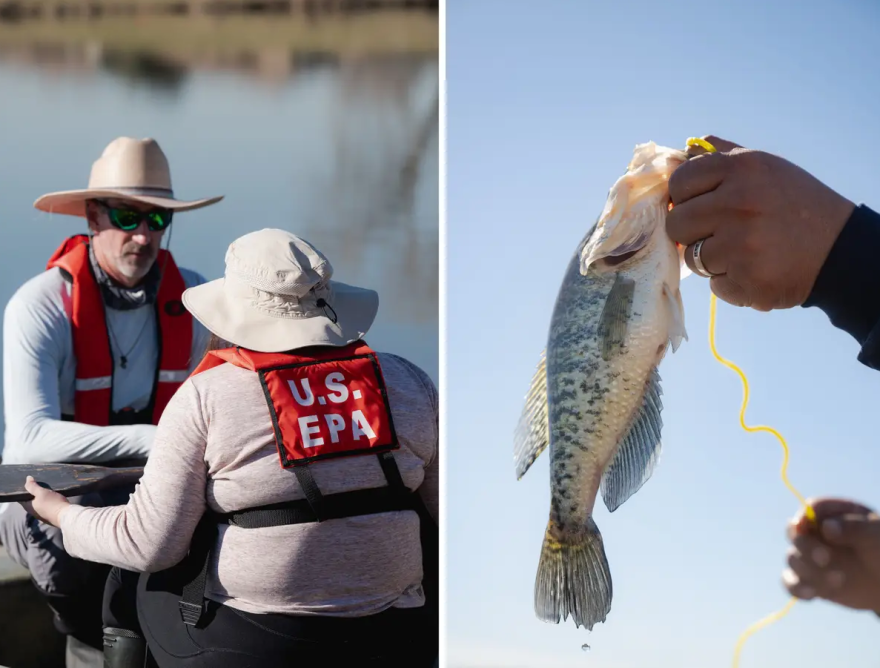
By 9:30 a.m. on Tuesday, three EPA scientists, wearing bright orange life vests, grabbed two Home Depot buckets, stuffing them with buoys and fish traps meant to capture predator fish like bass.
They boarded a small beige boat branded with the agency’s logo. When the boat’s motor refused to start, they paddled to the lake’s center.
Using cat food as bait, they cast their nets.
“[These nets] are just a really effective way to try and catch a lot of fish in a short amount of time,” said Rob Cook, an environmental scientist who has worked for the EPA for 12 years.
Desiree Rios
/
for The Texas Tribune
Cook, a 54 year-old who wore rain boots, reflective sunglasses and a straw hat, said the group needs to catch three to five catfish and predator fish like bass, all similar in size, for a reliable testing sample.
Nicholas Scott, 30, an EPA scientist who was on the boat with Cook, says they will filet the fish, freeze the filets and send them to a lab to test the tissue for heavy metals like lead and arsenic. The results from water sampling and the fish tissue analysis will help the EPA determine whether the lake’s water or fish are harmful to human health.
They paddled back to shore, leaving four red buoys floating in the lake, marking their nets’ location. Then they picked up trash around the lake for a couple of hours before rowing back out to retrieve the nets.
Kirk McDonnell, a spokesperson for the Texas Parks and Wildlife Department — which stocks the lake with catfish, bass and other species — said in an email that because the lake is near industrial sites and sometimes receives flood water from the Trinity River, which is under a fish consumption advisory, the department’s Dallas-Fort Worth fisheries division has “speculated that fish contamination could be an issue with the fish currently in the lake.”
West Dallas resident Cynthia Medina, curious about the scientists’ activities, stopped by the lake during her lunch break. The petite 30-year-old said she’s interested in the test results because her husband comes to the lake regularly to fish.
“I tell him: Don’t take [the fish] home, we are not going to eat it. It is not safe,” said Medina, who has lived in the neighborhood her entire life and works at a nonprofit that connects children of color to books and promotes reading.
She pointed to a shopping cart partially submerged near the lake shore. “I don’t know what those fish are eating.”
Scientist hopes study informs policy
Aimee Wilson, an EPA scientist and project manager in a navy striped blouse featuring an embroidered EPA logo she stitched herself, said the agency decided to conduct a cumulative impact assessment in Texas because TCEQ was proposing changes to the state’s concrete batch plant permits, which sets the air pollution standards companies must follow.
Those changes included lowering production limits, reducing dust coming from plants and setting minimum distance requirements from nearby communities, but did not take into account the cumulative pollution created by plants clustered close together, like those near Fish Trap Lake.
For years, environmental advocates have criticized the state for not taking into account the health impacts for people living near multiple concrete batch plants.
In 2021, Harris County attorney and Lone Star Legal Aid, a nonprofit law group, filed civil rights complaintswith the EPA alleging that the TCEQ discriminated against people of color and those with limited English proficiency in the agency’s permitting process to build new concrete batch plants and renew permits for existing ones.
“There hasn’t been a lot of studies on [cumulative impact],” said Wilson, who has worked for the EPA for 14 years. “So we want to see what’s there because we don’t know.”
While TCEQ announced its new requirements for concrete batch plants last week, before the EPA study was completed, Wilson hopes their work can help the agency develop better guidance and policies for how to consider cumulative impacts from industry in future permit decisions.
At noon, as the EPA scientists on the boat approached the lake shore, Cisneros, the neighborhood association director, waited with her two nephews and her mom to see what the EPA crew caught.
The group did not catch any of the fish they were looking for, but a local resident who caught a bass with a fishing rod donated it so the EPA can test its tissue.
Cisneros said the EPA’s attention to her community is a relief because at times she feels like her concerns are ignored by state regulators.
“The EPA is being brave,” Cisneros said earlier in the day while sitting with her 4-year-old daughter, Lila Rosa Bravero, under the park’s pavilion. “They are not fearing that this [project] might open up a can of worms.”
Disclosure: The Texas Parks And Wildlife Department has been a financial supporter of The Texas Tribune, a nonprofit, nonpartisan news organization that is funded in part by donations from members, foundations and corporate sponsors. Financial supporters play no role in the Tribune’s journalism. Find a complete list of them here.
This article originally appeared in The Texas Tribune at https://www.texastribune.org/2024/02/02/epa-concrete-batch-plants-study-dallas/.



Oftentimes, it’s a good idea to extend players early. The Dallas Cowboys have learned this the hard way as they’ve allowed negotiations with key contributors such as Dak Prescott, CeeDee Lamb, and Micah Parsons to get out of hand.
Prescott was able to use his leverage to land a contract worth $60 million per season, which was a record at the time. Lamb held out during that same offseason, eventually landing a deal worth $34 million annually, whereas Parsons forced his way out after his negotiations stalled.
To their credit, the Cowboys might have tried to avoid more issues by signing a few players early. That includes guard Tyler Smith, who landed a four-year, $96 million extension in 2025. That has proven to be a home run, but the same can’t be said for another one of their big extensions.
Dallas decided to lock up cornerback DaRon Bland, signing the former fifth-round pick to a four-year, $92 million extension. This was a surprise move from the Cowboys since Bland was coming off a frustrating season, which was marred by a foot injury. The Cowboys were banking on Bland returning to the form we saw in 2023, but that wasn’t the case.
Bland continued to struggle with durability and wasn’t the impact player we saw during his breakout season when he was on the field. Now, he enters his fifth season in the league with a hefty price tag, and there are questions about his long-term status with the team.
DaRon Bland’s cap hit in 2026 is a problem
According to Over The Cap, Bland has the fifth-highest cap hit on the team this season. Bland, who is earning an annual average salary of $23 million, has a hit of $17 million this year.
The good news for the Cowboys is that they seemed to protect themselves slightly with this deal. While they can’t feasibly move on in 2026, even if Bland loses his starting job, they do have a way out of his deal next year.
Dallas can release Bland ahead of the 2027 season while absorbing a dead cap hit of $12.941 million. That would essentially make his deal a two-year contract for $36.355 million. That’s still not an ideal situation for the Cowboys, but that’s also what happens when the front office rolls the dice.
It’s also an unfortunate trend, as the Cowboys decided to extend Michael Gallup and Terence Steele while coming off injury-plagued seasons, and the results weren’t much better.
— Sign up for the Cowboys Daily Digest newsletter for more free coverage from Dallas Cowboys on SI —
 Add us as a preferred source on Google
Follow

Why Gabby Williams chose to play for Golden State Valkyries
Valkyries’ Gabby Williams shares with USAT’s Meghan L. Hall why she chose Golden State in the wild WNBA free agency.
Sports Seriously
When the Dallas Wings travel to Las Vegas for a clash with the Aces on Thursday night, they’ll be without one of their key players.
Alanna Smith is listed as out for Thursday on the latest WNBA injury report as she is in concussion protocol.
Smith seemingly suffered an injury to her face on Saturday night during the Wings’ 93-92 win over the Chicago Sky. In the first quarter, Smith was shaken up after a head-to-head collision with Gabriela Jaquez as Smith was defending the Sky rookie’s drive to the basket. At halftime, the team announced that Smith would not return to the game.
On Monday, Smith didn’t play in the Wings’ 112-110 overtime win over the Seattle Storm, listed as being out due to a face injury. Smith has worn a protective face mask after she suffered a nasal fracture in the Wings’ preseason game against the Aces on May 3.
Smith is the highest-paid player on the Dallas roster, signing a three-year deal worth about $3.7 million this offseason. Last season with the Minnesota Lynx, she was the co-Defensive Player of the Year, sharing the award with A’ja Wilson.
A 6-foot-4 forward from Australia who played collegiately at Stanford, Smith found a consistent role over the past two seasons with the Minnesota Lynx, starting in all 81 games she appeared in for Cheryl Reeve’s squad. Across two seasons in Minnesota, Smith averaged 9.1 points, 5.3 rebounds, 3.1 assists, 1.3 steals and 1.7 blocks per game, helping the Lynx make back-to-back playoff appearances — including a trip to the Finals in 2024.
With the Wings, she’s started in just seven of the 15 games she’s appeared in, playing an average of 15.1 minutes per game. She’s posting 3.5 points, 2.9 rebounds and 1.3 assists per game.
Dallas has instead turned to Jessica Shepard in the frontcourt, who also arrived via free agency after spending last season with the Lynx. The Notre Dame product is posting career-highs in points (14.2), rebounds (11.1) and assists (5.6) per game while shooting 57% from the floor.
Still, Smith brings an imposing presence on defense, one that would have come in handy against the Aces.

A 12-year-old Dallas middle-schooler ended up on the streets, where a pimp discovered her. For as little as $50, he sold her for sex. He withheld food unless she worked. She later disappeared into the state’s foster care system after suffering from depression. She attempted suicide.
A 13-year-old seventh- grader was forced to have sex with men in Houston by a pimp who hooked her on drugs. She died shortly after turning 18 from a fentanyl overdose — a few months before her abuser was sentenced to prison.
A 17-year-old Lubbock runaway was required to have sex with men in hotels and truck stops until she earned her pimp $1,000 daily. That quota meant seeing up to 20 “clients” per day. She spiraled into drug addiction.
These children have more in common than the abuse they endured — and the lifelong trauma that comes with it. Each was mandated by federal law to receive financial compensation from the pimps and pedophiles who abused them.
You can read more in-depth reporting from our media partner, The Dallas Morning News.
-

 San Diego, CA24 seconds ago
Streetsblog San Diego Launches July 27 — Help Us Build the Future of Transportation Journalism – Streetsblog California
-
 Milwaukee, WI7 minutes ago
Milwaukee residents demand permanent fixes as city logs record pothole repairs
-
Atlanta, GA10 minutes ago
Seahawks Travel To Atlanta And Alabama For A Civil Rights Learning Tour
-

 Minneapolis, MN15 minutes ago
Minneapolis City Council approves 5-month pause on data center development
-

 Indianapolis, IN22 minutes ago
Indiana veteran completes 250-mile march for semiquincentennial
-

 Pittsburg, PA25 minutes ago
Hoffmann family makes very good first impression: ‘You will win in Pittsburgh’
-
Augusta, GA30 minutes ago
Nancy H. Bowers Obituary Jun 24, 2026 – Platt’s Funeral Home
-

 Washington, D.C37 minutes ago
Watch: Americans visit Great American State Fair in Washington DC


