Dallas, TX
Can North Texas solve our housing price crisis?


It seems like a match made in urban planning heaven. Most metro areas have an abundance of underperforming retail property, such as half-vacant shopping centers, and a shortage of housing that average Texans can afford. Turn that retail into housing, and voila, two problems solved at once.
But no complicated problem has such an easy fix. The North Texas growth juggernaut means that burgeoning exurbs need additional retail space even as dilapidated strip centers plague core cities and older suburbs. Some homeowners may fear and fight plans for new, higher-density housing near them, even when it replaces obsolete shopping centers.
Yet reinvigorating or repurposing underused commercial property can improve a neighborhood’s quality of life while also adding value to a city’s property tax base. That new revenue is especially important because state lawmakers have been keen to limit homeowners’ property taxes. Responsible city leaders need to grow other parts of the tax base just to keep up with the increasing cost of providing public services and maintaining aging infrastructure.
What North Texas needs is a variety of tactics to address these related issues: streamlined rezoning, public incentives to redevelop infrastructure, increased public education about budget issues, and a greater tolerance for change. Fading retail centers can be revitalized in ways that preserve their original use or transform them into something totally different, such as housing. It just takes determination, money and imagination.
Retail abundance
Dallas-Fort Worth has about 200 million square feet of retail space, and it’s about 95% to 97% occupied, said Steve Zimmerman, managing director of the brokerage group at The Retail Connection. Colliers, a real estate services and investment management firm, reported in August that retail rents here have been rising about 4% annually. Those statistics suggest that retail space isn’t severely overbuilt.
But not all retail centers are full of high-performing, high-value businesses. Aging strip centers tend to attract vape shops, nail salons, pay-day lenders, check-cashers, doughnut shops and vacancies; their capacious parking lots remain mostly empty. Those underutilized properties don’t enhance nearby neighborhoods or the tax base as much as busy, attractive retail centers would.
Last year, the Texas Legislature created a new tool to help redevelop commercial properties. Known as Senate Bill 840, the law forces large cities in urban counties to allow multifamily and mixed-use residential development on commercial, office, warehouse or retail property without a zoning change.
SB 840 is meant to encourage developers to transform bleak, underperforming retail spaces into badly needed housing. For example, it might have prevented the fight over Pepper Square in Far North Dallas.
That shopping center languished while the developer and nearby residents sparred in a bitter and protracted rezoning dispute. It is a prime example of how local government processes and NIMBYism make it hard to redevelop in Dallas.
But implementing the new law has been more complicated than we’d hoped. For starters, some North Texas suburbs reworked their zoning code to try to sidestep the new rules.
Irving, for example, set an eight-story minimum height requirement for new multifamily or mixed-use residential development — much taller than what’s typical in the area. Frisco pulled a different trick. Senate Bill 840 exempts industrial areas, so Frisco changed its zoning code to permit heavy industry in commercial zones.
Market conditions also may be slowing commercial-to-residential redevelopment. Our newsroom colleague, Nick Wooten, reported in November that there is a temporary over-supply of apartments in Dallas, fueled by a construction boom and a stream of remote workers in the post-COVID years.
(Unfortunately, that oversupply hasn’t made rent much cheaper. Even if a lease is relatively inexpensive, there are plenty of added costs, like electricity and Wi-Fi. Plus, building managers often nickel-and-dime residents with mandatory fees for trash collection, parking lot security gates, parcel lockers, pets and on and on.)
The temporary situation doesn’t erase the region’s long-term shortage of lower-cost homes. We need SB 840 to work because we need a larger, more diverse stock of housing, including multifamily and townhomes, across the entire region. With a more generous supply of all types of homes, both rental and owned, housing costs should eventually decline.
More options for faded retail
Senate Bill 840 is only one strategy for remaking forlorn retail properties into something more useful and valuable. Some creative owners, managers and public officials have found ways to maintain a property’s retail orientation while adding unique experiences and features.
Carrollton updated design standards and established a “Retail Rehabilitation Performance Grant Program” to encourage property owners to reinvest in underutilized retail centers. One notable success: Carrollton Town Center, where occupancy had dipped to 20% more than a decade ago, according to a story in PM Magazine. Now it is a bustling, walkable, Asian-focused retail and restaurant destination.
Hillcrest Village in Far North Dallas is part of an entire block of aging retail along Arapaho Road. A public-private partnership transformed a parking lot into the “Hillcrest Village Green,” a 1.5-acre expanse of turf with a playground at one end. Restaurants with oversize patios overlook the city-owned greenspace.
Local developer Monte Anderson, a champion of “incremental redevelopment,” is remaking the Wheatland Plaza shopping center in Duncanville. He’s reworking interior spaces and reclaiming some of the parking lot for food trucks, new landscaping, and eventually, a dozen for-sale townhomes built with Dallas Area Habitat for Humanity.
Cities can speed retail redevelopment with small and large incentive programs. Retail properties typically don’t have the utility infrastructure needed for housing; grants and revolving, low-interest loan funds can help residential developers keep costs down so their end product is more affordable. Elected officials need to help constituents understand why most cities need denser, higher-value redevelopment to keep tax rates lower.
D-FW has matured into a metropolis with a vibrant, diversified economy. To accommodate population growth, cities can’t ignore languishing commercial property, or allow only one type of new housing, or permit property tax bases to stagnate. By tackling all three issues at once, they can lay the foundation for a more prosperous future.
We welcome your thoughts in a letter to the editor. See the guidelines and submit your letter here.
If you have problems with the form, you can submit via email at letters@dallasnews.com



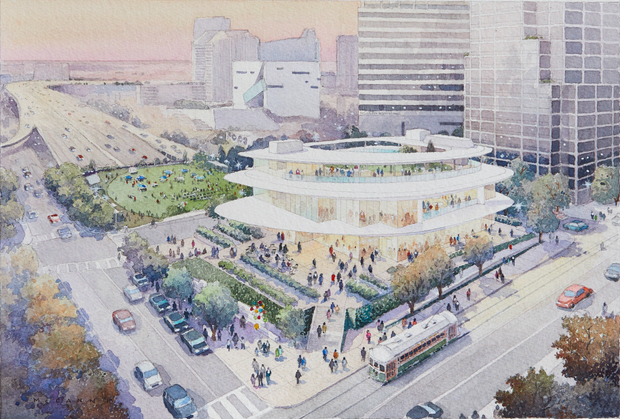
Klyde Warren Park, a top attraction in Dallas for more than a decade, is growing. Park and city leaders revealed details about the project on Monday morning, which will expand the park to 7.1 acres.
The park, which opened in 2012, connects Uptown Dallas with the Arts District over a recessed portion of Woodall Rodgers Freeway. The construction will span west to cover the remaining portion of the freeway, totaling 1.7 acres of new park space, according to the plans released Monday.
It will feature the Jacobs Lawn, a 37,000-square-foot green space that can be used for all types of community gatherings, performances and markets. In the winter, the lawn will feature an ice rink. Next to the lawn, the Overlook will give visitors a view of the highway traffic below them.
The expansion will also include a two-story pavilion with 24,000 square feet of climate-controlled event space, plus a rooftop terrace.
“This expansion isn’t simply about adding acreage. It’s an investment in Dallas, an investment in the community and an investment in future generations,” Klyde Warren Park chairman Jody Grant said in a statement.
“The expansion of this Park is exactly the kind of transformative investment we must continue to make throughout Dallas’s urban core. It will add new green space for residents to enjoy while driving continued economic growth, connecting our communities, and enhancing the quality of life that makes Dallas a destination for families, businesses, and visitors from around the world,” Dallas Mayor Eric Johnson said in a statement.
Construction firm Archer Western won a competitive bid to work on the project, the same firm that built the first phase of the park.
Construction will begin by the end of the year, and is expected to take two years to complete.

FRISCO, Texas — After 12 seasons in the NFL and the last eight with the Dallas Cowboys, defensive back CJ Goodwin has announced his retirement.
Goodwin, 36, has played in 108 games for the Cowboys since he joined the team in 2018. He was the second longest-tenured Cowboy on the roster behind only Dak Prescott, who preceded Goodwin by two seasons.
Since 2019, Goodwin has been one of Dallas’ key players on special teams, recording 69 tackles with the Cowboys [ninth in Cowboys history] and 87 in his NFL career. In 2021, Goodwin became the first player in franchise history to lead the team in special teams tackles for three consecutive seasons.
After going undrafted in 2014, Goodwin received a tryout with the Pittsburgh Steelers after Steelers Hall of Fame cornerback Mel Blount, whose son attended high school with Goodwin and who Goodwin had worked for as a farm hand, urged the team to give him an opportunity. Pittsburgh would sign him as an undrafted free agent afterwards.
Following time with the Steelers, Falcons, Cardinals, Giants, 49ers and Bengals, the Cowboys signed Goodwin off of Cincinnati’s practice squad in October of 2018.
In his eight seasons with Dallas, Goodwin notched 2,211 snaps on special teams. He worked primarily as a gunner on punt coverage and was one of Dallas’ most impactful defenders on kickoff coverage during his career with the team.
Goodwin was named one of the Cowboys’ six captains in 2025, and the second captain on special teams alongside Brandon Aubrey. He finished the year with 18 special teams tackles.
In 2026, the Cowboys will now have to look to fill Goodwin’s shoes on special teams. Some of their offseason signings, like safety P.J. Locke, have a strong history as defenders on special teams and could end up being crucial for special teams coordinator Nick Sorensen in his second season in Dallas.

-

 Iowa5 minutes ago
Iowa City braces for hundreds of thousands of visitors this weekend
-
 Kansas8 minutes ago
New food trucks join Love Lot in Kansas City, benefit from World Cup excitement
-

 Kentucky13 minutes ago
Kentucky Cares, Lexington Humane Society offer free pet food after floods
-

 Louisiana20 minutes ago
Louisiana man sentenced in child sex crimes case involving dolls now banned by state law
-

 Maine23 minutes ago
Maine driver to honor friend Kyle Busch during Celebration of America 300
-

 Maryland28 minutes ago
Maryland man sentenced for making online threats toward Black and Muslim communities
-

 Michigan35 minutes ago
Michigan Lottery Daily 3, Daily 4 results for June 29, 2026
-

 Massachusetts38 minutes ago
Millions of gallons of wastewater discharged into Merrimack River due to broken pipe

