Connect with us

South

Dallas Based Southwest Air Faces Lawsuit From Cancer Sufferer Who Tried to Book Two Seats For His Disability Only to Be Attacked By Gate Agent

Published

on

Dallas Based Southwest Air Faces Lawsuit From Cancer Sufferer Who Tried to Book Two Seats For His Disability Only to Be Attacked By Gate Agent


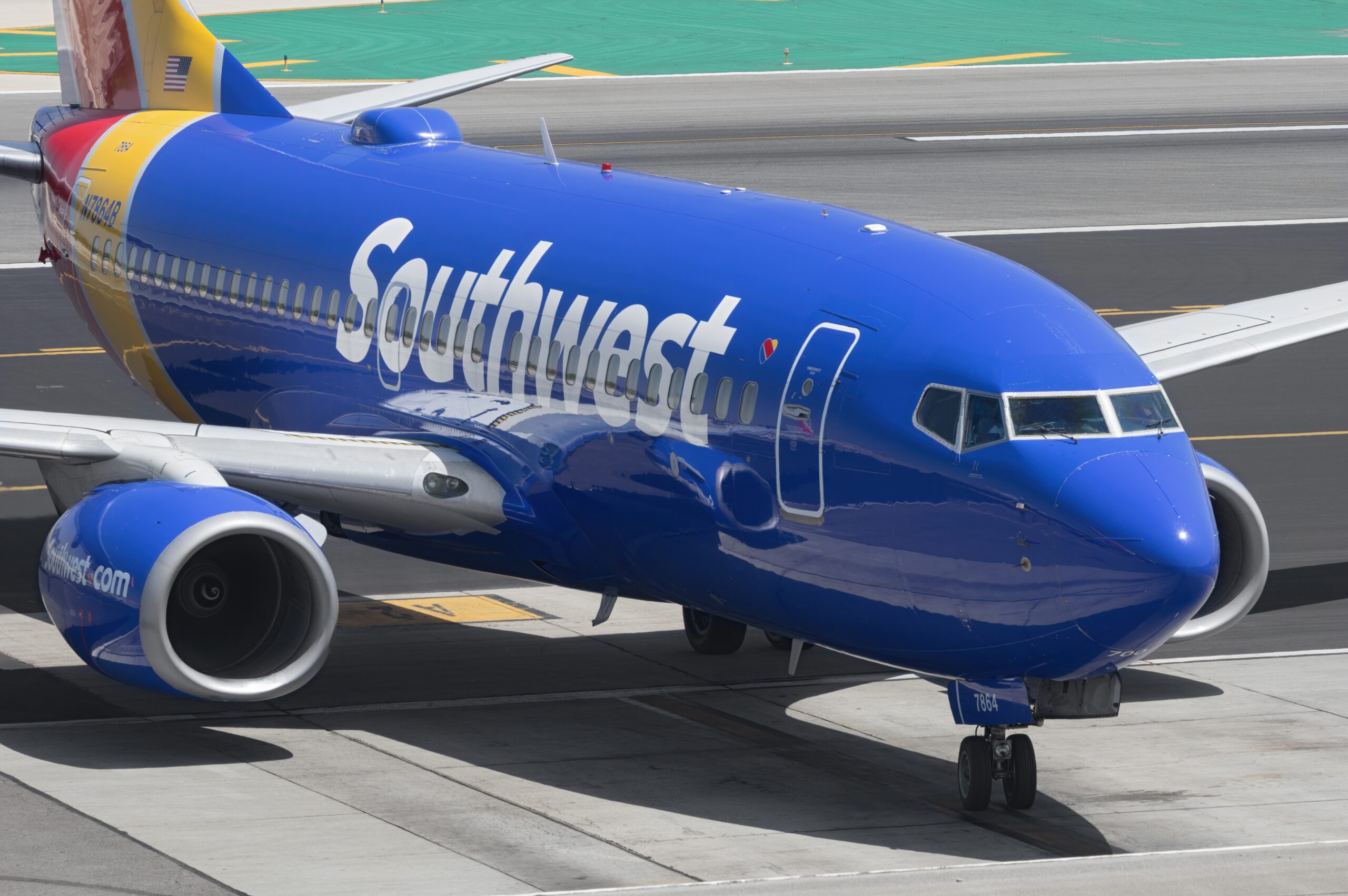
A Southwest Airlines passenger who was undergoing intense chemotherapy at the time that he tried to fly with Dallas based carrier says he was physically attacked and had his cell phone robbed from him by an airport gate agent who refused to honor Southwest’s ‘extra seat’ policy.

The now infamous and controversial ‘extra seat’ policy allows Southwest passengers to book two seats for one person if they are obese or might otherwise encroach into the space of the neighboring seat.

Passengers who feel they might need an extra seat simply need to phone Southwest’s reservation call center to make the purchase, which then allows Southwest to adjust its available seat count based on the needs of passengers.

Advertisement

If, however, the plane takes off with spare seats, then customers who have bought an extra seat should be allowed to claim a refund.

David Ford from Avon, Connecticut, says in a recently filed lawsuit against Southwest Airlines that rather than honoring its extra seat policy, he was left demeaned and humiliated by gate agents who told him that he didn’t look disabled before physically assaulting him and snatching his cellphone.

Weighing 230 pounds and with a height of 6’1″, David is on the larger size but wouldn’t be considered the stereotypical user of Southwest’s extra seat policy. He is, however, a cancer survivor, and at the time he tried to fly with Southwest in June 2024, he was undergoing chemotherapy and radiation treatment.

As a result, David says he moved about a lot and would encroach on the neighboring seat.

Advertisement

David phone Southwest’s call center and explained his circumstances and, according to a lengthy legal complaint, the reservation agent was more than happy to book him an additional seat through the ‘extra seat’ policy.

On the outbound flight from Las Vegas to Spokane, David says there weren’t any issues, but on his return, he ran into multiple problems with the gate agents who demanded to know what disability he suffered from and told him that he didn’t look like he needed an additional seat.

David was left embarrassed, although the treatment that he received in Spokane was only the tip of the iceberg, according to his attorney.

On June 12, David had a flight booked with Southwest from Bradley International Airport and he had again called Southwest’s reservation center ahead of his flight to book an extra seat.

Advertisement

Again, the gate agents demanded to know what disability he suffered from and told him “You don’t look handicapped,” before refusing to issue a boarding pass for David’s additional seat.

As David demanded a supervisor to complain, a second agent then allegedly climbed on the check-in weighing scales in order to stand over him and told him: “You ain’t getting a second seat on my watch.”

By this point, David says he was feeling intimidated, so he started recording the encounter on his cell phone, only for the agent to rip it out of his hand and refuse to return it.

Not long after, local police arrived to find out what was going on, and only at this point did the agent return David’s phone. Eventually, a supervisor intervened and agreed to print both boarding passes so that David could travel with an extra seat beside him.

Advertisement

Shaken and upset, David thought the matter might be over, but the lawsuit alleges that the agent who snatched the phone from him then boarded the plane once everyone was sat down and took the seat beside David to demand he delete the video recording.

David has already complained to Southwest about his treatment at the hands of its agents, and the airline allegedly wrote back to him, admitting that it had “failed to comply with regulations in your case”.

The lawsuit seeks to sue Southwest on a number of grounds, including unfair trading practices over the way it markets its extra seat policy, and infliction of emotional distress. David is suing Southwest for an unknown amount in compensatory and punitive damages.

Advertisement

Subscribe to our newsletter

No spam, just a weekly roundup of the best aviation news that you don’t want to miss

Mateusz Maszczynski


Mateusz Maszczynski honed his skills as an international flight attendant at the most prominent airline in the Middle East and has been flying ever since… most recently for a well known European airline. Matt is passionate about the aviation industry and has become an expert in passenger experience and human-centric stories. Always keeping an ear close to the ground, Matt’s industry insights, analysis and news coverage is frequently relied upon by some of the biggest names in journalism.

Advertisement


Source link

South-Carolina

South Carolina is in for the longest day of year as summer 2026 starts

Published

on

South Carolina is in for the longest day of year as summer 2026 starts


play

  • The first astronomical day of summer in 2026 is Sunday, June 21, which is also the summer solstice.
  • Meteorologically, summer begins on June 1 and ends on August 31 for easier climate data comparison.
  • The summer solstice marks the longest day of the year, when the North Pole is at its maximum tilt toward the sun.
  • On June 21, South Carolina will experience over 14 hours of daylight.

It may have felt like summer in South Carolina these past few weeks, but it is just now the first official day of summer.

Days have become longer, and temperatures have pushed toward 100 on some days ahead of the first day of summer. Now the longest day of the year is here, and the hottest months in the South are ahead of us.

Advertisement

On June 21, Greenville and Upstate South Carolina will experience more than 14 hours of daylight, according to Time and Date. From there, days will start being shorter once again.

Here’s how much daylight Upstate South Carolina is expected to see for the summer solstice.

When is the first day of summer 2025?

Well, there are technically two answers.

The first official day of summer astronomically for 2026 is Sunday, June 21, which is when the Northern Hemisphere has the longest day of the year, according to the Old Farmer’s Almanac.

But when we talk meteorologically, summer starts on June 1. The reason for this is that meteorologists divide the year into four seasons based on the months and the temperature cycle. Doing it this way also allows them to compare and organize climate data more easily. In this system, summer begins on June 1 and ends on August 31.

Advertisement

What is the summer solstice?

The summer solstice marks the astronomical first day of the summer season in June in the Northern Hemisphere.

This is also when the Earth arrives at the point in its orbit where the North Pole is at its maximum tilt toward the sun, according to the Almanac. This makes it the longest day with the longest period of sunlight hours and the shortest night of the calendar year.

It will begin at 8:25 UTC or 4:25 a.m. ET on June 21, according to EarthSky.org.

When is the longest day of the year?

The summer solstice is the longest day of the year. On June 21, it will be the day with the longest period of sunlight, with some areas in the Northern Hemisphere getting upwards of 15 hours of sunlight on that day, according to EarthSky.org.

Advertisement

In South Carolina, communities will see around 14 hours and 28 minutes of daylight on the longest day of the year, according to timeanddate.com, which tracks when sunrise and sunset occur in communities across the United States.


Source link

Continue Reading

Tennessee

Voting rights ruling echoes Tennessee’s Jim Crow past | Opinion

Published

on

Voting rights ruling echoes Tennessee’s Jim Crow past | Opinion


As the Supreme Court weakens voting rights protections, Tennessee’s Jim Crow history offers a stark warning about race, power and representation.

Advertisement
play

  • The Supreme Court’s recent decision on the Voting Rights Act has raised concerns about a return to Jim Crow-era policies.
  • Tennessee was among the first Southern states to implement segregation laws and disenfranchise Black voters through poll taxes and literacy tests.
  • Civil rights advancements like the Voting Rights Act were achieved through sustained pressure from activists demanding justice and equality.

Recent developments concerning race and democracy have prompted much discussion about the American experiment and the meaning of citizenship. This series of guest essays examines major issues, such as race, slavery, Jim Crow and civil and voting rights, in the context of their collective meaning in our present. 

These guest essays help us understand the importance of these topics in light of the U.S. Supreme Court’s decision on the Voting Rights Act of 1965. 

The Supreme Court has nakedly attacked the most significant legislative achievement in American history: the Voting Rights Act. Justice Samuel Alito argued that Louisiana’s use of the law to support minority majority congressional districts was an unconstitutional “racial gerrymander.” 

Louisiana v. Callais will be remembered as the culmination of a decades-long effort by conservative politicians and jurists to undermine one of the central underpinnings of American democracy. The brazenness of the Court’s action is as disturbing as it was predictable. Many have argued the Court’s actions will lead to a new Jim Crow. 

Advertisement

As the nation comes to grips with a new legal paradigm regarding civil rights, imposed by an unelected and hyper-partisan Court, it is time to reexamine just what Jim Crow actually meant to Tennessee and the South, as well as what it might portend for our future.

What Jim Crow was and how it took hold

The Jim Crow era, de jure and de facto, existed from the end of Reconstruction to the late 1960s. The term is the center identifier for all the laws, rules, and customs that governed the period. It originated around 1828, when Thomas Dartmouth “Daddy” Rice originated the character of “Jim Crow” in New York. Wearing “blackface,” Rice regaled audiences with dance and song in blackface, using burnt cork makeup to give the appearance of Black skin.

By 1840, “Jim Crow” was incredibly popular because of its deeply offensive representations of Black people. The outrageous stereotypes meant to dehumanize Black America would, by the 1890s, take on an even more menacing tone.

Advertisement

How Tennessee built a segregated society

Tennessee was the first state to reenter the Union in June 1866. Our state had a long history of holding people in bondage. Enslaved people were chattel, meaning they were little more than property to be bought, sold and possessed. After the war, Tennessee designed laws to make Blacks into second-class citizens.

In 1875, Tennessee created one of the first frameworks for a segregated society, which allowed a variety of public-facing entities – hotels, businesses, transportation and others – to refuse service and/or admission to Black Tennesseans. This was in response to Congress passing the 1875 Civil Rights Act, which promised equal treatment for Black people in public places and the right to serve on juries.

By the start of the 20th century, Tennessee, like the rest of the South, erected all kinds of laws to trap Blacks into second-class citizenship. Everything was segregated, from housing to hospitals to cemeteries to water fountains to bathrooms to lunch counters. The Supreme Court gave its blessing to segregation in 1896 when it decided the infamous Plessy v. Ferguson decision. The federal government had given Tennessee and the rest of the South its blessing to enforce a deeply dehumanizing, two-tiered apartheid system.

Advertisement

The vast majority of Blacks were disenfranchised by a series of official acts of the Tennessee legislature in 1889. Laws regarding poll taxes and literacy tests restricted many from accessing the ballot. Lynchings served to intimidate Black Tennesseans from challenging the new laws.

At least 177 Black Tennesseans were lynched during Jim Crow. Ida B. Wells began her career in Memphis documenting the scourge of lynchings in her Free Speech newspaper. She was terrorized by angry whites, and after her press was burned by a white mob, she remained in the North, where she continued her work. The murders and mayhem undergirded Jim Crow in Tennessee.

Why change required sustained pressure

Today, it is not enough to say these laws have changed. Too often, it is noted that the country has moved past race. Brown v. Board of Education came to pass. The Civil Rights Act came to pass. The Voting Rights Act came to pass. The Fair Housing Bill came to pass. These advancements came about because of the courage of Black Americans, white and Jewish allies, and others who demanded change toward justice. Commentators point out these changes as if the country should be rewarded for finally delivering on basic rights already guaranteed by the Constitution. 

Congress and the statehouses did not change because they felt morally responsible for the plight of Blacks. The changes came because people said “enough.”

Advertisement

How today’s disputes reflect unresolved history

In 2026, our problems remain rooted in the Jim Crow past. A great many Americans, including those in Tennessee, never accepted the racial progress of the 1950s and 1960s. Some argue our new congressional maps are simply an exercise in partisanship and power.

Poppycock! Such measures will result in the disenfranchisement of Tennesseans. If some are not able to elect representatives who are in alignment with their political and policy views, then something most vile has been reawakened in the Volunteer State. 

Basic issues such as support for public schools, public works, infrastructure and investment will subside as political attention is devoted to areas of the state perceived to be more authentically Tennessean at the expense of Black and poor residents. The irony is that the supermajority has forgotten that less than 20 years ago, they were in the minority and were quite sensitive about violations of the rights of the minority.

Advertisement

The stakes for voting rights and representation

To argue that race no longer plays a role in American life simply does not pass the smell test. Conservatives are missing an opportunity to gain traction, followers and, most importantly, voters because many are unwilling to put down the barbed clubs of grievance and shortsightedness. 

The Voting Rights Act was not a radical legislative solution. Its design was very basic and conservative in its purpose: to develop a series of mechanisms to enforce and ensure equal opportunity and access for all Americans to taste the richness of American democracy.

Daryl A. Carter, Ph.D., is associate dean, director, and professor of history at East Tennessee State University.


Source link

Advertisement
Continue Reading

Texas

Hot and humid Father’s Day for North Texas to kick off summer equinox

Published

on

Hot and humid Father’s Day for North Texas to kick off summer equinox


Happy Father’s Day and official start to Summer Equinox! Summer Solstice started at 3:24 a.m. on Sunday, and is the longest day of the year. Expect the day to last 14 hours and 19 minutes.

The start of summer will be hot! Most of the North Texas area will see sunshine and dry conditions, though a few afternoon storms will be possible east of I-35. Lightning, gusty winds, and localized flooding due to heavy rainfall are the highest threats.


Source link

Continue Reading
Advertisement

Trending