Science
Launch of First Amazon Project Kuiper Internet Satellites Is Scrubbed


The battle of billionaires in space between Jeff Bezos and Elon Musk is ready to enter a new arena: satellite internet. But the contest will have to wait another day as weather along Florida’s Space Coast on Wednesday night interfered with a launch attempt.
Amazon, the company that Mr. Bezos started as an online bookseller three decades ago, is now a merchandising behemoth, the owner of the James Bond franchise, a seller of electronic gadgets like Echo smart speakers and one of the most powerful providers of cloud computing.
So perhaps it is not a surprise that Amazon is now launching the first few of thousands of satellites known as Project Kuiper to provide another option for remaining connected in the modern world. The market for beaming high-speed internet to the ground from orbit is currently dominated by Elon Musk’s SpaceX rocket company, which operates a similar service, Starlink. Starlink, with thousands of satellites in orbit and more launching nearly every week, already serves several million customers around the world.
Why was the launch postponed?
The first 27 Project Kuiper satellites were scheduled to lift off on Wednesday between 7 and 9 p.m. Eastern time from Cape Canaveral Space Force Station in Florida. They were to fly on an Atlas V, a rocket made by United Launch Alliance, a joint venture between Boeing and Lockheed Martin. U.L.A.
But the flight attempt was dogged by poor weather near the launch site, with rain, wind and cloudy conditions making a liftoff unsafe. After pushing back the launch time several times during the two-hour window, U.L.A.’s flight director decided to scrub the flight around 8:41 p.m.
The company is reviewing the next opportunity for a launch.
What is Project Kuiper?
Project Kuiper will be a constellation of internet satellites intended to provide high-speed data connections to almost every point on Earth. Doing this successfully will require thousands of satellites, and Amazon’s goal is to operate more than 3,200 in the years to come.
The company will compete with SpaceX’s Starlink, a service that was originally marketed primarily to residential customers.
While Kuiper also aims for that market, particularly in remote areas, it will also be integrated with Amazon Web Services, the company’s cloud computing offering, which is popular with large corporations and governments around the world. That might make it more attractive to businesses that involve satellite imagery or weather forecasting that not only need to move large amounts of data across the internet, but also to perform calculations on the data.
Ground stations will connect the Kuiper satellites to the web services infrastructure in a manner that could also allow companies to communicate with their own remote equipment. For example, Amazon has suggested that energy companies could use Kuiper to monitor and control remote wind farms or offshore drilling platforms.
In October 2023, two prototype Kuiper satellites were launched to test the technology. Amazon said that the tests were successful. Those prototypes were never meant to serve in the operational constellation, and after seven months they were nudged back into the atmosphere, where they burned up. The company said it has since updated the designs of “every system and subsystem on board.”
“There’s a big difference between launching two satellites and launching 3,000 satellites,” said Rajeev Badyal, an Amazon executive in charge of Kuiper, in a promotional video ahead of the launch.
When will Amazon provide internet service from space?
Amazon told the Federal Communications Commission in 2020 that service would begin after it had deployed its first 578 satellites. The company has said that it expects to connect customers to the internet later this year.
While a fully functional constellation needs thousands of satellites, the company can offer service in specific regions with far fewer in orbit before expanding to more global coverage later on.
The F.C.C.’s approval of the constellation came with a requirement that at least half the satellites needed to be deployed by July 30, 2026. Industry analysts say the company could get an extension if it has demonstrated substantial progress by then.
Getting the satellites into orbit also depends on rocket launches occurring on schedule, which can be a problem if enough rockets are not available. Amazon also needs to build hundreds of ground stations, to relay their signals to users.



Science
Did you feel it? As Artemis II nears reentry, scientists want to know how far the sonic boom travels

Southern Californians may hear a distinct “boom” around 5 p.m. Friday as NASA’s Artemis II moon flyby mission makes its energetic reentry off the coast of San Diego, the U.S. Geological Survey said.
USGS does not know how far up and down the coast — or how far inland — Californians will be able to hear this sonic boom, produced as the capsule breaks the sound barrier as it slows down, said John Bellini, a geophysicist with the agency.
For this reason, USGS is asking for the public’s help: Californians can report whether or not they heard the boom to the agency’s “Did You Feel It” survey.
This information, Bellini said, will help scientists better predict sonic booms in the future, which are dependent on a variety of atmospheric conditions.
“Since this is a known source with a relatively known location and time of occurrence, people reporting this can help us in the future to better characterize unknown sources of a similar type,” he said.
NASA astronaut and Artemis II Pilot Victor Glover in the Orion spacecraft during the Artemis II lunar flyby.
(NASA via Getty Images)
For example, meteorites and space debris piercing the atmosphere can produce sonic booms — as can supersonic tests from the military and private aerospace companies.
While Southern Californians might hear the intense reentry, NASA isn’t so confident they’ll be able to see it.
However, Aaron Rosengren, assistant professor of space systems at UC San Diego, is more optimistic.
“The weather is quite nice today,” he said. “If you have any view along the Southern Coast and you’re looking westward along the horizon, you should be able to see a faint light in the sky as it reenters.”
Rosengren expects that streak in the sky to last less than a minute.
The Artemis II crew, the first to reach the moon in a half-century, will slam into the atmosphere at 30 times the speed of sound, generating a fireball of nearly 5,000 degrees Fahrenheit around the capsule.
When Artemis II pilot and SoCal native Victor Glover was asked Wednesday evening about the moments from this mission he’ll carry with him for the rest of his life, he joked: “We’ve still got two more days, and riding a fireball through the atmosphere is profound as well.”

Between all the monitors, wires and keyboards are the normal trappings of a workplace: lunchboxes, water bottles, backpacks and smartphones.
A vase of roses brightens up the center of the room. Since the Challenger disaster in 1986, a couple in Houston has sent more than a hundred bouquets to mission control to commemorate NASA’s space launches and honor the lives of fallen astronauts.
Mission control is in a new room, and looks a little different than in the Apollo era. Wood desks have replaced green metal mainframes, and the ashtrays and rotary phones are gone.
But the bones of the operation have not changed, said Judd Frieling, one of the Artemis II flight directors, who spoke from mission control to reporters on Saturday. Every spacecraft needs similar systems — propulsion, navigation and the like — to succeed.
“We’re building upon the giants that started it back in the Apollo era,” Mr. Frieling said. “We continued our evolution during the space shuttle program, during the International Space Station program and now on to the Artemis program.”
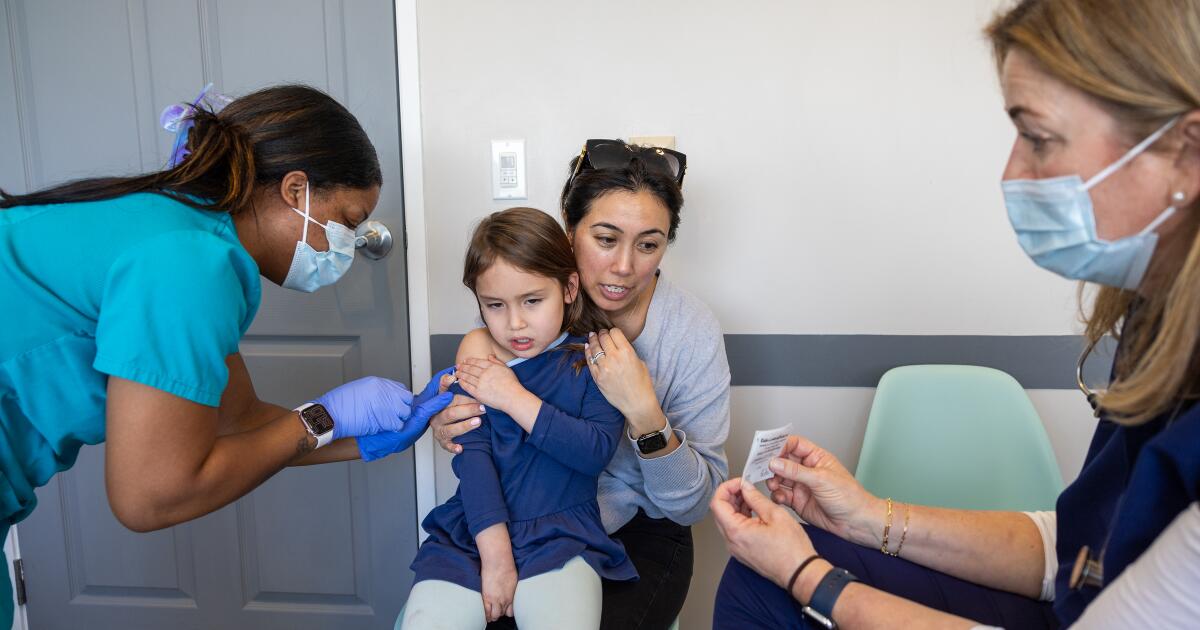
Measles is back in the United States. More than 1,500 cases have already been reported in the first months of 2026, putting the country on pace to surpass last year’s total of more than 2,200, the highest number in decades. Public health officials warn that the nation’s status as “measles free” is now at risk as childhood vaccination rates decline.
Measles may not be the only disease poised for a comeback. Another virus that once infected thousands of American children each year could be heading in the same direction.
A recent study my colleagues and I conducted using national electronic health record data found that hepatitis B vaccination rates among newborns declined by more than 10% between 2023 and August 2025.
At first glance, hepatitis B may seem like an unlikely threat to infants. The virus spreads through infected blood or bodily fluids, exposures many parents assume newborns would rarely encounter. But before routine vaccination began, hepatitis B infected roughly 18,000 children under the age of 10 in the United States every year.
About half of those infections were passed from mother to child during birth. The rest occurred through everyday household exposure, often through contact with a caregiver or family member who did not know they were infected.
The consequences can be lifelong. While acute infection is often mild or asymptomatic, as many as 90% of babies infected in their first year of life develop chronic hepatitis B. Over time, chronic infection can lead to cirrhosis, liver cancer and liver failure.
The first major step toward prevention was screening. In 1988, universal hepatitis B testing during pregnancy was recommended so that infants born to infected mothers could receive protection immediately after birth. The strategy helped identify many high-risk cases, but it did not prevent all infections. Each year between 50 and 100 infants still developed hepatitis B.
To close those remaining gaps, universal newborn vaccination was recommended in 1991. Over the following decades, hepatitis B infections in children fell to fewer than 20 annually.
That is why many physicians were surprised when, in December, the federal government’s Advisory Committee on Immunization Practices revised its recommendation for newborn hepatitis B vaccination. Under the new guidance, babies born to mothers who test negative for hepatitis B may receive the vaccine based on individual clinical decision making rather than a universal recommendation.
The idea behind this approach is straightforward. If a mother tests negative for the virus, the immediate risk to the newborn is extremely low.
But the history of hepatitis B prevention shows why universal protection became necessary in the first place.
Today, an estimated 660,000 Americans still live with chronic hepatitis B, and roughly half are unaware of their infection. Exposure risks have not disappeared. They have been controlled through vaccination and screening.
At the same time, the nation’s vaccine guidance is becoming increasingly confusing. Earlier this year, the Centers for Disease Control and Prevention revised its childhood immunization schedule, moving several vaccines from being universally recommended to being suggested as topics of discussion for parents and providers.
The changes were not supported by new evidence. In response, the American Academy of Pediatrics created its own immunization schedule that largely maintains the previous recommendations.
As a result of a lawsuit against the CDC and the Department of Health and Human Services, a federal judge has temporarily blocked the changes to the federal recommendations and invalidated actions taken by the advisory committee.
The result is growing confusion.
In my clinic, parents have begun asking questions I never heard before. Which vaccine schedule should we follow? Is this the schedule with all the vaccines or only some of them? Vaccination decisions are influenced by science but also by trust and consistency. When parents receive mixed messages, some begin to question whether vaccines are necessary at all. We have already seen the consequences of declining vaccination with measles.
For decades, hepatitis B vaccination protected American children from a virus that once infected thousands every year. Because the disease became rare, many parents and younger physicians have never seen its consequences firsthand.
If measles is a warning, hepatitis B could be next.
The lesson from the past is simple. When we stop using vaccines that work, the diseases they prevent come back.
Joshua Rothman is a pediatrician at UC San Diego Health and a clinical assistant professor of pediatrics at the UC San Diego School of Medicine.

Noah Kahan backs Vermont bill targeting ticket scalpers

Made in Southwest Virginia craft market returns

DOJ asks judge to allow search of Washington Post reporter’s phone, laptops

Wisconsin sheriff suing local woman, Cook County commissioner over detention claims

West Virginia man sets new state record for tiger trout

Florida High School Football Rankings: Top 25 teams – Oct. 21

How old is Bo Nix? What to know about Oregon quarterback ahead of 2024 NFL Draft

Cleary's 21 help Le Moyne down Central Connecticut State 69-64 in OT

99th annual Pony Swim held in Virginia

Indiana Members Credit Union announced as new anchor tenant at Bottleworks District

Swalwell’s former female staffer drops bombshell allegations of sexual assault, exposing himself: report

NASA’s Artemis II prepares for splashdown on Earth

Trump proposes painting executive office building white

Rep Randy Fine joins House Freedom Caucus: ‘Strongest group of conservative patriots in Congress’

Trump issues NATO ultimatum to reopen Strait of Hormuz ‘within days’
-

 Atlanta, GA6 days ago
1 teenage girl killed, another injured in shooting at Piedmont Park, police say
-

 Education1 week ago
Video: YouTube’s C.E.O. on the Rise of Video and the Decline of Reading
-

 Movie Reviews1 week ago
Vaazha 2 first half review: Hashir anchors a lively, chaos-filled teen tale
-

 Georgia3 days ago
Georgia House Special Runoff Election 2026 Live Results
-

 Education1 week ago
Video: Toy Testing with a Discerning Bodega Cat
-

 Pennsylvania4 days ago
Parents charged after toddler injured by wolf at Pennsylvania zoo
-
 Milwaukee, WI4 days ago
Potawatomi Casino Hotel evacuated after fire breaks out in rooftop HVAC system
-
 Entertainment1 week ago
Inside Ye’s first comeback show at SoFi Stadium