Science
A SoCal native is set to pilot NASA’s lunar mission — and become the first Black person to reach the moon

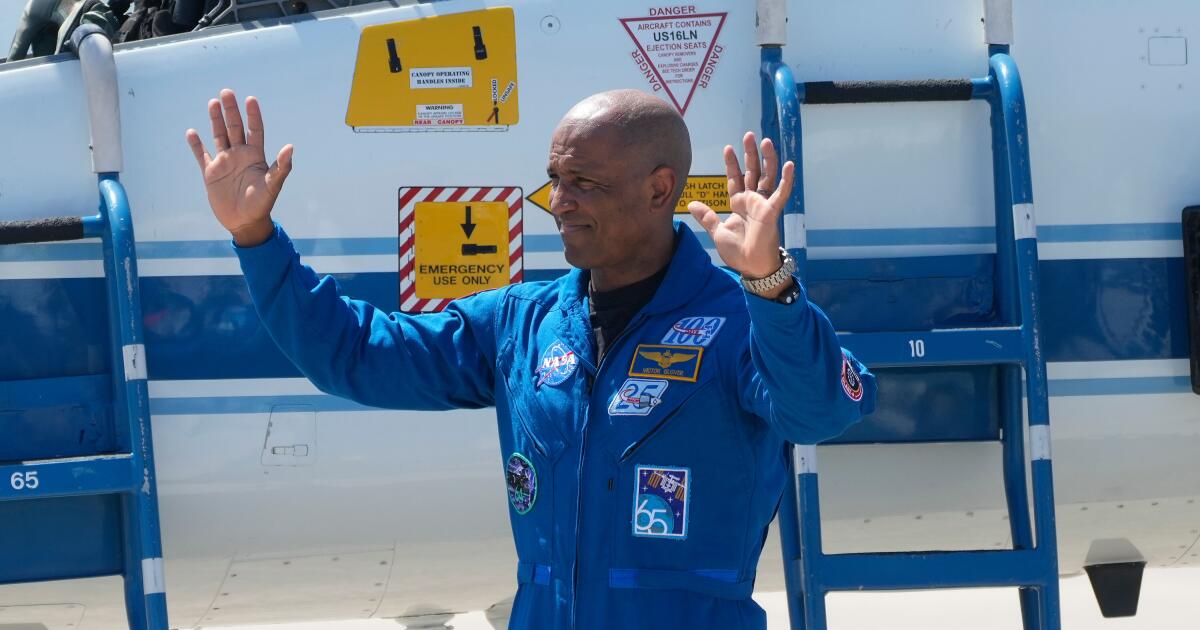
NASA’s Artemis II mission, the first to send humans around the moon in half a century, is slated to launch Wednesday. It will be piloted by one of Southern California’s own.
Victor Glover — a former Ontario High School wrestler and Navy test pilot who often wears his excitement on his royal-blue jumpsuit sleeve — will be the first Black person to reach the moon. The mission is a lunar flyby, so the crew will not land on the moon or enter lunar orbit.
Glover, 49, became the first Black person to serve on an International Space Station expedition in 2020.
“That cannot be right,” Livingston Holder, a former manned spaceflight engineer with the Air Force and space shuttle payload specialist, recalled thinking when he first heard that fact. “How can we go two decades without flying a Black astronaut on a full mission to the station? How can that possibly be?”
Yet, it’s true: Several trailblazing Black astronauts stayed aboard for several days while helping build the ISS on space shuttle missions. None had lived aboard for months on end as an expedition crew member afterward.
Artemis II backup crewmembers and prime crewmembers, including Victor Glover, pose for a picture with NASA’s Space Launch System rocket and Orion spacecraft, Saturday, Jan. 17, 2026, at NASA’s Kennedy Space Center in Florida.
(NASA/Joel Kowsky)
For Glover, the achievement — and title of “first” — stirred complicated feelings. In the flurries of media interviews that come with life as an astronaut, he acknowledged the deep responsibility he felt toward the next generations of Black astronauts he hoped to inspire. At the same time, he often reframed his role into NASA’s greater mission and pointed to the many Black trailblazers, such as Holder, before him.
“He’d probably been the first Black person to do X, Y or Z,” said Holder, whose planned mission to space was ultimately canceled after the Challenger disaster in 1986. And since Glover, a team player, was not the first person to serve on an ISS expedition or reach the moon, but instead the first Black person to do so, “I don’t think he really wanted to emphasize ‘I’m the first,’” Holder added.
Glover wasn’t really supposed to be the first Black person to serve on an ISS expedition, either. In 2018, Jeanette Epps was scheduled to join a Russian Soyuz mission to the ISS, which would have given her the title, but five months before the mission, NASA suddenly benched her without explanation.
And while he was aboard the ISS, many Black Americans — including Glover — were forced to grapple with more Earthly challenges. Just months before launch, a white police officer murdered George Floyd in the streets of Minneapolis.
It’s a familiar tension in Black America: The Apollo program began during the peak of the civil rights movement. Many criticized the program as a distraction from the country’s problems and a waste of money that the government could instead use to better the lives of everyday Americans.
During the training for his moon mission, Glover listened to the poem “Whitey on the Moon” by the late Black poet and jazz musician Gil Scott-Heron — which articulates those arguments painfully and pointedly — every week on his morning commute to ground himself in his work.

Glover undergoes spacesuit checks inside the crew quarters suit-up room in the Neil A. Armstrong Operations and Checkout Building as part of the Artemis II Countdown Demonstration Test at the agency’s Kennedy Space Center on Dec. 20, 2025.
(NASA/Glenn Benson)
For Glover, space exploration is an opportunity to lift all Americans and invest in technology that creates hope for a better future.
“Every time you are the first — the first person in your family to go to college, the first person from your school to get a PhD … it’s important for all the people that start where you started,” Holder said. Now they can say, “‘Oh, it is possible.’”
For Black parents in Pomona and beyond who see the next generation of NASA astronauts in their cute, nerdy children, Glover’s example is deeply meaningful.
Glover, born in 1976 in Pomona, was an adrenaline junkie who dreamed of being everything from a stuntman to a race car driver. His parents, a police officer and a bookkeeper, encouraged his curiosity. The young astronaut-to-be also looked up to his grandfather, who enlisted in the Air Force during the Korean War, but was told he couldn’t fly because of his race.
When a young Glover watched a space shuttle launch on television, he immediately wanted to drive the thing.
His first attempt to leave Earth was through sports — pole vaulting, to be specific. Throughout his time at Ontario High and Cal Poly in San Luis Obispo, Glover also added football into the mix and ultimately became best known for his wrestling prowess (despite feeling quite intimidated by his college teammate at the time, Chuck Liddell, who ultimately became an MMA star).
Gregg Givens, an English teacher at Ontario who coached football at the time, remembered Glover as a very nice, very smart kid. “He was marching to his own drummer,” Givens said. “I know that’s a cliche way to say things, but … he was going to do what Victor was going to do.”
After getting a bachelor’s degree in engineering, Glover enlisted in the Navy in 1998. Over his 15 years in the military, he accumulated 3,500 flying hours in more than 40 aircraft, a few master’s degrees along the way, and served in 24 combat missions.
One of his commanding officers bestowed on him a call sign that’s stuck through his NASA days: “Ike,” meaning “I know everything.” (It’s a sensibility his four daughters surely appreciated when Glover, a family man at his core, checks in from space to help them with their homework.)
Like many others before him — including Neil Armstrong, the first person to walk on the moon — Glover cut his teeth as a test pilot out in the Mojave. He attended test pilot school at Edwards Air Force Base, the site of many daring Armstrong flights and space shuttle landings, then served with the Navy’s Dust Devil test pilot squadron in China Lake, Calif.
In 2013, while Glover was in Washington, D.C., on assignment as a Navy legislative fellow, he happened to miss a phone call from NASA. After frantically calling back, he got the news: He was one of eight selected out of a pool of more than 6,000 for the space agency’s 21st class of astronauts.
On Artemis II, he won’t be the only “first” on the capsule: NASA astronaut Christina Koch is set to be the first woman to reach the moon, and Jeremy Hansen, an astronaut with the Canadian Space Agency, is set to be the first non-American to do so.
Holder, whom Glover has pointed to as a mentor, is happy to live vicariously through Glover’s generation of Black astronauts.
On a recent trip to Australia, Holder, now a co-founder of the spaceflight startup Radian Aerospace, stopped by one of the many stations that will help the astronauts communicate with Earth to send Glover a message ahead of launch:
“Through you, we all go to the moon.”



I’ve been investigating a transformation in the illegal drug market and how it has led to this explosion of drug overdoses. “America’s public enemy No. 1 is drug abuse.” The war on drugs starts in the early ’70s. At that time, annually, there were roughly 7,000 drug overdose deaths. Subsequently, that number completely explodes. How could we have invested so much to stop the problem and just have it get so much worse? So when we start looking at this data, I find that it’s fundamentally a synthetic drug problem. Fentanyl is the first example, but it’s essentially a subset of what we know as novel psychoactive substances. They are often lethal. “So this sample was a 19-year-old in Chicago who was found deceased after taking what he thought was Percocet. But we found one of these synthetic cannabinoids that is several times more potent than fentanyl.” When you get that sample, you’re trying to tease out a molecule that maybe hasn’t been seen before? “Yes, we create what is essentially a digital record, a chemical fingerprint, if you will. But then there’s the interpretation. We need to understand the pharmacology of it, the potency of it, to understand how these substances can affect humans.” This is an information-era story. It’s everything from chat groups where people are sharing different ideas, to exchanges between users and suppliers, and then the chemistry know-how is also being shared. One way to appreciate the magnitude of the problem is to see how easy it is to change these molecules. “So this is MDMA and these are all being manufactured to really elicit similar responses. Methylone, ethylone, butylone, dimethylone, we’ve seen all of those. The left side of the molecule in all of these is the same. It’s really the right side of the molecule that’s different.” Why can’t we just outlaw all drugs of a certain class or type, wouldn’t that simply solve the problem? “The challenge is there’s been so many examples and stories of that leading to even more potent drugs. You kind go through this roller coaster of one substance emerging because another has been scheduled, and then you have that going away, a new substance emerging, new substance emerging over time. So do you like the thing that’s dangerous to the power of five, or do you want the thing that’s dangerous to the power of 100?” Understanding the science and the chemistry is vital to at least knowing what we’re dealing with in this supply. And that way, ideally, we could frame public policy that would get at the problem and not make it worse.

new video loaded: Artemis II Crew Prepares for Moon Launch
transcript
transcript
Artemis II Crew Prepares for Moon Launch
The four astronauts of the Artemis II, the first crewed mission to the moon since Apollo in 1972, spoke to the news media leading up to Wednesday’s launch window.
-
“It is our strong hope that this mission is the start of an era where everyone, every person on earth, can look at the moon and think of it as also a destination.” “We can safely say, the crew’s ready, the rocket’s ready, the spaceship’s ready. The one thing we are watching is the weather.” “One of the things that the future Artemis missions are going to do is actually to work on the surface of the moon. And even though this mission is not going to the surface, we are starting some of the processes that we think are going to help them be successful.” “I love that, but I also hope we are pushing the other direction — that one day we don’t have to talk about these firsts. It’s about human history. It’s the story of humanity, not Black history, not women’s history, but that it becomes human history.”

By Shawn Paik
March 30, 2026

Kenyan distance runner Albert Korir has admitted to doping, prompting officials on Monday to ban him for five years.
Long a fixture at the New York Marathon, Korir tested positive for a blood-boosting substance in three separate samples taken in October while he was training to run in the New York Marathon on Nov. 2. He finished third in the race.
A verdict issued by the Athletics Integrity Unit said that Korir’s results since October will be disqualified, including that third-place finish in New York.
The three positive results provide “clear evidence of the athlete’s use of a prohibited substance on multiple occasions which is expressly identified in the definition of aggravating circumstances,” the verdict stated.
The punishment was reduced by one year because Korir, 32, admitted to taking a banned substance without requesting a hearing. He is banned until January 2031.
Korir will keep his 2021 New York Marathon title. He also was runner-up in 2019 and 2023, and finished third in 2024 in addition to 2025. His other first-place finishes came in the 2019 Houston Marathon, the 2017 Vienna Street Race and the 2019 and 2025 Ottawa Race Weekend.
Korir tested positive for Continuous Erythropoietin Receptor Activator (CERA), a long-acting agent that stimulates red blood cell production much like the banned substance EPO. It is used legally to treat anemia associated with chronic kidney disease and typically is administered once every two to three weeks.
The World Anti-Doping Agency said in October that Kenya had made “significant” progress in tackling doping but the country remains on probation while it seeks to improve its monitoring.
The action by WADA occurred after Kenyan runner Ruth Chepngetich, the world marathon record holder, was banned for three years after admitting the use of Hydrochlorothiazide (HCTZ), a banned diuretic used as a masking agent.

Warm, windy with strong storms possible | March 31, 2026

Staind, Hoobastank and BigXthaPlug to perform at Iowa State Fair

Kentucky Wildcats News: McDonald’s All-American Gameday

Louisiana could get rid of inspection stickers — in most places. Is your parish on the list?

Hermon man accused of assaulting and threatening Bangor woman with a gun

Florida High School Football Rankings: Top 25 teams – Oct. 21

How old is Bo Nix? What to know about Oregon quarterback ahead of 2024 NFL Draft

Cleary's 21 help Le Moyne down Central Connecticut State 69-64 in OT

99th annual Pony Swim held in Virginia

Indiana Members Credit Union announced as new anchor tenant at Bottleworks District
Latino Republicans in South Texas Turn on Trump Over Birthright Citizenship

Fugitive illegal alien convict on the run after attempting to strike ICE officer with vehicle: DHS

EU to urge Israel to scrap death penalty bill as ‘grave regression’
Army reviewing after helicopters hovered alongside Kid Rock’s swimming pool as he saluted

Emanuel pushes back on ‘straight White man’ question, says ideas matter most in 2028
-

 Sports1 week ago
IOC addresses execution of 19-year-old Iranian wrestler Saleh Mohammadi
-

 Miami, FL5 days ago
Jannik Sinner’s Girlfriend Laila Hasanovic Stuns in Ab-Revealing Post Amid Miami Open
-

 South-Carolina2 days ago
South Carolina vs TCU predictions for Elite Eight game in March Madness
-

 New Mexico1 week ago
Clovis shooting leaves one dead, four injured
-

 Politics1 week ago
Schumer gambit fails as DHS shutdown hits 36 days and airport lines grow
-

 Science1 week ago
Record Heat Meets a Major Snow Drought Across the West
-

 Minneapolis, MN5 days ago
Boy who shielded classmate during school shooting receives Medal of Honor
-

 Tennessee1 week ago
Tennessee Police Investigating Alleged Assault Involving ‘Reacher’ Star Alan Ritchson