Politics
Trump’s Moves to Upend Federal Bureaucracy Touch Off Fear and Confusion


An Education Department employee was attending a funeral this week when she got the call: She was being placed on administrative leave because she works on projects that connect Black students, among others, to federal government programs.
A disabled veteran employed at the Department of Veterans Affairs grew emotional when he heard about the rescinding of telework options, unsure whether it would mean the end of his job taking care of fellow soldiers.
A Federal Trade Commission employee was so anxious that he told family members not to talk about politics on unencrypted lines. Across government agencies, workers eyed one another nervously, wondering whether a colleague would report them, accusing them of resisting the new administration’s move to end certain programs.
President Trump’s rapid push to overhaul the federal bureaucracy in his first days in office has been met with a mix of fear, fury and confusion throughout the work force.
Dozens of employees across the government, many of whom spoke on the condition of anonymity because of worries of retribution, described agencies gripped with uncertainty about how to implement the new policies and workers frantically trying to assess the impact on their careers and families. As the nation’s largest employer, the upheaval in the federal government could reverberate in communities throughout the country.
Starting on Inauguration Day, the orders and memos came down one after the other, many crafted in the pugnacious tone of a campaign speech: the shuttering of “Radical and Wasteful” diversity programs in federal agencies; the stripping of civil service protections from a share of the federal work force; the end to remote work, which, one administration memo claimed, had left federal office buildings “mostly empty” and rendered downtown Washington “a national embarrassment.”
All new hiring was frozen, job offers were rescinded, scientific meetings were canceled and federal health officials were temporarily barred from communicating with the public, a directive that some understood as so broad that it even extended to making outside purchase orders for lab supplies.
For the more than two million federal workers, roughly four-fifths of whom live outside the Washington area, change is inevitable whenever a new administration takes over. But few had expected it to come at this speed and scale.
“They are being upended in the most brutal and traumatic way imaginable,” said Max Stier, president of the Partnership for Public Service, a nonprofit that works to promote excellence and best practices in the federal government. Mr. Stier said he had deep concerns about the consequences of Mr. Trump’s swift changes on the ability of the country to face a range of threats, from terrorism to pandemics.
An ambition to change things is reasonable, he said. But “the speed is unnecessary and destructive,” he added.
Federal employees looked to their supervisors for guidance, but said they often had none to give, as they tried to interpret brief orders and memos with few specifics. For example, the return-to-office memo said employees with a disability could be exempt, but it was unclear what kind of disability might qualify. Some managers said they knew nothing beyond what was in the news. Adding to the panic were remarks by the president himself, who suggested on Friday that he might consider shuttering the Federal Emergency Management Agency, which employs 20,000 workers around the country.
A spokesperson from the Office of Personnel Management defended the actions in a statement, calling them “exciting steps to build a federal work force based on merit, excellence and accomplishment, so we can have a government that serves the public effectively and efficiently.”
“We have already saved millions of hard-earned taxpayer dollars that are no longer directed to DEIA programs that wasted millions of hard-earned taxpayer dollars and discriminated against federal workers,” the statement said, referring to diversity, equity, inclusion and accessibility efforts.
Donald F. Kettl, an emeritus professor at the University of Maryland who studies the civil service, said there was widespread consensus among experts that the civil service is in need of changes.
“It’s too hard to hire, it’s too tough to fire, and there’s too little match between the civil service system and the capacity government needs to handle 21st-century challenges,” Dr. Kettl said.
But he said that many of the Trump administration’s proposed changes would be counterproductive. “They’re focused much more on shifting the balance of power than they are on improving the results of government,” he said.
Inside federal offices, the mood has been tense and anticipatory. One employee at the Homeland Security Department said the staff felt at risk of being fired at any moment. At the Commerce Department, employees were terrified whenever a meeting was called, one worker said.
The isolation is deepened, some federal employees said, by the fact that most of their fellow Americans see the federal government as bloated and inefficient. Some said that reform, if it were well thought-out, would be healthy and welcome. But many noted that they had accepted significant pay cuts to work for the government because they believe in public service — issuing Social Security checks, keeping air travel safe and inspecting food, among other roles.
“The reality is that the American economy needs my agency’s work,” said Colin Smalley, a geologist with the U.S. Army Corps of Engineers and the president of his local of the International Federation of Professional and Technical Engineers. “We keep construction projects going, ports and waterways open, power grids functioning, and we protect communities from natural disasters and help affected communities recover. Hurting our mission hurts the public.”
Compounding the anxiety was a directive from the Office of Personnel Management instructing agency heads to turn over by Jan. 24 names of those who were still in their probationary period, typically within one or two years of their hiring.
The directive noted that such employees “can be terminated during that period without triggering appeal rights,” and that managers should determine whether they should be retained, according to a copy obtained by The New York Times.
Jacqueline Simon, the policy director for the American Federation of Government Employees, which has about 300,000 active members across dozens of agencies, said that attempts to terminate federal employees still in their probationary periods could have damaging effects on government services.
For example, she said, employees of the Food Safety and Inspection Service, who work in meat and poultry plants to prevent diseased animals and other contaminants from entering the food supply, frequently leave within a year because the job is so depleting.
“It’s not a job you stay in long,” Ms. Simon said, calling the work “dirty and dangerous.” If the Trump administration were to remove everyone in the service who was still on probation, she added, there would be a severe shortage of inspectors at meat processing plants.
An attorney at a federal enforcement agency said he works on a team of more than a dozen lawyers, more than half of whom are still in their probationary period. If the team were to lose all of its members still on probation, the attorney said, it would be “catastrophic” for the team’s ability to shoulder its law enforcement responsibilities.
One of the most sweeping changes made by Mr. Trump in his first week was to order federal workers back to the office full time by later next month, ending years of a flexible telecommuting policy, which in many offices dated to well before the pandemic. For some who want to keep working for the government, this could mean selling homes, changing children’s schools and moving hundreds of miles in a matter of weeks. New mothers are debating whether they will be able to return from maternity leave, and couples have been forced to choose who gets to keep their current jobs.
Many offices do not currently have enough room for all of the employees to come back. This, some contend, is the whole point. Shortly after the November election, Elon Musk and Vivek Ramaswamy, the men tapped by Mr. Trump to remake the government, wrote in a Wall Street Journal op-ed: “Requiring federal employees to come to the office five days a week would result in a wave of voluntary terminations that we welcome.”
“I think we know where it looks like he’s trying to go, which is to force people to quit,” said Representative Glenn F. Ivey of Maryland, a Democrat whose district is home to tens of thousands of federal workers. “They’re going to try and force a lot of federal employees out of work, and then replace them with political loyalists.”
The administration’s efforts are already being challenged in court by unions and other groups, who argue, among other things, that the lifting of civil service protections runs afoul of laws governing federal workers.
Among the first to feel the direct impact of the president’s new policies were employees working on diversity, equity and inclusion initiatives and programming. Mr. Trump ordered the immediate shutdown of all such offices, with their staff placed on administrative leave by Wednesday at 5 p.m. Agencies were ordered to draw up plans to lay them off by Jan. 31. The administration also threatened employees with “adverse consequences” if they failed to report on colleagues who defy the orders within 10 days, setting up a special email account for such reports.
The Education Department employee who was placed on leave while she was at a funeral said she had worked on an acclaimed program connecting students with scholarships and industry leaders, and helped Black people tap into government programs they often did not know existed. In various communications, the Trump administration has called such efforts “harmful” and “wasteful.”
“I guess if that’s harmful, then I’m proud of providing that harm — empowering the community to be better because we are brilliant,” she said. “We just don’t have the access to generational wealth and nepotism that they have, so we have to teach people how to make it for themselves.”
In a work force that is nearly 20 percent Black, many employees said there could be another consequence of the moves: making the federal government whiter and less diverse.
By the end of the week, some employees said wearily that they did not know how long they could hang on. Many described conditions as reminiscent of the McCarthy era, and were despondent to see how quickly their office’s leaders acquiesced.
At the Department of Labor, staff members watched a colleague who had been recently hired to a civil service position be escorted out because she was a former political appointee. One employee said her manager required her to scrub the website not only of the words “diversity, equity and inclusion,” as the executive order required, but also of references to “underserved” and “marginalized communities.” Afterward, she said, she went into a closet, called her mother and wept.
On Tuesday morning, Moriah Lee, an analyst at NASA, joined a virtual town hall to learn what all the orders would mean for her small team, which monitors and audits projects in the space program. The acting supervisors, people she had known personally for years, made it clear to everyone that they were not inclined to show flexibility, she said.
Gone was the weekly speaker series that had been organized under the diversity program, which had brought in deaf people, combat veterans and others to share their experiences. Gone was her ability to live in Nashville and go twice a month to an office two hours away in Huntsville, Ala.
After the meeting, she and her colleagues went back to their jobs. They were rattled, she said, but not afraid. “The people who are acting most in fear are the ones in authority,” she said.
But the change to remote work, combined with the other directives, was just too much for her. And so Ms. Lee sent in her notice: Nearly six years after she began working for the federal government, she was resigning.
Kate Kelly, Hamed Aleaziz and Sheryl Gay Stolberg contributed reporting from Washington.



As anyone who has ever seen his buildings knows, Donald Trump has always liked to see his name displayed prominently. It’s become a hallmark of his presidency, to the point that the Treasury Department announced on Thursday that President Trump’s signature will appear on U.S. dollars later this year, a first for a sitting U.S. president.
The move is the latest reflecting a push to imprint his personal brand on Washington and the nation in ways that could outlast his presidency.
In total, since the start of Mr. Trump’s second term, there have been more than a dozen instances of his name, image or signature emblazoned on a variety of American initiatives and institutions. Some changes seem as if they could be lasting, some are caught up in the courts, and others may never get off the ground.
Here is a look at that ever-growing list.
Already approved uses
Joseph Eid/AFP via Getty Images, Stephen Crowley/The New York Times

U.S. Treasury
Eric Lee/The New York Times
Eric Lee/The New York Times
Trump Card
TrumpRX
Dr. Mehmet Oz, who runs Medicare and Medicaid, has said that Mr. Trump was not involved in picking the name. “We thought it had a catchy element to it,” he said.
Trump Accounts
Department of Interior, via Center for Biological Diversity
U.S. Navy
U.S. Air Force
Proposed uses
Johnny Milano/The New York Times
Todd Heisler/The New York Times
Shawn Thew/EPA, via Shutterstock
Washington Commanders
Ruth Fremson/The New York Times
Joseph Eid/AFP via Getty Images
Chip Somodevilla/Getty Images

NEWYou can now listen to Fox News articles!
A bipartisan group of lawmakers found Rep. Sheila Cherfilus-McCormick, D-Fla., guilty of more than two dozen ethics violations, but House Democratic leadership is standing by their embattled colleague.
“As I understand it, the Ethics Committee has one final step in their process, so I’m not going to get out ahead of the Ethics Committee process that will be completed upon our return,” House Minority Leader Hakeem Jeffries, D-N.Y., said Friday morning. “And then I’ll have more to say.”
House Democratic Conference Chairman Rep. Pete Aguilar, D-Calif., also told Punchbowl News on Friday that he had not seen the ethics panel’s findings, but added “that doesn’t sound good” when told the body determined that she committed 25 ethics violations. Those charges include money laundering, making false statements on campaign finance reports and seeking special favors from entities receiving federal funding.
INDICTED DEMOCRAT REP. SHEILA CHERFILUS-MCCORMICK ONE STEP CLOSER TO EXPULSION
An eight-member House Ethics investigative subcommittee determined Friday that Rep. Sheila Cherfilus-McCormick, D-Fla., committed 25 House ethics violations, which could lead to her potential expulsion from the House of Representatives. (Joe Cavaretta/South Florida Sun Sentinel/Tribune News Service via Getty Images)
The Florida Democrat is facing a separate federal criminal indictment that could result in more than five decades in prison if convicted. Cherfilus-McCormick, who has pleaded not guilty, is accused of illegally transferring millions in disaster relief funds improperly paid to her family’s healthcare company to finance her run for Congress and the purchase of luxury items, including a massive diamond ring.
The House Ethics Committee said it would announce its recommended punishment for Cherfilus-McCormick in April, which could be as severe as expulsion. Under House rules, a two-thirds majority would have to support the resolution to formally remove the Florida Democrat from the chamber.
Jeffries’ refusal so far to condemn Cherfilus-McCormick’s conduct mirrors the relative silence of the Democratic caucus, though some rank-and-file members are beginning to break their silence on the Florida Democrat.
Moderate Rep. Marie Gluesenkamp Perez, D-Wash., was the first Democratic lawmaker to publicly issue a statement Friday calling on Cherfilus-McCormick to resign or be removed following the guilty verdict.
“You can’t crime your way into legitimate power,” Gluesenkamp Perez wrote. “Since she was found guilty, she should resign or be removed.”
House Minority Leader Hakeem Jeffries, D-N.Y. has so far refused to condemn Rep. Sheila Cherfilus-McComrick, an indicted lawmaker facing a looming expulsion threat. (Kevin Dietsch/Getty Images; Andrew Harnik/Getty Images)
HOUSE DEMOCRAT ACCUSES FELLOW DEM OF VIOLATING A ‘FREE AND FAIR ELECTION’ IN STUNNING PUBLIC MOVE
A handful of other congressional Democrats said Friday that they would consider backing an expulsion resolution if the indicted lawmaker did not leave on her own terms.
A Jeffries spokeperson did not respond to Fox News Digital’s request for comment.
Despite the looming expulsion threat, Cherfilus-McCormick has given no indication that she will resign. She is also running for a fourth term in November’s midterm elections.
“I look forward to proving my innocence,” Cherfilus-McCormick said in a statement Friday. “Until then, my focus remains where it belongs: showing up for the great people of Florida’s 20th District who sent me to Washington to fight for them.”
Rep. Marie Gluesenkamp Perez, D-Wash., was the first congressional Democrat to call for Rep. Sheila Cherfilus-McCormick to resign or be removed following the conclusion of a rare House ethics hearing. (Tom Williams/CQ-Roll Call, Inc via Getty Images)
CLICK HERE TO DOWNLOAD THE FOX NEWS APP
The National Republican Congressional Committee (NRCC), House Republicans’ campaign arm, ripped congressional Democrats’ lack of outrage over Cherfilus-McCormick’s conduct.
“The Ethics Committee just confirmed that Sheila Cherfilus-McCormick broke the rules, and House Democrats are still saying nothing,” NRCC spokesman Mike Marinella said Friday. “Their silence is a choice. Democrats can stand for accountability or keep protecting a proven ethics violator, but voters won’t forget it.”
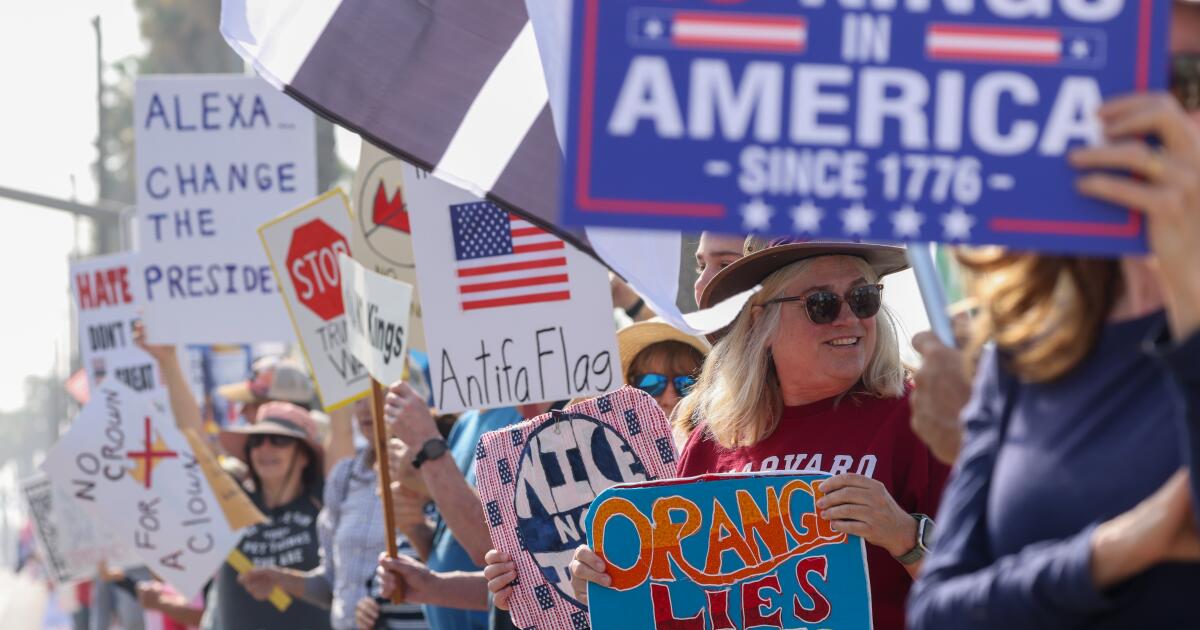
A rolling wave of “No Kings” protests swelled through America’s small towns and big cities Saturday, with crowds gathering to blast President Trump, Immigration and Customs Enforcement crackdowns, the war in Iran and high gas and food prices.
Saturday’s demonstrations were expected to draw millions of people nationwide, including thousands for a downtown Los Angeles rally. More than 40 protests were planned for L.A., Orange and Ventura counties, part of the national “No Kings Day of Nonviolent Action.”
No Kings Coalition organizers were hoping that turnout for the rallies in all 50 states could combine to form the largest single-day protest in U.S. history. They pointed to growing anger over the country’s direction, including fatal ICE shootings and troops dispatched to the Middle East, since the first “No Kings” demonstration was held last June.
On Saturday morning, hundreds gathered around the reflecting pool at Pasadena City College. A band rolled through with a fascism-themed parody of Johnny Cash’s “Folsom Prison Blues.” Sign-toting protesters lined Colorado Boulevard, drawing a constant stream of honking from the cars driving by. For many, the Iran war was top of mind.
“Every time we protest, there’s something completely new, which speaks to the chaos of the Trump administration,” Cindy Campbell told The Times. “ICE raids last year, Epstein files a few months ago. Now, war.”
“This administration doesn’t serve us. It serves billionaires,” said Kent Miller, of Monrovia, who participated in the Pasadena protest. “War with Iran is only making life harder for working people.”
Miller pointed to a Chevron gas station advertising gas for $6.45 per gallon.
“See?” he said.
National coordinators said there has been increased interest in smaller communities, including Republican bastions, with higher-than-expected attendance during Saturday’s protests.
“I’m out here because I’m disgusted with what I’m seeing,” said Kersty Kinsey, a mother who was protesting near the Beaufort, S.C., City Hall. “People are suffering, and he’s playing golf. People are suffering, and he’s going other places and blowing things up.”
In Beaufort, an antebellum city founded in 1711, an estimated 3,000 people turned out — a marked increase over earlier “No Kings” rallies, said Barb Nash, one of the coordinators. Amid the moss-draped live oaks and blooming pink and white azaleas, a person in a purple Barney dinosaur costume held a sign reading: “Dino’s for Democracy.” A young girl handed out homemade “Resistance Cookies.”
Los Angeles coordinators said they expect more than 100,000 people at the local events, which were being planned for Beverly Hills, Burbank, West Covina, West Hollywood and Thousand Oaks. One group planned a “Road Outrage” car caravan to motor through Mid City with flapping flags calling for “No War,” and “ICE Out of LA.” At a Torrance gathering, cars honked, protesters waved flags, and a person in an inflatable green cow costume hoisted a large American flag.
The White House, in a Saturday statement, dismissed the protests as a “Trump Derangement Therapy Session.”
Organizers said they have been particularly encouraged by the surge of interest from groups in rural communities that wanted to join the loose-knit No Kings Coalition and hold protests.
Jaynie Parrish, founder of the Arizona Native Vote project, started planning a protest for her tiny town of Kayenta, on the Navajo Nation in northern Arizona, only earlier this week.
“My dad, who’s a [military] veteran and an elder, said: ‘We should go,’ and I said, ‘OK,’” Parrish told The Times.
“Our folks don’t always protest for things, but this was very important,” Parrish said. “A lot of our families are feeling the impacts right now of higher prices and things being cut. A lot of our healthcare benefits are being cut … and our tribal sovereignty is being threatened.”
Upbeat Midwestern activists withstood whipping winds to form a line of protesters stretching nearly three blocks of Burlington Avenue in Hastings, Neb. Under the crisp blue skies, one of the protesters, Drew Fausett, told The Times in a phone interview that he is a registered Republican in the decidedly red state.
“My politics haven’t really changed — but the party around me has,” Fausett said. “It used to be the two parties were two sides of the same coin, and they would work together — but not anymore.”
He and his wife, Becky, have attended “No Kings” and other protests because “it’s the only way to show that people have different opinions,” he said. “People are out here speaking for their families and their neighbors. That’s what this is all about.”
Trump’s policies are hurting many in Nebraska — including farmers, said Debby Thompson, one of the Hastings organizers.
“We want to urge our representatives in Congress to not just rubber stamp whatever Trump wants because it’s really hurting rural folks and farmers,” Thompson said. “The tariffs and huge increase in prices on fertilizer are hitting farmers really hard.”
The “No Kings” campaign sprouted in June as an act of defiance on Trump’s 79th birthday. He wanted a military parade in Washington to mark his milestone, and anti-Trump protesters came out in force — an estimated 5 million people around the country — with their own display. At the time, Trump’s second-term policies were coming into focus, including ramping up immigration raids, deploying the National Guard to L.A. in response to protests, and mass firings within the federal government.
A subsequent event in mid-October drew even larger crowds, with an estimated 7 million people protesting around the country.
Saturday’s event coincided with a dip in Trump’s approval ratings. A Reuters/Ipsos poll last week found 36% approve of Trump’s job performance, marking the lowest level since his return to office last year. In a separate Fox News Poll released last week, 59% disapproved of his job performance.
“Since the last ‘No Kings,’ we’re seeing higher gas prices and groceries, all while there’s an illegal war in Iran,” national organizer Sarah Parker of the organization 50501 said during a Thursday press briefing. “We’ve also seen our neighbors executed — American citizens executed.”
Widespread protests and candlelight vigils followed January’s fatal shootings by ICE agents in Minneapolis of Renee Good, a 37-year-old mother of three, and Alex Pretti, a 37-year-old intensive care unit nurse.
“The defining story of this Saturday’s mobilization is not just how many people are protesting — but where they are protesting,” Leah Greenberg, co-founder of Indivisible, said during the press briefing. She said two-thirds of the RSVPs to national organizers came from outside of major urban centers.
The Los Angeles event was organized by the local chapter of 50501 (short for “50 protests, 50 states, 1 movement”) and other progressive groups, including the ACLU, Human Rights Campaign, Indivisible and Public Citizen, as well as labor unions such as Unite Here Local 11 and the Service Workers International Union.
“There’s an affordability crisis in this country — people can’t afford groceries or healthcare,” Joseph Bryant, SEIU executive vice president, said in a statement. “But this administration is focused on expanding its power, starting unnecessary wars that benefit billionaires, and targeting immigrants and citizens who dare to stand up for them.”

How Mississippi State’s Tomas Valincius dominated third straight SEC team vs Ole Miss

Thousands show up to protest current administration at ‘No Kings’ rally in Kansas City, Missouri

Protestors back at Montana Capitol, other ‘No King’ rallies double

No Kings protests return to Nebraska, draw hundreds and thousands

Indivisible Las Vegas to host No Kings rally, march at federal courthouse downtown

Florida High School Football Rankings: Top 25 teams – Oct. 21

How old is Bo Nix? What to know about Oregon quarterback ahead of 2024 NFL Draft

Cleary's 21 help Le Moyne down Central Connecticut State 69-64 in OT

99th annual Pony Swim held in Virginia

Indiana Members Credit Union announced as new anchor tenant at Bottleworks District

Jeffries declines to break with indicted Democrat after ethics panel’s guilty verdict

Hundreds of thousands march through London in stand against the far right

2 students killed, 7 other people injured in Tennessee bus crash during school field trip

Dem senators dodge crucial question on illegal alien accused of killing Chicago college student

EU Parliament unblocks key political hurdle in digital euro talks
-

 Detroit, MI1 week ago
Drummer Brian Pastoria, longtime Detroit music advocate, dies at 68
-

 Movie Reviews1 week ago
‘Youth’ Twitter review: Ken Karunaas impresses audiences; Suraj Venjaramoodu adds charm; music wins praise | – The Times of India
-

 Sports1 week ago
IOC addresses execution of 19-year-old Iranian wrestler Saleh Mohammadi
-

 New Mexico6 days ago
Clovis shooting leaves one dead, four injured
-
 Business1 week ago
Disney’s new CEO says his focus is on storytelling and creativity
-

 Tennessee5 days ago
Tennessee Police Investigating Alleged Assault Involving ‘Reacher’ Star Alan Ritchson
-

 Technology6 days ago
YouTube job scam text: How to spot it fast
-

 Texas1 week ago
How to buy Houston vs. Texas A&M 2026 March Madness tickets