Politics
Israel's religious right has a clear plan for Gaza: 'We are occupying, deporting and settling'

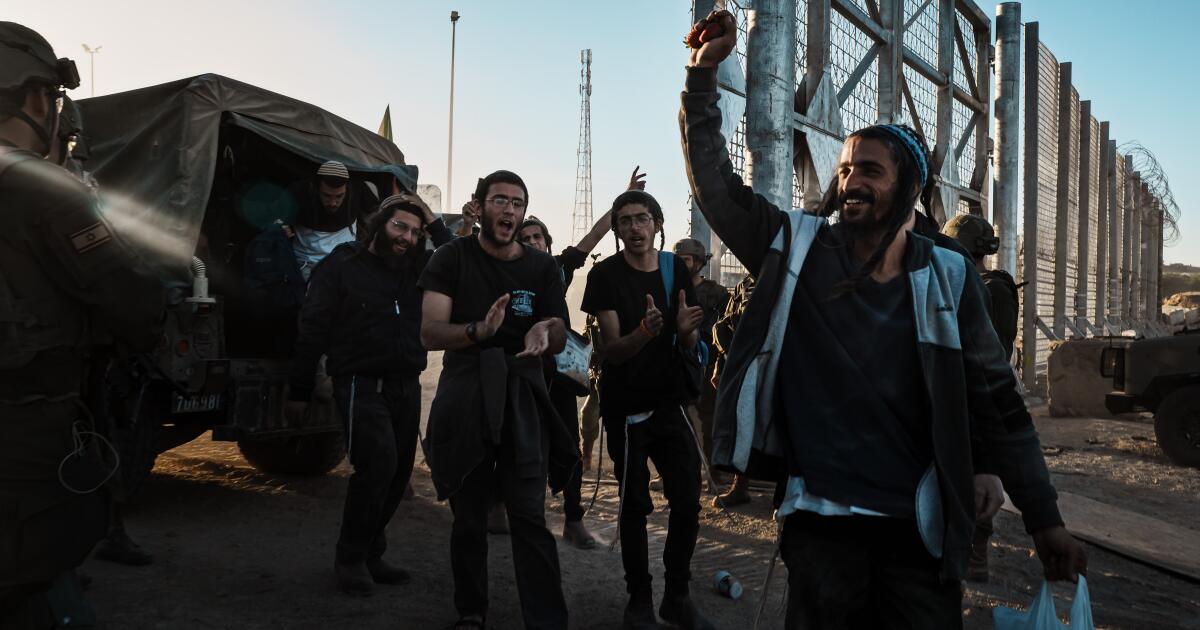
Carrying planks of plywood, a group of Israeli settlers pushed past soldiers guarding the barrier surrounding the Gaza Strip and quickly got to work. Within minutes, the young men had erected two small buildings — outposts, they said, of a future Jewish settlement in the war-torn Palestinian enclave.
Their movement had hungered for this moment for years, but now, after Oct. 7, they felt it was just a matter of time before Jews would be living in Gaza again. “It is ours,” said David Remer, 18. “[God] said it is ours.”
1
2
3
1. Protesters march to a border checkpoint in Kerem Shalom, Israel, hoping to block aid shipments into war-torn Gaza. 2. Israeli troops stand by at Erez Crossing as activists try to enter the military buffer zone into Gaza. 3. Israeli troops remove a protester from a sit-in intended to block shipments of aid into the Gaza Strip.
Religious Zionists, who believe the Jewish people have divine authority to rule from the Jordan River to the Mediterranean Sea, make up only around 14% of Israel’s population. But in recent years they have greatly expanded their influence in the military, the government and society at large, and their often extremist ideology is helping shape Israel’s war against Hamas.
Although they are not politically homogeneous, most religious Zionists embrace far-right views. They loudly oppose a cease-fire deal to bring home Israeli hostages, and have repeatedly blocked humanitarian assistance from entering Gaza by standing in front of aid trucks.
They see the deadly Oct. 7 Hamas-led attack on Israel as proof of their longtime assertion that peace cannot be made with the Palestinians, and view Gaza as a territory that they have a religious obligation to conquer. Increasingly, they have called for the expulsion of the 2.3 million Palestinians living there.
Jewish settler activists hastily erect outposts inside the Israeli military’s buffer zone for the Gaza Strip at the Erez crossing.
First, they dream of reestablishing Gush Katif, a bloc of Jewish settlements that existed in Gaza until Israel withdrew from the enclave in 2005.
It’s a goal embraced by some of the top leaders in Israel’s far-right government, many of whom appeared at a recent Jerusalem rally pushing for Gaza’s resettlement. While videos played showing Israel’s brutal military assault on the enclave and organizers shared brochures promising new houses with views of the Mediterranean Sea, National Security Minister Itamar Ben-Gvir sang religious songs alongside participants and told them: “Now is the time to return home.”
On the battlefield, some religious soldiers have recorded themselves dancing with Torah scrolls and waving the orange flags of Gush Katif. Other combatants travel with mezuzahs, small boxes containing biblical Scriptures meant to be hung outside Jewish residences, to affix to Palestinian homes.
Reuven Gal, former chief psychologist for the military and a researcher at the Israel Institute of Technology, says that for many soldiers, the Gaza conflict that has killed more than 30,000 Palestinians is “not just a military operation.”
“For them,” he said, “it’s a holy war.”
Top, Settler Avraham Sheinman, overlooking Nablus in the West Bank from Mt. Gerizim, points out passages in his Torah that he says show Jews have a religious obligation to conquer Palestinian territories. Bottom, Yishai Sheinman, left, and father Avraham Sheinman uncover the Torah in a synagogue in Yitzhar, West Bank. Yishai, 27, belongs to a violent extremist group devoted to expanding Israeli control of the region.
Yair Margolis, an army reservist who was called up from his yeshiva studies last year to fight in Gaza, said during a recent break from battle that the war had a clear spiritual dimension.
“Going back to that land is returning home,” he said. “This is where we are from, and this is what we are fighting for.”
It’s a vision starkly at odds with Israel’s mainstream, even as the country’s political center has shifted discernibly to the right in recent years. A January poll by Israel’s Channel 12 broadcaster found that 51% of Israelis oppose building Jewish settlements in Gaza, compared with 38% who support doing so.
1
2
1. Israel’s national security chief and leader of the far-right Jewish Power Party, Itamar Ben-Gvir, center, called at a recent convention for rebuilding Jewish settlements in Gaza and expanding those in the occupied West Bank. 2. The crowd celebrates at the Jerusalem convention, organized by far-right activists seeking expansion onto more Palestinian land.
Prime Minister Benjamin Netanyahu, a right-wing populist, has called settling Gaza “unrealistic.” But in 2022, as his ongoing corruption trials left him isolated, Netanyahu made a deal with several religious Zionist parties to form a coalition government, and his political future is now closely tied to theirs.
Beyond a pledge to maintain indefinite military control over Gaza and eventually turn over administrative duties to Palestinians, Netanyahu’s postwar strategy remains murky, leaving a vacuum, political analysts say, that the religious right is eager to fill.
Israeli forces arrive at the Erez border crossing next to the northern Gaza Strip.
In a recent video from Gaza circulated on social media, an Israeli soldier dressed in camouflage stands smiling with a machine gun in front of a bombed-out building. He directly addresses Netanyahu, who is widely known by his nickname “Bibi.”
“We are occupying, deporting and settling,” the soldier says. “Do you hear that, Bibi?”
::
During the war in 1967, Israel captured a wide swath of Palestinian land that included the West Bank, East Jerusalem and the Gaza Strip.
Almost immediately, Jewish settlers began establishing communities in each of them, displacing Palestinians who lived there.
Tuvia Levy, far right, and Marom Harel, center, look over Palestinian towns from a security outpost in Yitzhar, West Bank. Both men live in West Bank settlements and were called up for reserve duty after Oct. 7.
While the settler movement isn’t composed just of religious people, and over the years it has received backing from both right- and left-wing Israeli governments, it is ideologically driven by practitioners of Orthodox Judaism who believe God gave what they call the Land of Israel exclusively to the Jews.
Unlike the ultra-Orthodox, some of whom oppose the Zionist project and decline to serve in the military, religious Zionists embrace the teachings of rabbis who say believers have a spiritual imperative to expand Israel’s borders.
By 2005, around 8,000 mostly religious Zionists were living in Gaza, often in neighborhoods that resembled Southern California subdivisions, with their orderly rows of red-tile-roofed homes. The settlements were heavily guarded by the military, and residents frequently clashed with their Palestinian neighbors.
Amid growing concerns about high casualties among the troops tasked with protecting the settlements, Prime Minister Ariel Sharon ordered a complete Israeli withdrawal from the enclave. Sharon, who was a supporter of settlers in the West Bank, now instructed soldiers to forcibly remove them from Gaza.
The “disengagement” from Gaza, with its scenes of screaming settlers being pulled from their homes and synagogues, was transformative for religious Zionists. Many vowed to gain more influence in the traditionally secular institutions they felt had betrayed them.
“For them it was a traumatic event,” said Yagil Levy, a professor of political sociology at the Open University of Israel. “They want to erase this trauma by any means.”
Palestinians take in the rubble left by an Israeli airstrike on residential buildings and a mosque in Rafah, Gaza Strip.
(Fatima Shbair / Associated Press)
That meant building a political movement that has sought “to push the government as far right as it can go” and “completely demolish any talk of a Palestinian state,” said political scientist Dahlia Scheindlin. Over time, she said, ideas that once seemed extreme — like expanding settlements in the West Bank — became normalized.
Helping their cause were the country’s changing demographics: Religious Zionists, like the ultra-Orthodox, were having children at a much higher rate than their secular peers.
At the same time, they were making new inroads in the army.
The military academy that has become the West Point for the religious right is built atop a wind-swept hill in the West Bank settlement of Eli. Here, young men wearing yarmulkes spend their days studying both the Torah and military strategy.
For many years, religious Zionist families were hesitant for their sons to fulfill Israel’s mandatory three-year army service, worried that exposure to secular peers would erode their faith. This school, Bnei David, promised to minimize that risk, offering teenage boys a chance to fortify their religious beliefs before entering the military. Its website boasts of starting a “quiet revolution in the Israel Defense Forces.”
Students are taught that God “wants a people of Israel, and there is no state of Israel if there isn’t a strong army,” said Rabbi Eli Sadan, the school’s founder. They’re also taught by instructors who oppose the presence of women in the military and who have described gay people as “sick and perverted.”
Speaking from behind a large desk strewn with rabbinical texts, Sadan said he supports a scorched-earth military strategy in Gaza, “so Israel’s enemies will see the ruins and think: ‘I don’t want to mess with the Jews.’”
He is against the rebuilding of Palestinian society in Gaza, where at least half of all buildings have been damaged or destroyed during Israel’s fierce bombing campaign. “We must eliminate the possibility of Gazans returning,” he said, arguing that displaced civilians should be forced to live in tents for many years until they decide “to emigrate willingly.”
Top, Rabbi Eli Sadan, the founder of the Bnei David military academy, said he supports a scorched-earth strategy in Gaza. Bottom, Students attend a class in a room at Bnei David that honors alumni who died serving in the Israeli military. The school has lost 18 former students in the Gaza war.
Sadan said his school, which recently hosted events with both Netanyahu and Israel’s defense minister, has produced 3,000 soldiers, more than 50% of whom have risen to the rank of officer or higher. Since the conflict broke out, 18 alumni have died in Gaza.
The rise of religious military academies like this one has dramatically changed the makeup of the army, said Levy, the sociologist. Religious Zionists made up about 3% of officer school graduates in 1990, Levy’s research shows; in 2018, they accounted for over a third.
Levy, who has written about what he calls the “theocratization of the Israeli military,” said the trend has caused conflicts, with some religious soldiers refusing to serve alongside women.
A student does push-ups at the religious and military academy for religious Zionists.
A pressing question, he said, is whether religious soldiers would comply with orders to forcibly remove Jewish residents from a settlement — a scenario that could play out under the creation of a Palestinian state.
Sadan said he teaches his students to always heed commands from military superiors. But during the 2005 disengagement from Gaza, other rabbis called on soldiers to refuse orders, and some did.
“What we see is growing resistance in the ranks,” Levy said. “They’re trying to challenge the formal codes of the military.”
::
Those hoping to establish Jewish settlements in Gaza say they will model their strategy on the West Bank, where today 500,000 settlers live among 3 million Palestinians.
Since Oct. 7, tensions here have been simmering as the line between settlers and soldiers has become increasingly blurred.
Reservist Yosef Shalom Sheinman, 30, was called up after Oct. 7 to help protect Jewish settlements in the West Bank, where he lives.
After the Hamas attack in southern Israel killed around 1,200 people, hundreds of thousands of Israeli reservists were called up for duty. Many reservists in the West Bank were instructed to don uniforms and guard their own communities.
Among them were Yosef Shalom Sheinman, 30, who is from Har Bracha, a mountain settlement overlooking the Palestinian city of Nablus.
Sheinman’s parents helped found Har Bracha in 1987 amid protests from Jewish leftists and the Palestinians who once grazed sheep here. His younger brother, 27-year-old Yishai, belongs to a famously violent extremist group known as the Hilltop Youth, which is devoted to expanding Israeli control of the region. “These are kids who would eat Arabs for breakfast,” their father says proudly.
For decades, Israeli soldiers have been deployed throughout the West Bank to protect existing settlements, which most of the world considers illegal under international law. But the soldiers are also often instructed to stop the building of illegal settlement outposts. In the past, they sometimes clashed with Yishai Sheinman, tearing down new outposts he and his friends had erected.
Like many religious Zionists, Yishai Sheinman, his wife, Rashid, and their children live in a settlement on Palestinian territory despite the disapproval of Washington and international law.
Now many of the soldiers in the region are his friends — or, in the case of his older brother, his family.
The reservists are not curtailing settlement expansion, the older brother said. Instead, they’re focused on patrolling nearby Palestinian villages — and making sure they aren’t growing. His unit recently cut a new road through a stretch of hillside between a Palestinian hamlet and Har Bracha, in effect claiming the area for the settlement.
“This is our land,” he said. “And God is with us.”
On a recent afternoon, Sheinman stood with his father, Avraham, taking in views sweeping from the peaks of Jordan to the skyscrapers of Tel Aviv. Avraham Sheinman clutched a well-worn Torah, which he consulted frequently to highlight passages that he says show Jews have a religious obligation to be here. “We have a commandment to conquer it,” he said.
He spoke of a war with Palestinians, but also of “an inner war” within Israel.
“Who are we? What direction are we going?” he asked. “Are we going in the direction of our destiny as a chosen people in the Land of Israel — as a Jewish state according to Jewish law? Or are we a secular leftist copy of Europe or America?”
Israeli troops try to to stop one of many far-right activists from entering the Erez Crossing military buffer zone into Gaza.
Many on the other side of the political divide view that question with the same urgency.
In an interview with Sky News this month, writer and historian Yuval Noah Harari said the biggest threat to Israel is not Hamas, Hezbollah or Iran, but Jewish extremism: “There is really a battle for the soul of the Israeli nation between patriotism on the one side and ideals of Jewish supremacy on the other.”
It is too early to say exactly how the Hamas attack and the Gaza war will shape that debate. But early indications suggest they have awakened new support for the right.
Protests near the Egyptian border to halt aid delivery into Gaza were first organized by religious Zionists, but now draw secular participants. And while much of the international community holds out hope that the West Bank, East Jerusalem and Gaza will one day be recognized as a Palestinian country, faith among Israelis in a two-state solution has dimmed.
A Tel Aviv University poll found that support for peace negotiations among Israeli Jews had fallen from 48% just before the Hamas attacks to 25% a few weeks after.
Supporters of Jewish settlements talk with Israeli troops in an effort to enter war-ravaged Gaza.
Leaders of the religious right, meanwhile, are using the war as an opportunity to push through extreme policies.
Ben-Gvir, the national security chief, leads the Jewish Power party and has helped arm thousands of Israeli civilians by relaxing restrictions on gun ownership. Finance Minister Bezalel Smotrich, head of the Religious Zionist Party, recently announced plans to expand settlements in the West Bank by more than 3,000 homes. Both Smotrich and Ben-Gvir, who has been convicted of inciting racism and supporting terrorism, live in the West Bank.
Life for Palestinians there has gotten markedly worse since Oct. 7, with more than 600 settler attacks against Palestinians recorded since the war broke out, according to the United Nations, and more than 1,200 Palestinians displaced from their homes.
Palestinian activist Issa Amro lives in the historic center of Hebron, the largest city in the West Bank, in the midst of a heavily guarded Jewish settlement.
On the day of the Hamas attack, he was returning from work when several neighbors surprised him in an olive grove and began assaulting him. Some, he said, wore army uniforms probably left over from their military service.
Palestinian Issa Amro says he has lived in fear since he was assaulted by settlers, then detained and beaten at a military base. He’s surrounded in Hebron, West Bank, by a heavily guarded settlement.
Amro was then taken to a military base, where he says he was detained for 10 hours and beaten.
He said he lives in fear. Every day he passes former Palestinian businesses shuttered by settlers, as well as a sign that says: “We’re occupying Gaza now.”
“Every meter I walk, I think I may be shot,” he said.
Amro said he doesn’t blame the settlers so much as the political leaders who have allowed the settlements to flourish. He pointed to Netanyahu, who allied with Ben-Gvir and Smotrich, and to Donald Trump, who as president abandoned Washington’s long-held position that West Bank settlements violate international law. “Netanyahu made them mainstream,” Amro said. “The Trump administration made them mainstream.”
An Israeli soldier orders Palestinian children in the West Bank city of Hebron to go back inside, barring them from playing on the street.
President Biden has since reversed the U.S. stance on West Bank settlements — and recently imposed sanctions on four Israeli settlers for carrying out violence against Palestinians. And Secretary of State Antony J. Blinken says Washington opposes the reoccupation of the Gaza Strip by Israel and any reduction of the Palestinian territory’s size.
Joel Carmel, a former Israeli soldier who is now a peace activist, said the future of Jewish settlements in Gaza may depend on who wins the U.S. election in November.
“Probably the only thing holding back the resettlement of Gaza is the Biden administration,” he said. “And who knows how long that’s going to last.”
Many Palestinians in the West Bank think it’s only matter of time before Israeli settlers move permanently into Gaza.
Areej Al Jaabari, who lives in Hebron, West Bank, points toward the settlement where Israel’s national security minister lives.
Areej Al Jaabari, a mother in Hebron, has watched as settlements have crept ever closer to her family home. Ben-Gvir lives in a sprawling suburban community she can see from her living room window.
“They’re gradually accomplishing their goals,” she said of the settlers. “Eventually they will control everything in Gaza too.”
Linthicum reported from Jerusalem and from Yitzhar, Har Bracha and Hebron in the West Bank. Times staff photojournalist Marcus Yam contributed to this report from Erez Crossing, Israel.


James Gagliano on anti-ICE protests and threats against agents
Retired FBI Special Agent James Gagliano discusses anti-ICE protests and threats against agents in Newark, New Jersey. A new curfew has curbed chaos after violent clashes, with one Brooklyn man arrested for threatening to kill an ICE agent. DHS Secretary Markwayne Mullin vows ‘zero tolerance’ for attacks, while Sen. Cory Booker, D- N.J., calls ICE ‘out-of-control.’ Gagliano warns against allowing these protests to continue.
NEWYou can now listen to Fox News articles!
A Canadian national accused of slapping a teen wearing political clothing at the Jersey Shore has been turned over to Immigration and Customs Enforcement, a representative for the local jail told Fox News Digital on Wednesday.
Over the Fourth of July weekend, Kaitlyn Tracey, 33, was reportedly seen on surveillance video confronting a group of teens in Point Pleasant Beach, some of whom were wearing pants with the words “Trump” and “ICE” on them, local media reported.
Tracey, a Canadian national who entered the U.S. on a passport in 2024, then allegedly struck one of the girls and recorded the confrontation, according to court documents reported by NJ.com.
An official who picked up the phone at the Ocean County Jail in Toms River confirmed to Fox News Digital that Tracey had been released into ICE custody as of Monday.
ICE CLASHES WITH AGITATORS INTENSIFY OUTSIDE DELANEY HALL
She was reportedly taken to Delaney Hall in Newark – the site of months-long clashes between left-wing agitators and ICE.
NEW JERSEY GOVERNOR, DEMOCRATIC SENATOR SPEND MEMORIAL DAY PROTESTING ICE FACILITY
Billboard at Trump rally in Wildwood declaring historical blue New Jersey is “Trump Country.” (The Image Direct for Fox News Digital)
Tracey’s criminal charges include endangering the welfare of a child and simple assault, according to reports.
The alleged victim was reportedly uninjured.
NJ TAXPAYERS ON THE HOOK FOR $12M MORE AS DEM GOVERNOR PROTECTS ILLEGAL ALIENS BATTLING DEPORTATION
CLICK HERE TO DOWNLOAD THE FOX NEWS APP
While New Jersey at a state level has adopted sanctuary-type policies, Ocean County is known as one of the few Republican strongholds remaining, and retains the state’s longest-serving lawmaker of any party: Rep. Chris Smith, R-N.J., in office since 1981.
People enjoy the Jersey Shore in Seaside Heights, N.J., as businesses prepare for the holiday weekend on May 23, 2025. (Asbury Park Press via IMAGN)
SIGN UP TO GET THE POLITICS NEWSLETTER
It was not immediately clear on what immigration basis ICE initiated proceedings against Tracey. Fox News Digital reached out to DHS for clarification and comment.
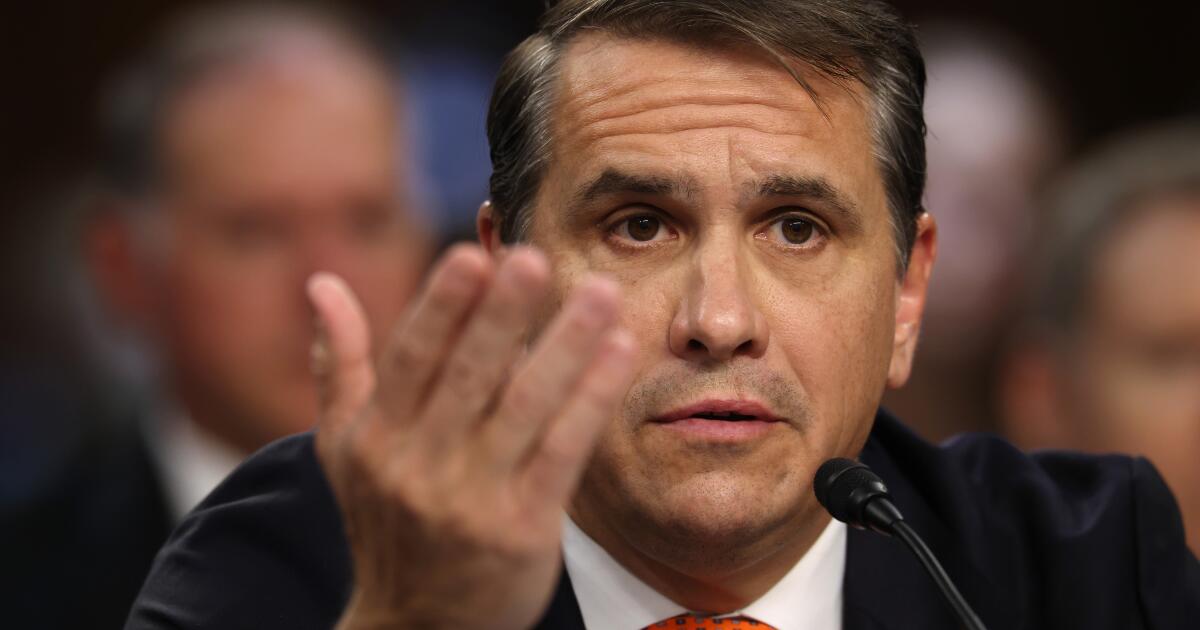
WASHINGTON — The Senate confirmation hearing Wednesday for Todd Blanche, President Trump’s pick for attorney general, will be a referendum on far more than his individual merits.
Blanche, the acting attorney general, served as Trump’s defense attorney before taking office and has been closely linked to many of the most consequential — and controversial — issues that have dominated the first two years of Trump’s second term.
Blanche is set to appear before the Senate Judiciary Committee, which will decide whether to approve his nomination and send it to the full Senate for a confirmation vote. The committee hearing will continue Thursday.
“I would expect committee Democrats to treat Mr. Blanche’s hearing as an opportunity to conduct oversight of the Department of Justice,” said Phil Brest, president of the American Constitution Society, a progressive legal nonprofit and a former top Democratic staffer on the committee. “It’s a test of the Senate’s willingness to probe the department’s operations and to actually serve as a check on the department and the administration more broadly.”
Democrats on the committee are expected to push Blanche on a host of topics, including the $1.8-billion “anti-weaponization fund” that critics derided as a slush fund for the president’s allies, the Justice Department’s rollout of the so-called Epstein files, and the department’s prosecution of several perceived enemies of Trump, notably former FBI Director James Comey.
“While deploying the Justice Department as a shield for the president and his cronies, Blanche has also used our top law-enforcement agency as a sword against Trump’s political opponents,” said Sen. Dick Durbin (D-Ill.), the ranking Democrat on the committee last month. “The independence of DOJ has been decimated under Blanche’s authority.”
Blanche was confirmed by the Senate as deputy attorney general in March, 2025, and was elevated to his current role after Atty. Gen. Pam Bondi was fired in April.
More critical to the success of Blanche’s nomination will be whether he can win the support of two lame-duck Republican senators, Thom Tillis of North Carolina and John Cornyn of Texas, who expressed some reservations about Blanche soon after his nomination was announced.
Cornyn raised concern about Blanche’s independence from Trump, while Tillis said Blanche’s stance on protesters who violently stormed the U.S. Capitol on Jan. 6, 2021, would be critical to his consideration.
Some of those Jan. 6 protesters were expected to be the beneficiaries of the $1.8-billion fund announced as part of a settlement to a lawsuit Trump and his sons and business brought against the IRS.
In a scathing ruling this week, the federal judge wrote that the lawsuit was improper and recommended sanctions against two Justice Department attorneys who worked on the case, though not Blanche himself.
Cornyn told Semafor on Tuesday that the ruling raised a number of issues, including “the potentially collusive nature of the lawsuit.”
He has said previously that he will hold off on making a decision about whether to approve Blanche until after the hearing.
Tillis, meanwhile, told CNN’s Manu Raju on Tuesday that the weaponization fund would need to be completely off the table for him to support Blanche’s nomination.
Trump touted Blanche’s record ahead of the hearing.
“Todd Blanche is doing a PHENOMENAL job as Acting Attorney General of the United States,” the president wrote on Truth Social. “He is a great lawyer, always very fair, and every Republican Senator should vote to CONFIRM Todd Blanche, ASAP!”
Sen. Lindsey Graham’s death means that Republicans currently only enjoy a one-seat majority, but a replacement for Graham on the committee could be in place before it votes on whether to move his nomination to the Senate floor, which will likely come two weeks after the hearing.
Blanche, 51, spent 12 years working for the U.S. attorney’s office for the Southern District of New York, working largely on drug and violent crime cases, and rose to the level of co-chief of the district’s White Plains division.
He left the office in 2014 for private practice and joined the prominent law firm Cadwalader, Wickersham & Taft in 2017 as a partner. He left the firm in 2023 and went independent after other partners expressed concern when he took Trump on as a client.
Blanche went on to represent Trump in several criminal matters, including the New York case about hush money payments to porn star Stormy Daniels, and cases brought by Special Counsel Jack Smith about Trump’s alleged efforts to block the transfer of power after the 2020 presidential election and his alleged retention of classified documents.
He listed all three as among the 10 most significant cases of his career in the questionnaire he completed ahead of the hearing, along with his work at the Justice Department on a lawsuit challenging the construction of a new White House ballroom.
A group of more than 1,200 former Justice Department attorneys wrote a letter opposing Blanche’s nomination, asserting that his leadership has resulted in mass departures of career staff. That has “meant that much of the department’s vital work isn’t being done, or isn’t being done as well – leaving communities less safe, Americans’ rights less protected, and our national security more vulnerable,” the lawyers wrote.
Former Justice Department pardon attorney Liz Oyer is scheduled to testify as a witness for Democrats on Thursday. She has said she was fired for refusing to recommend the restoration of actor Mel Gibson’s gun rights.
Oyer will be joined Thursday by Dani Bensky, one of many victims of the deceased sex abuser Jeffrey Epstein who has criticized Blanche’s handling of the release of the so-called Epstein files — millions of pages of records detailing the Justice Department’s investigations into Epstein’s crimes.
Numerous victims have said that their names and other sensitive information were not properly redacted in the files and criticized Blanche and the department for failing to investigate Epstein’s potential co-conspirators.
Blanche has also come under criticism from survivors of Epstein’s abuse for the interview he conducted in July, 2025, with Epstein accomplice Ghislaine Maxwell, who is serving a 20-year prison sentence for her role in facilitating and participating in Epstein’s abuse.
Days after their interview, Maxwell was moved from her prison in Florida to a minimum-security prison in Texas.
Politics
Biden special counsel’s ‘runaway train’ scooped up sensitive lawmaker info: ‘Abuse of power’

NEWYou can now listen to Fox News articles!
Former special counsel Jack Smith’s investigation into President Donald Trump swept up text messages from nearly 50 members of Congress, bypassing a required review process in what one victim alleged is a direct constitutional violation.
Senate Judiciary Committee Chairman Charles Grassley, R-Iowa, said the situation is more proof Smith’s probe was a “runaway train” of abuses of power, and the elder statesman and Senate Investigations Subcommittee Chairman Ron Johnson, R-Wis., jointly released their filings Tuesday evening.
Grassley and Johnson’s findings were from a full-scale probe of Operation Arctic Frost, the code name for Smith’s endeavor to investigate Trump for alleged corruption and election malfeasance, an operation top Senate Republicans call “worse than Watergate.”
LEGAL WAR ON TRUMP’S AGENDA GAINS FIREPOWER AS FEDERAL LAWYERS DEFECT TO DEMOCRATS
Jack Smith, former U.S. special counsel, arrives for a closed-door deposition before the House Judiciary Committee in Washington, D.C., Dec. 17, 2025. (Getty Images)
Forty-four members of Congress had the contents of their text messages obtained and reviewed by Smith’s team in a way that bypassed protocol. A “filter team” was tasked with reviewing millions of documents in the case and should have had first crack at determining whether such messages were relevant or potentially violated statute or ethics.
Rep. Elise Stefanik, R-N.Y., one of the lawmakers whose texts were swept up in this way, said Tuesday such reviews amounted to clear violations of the Constitution’s speech and debate clause that protects lawmakers from being questioned in “any other place” than the Capitol for legislative acts.
Internal communications have been historically included in that clause in the courts as technology has advanced.
SUPREME COURT JUSTICES HEAD TO CAPITOL HILL FOR FIRST CONGRESSIONAL APPEARANCE SINCE 2019
Stefanik said in a statement that the new records prove Smith’s team “unlawfully and unconstitutionally accessed my private text messages, along with 43 other Members of Congress, in clear violation of the Constitution.”
She said she long suspected there had been “unconstitutional spy[ing] on members of Congress.”
The records were provided by the Trump Justice Department to Grassley and Johnson, which the chairmen said indicated Smith’s team had “circumvented its own filter review process.” The process is additionally meant to protect attorney-client privilege, they said in a statement.
OBAMA-APPOINTED JUDGE TORCHES TRUMP ADMIN IN LATEST COURTROOM SHOWDOWN, REFERS ATTORNEY FOR BAR REVIEW
Former special counsel Jack Smith says the Pledge of Allegiance before he prepares to testify during a hearing before the House Judiciary Committee in the Rayburn House Office Building on Capitol Hill Jan. 22, 2026, in Washington, D.C. (Al Drago/Getty Images)
The news also complicated some of Smith’s prior depositions under oath, including an excerpt in which he answered “no” to a question from a congressional counsel whether records he requested from congresspeople included text messages.
Johnson called the situation a “grotesque example” of Biden-era “weaponization” of the executive branch.
“Jack Smith’s criminal investigation of President Trump was a runaway train that had no brakes,” Grassley added Tuesday.
“Based on the information that’s been produced to me and Senator Johnson, Biden DOJ and FBI investigators apparently ignored their own routine investigative protocols to obtain and review work-related messages from me and dozens of my Republican and Democrat colleagues who were outside the scope of the government’s investigation.”
Grassley added that he hopes Democrats caught up in the otherwise bipartisan text tranche will finally discard their partisanship and recognize the severity of the alleged violations by Smith.
He also indicated he planned to recall Smith before Congress to “hold him accountable.”
Of the 44 members swept up in the text reviews, several were Democrats, including Los Angeles Mayor Karen Bass, Rep. Josh Gottheimer, D-N.J., Sen. Cory Booker, D-N.J., and the top Democrat on the House Armed Services Committee, Rep. Adam Smith of Washington.
Grassley, Johnson and Stefanik were also swept up in the situation, along with top figures like senators Mike Lee, R-Utah; Josh Hawley, R-Mo.; Dan Sullivan, R-Alaska; Rand Paul, R-Ky., former Senate Republican Conference Chairman Lamar Alexander, R-Tenn.; and the late Lindsey Graham, R-S.C.
SIGN UP TO GET THE POLITICS NEWSLETTER
Former House Intelligence Chairman Devin Nunes, R-Calif., was one of the victims, along with current House Judiciary Committee Chairman Jim Jordan, R-Ohio, as well as House Freedom Caucus member Scott Perry of Pennsylvania, EPA Administrator Lee Zeldin of New York, Veterans Affairs Secretary Doug Collins of Georgi, and prominent Trump critic Rep. Thomas Massie of Kentucky.
CLICK HERE TO DOWNLOAD THE FOX NEWS APP
Several lawmakers sounded off on the news soon after Grassley announced his findings, including Hawley, who called for “everyone involved [to] be prosecuted.”
“Joe Biden’s DOJ not only tapped my phone; I just learned they illegally obtained my texts with members of President Trump’s administration,” the Missourian fumed.
Paul called the allegations a “blatant abuse of power and exactly what our Founders warned about,” while citing Smith’s past denial under oath.
Fox News Digital reached out to a representative for Smith for comment.
-

 Augusta, GA4 minutes ago
Augusta youth program feels state budget cut heading into new school year
-

 Washington, D.C10 minutes ago
National Guard continuing DC deployment through Inauguration ’29
-

 Cleveland, OH16 minutes ago
Cleveland Advances Housing Manufacturing Strategy with MMY US Selection and Historic Tax Credit Award for Wellman-Seaver-Morgan Building
-

 Austin, TX22 minutes ago
Austin Pets Alive! activates emergency response to assist shelters affected by flooding
-

 Alabama28 minutes ago
Governor Ivey Taps Glenda Allred as New Tourism Director, Announces Lee Sentell’s Retirement –
-

 Alaska34 minutes ago
Alaska university gets funding for critical minerals center
-
 Arizona40 minutes ago
WATCH: Officers crack down on drivers running red lights in Arizona
-

 Arkansas46 minutes ago
Rock City Margarita & Arkansas Beer Festivals: An Interview with Organizer Reed Llewellyn

