Politics
Hollywood showed up in force for Kamala Harris at DNC, even if Beyoncé and Taylor were absent

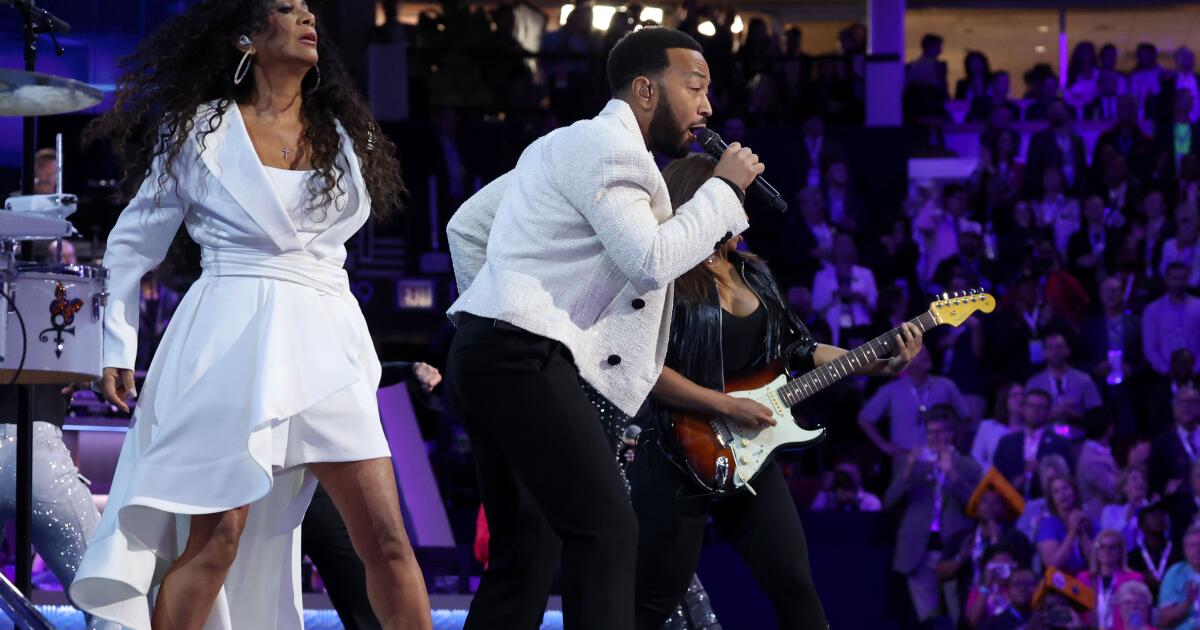
Anyone who tuned in to the Democratic National Convention on Thursday night expecting to watch Beyoncé make a surprise appearance onstage was likely disappointed to see former Secretary of Defense Leon Panetta standing there instead, not a rhinestone to be found on his staid blue suit.
For weeks, ever since Queen Bey gave Kamala Harris’ campaign permission to use her stirring anthem “Freedom” as its theme song, speculation had mounted that she would perform at the convention — and that maybe she would even team up with fellow pop supernova, Taylor Swift, to send a woman to the White House. On Thursday, the theories shifted into overdrive on social media, thanks largely to a single tweet from a random X user teasing a surprise appearance on the final night of the event.
If the unchecked, unfounded Bey-Tay rumors now feel like a moment of virtual mass hysteria, it’s also easy to understand why so many of us got carried away with the showbiz wish-casting. The star power across the four nights of the Democratic National Convention was so potent, the mood so buoyant, it made sense that two of the only figures whose fame and influence transcends an increasingly fractured cultural landscape, would be there, too.
Organizers of the event — which was hastily revamped in a matter of weeks after President Biden dropped out of the race — pulled off a feat that seems impossible in 2024: turning the convention into must-see TV.
“For a celebrity, an athlete, a musician, to lend their name, their influence to a candidate, they are risking a lot — starting with some amount of trolling in the comment section. It’s not without its sacrifices, so you have to really be motivated to do it on behalf of a candidate,” said Genevieve Roth, founder and president of Invisible Hand, a culture change and strategy agency, who also served as director of creative engagement on Hillary Clinton’s 2016 campaign. “Kamala Harris seems to have inspired a tremendous amount of devotion from this community,”
Lil Jon, right, with Sen. Raphael Warnock of Georgia. The rapper led the state’s roll call Tuesday.
(Paul Sancya / Associated Press)
The DNC was a big tent, culturally speaking, offering a little something for virtually every taste, except, perhaps fans of aging professional wrestlers. There were musical performances by Jason Isbell, Pink (and her adorable daughter, Willow Sage Hart), Patti LaBelle, Sheila E., Stevie Wonder and — who could forget? — Lil Jon, who helped turn the once-tedious state roll call into an exuberant dance party. Celebrity hosts anchored each evening’s lineup, with Mindy Kaling cracking jokes about the demise of Bennifer 2.0, and Kerry Washington staging a reunion with her “Scandal” co-star, Tony Goldwyn. Kenan Thompson, the longest-tenured “SNL” cast member in history, did a funny-but-scary bit about Project 2025.
Golden State Warrior Steph Curry offered his endorsement as did his coach, Steve Kerr. The first three nights of the convention drew in around 20 million viewers each, while Thursday night attracted 26 million — outpacing the Republican National Convention last month. Similar to the Oscars, some of the best moments came not from the big celebrities, but the normal people being themselves, like Gov. Tim Walz’s teenage son, Gus, who wept with joy at the sight of his father onstage.
In the absence of Beyoncé, the biggest celebrity moment was Wednesday‘s surprise appearance by media mogul Oprah Winfrey, who returned to Chicago, the city where she built her empire, to enthusiastically endorse Harris as “the best of America.” Winfrey has played the role of political kingmaker before: According to one study, her endorsement of Barack Obama in 2007 translated to a million votes for the candidate.
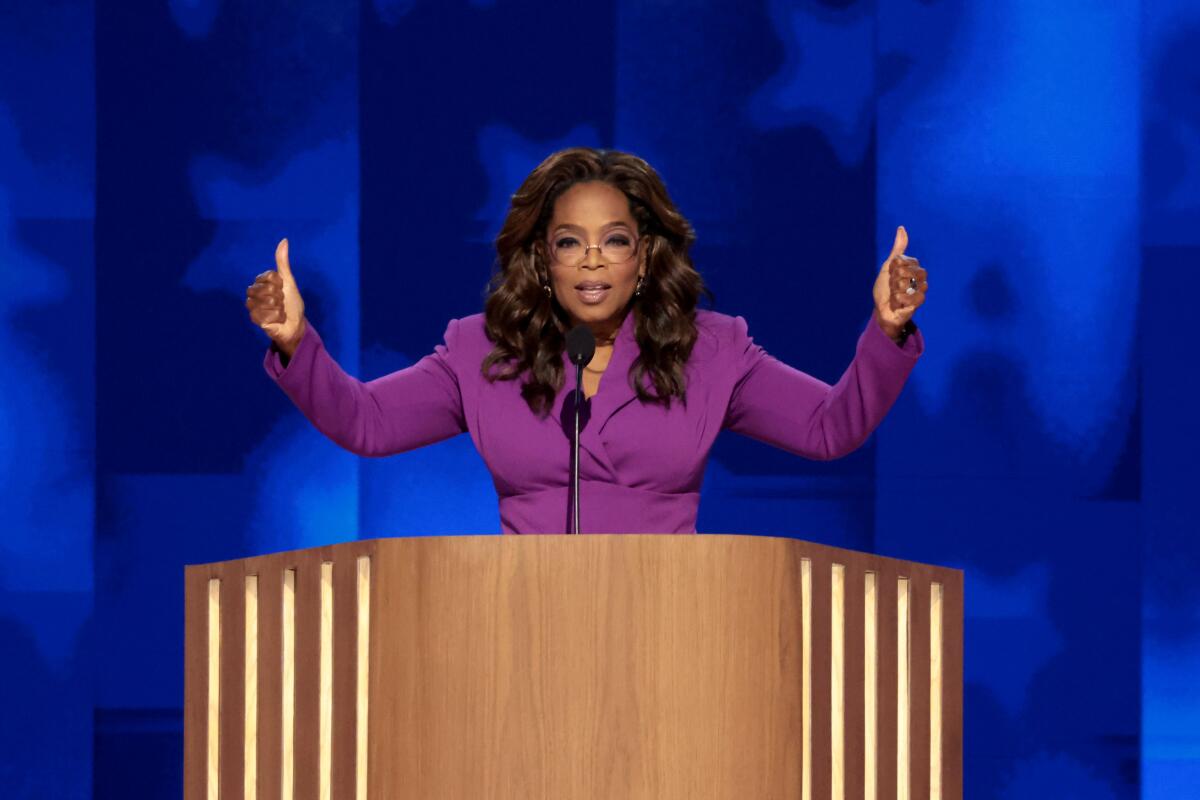
Media mogul Oprah Winfrey made a surprise appearance during the Democratic National Convention on Wednesday.
(Myung J. Chun/Los Angeles Times)
And while few stars these days wield her kind of influence, they can still have a potent voice.
“When a trusted source communicates about participating in our democracy in an authentic way, people are responsive,” said Ashley Spillane, who was author of a study by the Ash Center for Governance at Harvard University, which looked at efforts by celebrities like Billie Eilish and Washington to mobilize voters. It found that celebrities can have a powerful influence on the electorate — if the conditions are right. “The most important thing was that they were delivering a message to their community of fans in a way that felt on brand and authentic. As long as you are talking to people in your community in a way that is transparent and relatable, you can have a very significant impact,” Spillane said.
The Kamala-mania on display ever since Biden dropped out of the race last month, and especially over the last four days, has invited comparisons to Obama, who remains beloved by Hollywood and, since leaving the White House, has launched a successful Oscar-winning production company with his wife, Michelle, the former first lady.
The DNC offered a stark contrast with the Republican National Convention, where a scant handful of celebrities, most of whom peaked in the last millennium and have been mired in controversy, were supporting players in an event that was all about lavish displays of loyalty to one person: Donald Trump. There was Hulk Hogan, a man known for using the N-word in a sex tape; musician Kid Rock, who once flew the Confederate flags at his concerts, even though he is from Michigan; and Ultimate Fighting Championship President Dana White, who was caught on video slapping his wife last year. If speeches by Republicans other than Trump were memorable at all, it was for how shamelessly his former critics kissed the ring.
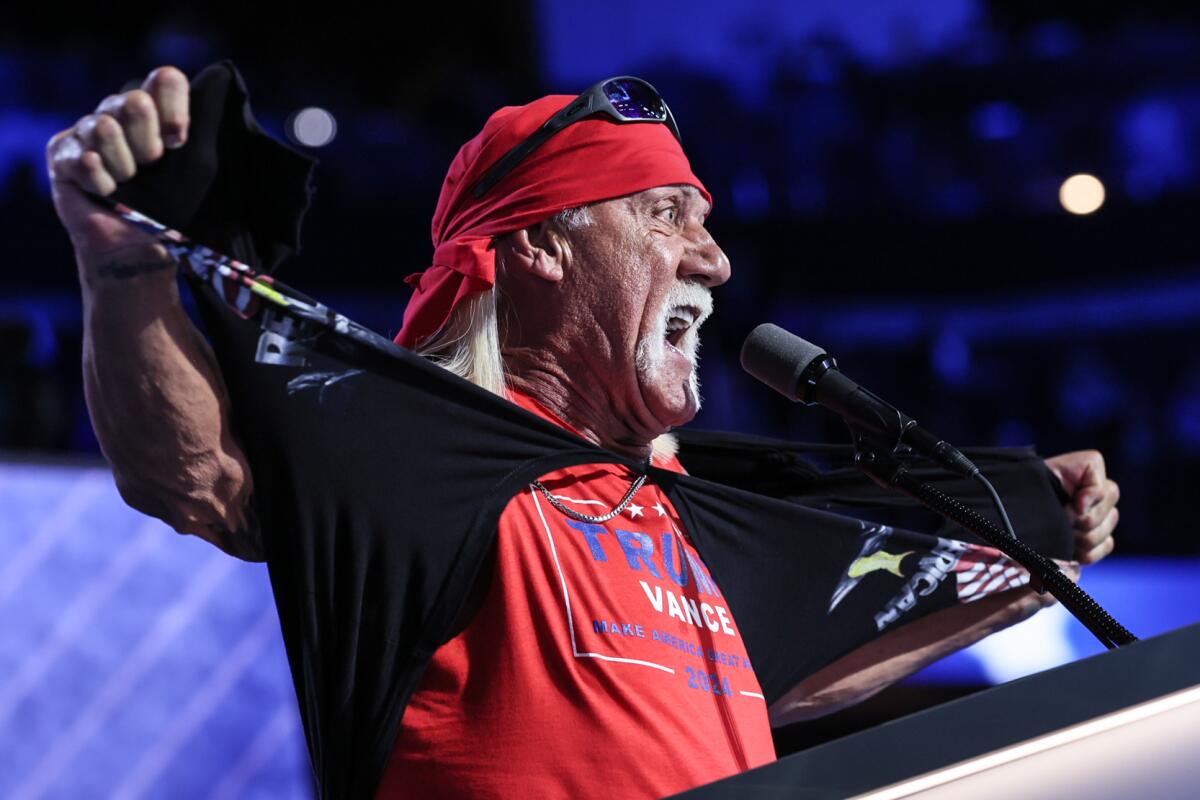
Hulk Hogan on the final day of the Republican National Convention in Milwaukee last month.
(Robert Gauthier/Los Angeles Times)
For all their professed disdain for “Hollywood liberals,” it is often the Republicans who appear to be more enthralled by celebrities, no matter how culturally irrelevant or low-wattage they might be. As long as they are willing to voice support for their party — and Trump in particular — any semi-famous person will do. The 2016 convention featured a cavalcade of names from a “where are they now?” special, including “Charles in Charge” star Scott Baio, “General Hospital” actor Antonio Sabato Jr. and former “Real World” cast member Rachel Campos-Duffy.
It’s telling that Trump and his running mate, JD Vance, were both reportedly motivated to take a hard right turn into politics after facing rejection from Hollywood and the liberal establishment. Trump, who resented how “The Apprentice” was snubbed at the Emmys and was known to exaggerate the show’s ratings — even to TV journalists — spent years teasing a presidential run. According to Roger Stone, he finally decided to get serious about a White House bid after getting brutally roasted by Obama and Seth Meyers at the 2011 White House Correspondents Dinner. Vance first made his name as a Never-Trump Republican who wrote a bestselling memoir, “Hillbilly Elegy,” that liberals read to understand the frustrations of rural white voters. But when the film adaptation, directed by Ron Howard, received a critical drubbing, it reportedly represented the “last straw” for Vance, who soon refashioned himself as a MAGA warrior and successfully ran for the Senate in Ohio.
Democrats have long had an edge when it comes to corralling big-name celebrities to their cause, said Roth. “If you look throughout history and election cycles, they’re doing a heck of a lot better than anyone on the other side is.”
Bill Clinton won the White House in 1992, fueled in part by his masterful use of pop culture, including a saxophone-playing appearance on “The Arsenio Hall Show.” Such was his power that Fleetwood Mac reunited for the first time in years to perform at his inauguration in 1993, a feat comparable to getting Beyoncé and Taylor Swift to sing together in public.
But there’s an inherent danger, particularly in a party criticized for elitism, in giving too much ground to big-name actors or musicians who may not exactly scream “salt of the earth.”
“I think it is a mistake to think about it as proximity to razzle-dazzle,” said Roth. Instead, the animating questions, she said, should be: “How can you deploy people for their incredible storytelling ability? How can you make sure that you’re connecting them to the issues and the people on the ground living the issues?”
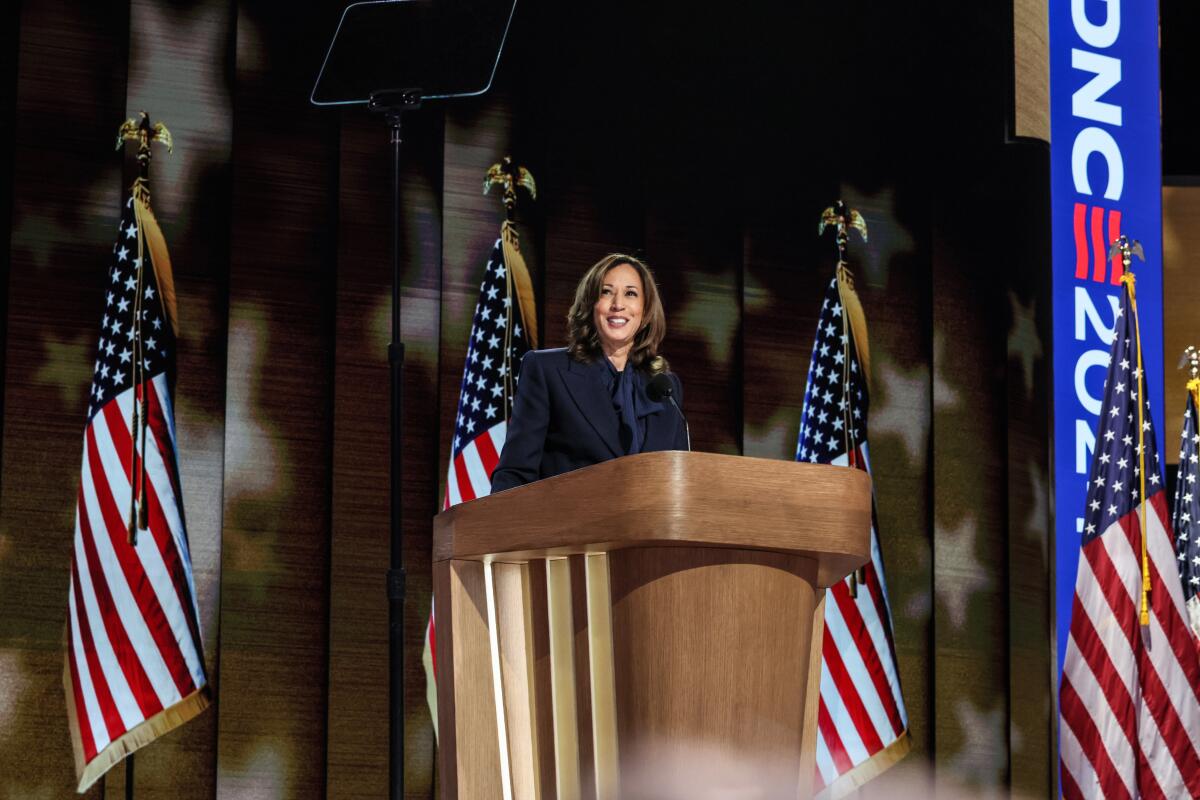
Vice President Kamala Harris on Thursday accepting the party’s nomination for president at the Democratic National Convention.
(Robert Gauthier/Los Angeles Times)
Biden had the support of Hollywood, at least behind closed doors at fundraising events, until the first debate in June when he delivered a performance so disastrous that showbiz allies like George Clooney called for him to drop out. When he eventually did July 21, the party quickly consolidated around Harris — and so did the stars, who have flocked to her candidacy with enthusiasm not seen since Obama‘s campaign in 2008.
Hours after Biden’s announcement, British pop star Charli XCX tweeted, “Kamala IS brat,” an apparent endorsement that triggered a flood of memes that delighted Gen Z while confusing their parents. And Harris’ first rally as the presumptive nominee, in Georgia, featured an appearance by Megan Thee Stallion. While stopping short of an explicit endorsement, Beyoncé provided the campaign not only with a theme song, but an inclusive slogan that sums up its stance on issues as diverse as abortion and gun violence.
The perceived value of an endorsement from Swift, who supported Biden in 2020 but has not yet weighed in on this year’s election, is so high that Trump shared fake images of the singer, dressed as Uncle Sam, with the message, “Taylor wants you to vote for Donald Trump.”
“Taylor Swift and Beyoncé have huge followings and fans who really enjoy being in community with one another. It’s natural to look for the places that and the people who can help you organize,” said Spillane, who is also founder and president of Impactual, a social impact agency.
DNC organizers didn’t let the bold-faced names overshadow the rising stars in the party — or its nominee. Now that the convention is over, it seems obvious why they wouldn’t have wanted Beyoncé or Taylor Swift to perform, even if the musicians had made themselves available: It would have undercut the air of normalcy and relatability the campaign fought so hard to cultivate. And instead of talking about Harris’ speech, fans would have been obsessing over Swift’s outfit and whether Travis Kelce was there, too.
The convention was in many ways less a showcase for celebrity activists than for the deep bench of talent in the Democratic Party, names like Rep. Alexandria Ocasio-Cortez of New York, Gov. Gretchen Whitmer of Michigan; Gov. Wes Moore of Maryland; and “Slayer Pete” himself, Secretary of Transportation Pete Buttigieg, whose speeches were all highly anticipated like top acts at a music festival.
“People are just happy to have a candidate that they can really get behind, and they’re happy to have the things that they care about articulated so clearly on stage,” Roth said.



Politics
Fetterman unleashes on ‘dirtbag’ wing of Dems after far-left victories: ‘Orgy of socialism’

NEWYou can now listen to Fox News articles!
Sen. John Fetterman, D-Pa., unloaded on his own party on Sunday evening, blasting a series of victories for progressives he called “anti-America.”
“Big night for the dirtbag left,” Fetterman said, referring to New York’s recent primaries, where two members of the Democratic Socialists of America (DSA) won primaries.
“I’ve said the party is becoming an orgy of socialism. Clearly anti-America, anti-Western Civilization,” Fetterman said.
Fetterman’s striking calls give a rare look at how some moderates may view the developments on their far-left flank that have dominated the party’s momentum in recent months, sparking concern that their high visibility is dragging the party further and further left.
FETTERMAN WARNS DEMOCRATS ‘DRIFTING FIRMLY INTO COMMUNISM’ AFTER SOCIALIST PRIMARY WINS
Sen. John Fetterman, D-Pa., speaks to reporters outside the Senate Chamber during votes on Nov. 10, 2025, on Capitol Hill in Washington, D.C. (Andrew Harnik/Getty Images)
His comments come on the heels of a handful of key progressive victories.
In Maine, Graham Platner, a controversial Democratic candidate for U.S. Senate, has attracted controversy for denying knowledge of the meaning behind a Nazi-linked tattoo, for off-color comments about race and calling himself a “communist” in a deleted Reddit post.
In New York, one DSA member, Claire Valdez, won a primary on a platform of abolishing ICE and a Green New Deal-style approach to climate change. Similarly, Darializa Avila-Chevalier, another DSA candidate, beat out incumbent Rep. Adriano Espillat, D-N.Y., a high-ranking Democrat and the chair of the Congressional Hispanic Caucus.
WINNERS AND LOSERS EMERGE AFTER SOCIALIST EARTHQUAKE ROCKS NYC PRIMARIES
Graham Platner, Democratic Senate candidate for Maine, speaks at a primary election night event at the Blue Hill YMCA in Blue Hill, Maine, on June 9, 2026. Platner won the party’s Senate primary after a campaign marked by accusations of past misbehavior and voter concerns. (Graeme Sloan/Bloomberg via Getty Images)
Both Chevalier and Valdez had the backing of New York Mayor Zohran Mamdani, himself a socialist.
The wins have captured national attention and drawn criticisms from Republicans who have pointed to their success as emblematic of the direction of the Democratic Party.
Fetterman, who has not shied away from confrontations, has been one of the few Democrats to express alarm about the kind of candidates carrying the party’s banner.
“I mean, you look at some of the things that people have said. Abolish prison, abolish the border, abolish ICE, I mean these crazy people — I have colleagues in my caucus that refuse to even call this out,” Fetterman said.
FETTERMAN REACTS TO MAMDANI’S REFUSAL TO ACCEPT SUPREME COURT’S IMMIGRATION RULING
U.S. Sen. John Fetterman, D-Pa., walks through the Senate Subway during the Senate War Powers vote on April 22, 2026, in Washington, D.C. (Heather Diehl/Getty Images)
CLICK HERE TO DOWNLOAD THE FOX NEWS APP
“Between P-hustle in Maine and some of the other winners in New York, they should form their own party and run on all the things that they’ve had to delete on social media,” Fetterman said, referring to Platner.
“That’s where our party has moved,” he added.
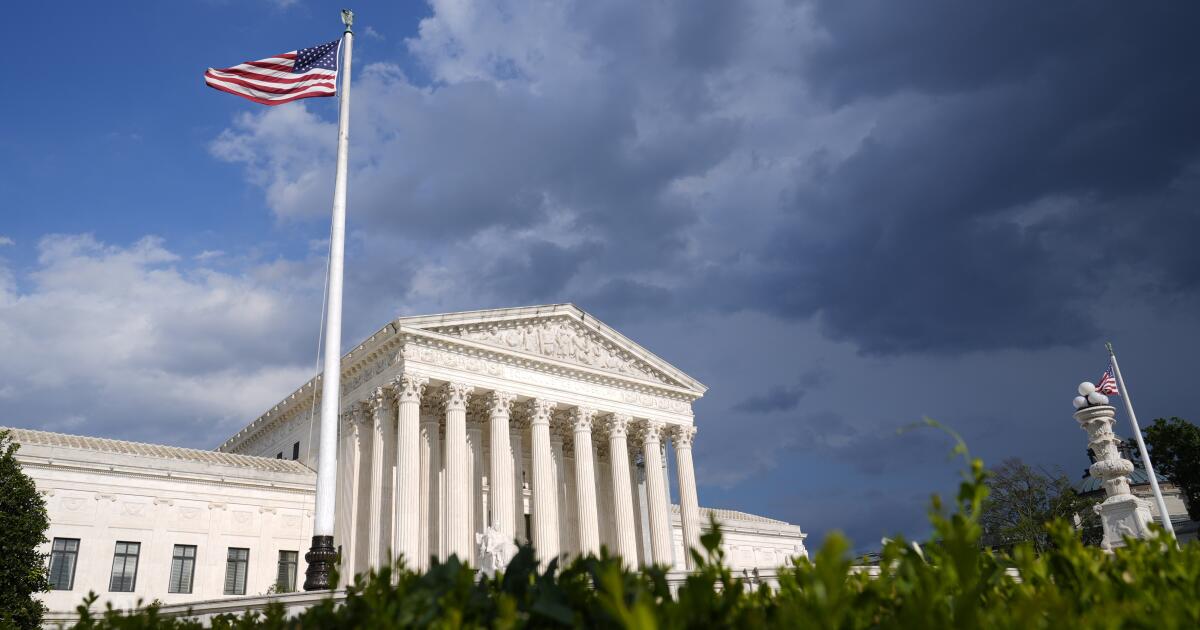
WASHINGTON — The Supreme Court cast doubt Monday on whether police may obtain cellphone data to find crime suspects.
In a 6-3 decision, the justices said this location information showing where a cellphone user has traveled is personal and private and subject to the protection of the 4th Amendment’s ban on unreasonable searches.
Justice Elena Kagan said these “records serve as a personal journal of a user’s movements.”
She said the information “resembles other private materials — think of emails, documents, photographs, or calendars—that even if stored on Google’s servers, a user reasonably views as his own…and reasonably expects to be shielded from the inquisitive eyes of the government.”
Because an “individual has a legitimate expectation of privacy in his cellphone location data,” she said police investigators need a valid search warrant from a magistrate.
The court stopped short of deciding the proper basis for a search warrant in such cases. Instead, the justices sent the case back to judges in Virginia.
But the outcome casts doubt on “geofence warrants.”
In recent years, police have gone to Google and cellphone companies seeking tracking data on cellphones that were at a crime scene. Sometimes, they have had a warrant from a magistrate.
Civil libertarians say the use of this tracking data raises the specter of mass surveillance on innocent people.
Police and government lawyers say no one has a reasonable right to privacy when they are walking on a sidewalk or driving down the street.
The case before the court arose from the armed robbery conviction of a Virginia man who stole $195,000 from a credit union in a small town near Richmond.
By the time police arrived, the robber had fled. But surveillance cameras showed he was carrying a gun and a cellphone.
Lacking other leads, detective Joshua Hilton asked a judge to issue a special type of warrant seeking information from Google.
Referred to as a “geofence warrant,” it seeks data from phones in a particular area at a particular time.
The detective sought data on phones that were within 150 yards of the credit union within one hour of the late afternoon robbery.
After examining and paring down the data, the detective asked for the phone records of Okello Chatrie. Then, with a search warrant of his home, investigators found two robbery-style demand notes, a semi-automatic pistol and about $100,000 in cash.
A judge refused to suppress the evidence from an allegedly unconstitutional search, and Chatrie entered a conditional guilty plea.
The full 4th Circuit Court of Appeals split evenly on the legality of the geofence warrant, and the Supreme Court agreed to decide the issue in Chatrie vs. U.S.
Usually investigators obtain warrants to search the home or vehicle of a known crime suspect.
The new and disputed geofence warrants seek to find a suspect by examining data on the cellphones that were at the scene of a crime.
The FBI used this cellphone data in 2021 to identify suspects who broke through police barricades on Jan. 6, 2021, and pushed their way into the Capitol to disrupt the official counting of electoral votes.
Chief Justice John G. Roberts Jr. and Justices Sonia Sotomayor, Neil M. Gorsuch, Brett M. Kavanaugh and Ketanji Brown Jackson agreed on the outcome in Chatrie vs. U.S.
In a 21-page dissent, Justice Samuel A. Alito Jr. said the court had “carefully set the stage for its planned performance: striking a pose as a great champion of privacy in the digital age. I cannot support this irresponsible escapade.”
Justice Clarence Thomas agreed.
Justice Amy Coney Barrett agreed in a one-paragraph dissent. “Chatrie had no reasonable expectation of privacy in data about his public movements that he voluntarily disclosed to Google,” she said.
The Supreme Court ruled 6-3 that President Trump could fire independent regulators for any reason. But the justices carved out an exception for the Federal Reserve, preventing the immediate removal of Lisa D. Cook, a Federal Reserve governor.
-
World6 minutes ago
Pope issues last-ditch appeal, begs breakaway traditionalist group to back off bishop consecrations
-
 Lifestyle44 minutes ago
How should we behave online? : It’s Been a Minute
-

 Technology54 minutes ago
After a great start, DC’s new cinematic universe is already slowing down
-

 World59 minutes ago
UK asylum seekers could have to pay government $13K before applying for settlement
-

 Politics1 hour ago
Fetterman unleashes on ‘dirtbag’ wing of Dems after far-left victories: ‘Orgy of socialism’
-

 Health1 hour ago
Doctors thought man had brain cancer — they found live tapeworms instead
-

 Sports1 hour ago
Paraguay stuns four-time World Cup champions Germany in penalty shootout after controversial call
-
 Business1 hour ago
Comcast is spinning off NBCUniversal media and entertainment assets

