Politics
Immigrant rights advocates rally for more state healthcare funding, criticize Newsom

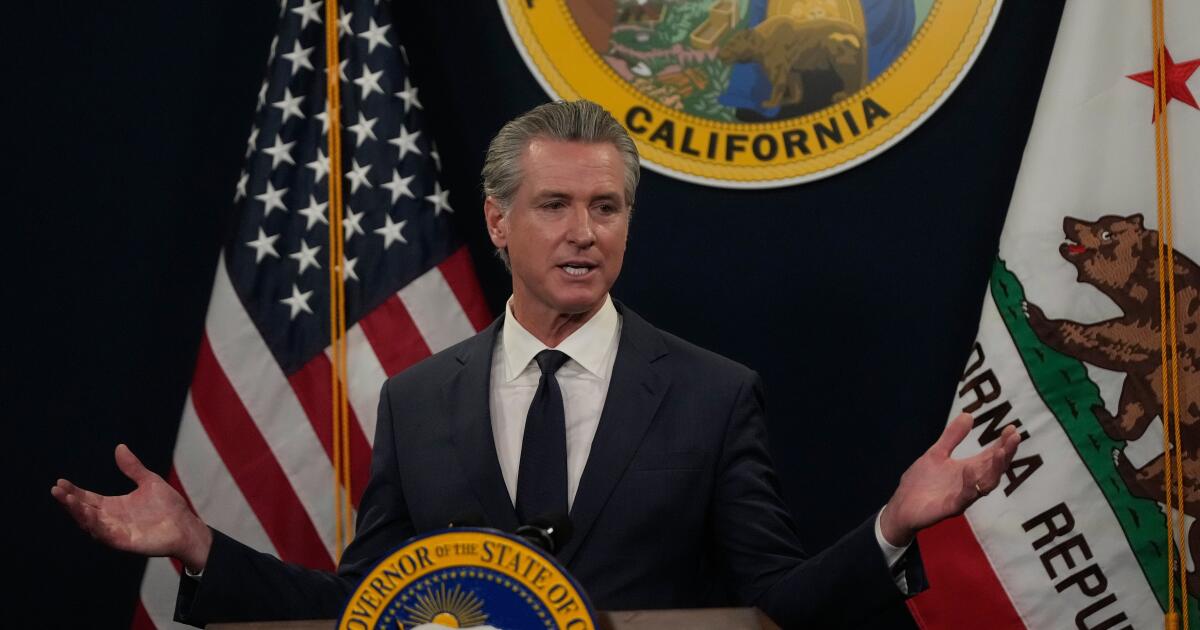
SACRAMENTO — Human rights advocates on Tuesday rallied outside the state Capitol to push back on Gov. Gavin Newsom’s proposed budget plan to reduce state-sponsored healthcare coverage for undocumented immigrants.
“We are here to demand a budget that protects California’s values,” said Kiran Savage-Sangwan, executive director of California Pan-Ethnic Health Network. “We are fighting for a budget that rejects Medi-Cal cuts, seeks new revenues and strengthens our safety net reserve to keep families whole.”
Newsom last week unveiled his revised budget proposal, which would further move away from his previous policy to provide free healthcare coverage to all low-income undocumented immigrants.
His proposal would require monthly premiums for undocumented immigrants receiving coverage from Medi-Cal, the state’s version of the federal Medicaid program. It would also continue to block new adult applications, a cutback imposed last year.
The governor has explained that his original policy was more costly than expected and that difficult decisions must be made as the state could soon face an economic downturn.
Speakers at Tuesday’s rally argued this was unacceptable.
The cuts would force many immigrants to choose between putting food on the table or visiting a doctor, said Savage-Sangwan. She said certain groups, including refugees, older adults and those with disabilities, would be left especially vulnerable.
“These are the kinds of actions we would expect from a federal government that scapegoats immigrants and sends violent ICE forces to terrorize our community,” she said. “Instead, these proposals were made by our own governor in a state that claims to value immigrant communities. We know California is better than this.”
The governor’s office did not respond to a request for comment about the rally.
The event drew about 100 attendees, including Anahi Araiza, a policy researcher with Imperial Valley Equity and Justice. She told The Times that many immigrants in their community struggle to afford medical care and subsequently put off doctor visits.
“They wait until it’s an absolute emergency,” she said. “We’ve heard stories where people delay care and then get diagnosed with Stage 4 cancer.”
The event was supported by several organizations, including California Pan-Ethnic Health Network, Survivors of Torture International, Communities Organized for Relational Power in Action, Health4All Coalition, and Organizing Rooted in Abolition, Liberation and Empowerment.
One man carried a large sign with an image of the Virgin Mary that read “Safety Net For All.” Other marchers donned flowing monarch butterfly wings. The orange-and-black insect became a symbol for the pro-migrant movement years ago because it travels long distances between Mexico and the United States.
Meanwhile, another group gathered outside the Capitol for a news conference to raise awareness about the instability caused by federal healthcare cuts.
Assemblymembers Patrick Ahrens (D-Sunnyvale), Robert Garcia (D-Rancho Cucamonga) and Tina S. McKinnor (D-Hawthorne) joined several doctors and nurses to call for a $500-million state investment into public hospitals.
“Public hospitals are the backbone of our healthcare system,” Ahrens said. “It is estimated that federal cuts will strip over $3 billion a year from the California public hospital system — we cannot balance our budget on the backs of the most vulnerable Californians.”
The Republican-backed “Big Beautiful Bill” signed by President Trump last year shifted federal funding away from safety-net programs and toward tax cuts and immigration enforcement. During a legislative hearing this year, healthcare professionals warned state lawmakers the cuts would harm all patients, including those with private insurance.


Trump will not sign housing bill without voter ID, criticizes Senate
President Donald Trump took to Truth Social, declaring he will not sign the housing bill despite congressional approval. He protests the Senate’s inability to pass The SAVE America Act, which he claims is supported by 97% of Republicans and many Democrats. Trump emphasizes the need for photo voter ID and proof of citizenship to prevent voter fraud.
NEWYou can now listen to Fox News articles!
After a popular Italian restaurant chain dished out an online response to a curious diner about its new unlimited pasta pass, politically-minded social media users, including those at the top of the food chain, are taking a stand.
Olive Garden took to X on Wednesday to promote its new deal, which offers customers the chance purchase a “Never Ending Pasta Pass” for $100 plus tax, giving the first 10,000 people to purchase their pass 13 weeks of unlimited pasta.
A user posed a question to the iconic American restaurant chain, asking whether they could purchase the unlimited pasta pass and share it with their family.
An Olive Garden sign is affixed atop one of its locations. (iStock)
WATCH: ELISSA SLOTKIN SAYS SAVE AMERICA ACT WOULD MAKE IT ‘HARD FOR ANY DEMOCRAT’ TO WIN AN ELECTION
“No. The Never-Ending Pasta Pass is only for use by the Passholder whose name is printed on the Pass,” Olive Garden replied. “Passes are personalized and non-transferable.”
“Passholders must present a valid photo I.D. along with the Pass at the time of ordering,” the chain instructed from its X account.
Immediately, the political right seized the the opportunity to prove a point — that Olive Garden appears more strict about its unlimited pasta promotion than Democrat-run states are about voting. The timely post comes as Trump continues to push for what would be a signature legislative victory — the SAVE Act — which, if passed, would require photo identification to vote. It has faced fierce pushback from the left-wing, who have argued against requiring proof of identity to cast a ballot in elections.
“Olive Garden takes their Pasta Pass security more seriously than Democrats take election security,” White House spokesperson Abigail Jackson told Fox News Digital. “It’s sad but true.”
“The SAVE America Act is a commonsense police, supported by the vast majority of Americans, that will secure our elections for generations to come. The only people opposed seem to be Democrats in Congress… I wonder why?” she added.
People with signs supporting the SAVE act at Upper Senate Park. (Kent Nishimura/Getty Images)
WATCH: MCCARTHY SAYS TRUMP WILL USE ‘EVERYTHING HE CAN’ TO FORCE SENATE ACTION ON SAVE AMERICA ACT
The social media post quickly caused an online feeding frenzy.
“PUT OLIVE GARDEN IN CHARGE OF OUR ELECTIONS!!!” one popular X account quipped.
“I hope you understand that this is extremely discriminatory towards minorities and married women,” one user said, parroting talking points that the political left has used in opposition of the SAVE Act.
MEMPHIS PIZZA JOINT SPARKS BACKLASH AFTER OWNER REFUSES TO SERVE NATIONAL GUARD TROOPS
US President Donald Trump addresses the nation from the East Room of the White House in Washington, DC on July 16, 2026. SAUL LOEB/Pool via REUTERS
Another user also mockingly used the common parlance of the political left in response to Olive Garden’s strict policy.
“I’m sorry, but this sounds incredibly racist to me, a requirement ID and some sort of proof of being a passholder will negatively affect marginalized communities ability to access Olive Garden,” wrote the sarcastic user. “Do better Olive Garden.”
“Are you saying that if photo ID is not presented, it could lead to cheating the system?” another social media user asked.
“Good grief, Olive Garden is more secure than our elections,” said yet another.
Adding protein, fat, or fiber to carbs—like topping pasta with chicken, spinach, and olive oil—helps slow digestion and prevent blood sugar spikes. (iStock)
CLICK HERE TO DOWNLOAD THE FOX NEWS APP
Since Republicans in the House of Representatives passed the SAVE Act in February, the bill has faced major obstruction by Democrats in the Senate, as the conservative lawmakers don’t have the 60 votes required to overcome a filibuster.
Earlier this week, SAVE Act language was attached to a State Department appropriations bill in a creative attempt to pass the law.

WASHINGTON — Democrats are making a growing effort to adopt a pragmatic focus as they campaign on affordability in the midterms, as some within the party push for moving away from ideological arguments.
Across the country, Democratic candidates are trying to win over voters by talking about real-life scenarios, framing other platform issues in economic terms and, strategists say, aiming to shift a perception that Democrats deal in the abstract.
They see an opening created by voters’ focus on the economy and their ability as the party not in power to leverage affordability as the key midterms issue as Trump’s economic approval remains low. Trump has dismissed the issue, calling affordability a “hoax” by Democrats while also promising economic improvements.
“There has been a learning process in being able to take what Trump and the Republicans are doing and make sure that [candidates] are coming back to the real-world economic implications of whatever that might be,” Democratic strategist Alex Jacquez, who served in the Biden White House. “That’s where maybe [Democrats] haven’t always, in the recent past, made the full connection all the way through.”
Now, “the moment is ripe,” he suggested, for the party to shift its image.
The Democrats’ concentration on affordability and the economy has defined their midterm messaging, playing off elevated inflation, the effects of Trump’s tariffs and high gas prices caused by the war in Iran. The party is attempting to capture enough swing voters to win a House majority in November, and some believe the Senate could also be within reach.
Polling shows pessimism about the economy has increased among all Americans and most believe the country is in an affordability crisis. Americans most frequently mention government leadership and economic issues as the country’s most important problems in Gallup polling.
Voters also increasingly disapprove of Trump’s handling of the economy, including working-class white voters who make up a key part of his base. In an NPR/PBS News/Marist Poll last month, Americans gave the president his lowest-ever approval rating on the economy at 33%.
Speaking in Pennsylvania on Thursday, Trump said of affordability: “That’s a fake word that they use. They caused the affordability problem. It’s called high prices.”
Rep. Adam Gray, a Democrat who represents a purple Central Valley district and is a member of the center-left Blue Dog Coalition in Congress, said he believes voters have grown frustrated by the failure of Washington lawmakers to pay attention to what the people want out from government.
He pointed to Central Valley growers whose business has been affected, he said, by the rising price of fuel and fertilizer, the squeeze on the labor market caused by immigration enforcement and changes to federal programs.
“How regular people experience politics, it’s not the kind of ideological debates we have in Washington,” Gray said. “It’s the experience of doing something, whether that’s shopping for groceries or going to the lake to go boating with your family and realizing the price of gas is through the roof or the road to the lake is in disrepair.”
At a time when Democrats have debated how to embrace a party identity beyond opposing Trump and intra-party fights between progressive and moderate candidates have drawn attention, some believe the “practical” tactic may offer one key to the party’s path forward.
In Texas, Democratic candidates are pointing to the impact of data centers on water supply or the consequences of the state’s abortion ban, said Matt Angle, director of Lone Star Project, a political research organization that works to help get Democrats elected.
“The fact that Corpus Christi is running out of water … [or] you have women who have died because they were denied abortion services,” Angle said. “It’s very important that those things not be talked about in ideological terms but in practical terms. I think Democrats are doing a better job of that than ever before.”
“Real life is happening on the ground,” Angle added. “I think Democrats see that.”
Republicans pursued a similar strategy successfully in 2024, and their attacks on Democrats for focusing on cultural issues may have been successful in pushing Democrats away from that messaging, said Republican strategist Brittany Martinez.
“They have made it clear that’s the direction in which they’re trying to go,” she said of Democrats. “I also think you have outliers of the party that sometimes suck all the oxygen out of the room and maybe derail that message.”
National Republican Congressional Committee spokesperson Christian Martinez said Democrats’ economic record, including in California under Gov. Gavin Newsom, demonstrates a failure to prioritize working families.
“It’s laughable that Democrats are trying to make kitchen-table issues their brand,” he said. “It only proves their political brand is broken, while Californians continue living every day with the receipts from Democrats’ failed agenda.”
Republican National Committee Chair Joe Gruters said Thursday at a summit convened by the Washington-based news outlet the Hill that he was confident the party would retain the House and Senate and projected optimism about the economy.
“He’s going to bat for the American worker every single day,” Gruters said of Trump. “He’s going to continue to do everything he can to get the nose of the economy in this country up and to get prices down.”
But as Trump appears to prioritize other issues, Martinez said, Republicans are facing their own uphill battle to win over swing voters.
“When the president has mocked affordability, said it’s not a crisis, I don’t think that helps [Republicans],” Martinez said. “Democrats have an opportunity to capitalize on that right now.”
Both moderate and progressive Democrats see the moment as a chance to define what the party stands for beyond opposing Trump, and both have seized on real-life arguments, though the approaches differ.
Progressives have long framed a spectrum of issues in economic terms, said Usamah Andrabi, spokesperson for the progressive caucus Justice Democrats.
“That has always been the progressive economic playbook, and I think it’s about time that the other wings of the Democratic Party catch up to us,” Andrabi said.
That also means, he said, not backing away from other issues, such as abortion, foreign wars and healthcare.
“It has always been the right that has sought to divide our communities on these so-called culture war issues,” Andrabi said. “Our vision forward should be one that includes everyone… That does not mean simply ignoring some people’s most urgent crises to focus on something else, because these are interconnected.”
Climate advocates, for instance, are “effectively connecting” climate to top midterm issues, including including gas and utility costs, AI data centers and the Iran war, said Jamie Henn, executive director of nonprofit communications lab Fossil Fuel Media, and have encouraged Democratic candidates to do the same.
“Climate, like many issues, doesn’t win itself on its own merits. It’s in the ways that you talk about it and connect it to kitchen-table issues,” Henn said. “Do it in the right way – it’s not a science lecture on global warming, it’s a story about how clean energy can reduce your bills.”
Still, getting more candidates to pick up those messages can be a steep climb, he said. Advocates in some spaces, including climate, have worried about their issues being sidelined.
“There are Democrats that could be threading this needle who aren’t,” Henn said. “We know the issues that climate needs to be connected to, but [politicians] need… to do a better job to clearly articulate the messages.”

NEWYou can now listen to Fox News articles!
President Donald Trump accused members of the U.S. intelligence community Thursday night of operating a “shadow government” to allegedly conceal evidence of China’s efforts to influence U.S. elections, seizing on newly declassified emails that he says reveal a bitter internal dispute about how Beijing’s activities should be characterized.
Trump did not claim China changed votes or altered election results. Instead, he argued Beijing engaged in an influence campaign aimed at shaping U.S. public perceptions.
Trump claimed intelligence officials kept significant reporting out of his presidential briefings and highlighted an email in which a National Security Agency analyst allegedly wrote, “We have deliberately massaged our one pending (presidential daily brief) to avoid any direct links to the election.”
TRUMP RELEASES DECLASSIFIED ELECTION INTELLIGENCE, SAYS IT REVEALS ‘SHOCKING VULNERABILITIES’
“Those responsible for sounding the alarm instead kept the information secret and hidden,” Trump claimed. “They did not disclose (it) to me as president or to anyone else.”
Trump gives an address to the nation about elections on July 16, 2026. (Saul Loeb/Pool via Reuters)
Trump used the disclosures to press Congress to pass the SAVE America Act, casting the newly released intelligence as evidence that lawmakers must tighten federal election rules before the midterms.
“Most importantly, addressing this crisis of election security demands that Congress must pass the SAVE America Act,” Trump said. “These reforms are urgently needed to stop the vulnerabilities that I’ve mentioned.”
The SAVE America Act passed the House in February but stalled in the Senate in March, when a 53–47 vote fell short of the 60 votes needed to advance it. Trump urged Americans to call their senators and representatives and demand its passage “without delay.”
President Donald Trump used the disclosures to press Congress to pass the SAVE America Act, casting the newly released intelligence as evidence that lawmakers must tighten federal election rules before the midterms. (Kylie Cooper/Reuters )
REPUBLICAN SAYS TRUMP’S TOP ELECTION PRIORITY ‘DEAD’ IN SENATE AS GOP FRACTURES AHEAD OF MIDTERMS
The legislation would require documentary proof of citizenship to register for federal elections, photo identification to vote and ongoing state efforts to identify and remove noncitizens from voter rolls. Absentee voters would be required to submit a copy of an eligible photo ID when requesting a ballot and again when returning it.
Trump also called for eliminating mail-in voting except in cases of illness, disability, military deployment or travel. The current text of the SAVE America Act does not include that prohibition — it permits absentee voting subject to identification requirements.
Trump urged Americans to call their representatives and demand the bill’s passage “without delay.”
The newly released emails show that analysts disagreed over whether any alleged Chinese influence operations and intelligence collection should be explicitly linked to elections. After the NSA analyst described “massaging” the President’s Daily Brief, other intelligence officials questioned the decision, with one writing that “the mind boggles” and another calling the approach “highly irregular.”
Sen. Mark Warner, D-Va., said in response to the address: “Americans heard the president once again repeat claims about our elections that have been investigated for years and repeatedly rejected by the Intelligence Community.”
One official alleged the intelligence community was “deliberately avoiding mentioning a connection to elections for non-substantive reasons,” according to a November 2020 email. That official sought to reconnect the intelligence to the election-security assessment and prevent what another described as an “analytic objectivity mistake.”
The documents, however, do not establish Trump’s broader allegation of a politically motivated conspiracy. Instead, they portray competing intelligence assessments over whether China’s actions amounted to an effort to influence the presidential contest or a broader campaign focused on U.S. policies, public opinion and issues important to Beijing.
Trump went further Thursday, claiming an FBI official wrote that she was running a “shadow government” to prevent the China intelligence from becoming public.
China denied any interference in U.S. elections.
“China has all along adhered to the principle of non-interference in other’s internal affairs,” Chinese embassy spokesperson Liu Chang told Fox News Digital. “The U.S. election is an internal matter of the U.S. Its outcome is determined by the votes of the American people. China has never and will never interfere in the presidential elections of the U.S.”
Trump is still expected to meet with Chinese President Xi Jinping in September, a senior White House official told Fox News.
CLICK HERE TO DOWNLOAD THE FOX NEWS APP
Trump directed the Office of the Director of National Intelligence, Justice Department, FBI and CIA Thursday to investigate why the intelligence was withheld, fire anyone found to have participated in a cover-up and pursue criminal charges “if appropriate.”
Sen. Mark Warner, D-Va., said in response to the address: “Americans heard the president once again repeat claims about our elections that have been investigated for years and repeatedly rejected by the Intelligence Community.”
-

 Vermont2 minutes ago
Community Profile by Gordon Hayward: NYC bargeman drawn to rural life in Vermont
-

 Virginia8 minutes ago
Events canceled due to unhealthy air quality in central Virginia
-

 Washington14 minutes ago
Washington Nationals recall Harry Ford
-

 Wisconsin20 minutes ago
Cyclosporiasis cases in Wisconsin; what you need to know
-

 West Virginia26 minutes ago
Secretary of State maintains West Virginia’s elections are “safe, secure” after Trump claims – WV MetroNews
-

 Wyoming32 minutes ago
Wyoming Supreme Court upholds 125- to 175-year conviction for Steven Marler after child sexual abuse trial in 2025
-

 Crypto38 minutes ago
FBI arrests man accused of using Steam games to drain victims’ crypto wallets | TechCrunch
-

 Finance44 minutes ago
Butterfield Readies CIBC Caribbean Purchase

