Politics
A Central Valley politician was charged with voter fraud. Right-wing conspiracies took over

As the polls closed in California on Super Tuesday, Jim Hicks stood watch in the parking lot of a community center while election officials wearing red vests retrieved ballots from a drop-off box.
He jiggled the handle of the metal container when they were done to ensure it was locked and peeked his head into the white van holding boxes of ballots that would be transferred to the San Joaquin County registrar of voters to be counted.
Jim Hicks, far right, stands watch at the Kennedy Park Community Center in Stockton as polls close March 5.
(MacKenzie Mays)
“We just need to have eyes on things after everything that’s been going on,” Hicks said as he rushed to his SUV to tail officials down dark farmland back roads to more drop boxes where ballots were waiting to be collected, all part of his duties as a self-appointed election observer.
Hicks, a real estate agent from Lodi, believes California’s universal vote-by-mail process is fraught with fraud risks, echoing unfounded messaging from the far right that election officials nationwide have worked to combat since Donald Trump and his allies began blaming his 2020 presidential loss on claims of fraud that have been shot down by numerous courts.
That paranoia is difficult to dismiss in this part of California’s Central Valley, though, after a local politician was arrested on allegations of a slew of crimes involving election fraud.
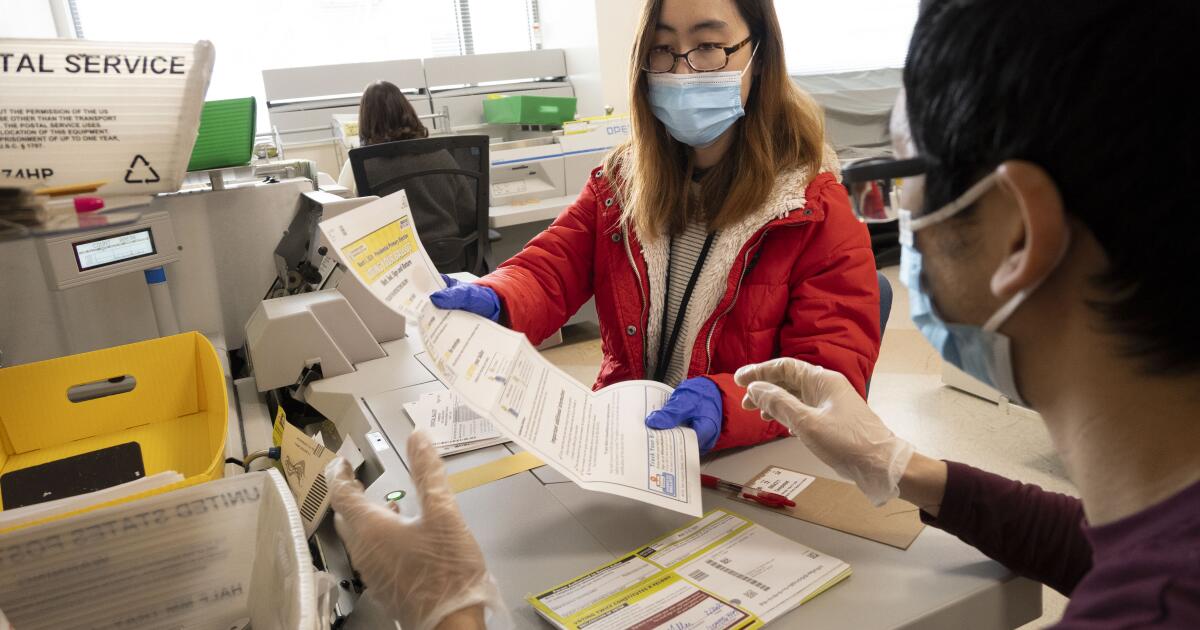
Erin Kane collects ballots for inspection at the office of the San Joaquin County registrar of voters.
(Jose Luis Villegas / For The Times)
Former Lodi City Council member Shakir Khan pleaded “no contest” in January to felony charges, including election fraud, after the San Joaquin County Sheriff’s Office said it found 41 sealed, completed ballots in his home and about 70 people registered to vote using his address, phone number or email.
The alleged scheme, which stems from Khan’s run for City Council in 2020, is just one piece of a complex criminal case in which he also faces charges for illegal gambling, money laundering, tax evasion and Employment Development Department fraud.
Officials seemed to foresee the potential fallout after the years-long investigation, reiterating that Khan, a 34-year-old “no party preference” voter who has lived among Lodi’s vineyards since he was a child, did not appear to have ties to any broader voter-fraud plot.
“I want to make it clear that this investigation has only uncovered criminal activity in our county here, in a local election,” San Joaquin County Sheriff Patrick Withrow said at a news conference last year announcing Khan’s arrest. “It has nothing to do with and has no impact on any state or federal elections that we know of.”
Still, the case has drawn the attention of national conservative commentators, supercharged a group of local right-wing activists, sowed voter distrust in an already chaotic political environment and pushed the county to spend thousands of dollars on election security measures such as new ballot boxes and cameras to monitor them.
For dedicated skeptics like Hicks, Khan’s case is proof that “more sophisticated operatives” are gaming elections and going unnoticed. Khan is merely “an amateur who got caught,” Hicks said, and there are “way more” like him.
“I believe that what happened to Mr. Khan only solidified what we already seriously suspected,” he said.
For Olivia Hale, San Joaquin County’s chief election official, the timing of a rare case like Khan’s — as voter fraud conspiracies have proliferated across the country — has been a nightmare.
“The narrative is continuing no matter what we do,” she said.
San Joaquin County Registrar of Voters Olivia Hale, right, gathers ballots while the staff continues counting March 11.
(Jose Luis Villegas / For The Times)
Khan’s case isn’t like many of the unfounded conspiracies promoted by the far right. There were no “fake” voters or dead people registered to vote, according to San Joaquin County deputies, who said Khan’s focus was winning his own election to the nonpartisan Lodi City Council, which oversees a population of about 67,000.
But the case alarmed officials and local Democrats and Republicans alike.
“Let today’s guilty plea send a message loud and clear, especially as we enter 2024: Any attempt to alter or undermine our electoral process and our democratic institutions in San Joaquin County will be dealt with immediately and to the fullest extent of the law,” Dist. Atty. Ron Freitas said at a press conference in January.
Former Lodi City Council member Shakir Khan, arrested for voter fraud.
(San Joaquin County Sheriff’s Office)
While running for City Council in 2020, Khan pressured people to vote for him, sometimes registering them to vote, filling out ballots for them, forging their signatures and collecting their information without their knowledge of his intent to illegally vote on their behalf, according to the San Joaquin County Sheriff’s Office, which conducted the investigation that led to his arraignment last year.
Khan’s “no contest” plea does not include an admission of guilt, and he has in the past denied the allegations. Khan is not in jail and is awaiting sentencing.
His attorney did not return requests for comment from The Times.
Some of Khan’s alleged fraud victims were elderly and, like him, Pakistani immigrants, unfamiliar with the American voting process, according to police.
California’s voting system didn’t immediately flag the ballots tied to Khan because the people being registered were real citizens with legitimate information, according to Hale, who was appointed in 2022 as the San Joaquin County registrar of voters.
Since Khan’s arrest, Hale has worked to assuage a seemingly endless list of concerns about fraud from a small group of regulars at county meetings and some Republican elected officials sympathetic to their demands.
She has beefed up the ballot signature verification process; zoned in on multiple voters registered to single addresses, in cases such as intergenerational homes; and opened her office to anyone with concerns about so-called ballot harvesting, a process — legal in California but allegedly abused by Khan — that allows voters to give their ballots to other people to turn in.
Hale worked with the county sheriff’s office to launch a voter fraud hotline and utilizes an election advisory committee created by the San Joaquin Board of Supervisors to “reform the public’s perception of the integrity of the electoral process.”
She does so even as she is staunch in her confidence in the county’s voting process, reiterating that there is no evidence that Khan’s case was anything other than an isolated event that was stopped because of the system’s checks and balances. Some of the accusations circulating in her community are “nonsense,” she said, but she welcomes skepticism and accountability as part of healthy government.
“I have an obligation to every single voter in San Joaquin County,” she said. “I believe so much in what we do in elections and how safe and secure it is, and how hard we work to keep it going in the right direction at every cost.”
For people like Molly Watkins, a self-described “farm wife” from the rural city of Linden, the county’s efforts are not enough.
Watkins was at a warehouse near the Stockton airport late into election night this month, watching officials in color-coded vests identifying them as “inspectors” and “supervisors” sift through yellow bins of bagged ballots. She was convinced, though, that her monitoring wouldn’t do much good.
“This is all smoke and mirrors,” she said as she kept an eye on the movement of ballots. Steps away, Hale gave a tour to a group of similarly concerned residents. “There is no transparency in the system.”
In 2021, California became the eighth state to permanently move to mail-in ballots following COVID-19 shutdowns — a move celebrated by Democrats, as research shows it increased voter turnout in 2020, especially in low-income neighborhoods.
But Republicans nationwide have alleged that the process is inferior to voting in person and less secure.
Watkins, who ominously refers to “the deep state,” has attended numerous local meetings since Khan’s arrest to demand changes to the election system. She wants the county to fight state law and do away with ballot drop boxes altogether. She mistrusts voting machine technology and is pushing county officials to revert to a system in which ballots are counted by hand.
Louis Campbell puts ballots into baskets after they are sorted by precincts.
(Jose Luis Villegas / For The Times)
Unlike in Shasta County, where a similar movement is playing out, San Joaquin is not a Republican stronghold, and voters here elected President Biden over Trump in 2020.
Election fraud is rare, but skepticism of the Democratic process can be a good thing, said Kim Alexander, executive director of the California Voter Foundation, a nonpartisan election watchdog group.
Alexander has seen a shift in her decades of election work and said that while “false narratives” about fraud shouldn’t drive the conversation, California officials should not ignore them.
“There is a stubborn minority of voters that are subscribing to election fraud conspiracy theories who are very vocal, and even though I don’t think the general public agrees with those theories, they still resonate,” she said. “It’s definitely taken a toll on voter confidence across the board.”
Alexander said the Khan case isn’t proof of greater fraud but proof that anyone who attempts it will be punished.
“It is one example of an election crime that’s being prosecuted. It doesn’t mean that it’s rampant; it means that the process is working,” she said. “That sends a message to anybody else who might try to cheat the process that it’s a losing proposition.”
San Joaquin County Supervisor Steve Ding, a Republican, says ballot boxes are “rife for mischief.” But he admits the issue has spiraled out of control in his community, saying “everybody needs to take a breath” and “back off” Hale, who has faced personal attacks as the elections chief.
“It’s cast a shadow,” Ding said of the Khan case. “Unfortunately, it’s become a partisan issue rather than a good government issue. It’s no longer about whether it works or doesn’t. People have drawn sides.”
At a San Joaquin County Board of Supervisors meeting last week, people rose for public comment to voice concerns about the March 5 primary election, alleging that Hale was rigging votes to help someone who attends her church get elected to the Stockton City Council.
Hale denies the claims and pointed out that the candidate in question is not projected to win the race.


James Gagliano on anti-ICE protests and threats against agents
Retired FBI Special Agent James Gagliano discusses anti-ICE protests and threats against agents in Newark, New Jersey. A new curfew has curbed chaos after violent clashes, with one Brooklyn man arrested for threatening to kill an ICE agent. DHS Secretary Markwayne Mullin vows ‘zero tolerance’ for attacks, while Sen. Cory Booker, D- N.J., calls ICE ‘out-of-control.’ Gagliano warns against allowing these protests to continue.
NEWYou can now listen to Fox News articles!
A Canadian national accused of slapping a teen wearing political clothing at the Jersey Shore has been turned over to Immigration and Customs Enforcement, a representative for the local jail told Fox News Digital on Wednesday.
Over the Fourth of July weekend, Kaitlyn Tracey, 33, was reportedly seen on surveillance video confronting a group of teens in Point Pleasant Beach, some of whom were wearing pants with the words “Trump” and “ICE” on them, local media reported.
Tracey, a Canadian national who entered the U.S. on a passport in 2024, then allegedly struck one of the girls and recorded the confrontation, according to court documents reported by NJ.com.
An official who picked up the phone at the Ocean County Jail in Toms River confirmed to Fox News Digital that Tracey had been released into ICE custody as of Monday.
ICE CLASHES WITH AGITATORS INTENSIFY OUTSIDE DELANEY HALL
She was reportedly taken to Delaney Hall in Newark – the site of months-long clashes between left-wing agitators and ICE.
NEW JERSEY GOVERNOR, DEMOCRATIC SENATOR SPEND MEMORIAL DAY PROTESTING ICE FACILITY
Billboard at Trump rally in Wildwood declaring historical blue New Jersey is “Trump Country.” (The Image Direct for Fox News Digital)
Tracey’s criminal charges include endangering the welfare of a child and simple assault, according to reports.
The alleged victim was reportedly uninjured.
NJ TAXPAYERS ON THE HOOK FOR $12M MORE AS DEM GOVERNOR PROTECTS ILLEGAL ALIENS BATTLING DEPORTATION
CLICK HERE TO DOWNLOAD THE FOX NEWS APP
While New Jersey at a state level has adopted sanctuary-type policies, Ocean County is known as one of the few Republican strongholds remaining, and retains the state’s longest-serving lawmaker of any party: Rep. Chris Smith, R-N.J., in office since 1981.
People enjoy the Jersey Shore in Seaside Heights, N.J., as businesses prepare for the holiday weekend on May 23, 2025. (Asbury Park Press via IMAGN)
SIGN UP TO GET THE POLITICS NEWSLETTER
It was not immediately clear on what immigration basis ICE initiated proceedings against Tracey. Fox News Digital reached out to DHS for clarification and comment.
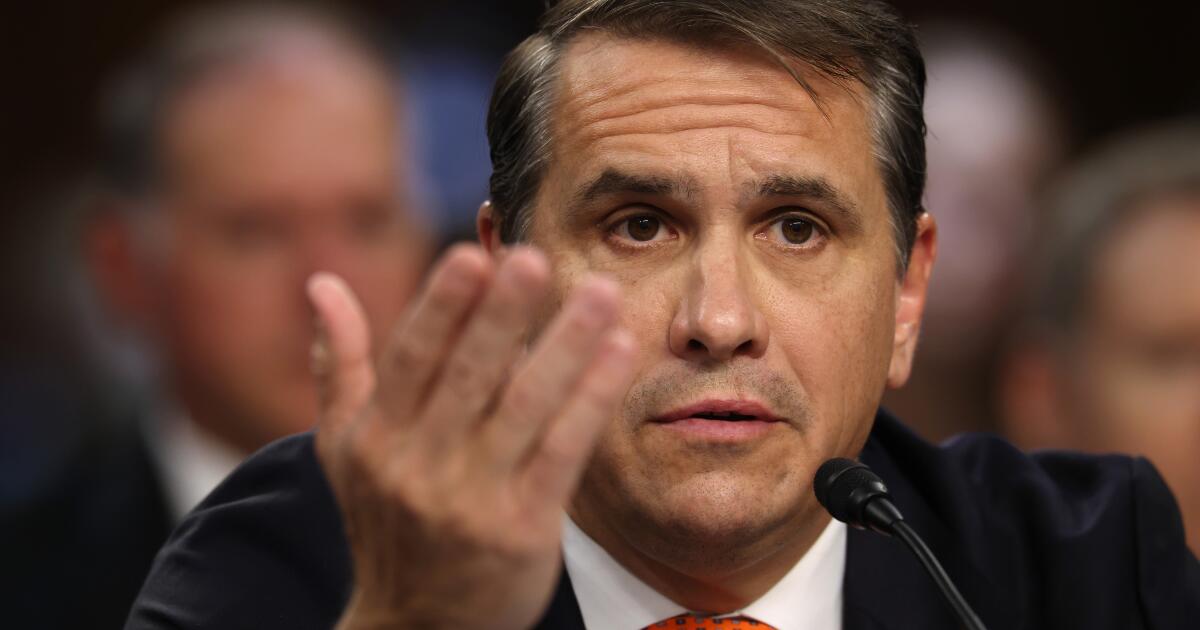
WASHINGTON — The Senate confirmation hearing Wednesday for Todd Blanche, President Trump’s pick for attorney general, will be a referendum on far more than his individual merits.
Blanche, the acting attorney general, served as Trump’s defense attorney before taking office and has been closely linked to many of the most consequential — and controversial — issues that have dominated the first two years of Trump’s second term.
Blanche is set to appear before the Senate Judiciary Committee, which will decide whether to approve his nomination and send it to the full Senate for a confirmation vote. The committee hearing will continue Thursday.
“I would expect committee Democrats to treat Mr. Blanche’s hearing as an opportunity to conduct oversight of the Department of Justice,” said Phil Brest, president of the American Constitution Society, a progressive legal nonprofit and a former top Democratic staffer on the committee. “It’s a test of the Senate’s willingness to probe the department’s operations and to actually serve as a check on the department and the administration more broadly.”
Democrats on the committee are expected to push Blanche on a host of topics, including the $1.8-billion “anti-weaponization fund” that critics derided as a slush fund for the president’s allies, the Justice Department’s rollout of the so-called Epstein files, and the department’s prosecution of several perceived enemies of Trump, notably former FBI Director James Comey.
“While deploying the Justice Department as a shield for the president and his cronies, Blanche has also used our top law-enforcement agency as a sword against Trump’s political opponents,” said Sen. Dick Durbin (D-Ill.), the ranking Democrat on the committee last month. “The independence of DOJ has been decimated under Blanche’s authority.”
Blanche was confirmed by the Senate as deputy attorney general in March, 2025, and was elevated to his current role after Atty. Gen. Pam Bondi was fired in April.
More critical to the success of Blanche’s nomination will be whether he can win the support of two lame-duck Republican senators, Thom Tillis of North Carolina and John Cornyn of Texas, who expressed some reservations about Blanche soon after his nomination was announced.
Cornyn raised concern about Blanche’s independence from Trump, while Tillis said Blanche’s stance on protesters who violently stormed the U.S. Capitol on Jan. 6, 2021, would be critical to his consideration.
Some of those Jan. 6 protesters were expected to be the beneficiaries of the $1.8-billion fund announced as part of a settlement to a lawsuit Trump and his sons and business brought against the IRS.
In a scathing ruling this week, the federal judge wrote that the lawsuit was improper and recommended sanctions against two Justice Department attorneys who worked on the case, though not Blanche himself.
Cornyn told Semafor on Tuesday that the ruling raised a number of issues, including “the potentially collusive nature of the lawsuit.”
He has said previously that he will hold off on making a decision about whether to approve Blanche until after the hearing.
Tillis, meanwhile, told CNN’s Manu Raju on Tuesday that the weaponization fund would need to be completely off the table for him to support Blanche’s nomination.
Trump touted Blanche’s record ahead of the hearing.
“Todd Blanche is doing a PHENOMENAL job as Acting Attorney General of the United States,” the president wrote on Truth Social. “He is a great lawyer, always very fair, and every Republican Senator should vote to CONFIRM Todd Blanche, ASAP!”
Sen. Lindsey Graham’s death means that Republicans currently only enjoy a one-seat majority, but a replacement for Graham on the committee could be in place before it votes on whether to move his nomination to the Senate floor, which will likely come two weeks after the hearing.
Blanche, 51, spent 12 years working for the U.S. attorney’s office for the Southern District of New York, working largely on drug and violent crime cases, and rose to the level of co-chief of the district’s White Plains division.
He left the office in 2014 for private practice and joined the prominent law firm Cadwalader, Wickersham & Taft in 2017 as a partner. He left the firm in 2023 and went independent after other partners expressed concern when he took Trump on as a client.
Blanche went on to represent Trump in several criminal matters, including the New York case about hush money payments to porn star Stormy Daniels, and cases brought by Special Counsel Jack Smith about Trump’s alleged efforts to block the transfer of power after the 2020 presidential election and his alleged retention of classified documents.
He listed all three as among the 10 most significant cases of his career in the questionnaire he completed ahead of the hearing, along with his work at the Justice Department on a lawsuit challenging the construction of a new White House ballroom.
A group of more than 1,200 former Justice Department attorneys wrote a letter opposing Blanche’s nomination, asserting that his leadership has resulted in mass departures of career staff. That has “meant that much of the department’s vital work isn’t being done, or isn’t being done as well – leaving communities less safe, Americans’ rights less protected, and our national security more vulnerable,” the lawyers wrote.
Former Justice Department pardon attorney Liz Oyer is scheduled to testify as a witness for Democrats on Thursday. She has said she was fired for refusing to recommend the restoration of actor Mel Gibson’s gun rights.
Oyer will be joined Thursday by Dani Bensky, one of many victims of the deceased sex abuser Jeffrey Epstein who has criticized Blanche’s handling of the release of the so-called Epstein files — millions of pages of records detailing the Justice Department’s investigations into Epstein’s crimes.
Numerous victims have said that their names and other sensitive information were not properly redacted in the files and criticized Blanche and the department for failing to investigate Epstein’s potential co-conspirators.
Blanche has also come under criticism from survivors of Epstein’s abuse for the interview he conducted in July, 2025, with Epstein accomplice Ghislaine Maxwell, who is serving a 20-year prison sentence for her role in facilitating and participating in Epstein’s abuse.
Days after their interview, Maxwell was moved from her prison in Florida to a minimum-security prison in Texas.
Politics
Biden special counsel’s ‘runaway train’ scooped up sensitive lawmaker info: ‘Abuse of power’

NEWYou can now listen to Fox News articles!
Former special counsel Jack Smith’s investigation into President Donald Trump swept up text messages from nearly 50 members of Congress, bypassing a required review process in what one victim alleged is a direct constitutional violation.
Senate Judiciary Committee Chairman Charles Grassley, R-Iowa, said the situation is more proof Smith’s probe was a “runaway train” of abuses of power, and the elder statesman and Senate Investigations Subcommittee Chairman Ron Johnson, R-Wis., jointly released their filings Tuesday evening.
Grassley and Johnson’s findings were from a full-scale probe of Operation Arctic Frost, the code name for Smith’s endeavor to investigate Trump for alleged corruption and election malfeasance, an operation top Senate Republicans call “worse than Watergate.”
LEGAL WAR ON TRUMP’S AGENDA GAINS FIREPOWER AS FEDERAL LAWYERS DEFECT TO DEMOCRATS
Jack Smith, former U.S. special counsel, arrives for a closed-door deposition before the House Judiciary Committee in Washington, D.C., Dec. 17, 2025. (Getty Images)
Forty-four members of Congress had the contents of their text messages obtained and reviewed by Smith’s team in a way that bypassed protocol. A “filter team” was tasked with reviewing millions of documents in the case and should have had first crack at determining whether such messages were relevant or potentially violated statute or ethics.
Rep. Elise Stefanik, R-N.Y., one of the lawmakers whose texts were swept up in this way, said Tuesday such reviews amounted to clear violations of the Constitution’s speech and debate clause that protects lawmakers from being questioned in “any other place” than the Capitol for legislative acts.
Internal communications have been historically included in that clause in the courts as technology has advanced.
SUPREME COURT JUSTICES HEAD TO CAPITOL HILL FOR FIRST CONGRESSIONAL APPEARANCE SINCE 2019
Stefanik said in a statement that the new records prove Smith’s team “unlawfully and unconstitutionally accessed my private text messages, along with 43 other Members of Congress, in clear violation of the Constitution.”
She said she long suspected there had been “unconstitutional spy[ing] on members of Congress.”
The records were provided by the Trump Justice Department to Grassley and Johnson, which the chairmen said indicated Smith’s team had “circumvented its own filter review process.” The process is additionally meant to protect attorney-client privilege, they said in a statement.
OBAMA-APPOINTED JUDGE TORCHES TRUMP ADMIN IN LATEST COURTROOM SHOWDOWN, REFERS ATTORNEY FOR BAR REVIEW
Former special counsel Jack Smith says the Pledge of Allegiance before he prepares to testify during a hearing before the House Judiciary Committee in the Rayburn House Office Building on Capitol Hill Jan. 22, 2026, in Washington, D.C. (Al Drago/Getty Images)
The news also complicated some of Smith’s prior depositions under oath, including an excerpt in which he answered “no” to a question from a congressional counsel whether records he requested from congresspeople included text messages.
Johnson called the situation a “grotesque example” of Biden-era “weaponization” of the executive branch.
“Jack Smith’s criminal investigation of President Trump was a runaway train that had no brakes,” Grassley added Tuesday.
“Based on the information that’s been produced to me and Senator Johnson, Biden DOJ and FBI investigators apparently ignored their own routine investigative protocols to obtain and review work-related messages from me and dozens of my Republican and Democrat colleagues who were outside the scope of the government’s investigation.”
Grassley added that he hopes Democrats caught up in the otherwise bipartisan text tranche will finally discard their partisanship and recognize the severity of the alleged violations by Smith.
He also indicated he planned to recall Smith before Congress to “hold him accountable.”
Of the 44 members swept up in the text reviews, several were Democrats, including Los Angeles Mayor Karen Bass, Rep. Josh Gottheimer, D-N.J., Sen. Cory Booker, D-N.J., and the top Democrat on the House Armed Services Committee, Rep. Adam Smith of Washington.
Grassley, Johnson and Stefanik were also swept up in the situation, along with top figures like senators Mike Lee, R-Utah; Josh Hawley, R-Mo.; Dan Sullivan, R-Alaska; Rand Paul, R-Ky., former Senate Republican Conference Chairman Lamar Alexander, R-Tenn.; and the late Lindsey Graham, R-S.C.
SIGN UP TO GET THE POLITICS NEWSLETTER
Former House Intelligence Chairman Devin Nunes, R-Calif., was one of the victims, along with current House Judiciary Committee Chairman Jim Jordan, R-Ohio, as well as House Freedom Caucus member Scott Perry of Pennsylvania, EPA Administrator Lee Zeldin of New York, Veterans Affairs Secretary Doug Collins of Georgi, and prominent Trump critic Rep. Thomas Massie of Kentucky.
CLICK HERE TO DOWNLOAD THE FOX NEWS APP
Several lawmakers sounded off on the news soon after Grassley announced his findings, including Hawley, who called for “everyone involved [to] be prosecuted.”
“Joe Biden’s DOJ not only tapped my phone; I just learned they illegally obtained my texts with members of President Trump’s administration,” the Missourian fumed.
Paul called the allegations a “blatant abuse of power and exactly what our Founders warned about,” while citing Smith’s past denial under oath.
Fox News Digital reached out to a representative for Smith for comment.
-

 Oklahoma5 minutes ago
J.D. PicKell: ‘Oklahoma is going to be a wagon once again’
-

 Oregon11 minutes ago
Oregon Ducks’ Big Ten Championship Chances Entering Fall Camp
-

 Pennsylvania17 minutes ago
Lawmakers break without addressing unconstitutional murder sentences, leave 1K Pa. lifers in limbo
-

 Rhode Island23 minutes ago
Providence mayor, City Council dispute over RENT fund program
-

 South-Carolina29 minutes ago
Could SC’s election rules shape who decides to run for Graham’s US Senate seat?
-

 South Dakota35 minutes ago
AARP commits $125,800 to strengthen community projects in Mobridge, Gregory, seven other South Dakota towns
-

 Tennessee41 minutes ago
Former Tennessee teacher who allegedly showed nude photo to student indicted by grand jury
-

 Texas47 minutes ago
Texas AG secures 23andMe bankruptcy settlement after 2023 data breach

