Donald Trump’s hush money trial was back in action yesterday, and there was news right out of the box.
Judge Juan Merchan, to absolutely no one’s surprise, ruled that Trump had violated his gag order – and fined him $9,000.
Now that’s just pocket change for him, but the larger point is that Merchan ruled against the former president on nine of the 10 accusations, a thousand bucks a pop. The order barred him from attacking witnesses, but Trump has repeatedly said it’s unfair and unconstitutional to keep him, as a presidential nominee, from speaking out and responding to attacks from the likes of Michael Cohen and Stormy Daniels.
COLUMBIA PROTESTORS OCCUPY BUILDING AS TRUMP BLAMES BIDEN FOR ANTISEMITIC DEMONSTRATIONS
The judge had castigated Trump for breaching the gag order during oral arguments, and scolded his attorney Todd Blanche for “losing all credibility” in defending his client. So it didn’t take a soothsayer to divine how he would rule.
Merchan ordered Trump to remove the offending posts, and said he would be subject to further fines and possibly incarceration (which is up to 30 days). No way I see that happening, even if Trump punched a witness in the nose. That would cause a surge in public sympathy, even among some Trump critics, and give the defendant something to take to the appeals court in arguing that the judge was blatantly biased against him.
The first witness, Gary Farro, Cohen’s former banker, delivered testimony that was very damaging to Trump’s fixer. It’s sure to be cited when Cohen, a disbarred lawyer who has served prison time, takes the stand.
But Michael Cohen isn’t on trial. Donald Trump is. And none of the testimony got to the central allegation–which Manhattan D.A. Alvin Bragg has stretched into a felony–that Trump falsified expense records to reimburse Cohen.
Farro said he had no indication that the account Cohen was establishing – with $131,000 from his home equity line – was related to a political candidate. That, he said, might have required additional scrutiny.
Nor did Farro know the account was related to someone in the adult film business. “It is not an industry we do work with,” he said.
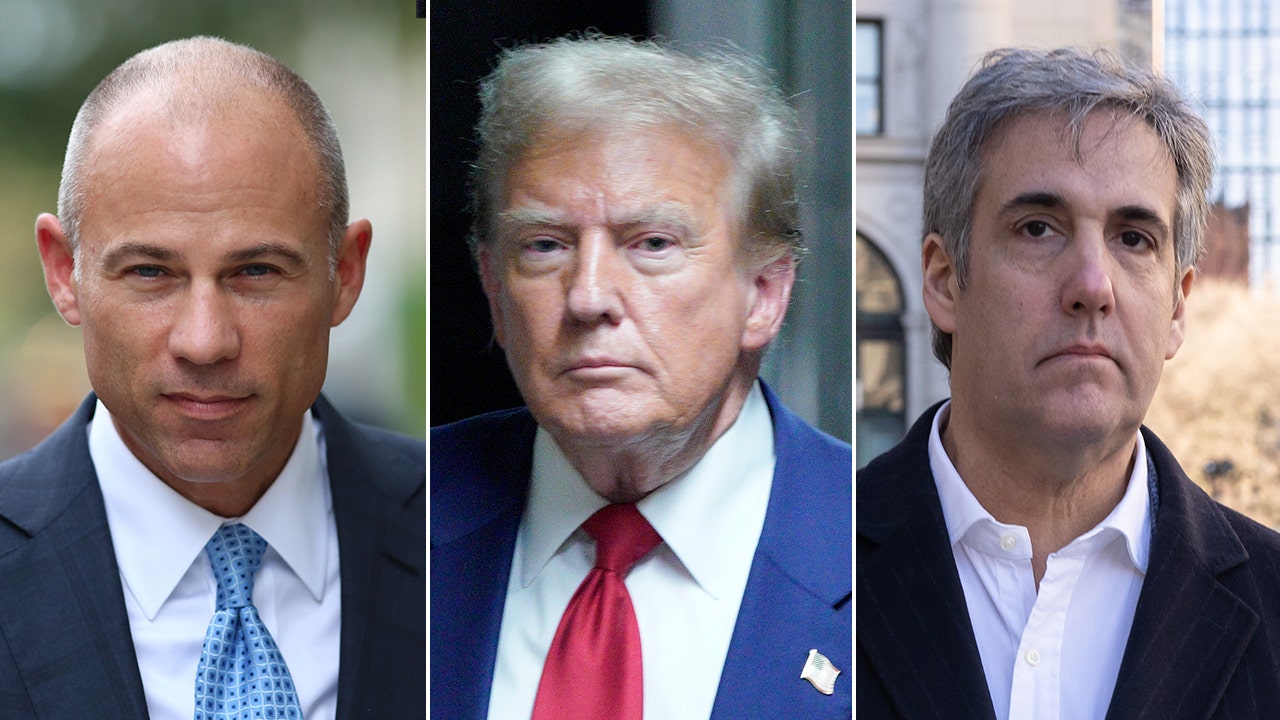
In Former President Donald Trump’s criminal hush-money trial in the state of New York, the names Michael Avenatti and Michael Cohen are often heard in the courtroom.
Next, Cohen created an account under Essential Consultants, and transferred it to an account that lawyer Keith Davidson maintained for Stormy Daniels. Cohen, he said, listed it as “retainer,” an obvious falsehood.
If he had known, Davidson said when he took the stand, that this was a shell company and not an operating business, he would not have approved it.
Davidson also represented Karen McDougal, the Playboy playmate, and what followed seemed to belie her later proclamation that she didn’t want to be “the next Monica Lewinsky.” She told him her 10-month relationship with Trump was “sexual in nature” (which he denies).
Davidson started shopping her story.
He texted Enquirer Editor Dylan Howard in June 2016: “I have a blockbuster Trump story.”
Howard responded: “I will get you more than ANYONE for it.”
THE ANTI-TRUMP MOVEMENT’S SECRET ZOOM CALLS GIVE THEIR TARGET AMMO
And: “Did he cheat on Melania?”
Davidson was also pitching McDougal to ABC.
He arranged a meeting with David Pecker’s American Media Inc., but the company declined, citing a lack of evidence.
Later on, though, Davidson offered an AMI deal that would pay McDougal for fitness columns. “She did not want to tell her story,” the lawyer testified. “She liked the AMI deal, which wouldn’t force her to do that.” Yep, we now know why.
Davidson asked for an initial million-dollar payment. Howard cautioned it would be more hundreds than millions.
A couple of clips were played, one from the E. Jean Carroll deposition and one from a North Carolina rally, weeks before the election, in which Trump said: “I’m being viciously attacked with lies and smears. It’s a phony deal. I have no idea who these women are.”
Former President Donald Trump leaves Trump Tower on his way to Manhattan criminal court, Monday, April 15, 2024, in New York. The hush money trial of former President Donald Trump begins Monday with jury selection. It’s a singular moment for American history as the first criminal trial of a former U.S. commander in chief. (AP Photo/Yuki Iwamura)
In the AMI deal, McDougal was granted rights to an “affair with a married man,” who Davidson testified with Trump.
They finally got to Stormy Daniels, whose manager told Davidson that “some jerk called me and was very, very aggressive.” It was Cohen.
Davidson said his call to Cohen was met with “a hostile barrage of insults, insinuations and allegations… He was just screaming.”
When the “Access Hollywood” tape came out, there was a “crescendo” of interest in the Stormy story, said Davidson. His own view of the candidacy: “Trump is F***ed.”
“Final nail in the coffin,” said Howard.
Davidson testified that he was handed off to Cohen once again, with Dylan Howard “washing his hands of the deal.
Former President Donald Trump attends the first day of his criminal trial, at Manhattan Criminal Court in New York City on April 15, 2024. (Angela Weiss/AFP via AP Pool)
“The moral of the story is nobody wanted to talk to Cohen,” Davidson said. But the $130,000 deal finally got done when Cohen said he’d pay the money himself.
And yet it wasn’t a blockbuster day. One pet peeve: Since we’re all dependent on reporters’ feeds from inside the courtroom, after the networks go to break, they jump ahead to what’s happening at that moment and you miss what you missed. At one point, CNN got bored and switched to police and protestors confronting each other at the University of North Carolina at Chapel Hill–though nothing was happening except a standoff. Fox switched to Columbia anti-Israel demonstrators continuing to occupy a building.
At the trial, there were technical witnesses like the C-SPAN archive director and a court reporter official. This was so dull that I would have fallen asleep faster than Trump could close his eyes.
Sure, these are building blocks, but you’d think the Bragg prosecutors would want to maintain the momentum from the damaging testimony last week of David Pecker, the Enquirer’s former publisher.
But it bears repeating: Pecker (who has immunity) isn’t on trial. McDougal isn’t on trial. Stormy isn’t on trial.
This other stuff may make for titillating drama, or would if there were cameras in the courtroom. But the case, even in anti-Trump Manhattan, will come down to whether prosecutors can prove that Trump committed a crime–and all he needs is one holdout juror.
SUBSCRIBE TO HOWIE’S MEDIA BUZZMETER PODCAST, A RIFF ON THE DAY’S HOTTEST STORIES
Footnote: One person is kinda, sorta on trial, with his famous client, Maggie Haberman and Jonathan Swan report.
Trump has “griped” that his lead lawyer Todd Blanche has been “insufficiently aggressive” and wants him to “attack witnesses, attack what the former president sees as a hostile jury pool, and attack the judge.” He’s also complained about high legal fees.
They write in the New York Times that Trump views himself as his own best legal strategist and casts about for attorneys who will do what he wants, such as contest the 2020 election. He has told associates he needs “a Roy Cohn,” who represented him early in his career and was repeatedly indicted and later disbarred.
Trump campaign spokesman Jason Miller said their team was “focused entirely on fighting a ‘ridiculous’ case and that ‘anonymous comments from people who aren’t in the room are just that…I would be highly skeptical of any gossip or hearsay surrounding this case.”
Howard Kurtz is the host of FOX News Channel’s MediaBuzz (Sundays 11 a.m.-12 p.m. ET). Based in Washington, D.C., he joined the network in July 2013 and regularly appears on Special Report with Bret Baier and other programs.