Politics
Michael Cohen swore he had nothing derogatory on Trump, his ex-lawyer says – another lie – as testimony ends


The prosecution and defense rested yesterday, meaning, to no one’s shock, that Donald Trump did not testify.
Trump had said he would, but it would have been judicial malpractice for his lawyers to expose him to a hundred different lines of interrogation.
Michael Cohen went into the hush money trial with a well-established reputation as a convicted liar.
We all knew he would be hammered on cross-examination for lying on behalf of Trump, lying to Congress, lying to investigators and lying to the press. That was baked into the equation.
CROSS-EXAMINATION THROWS MICHAEL COHEN OFF BALANCE, BUT BELABORS POINT THAT HE HATES TRUMP
Donald Trump’s former lawyer Michael Cohen concluded his testimony in the NY v. Trump trial. (Getty Images)
But the lie he acknowledged on Monday is in a whole different category – and may be a turning point in convincing one or more jurors to dismiss him as a money-grubbing thief and vote for Trump’s acquittal.
The onetime fixer fixed up a nice deal for himself: stealing from the Trump Organization.
Yep, he did it, said Cohen. Yep, he lied about it. Yep, he gladly pocketed the money because he was angry about his bonus being cut.
This was a real Perry Mason moment – and an absolute failure by the prosecution.
On the other litany of lies, Alvin Bragg’s lawyers brought them up on direct examination, with the best possible spin, to soften the sting when Trump’s lawyers were grilling him.
But on this one? Nada. At first, I thought Cohen didn’t tell the prosecutors, but Trump lawyer Todd Blanche asked, “And you told multiple prosecutors in the District 13 Attorney’s Office that story, right?”
“Yes sir.”
So it was sheer sloppiness – an unbelievable failure.
And the narrative gets even sleazier.
The Trump campaign hired a tech firm called Red Finch to try to discredit unfavorable polls by CNBC and Drudge. The fee was $50,000. Cohen delivered $20,000 in cash stuffed into a brown bag to the company’s chief – nothing suspicious there, right?
And Cohen kept the other $30,000 – later grossed up to $60,000 for tax reasons – blatantly stealing from his ex-boss’s company. (Trump decided not to pay Red Finch because its efforts petered out but didn’t know about the bag o’ cash.)
MICHAEL COHEN, CORROBORATING OTHERS, SAYS TRUMP WANTED TO SILENCE STORMY BECAUSE OF THE ELECTION
There was little the prosecutors could do when they had their turn. Cohen said he was “angered” by the two-thirds cut in his usual $150K bonus “so I just felt it was almost like self-help. You know, I wasn’t going to let him have the benefit this way as well.”
Ah, self-help. Stealing as therapy. A pretty lame explanation.
It didn’t matter what else Cohen said in 2018, such as insisting he would never have paid the $130,000 in hush money to Stormy Daniels, which is well-documented, without the president’s explicit approval. The damage had been done.
But there were more fireworks to come.
The defense called as its main witness Robert Costello, a veteran lawyer and talented talker who represented Cohen for a few months.
Former President Donald Trump leaves Trump Tower on his way to Manhattan criminal court, Monday, April 15, 2024, in New York. (AP Photo/Yuki Iwamura)
Cohen has testified that he didn’t trust Costello because he was close to Rudy Giuliani, offering a back channel to the White House, but also the risk that anything Cohen said would be repeated there.
Costello testified that he told Cohen that his legal problems could be resolved “if he had truthful information on Donald Trump and cooperated with the Southern District of New York.”
Cohen’s response, according to Costello, repeated 10 or 12 times: “I swear to God, Bob. I don’t have anything on Donald Trump.”
That was obviously a big fat lie.
Costello also alleged that Cohen had told him Trump didn’t know about the hush money payments, which gets to the heart of the case.
STORMY ALLEGES ONE-NIGHT STAND WITH TRUMP, AGREED TO LIE FOR HER $130,000 PAYOFF
But Robert Costello walked into that courtroom with a giant chip on his shoulder.
After one question, he audibly said “ridiculous.” After another, he said “Geez.”
Judge Juan Merchan had enough and sent the jury out.
“If you don’t like my ruling, you don’t say ‘Geez,’ okay. And then you don’t say ‘strike it;’ because I’m the only one that can strike testimony in the courtroom.”
The lecture was severe. “And then, if you don’t like my ruling, you don’t give me side eye and you don’t roll your eyes. Do you understand that?”
Costello gave the judge a long stare. “Are you staring me down right now?” At that point, he declared, “Clear the courtroom.” Everyone later returned.
Michael Cohen is questioned by prosecutor Susan Hoffinger on re-direct during former President Donald Trump’s criminal trial on charges that he falsified business records to conceal money paid to silence porn star Stormy Daniels in 2016, in Manhattan state court in New York City, May 20, 2024, in this courtroom sketch. (REUTERS/Jane Rosenberg )
In yesterday’s testimony, the prosecution got Costello to acknowledge he was referring to Trump when saying he had “friends in high places.”
An email about “getting everyone on the same page” was because Cohen “had been complaining incessantly that Rudy Giuliani was making statements in the press,” Costello said.
He said an email about getting everyone “on the same page” was about working out the complaints about Rudy.
Costello denied the prosecutor’s question about “encouraging him not to cooperate.”
On redirect, the defense asked: What about an email saying you were being “played”?
SUBSCRIBE TO HOWIE’S MEDIA BUZZMETER PODCAST, A RIFF ON THE DAY’S HOTTEST STORIES
Costello said they kept urging Cohen to sign a retainer – so they could get paid – but he kept making excuses and putting it off.
Was he pressuring Michael Cohen to do anything? Costello said he was not.
And that was it. Closing arguments are set for next Tuesday.
The prosecution has plenty of other witnesses and documents, but Cohen is the only one tying Trump directly to his reimbursement for hush money payments to Stormy Daniels and Karen McDougal in this openly partisan and shakily built case. So Cohen’s evisceration on the stand really matters to the falsification of documents charge, unless 12 jurors believe that the former president had to know.

Politics
Fetterman unleashes on ‘dirtbag’ wing of Dems after far-left victories: ‘Orgy of socialism’

NEWYou can now listen to Fox News articles!
Sen. John Fetterman, D-Pa., unloaded on his own party on Sunday evening, blasting a series of victories for progressives he called “anti-America.”
“Big night for the dirtbag left,” Fetterman said, referring to New York’s recent primaries, where two members of the Democratic Socialists of America (DSA) won primaries.
“I’ve said the party is becoming an orgy of socialism. Clearly anti-America, anti-Western Civilization,” Fetterman said.
Fetterman’s striking calls give a rare look at how some moderates may view the developments on their far-left flank that have dominated the party’s momentum in recent months, sparking concern that their high visibility is dragging the party further and further left.
FETTERMAN WARNS DEMOCRATS ‘DRIFTING FIRMLY INTO COMMUNISM’ AFTER SOCIALIST PRIMARY WINS
Sen. John Fetterman, D-Pa., speaks to reporters outside the Senate Chamber during votes on Nov. 10, 2025, on Capitol Hill in Washington, D.C. (Andrew Harnik/Getty Images)
His comments come on the heels of a handful of key progressive victories.
In Maine, Graham Platner, a controversial Democratic candidate for U.S. Senate, has attracted controversy for denying knowledge of the meaning behind a Nazi-linked tattoo, for off-color comments about race and calling himself a “communist” in a deleted Reddit post.
In New York, one DSA member, Claire Valdez, won a primary on a platform of abolishing ICE and a Green New Deal-style approach to climate change. Similarly, Darializa Avila-Chevalier, another DSA candidate, beat out incumbent Rep. Adriano Espillat, D-N.Y., a high-ranking Democrat and the chair of the Congressional Hispanic Caucus.
WINNERS AND LOSERS EMERGE AFTER SOCIALIST EARTHQUAKE ROCKS NYC PRIMARIES
Graham Platner, Democratic Senate candidate for Maine, speaks at a primary election night event at the Blue Hill YMCA in Blue Hill, Maine, on June 9, 2026. Platner won the party’s Senate primary after a campaign marked by accusations of past misbehavior and voter concerns. (Graeme Sloan/Bloomberg via Getty Images)
Both Chevalier and Valdez had the backing of New York Mayor Zohran Mamdani, himself a socialist.
The wins have captured national attention and drawn criticisms from Republicans who have pointed to their success as emblematic of the direction of the Democratic Party.
Fetterman, who has not shied away from confrontations, has been one of the few Democrats to express alarm about the kind of candidates carrying the party’s banner.
“I mean, you look at some of the things that people have said. Abolish prison, abolish the border, abolish ICE, I mean these crazy people — I have colleagues in my caucus that refuse to even call this out,” Fetterman said.
FETTERMAN REACTS TO MAMDANI’S REFUSAL TO ACCEPT SUPREME COURT’S IMMIGRATION RULING
U.S. Sen. John Fetterman, D-Pa., walks through the Senate Subway during the Senate War Powers vote on April 22, 2026, in Washington, D.C. (Heather Diehl/Getty Images)
CLICK HERE TO DOWNLOAD THE FOX NEWS APP
“Between P-hustle in Maine and some of the other winners in New York, they should form their own party and run on all the things that they’ve had to delete on social media,” Fetterman said, referring to Platner.
“That’s where our party has moved,” he added.
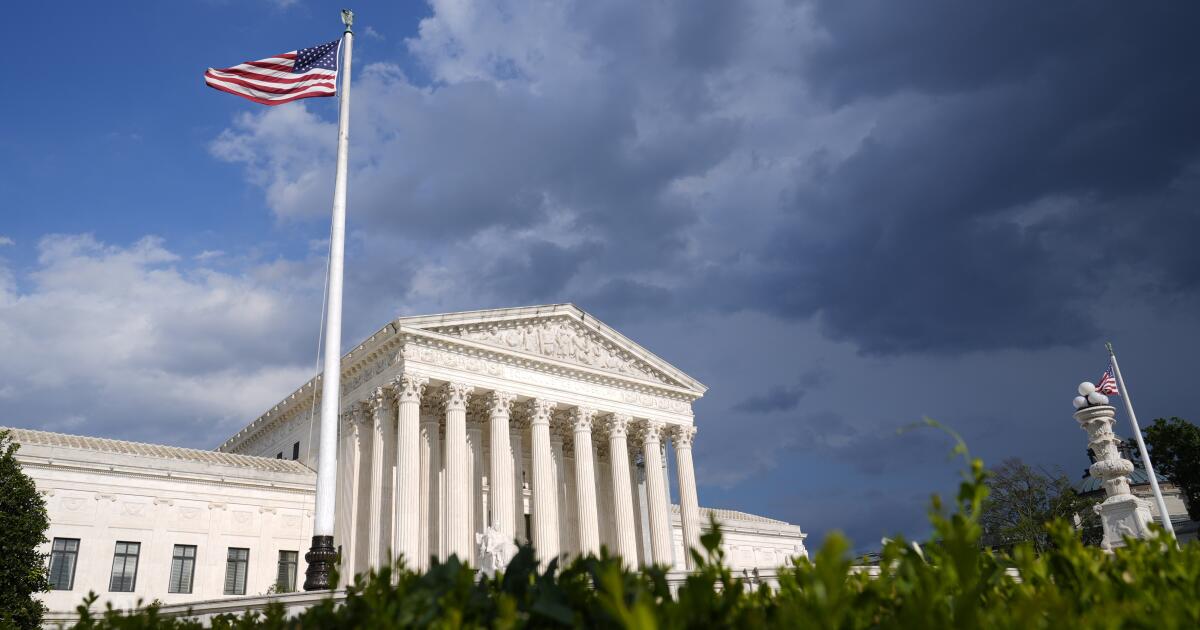
WASHINGTON — The Supreme Court cast doubt Monday on whether police may obtain cellphone data to find crime suspects.
In a 6-3 decision, the justices said this location information showing where a cellphone user has traveled is personal and private and subject to the protection of the 4th Amendment’s ban on unreasonable searches.
Justice Elena Kagan said these “records serve as a personal journal of a user’s movements.”
She said the information “resembles other private materials — think of emails, documents, photographs, or calendars—that even if stored on Google’s servers, a user reasonably views as his own…and reasonably expects to be shielded from the inquisitive eyes of the government.”
Because an “individual has a legitimate expectation of privacy in his cellphone location data,” she said police investigators need a valid search warrant from a magistrate.
The court stopped short of deciding the proper basis for a search warrant in such cases. Instead, the justices sent the case back to judges in Virginia.
But the outcome casts doubt on “geofence warrants.”
In recent years, police have gone to Google and cellphone companies seeking tracking data on cellphones that were at a crime scene. Sometimes, they have had a warrant from a magistrate.
Civil libertarians say the use of this tracking data raises the specter of mass surveillance on innocent people.
Police and government lawyers say no one has a reasonable right to privacy when they are walking on a sidewalk or driving down the street.
The case before the court arose from the armed robbery conviction of a Virginia man who stole $195,000 from a credit union in a small town near Richmond.
By the time police arrived, the robber had fled. But surveillance cameras showed he was carrying a gun and a cellphone.
Lacking other leads, detective Joshua Hilton asked a judge to issue a special type of warrant seeking information from Google.
Referred to as a “geofence warrant,” it seeks data from phones in a particular area at a particular time.
The detective sought data on phones that were within 150 yards of the credit union within one hour of the late afternoon robbery.
After examining and paring down the data, the detective asked for the phone records of Okello Chatrie. Then, with a search warrant of his home, investigators found two robbery-style demand notes, a semi-automatic pistol and about $100,000 in cash.
A judge refused to suppress the evidence from an allegedly unconstitutional search, and Chatrie entered a conditional guilty plea.
The full 4th Circuit Court of Appeals split evenly on the legality of the geofence warrant, and the Supreme Court agreed to decide the issue in Chatrie vs. U.S.
Usually investigators obtain warrants to search the home or vehicle of a known crime suspect.
The new and disputed geofence warrants seek to find a suspect by examining data on the cellphones that were at the scene of a crime.
The FBI used this cellphone data in 2021 to identify suspects who broke through police barricades on Jan. 6, 2021, and pushed their way into the Capitol to disrupt the official counting of electoral votes.
Chief Justice John G. Roberts Jr. and Justices Sonia Sotomayor, Neil M. Gorsuch, Brett M. Kavanaugh and Ketanji Brown Jackson agreed on the outcome in Chatrie vs. U.S.
In a 21-page dissent, Justice Samuel A. Alito Jr. said the court had “carefully set the stage for its planned performance: striking a pose as a great champion of privacy in the digital age. I cannot support this irresponsible escapade.”
Justice Clarence Thomas agreed.
Justice Amy Coney Barrett agreed in a one-paragraph dissent. “Chatrie had no reasonable expectation of privacy in data about his public movements that he voluntarily disclosed to Google,” she said.
The Supreme Court ruled 6-3 that President Trump could fire independent regulators for any reason. But the justices carved out an exception for the Federal Reserve, preventing the immediate removal of Lisa D. Cook, a Federal Reserve governor.
-
 News30 minutes ago
Rep. Tom Kean returns to Congress, says depression is why he went missing for months
-

 Los Angeles, Ca2 hours ago
LeBron James informs Lakers he will play elsewhere next year
-

 Detroit, MI2 hours ago
5 realistic cornerback trade targets for the Detroit Lions after Terrion Arnold’s release
-

 San Francisco, CA2 hours ago
Headlines, June 30 – Streetsblog San Francisco
-

 Dallas, TX2 hours ago
LIVE | Ivory Coast, Norway meet for World Cup knockout match at Dallas Stadium
-

 Miami, FL2 hours ago
Every Dolphins head coach’s start in Miami from worst to best
-

 Boston, MA2 hours ago
Historian clears up one of the biggest myths about the Boston Tea Party
-
Denver, CO3 hours ago
Nemanja Jokic, the older brother of\u00a0Denver …

