Northeast
Reparations in America: How cities from San Francisco to Wilmington are trying to get it done

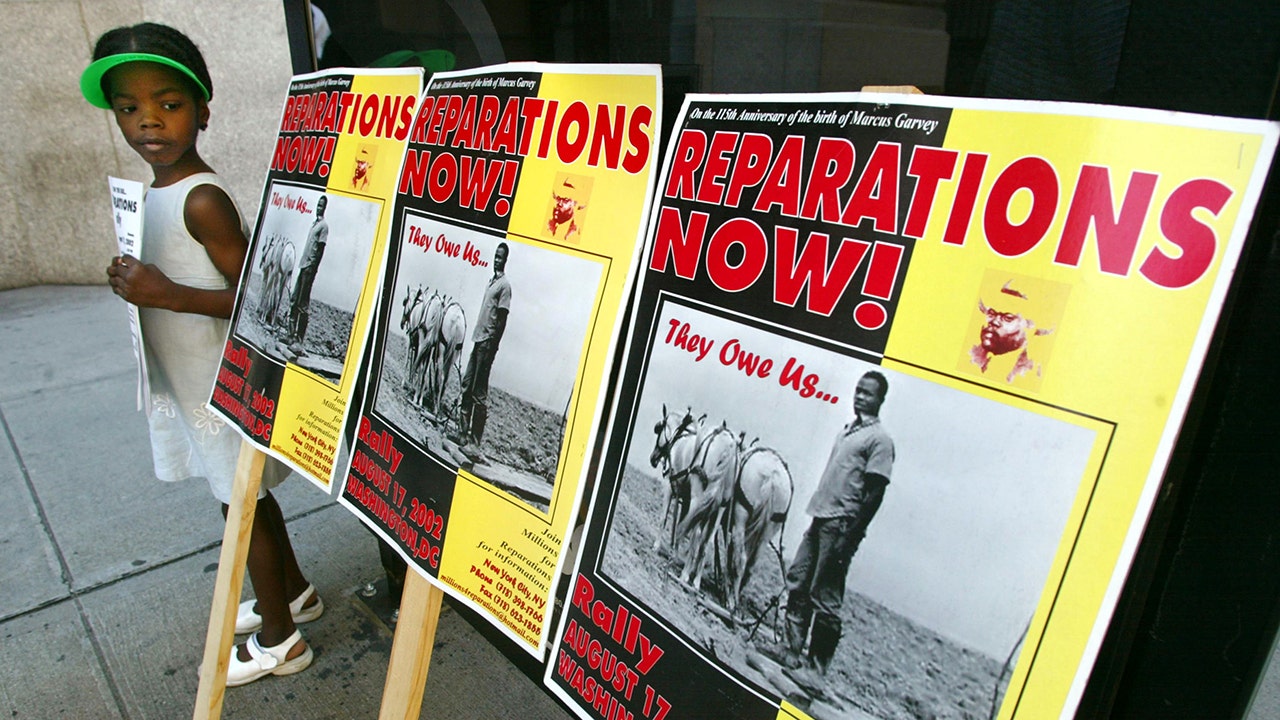
The latest example of an advancement towards reparations happened on Thursday in California, which formally apologized for the state’s role in slavery.
California is part of a trend of local and state governments across the U.S. establishing a task force that would recommend how reparations would be executed.
For example, in Boston, Massachusetts, task force members will propose reparations measures based on historical research and other factors compiled by the experts for City Hall to consider. New York Gov. Kathy Hochul established a reparations task force last year in December.
Reparations can take different forms but broadly refer to payments or other forms of recompense to the descendants of Blacks affected by slavery or past racist policies.
Reparations have also been proposed or expected to be implemented in other cities in California, as well as Fulton County, Georgia; Shelby County, Tennessee; Detroit; St. Paul, Minnesota; and Durham, North Carolina.
BOSTON ACTIVISTS CALL FOR $15 BILLION IN REPARATIONS, SAYS THE CITY MUST ‘FULLY COMMIT TO WRITING CHECKS’
The practice is even being considered at the federal level, with “Squad” member Rep. Jamaal Bowman, D-N.Y., sponsoring a resolution that seeks to establish that the U.S. has a “legal and moral obligation” to institute reparations.
“It’s not that cash payments by themselves are enough. It’s that cash payments are one way to recognize the harm that was done.”
Here is a list of what reparations task force committees are pushing across the U.S.
Wilmington, Delaware wants a ‘Black Wall Street’
The push for reparations is making gains in Wilmington, Delaware, President Biden’s hometown. The Wilmington City Council on May 2 approved recommendations from the local reparations task force.
According to Delaware Online, the 10-member task force was established in December 2022 to investigate the impact of slavery and the Jim Crow laws on Black residents in Delaware.
The investigation led to a 31-page report showing the legacy of slavery in Delaware. Delaware Online reported that the task force found disparities in housing and economic equality, policing, health, environmental justice, and education.
General view of the gate to the access road leading to the home of President Joe Biden in Wilmington, DE on Thursday, January 12. 2023. (Dario Alequin for Fox News Digital)
Per Delaware Online, “In the report, the committee said it identified issues that disproportionately affect African Americans in Wilmington. These include uneven law enforcement, differences in accessing city services, limited benefits from government policies and reduced business opportunities.”
Among a slate of proposals based on the findings of the impact of slavery on Black residents is for the city council to issue a “formal apology” like the state of California and the city of San Francisco.
Other proposals include establishing the Wilmington Reparations Housing Fund that would boost Black home ownership and financially support Black renters. They also want scholarships for health care training and to support young Blacks to access and stay in college, as well as a “Black Wall Street” economic development program in predominantly Black neighborhoods.
Asheville, N.C. pushes guaranteed income program
After two years since the Asheville Reparations Commission was established, the commission members in May voted on recommending a guaranteed income program to distribute payments for people who have been “harmed by historic, systemic, and ongoing wage and employment discrimination.”
According to commission documents, the members seek to “fund a guaranteed income program as a way to ensure basic needs are met for individuals with low-income and assets.”
The guaranteed income program is among four projects pushed forward by the commission.
Furthermore, the commission wants an Economic Development Center “designed for and led by Black residents,” to establish a Support for Existing Neighborhood Plans, and an Incentives Reparations Accountability Council.
The 25 members of the Reparations Commission were appointed by Asheville City Council on March 8, 2022.
San Francisco proposed $5 million in cash payments
The San Francisco Board of Supervisors put out an official apology last month – an eight-page resolution that stated, “The San Francisco Board of Supervisors offers its deepest apologies to all African Americans and their descendants who came to San Francisco and were victims of systemic and structural discrimination, institutionalized racism, targeted acts of violence, and atrocities.”
CIVIL RIGHTS ATTORNEY ARGUES CASH PAYMENTS TO DESCENDANTS OF SLAVES ‘RECOGNIZE THE HARM DONE’ FROM SLAVERY
When the San Francisco African American Reparations Advisory Committee published its final recommendations last July, it said that “the City and County of San Francisco and its agencies must issue a formal apology for the past harms, and commit to making substantial ongoing, systemic, and programmatic investments in Black communities to address historical harms.”
Despite the committee’s efforts to rectify the past with a symbolic apology, members of the committee and scholars voiced that such a resolution was not enough.
San Francisco Mayor London Breed recently announced budget cuts that gutted the city’s proposed Office of Reparations. (Justin Sullivan/Getty Images)
The resolution comes after the committee argued the city owed millions of dollars in compensation to Black residents for decades of discrimination. The committee proposed that eligible Black adult residents receive $5 million in cash payments and a guaranteed income of nearly $100,000 a year to address the racial wealth gap in the city.
According to the L.A. Times, the city’s mayor, London Breed, said that $5 million payments could amount to $100 billion, far more than the city’s $14 billion annual budget. The Times added that Breed is not committed to cash reparations.
Boston activists call on White churches to step up
Boston Mayor Michelle Wu announced in January that the city has established teams that will play a role in their reparations task force.
After examining the city’s slavery history and its impact on current residents, the Boston Reparations Task Force will create a report of recommendations “for reparative justice solutions” to aid Black residents for the city officials to consider. The task force members in March called on “White churches” to step up and pay the Black community back for racial inequities that root back to the trans-Atlantic slave trade, according to reports.
Rev. Kevin C. Peterson, the founder of the New Democracy Coalition and the Faneuil Hall Race, delivered remarks at a press conference in Roxbury to announce a proposal on how the City of Boston should implement reparations. (Rev. Kevin C. Peterson)
Grassroots activism has emerged amid the city’s push to formalize reparations. In February, the Boston activists called for the city to “fully commit to writing checks” and for a $15 billion payout since the city’s wealth was built on slavery.
Evanston, Illinois touts being a model of reparations
Evanston, Illinois, was the first city in the nation to pass a reparations plan, pledging $10 million over 10 years to Black residents.
Robin Rue Simmons, the former alderman for Evanston, Illinois, spoke at a meeting with civil rights leaders in Annapolis, Maryland, in July last year. The alderman encouraged other cities to follow Evanston’s example.
Maryland proposes tax increase
A Maryland lawmaker wants to increase taxes to invest in reparations efforts.
Sen. Jill Carter, D-Baltimore City, sponsored the Maryland Reparations Act of 2024, calling for a “certain amount of revenue from the State individual income tax and Maryland estate tax to be distributed to the Community Reinvestment and Repair Fund.”
Maryland established the Community Reinvestment and Repair Fund in 2023 to provide funds to organizations that would serve the individuals “most impacted by disproportionate enforcement of cannabis prohibition before July 1, 2022.” Carter’s bill would allocate more funding to the Community Reinvestment and Repair Fund by changing the state’s tax code.
Per state law, the money would service low-income individuals and “disproportionately impacted areas.”
California issues apology, yet cash payments not included
The California Assembly passed a bill Thursday that will accept responsibility for “all of the harms and atrocities committed by the state” and will head to the Senate, the Los Angeles Times reported. AB 3089 was passed unanimously among Democrats, but some Republicans abstained from voting.
The Golden State’s Legislative Black Caucus in February introduced a series of reparations measures in response to a report from the state’s reparations task force that detailed how systemic discrimination impacted Blacks within the state and across the country.
However, cash payments did not make it into the package.
Los Angeles, California-Sept. 22, 2022-Honorable Reginald Jones-Sawyer is a member of the California Reparations Task Force which gathered to hear public input on reparations at the California Science Center in Los Angeles on Sept. 22, 2022. ((Carolyn Cole / Los Angeles Times via Getty Images))
According to a news release, the 14 bills proposed address criminal justice reform, discrimination against certain types of hairstyles in sports, and dissolving criminal histories that have become a barrier to obtaining a business license.
SAN FRANCISCO’S PROPOSED REPARATIONS PLAN COULD COST CITY $100 BILLION: REPORT
California Gov. Gavin Newsom declined to endorse the cash payments — which could reach as high as $1.2 million for a single recipient — recommended by his reparations task force, telling Fox News Digital that dealing with the legacy of slavery “is about much more than cash payments.”
U.S. House of Representatives bill calls for $14 trillion
“Squad” member Rep. Bowman wants the federal government to be held accountable for slavery and the aftermath of it.
According to the Journal News, the lawmaker wants the federal government to push a $14 trillion reparations measure.
Bowman is among nine sponsors of H.R. 414, which seeks to establish that the U.S. has “a moral and legal obligation to provide reparations for the enslavement of Africans and its lasting harm on the lives of millions of Black people in the United States.”
The measure, introduced in 2023, would prompt the federal government to spend $14 trillion on a reparations program that would support the descendants of enslaved Black people and people of African descent. Blacks make up 12% of the population in the U.S., according to Census figures.
House Democratic Rep. Jamaal Bowman sponsored a resolution that seeks to establish that the U.S. has a “legal and moral obligation” to institute reparations. (Bill Clark/CQ Roll Call via Getty)
The measure to establish a federal commission on the impact of reparations was reintroduced this year and Bowman is a sponsor of it. The measure could address concerns over perceived racial disparities in housing, mass incarceration and education outcomes, and, as the bill states, “eliminate the racial wealth gap that currently exists between Black and White Americans.”
Bowman believes that the $14 trillion could be distributed over decades.
St. Louis University called to pony up $74 billion
St. Louis University stands out to be the only example of reparations being pushed outside a municipality. Descendants of the enslaved Black people who built the university calculated that they were owed up to $74 billion in unpaid labor.
Reparations developing on the higher education front show that the measure could be manifested in other ways outside of local and state governments.
A civil rights attorney representing descendants of the enslaved Black people who built St. Louis University shared how cash payments are one way of recognizing the harm done by slavery.
“It’s not that cash payments by themselves are enough. It’s that cash payments are one way to recognize the harm that was done,” civil rights attorney Areva Martin told Fox News Digital.
Read the full article from Here


When Americans think of the beverage that fueled the American Revolution, they usually picture black tea — but it turns out that green tea was just as popular.
The Founding Fathers and their contemporaries drank both types of tea, Bruce Richardson, the Kentucky-based founder of Elmwood Inn Fine Teas, told Fox News Digital.
British subjects “were as likely to be drinking green tea as black tea, whether you were in Jane Austen [era] England … or you were in colonial Boston,” he added.
“There were five teas, all from China, because that was the only country that was exporting tea,” Richardson said. “And of those five different teas, two of them were green and three of them were black.”
Richardson, a tea historian who works as the tea master at the Boston Tea Party Ships & Museum, said the five types of tea dumped into Boston Harbor in protest of the Tea Act of 1773 included three black varieties — Bohea, Souchong and Congou — as well as the green teas Hyson and Singlo.
Bohea, the most common and least expensive black tea of the era, was often made from older tea leaves harvested after the highest-quality leaves of the season had already been picked.
Most of the tea dumped into Boston Harbor was Bohea, Richardson said — and it was so ubiquitous that he compared it to the way Kleenex has become synonymous with tissues today.
“It was so common that often teapots at the time, or some that I’ve seen, would say Bohea on the side of the teapot,” he said. “If they wanted tea, they’d say, ‘I’ll have a cup of Bohea.’ It was that common.”
Not only did colonial Americans distinguish between green and black tea, they even stored them differently.
“They still wanted their tea time, but they didn’t want to support the British government.”
“The well-to-do people would have a tea caddy – a wooden, beautifully made tea caddy to store their tea in,” he said.
“It was kept under lock and key. And in that tea caddy, [there] would be two compartments, one for green tea and one for black tea.”

Merchants often favored black tea because it held up better during the long voyage from China to Europe and onward to the American colonies, Richardson said.
“The green tea was what China had always drunk,” he said.
“And so they were exporting that as well, but they found that the black tea actually made the voyage better than the green teas.”
Even after many colonists swore off British tea, they kept the ritual of drinking it — or at least a close substitute.
Many patriots brewed so-called “Liberty Teas” made from ingredients such as dried apples, blueberries, chamomile and herbs grown in their gardens.
“They still wanted their tea time, but they didn’t want to support the British government,” Richardson said.


-

 Wyoming4 minutes ago
Free Crow Culture Program at Fort Phil Kearny
-

 Crypto7 minutes ago
UK investors sue Binance in London for £150 million
-

 Finance12 minutes ago
What the Supreme Court’s campaign finance ruling means for the 2026 election
-

 Fitness19 minutes ago
I pushed myself too hard at the gym – and ended up in the hospital
-

 Movie Reviews27 minutes ago
Young Washington (Christian Movie Review) – The Collision
-

 World37 minutes ago
Neon Closing in on Luca Guadagnino’s Sam Altman Open AI Movie ‘Artificial’ After Amazon Drops Controversial Film
-
 Lifestyle1 hour ago
‘Dead but Dreaming of Electric Sheep’ is full of beautifully written grotesqueries
-

 Technology1 hour ago
Google’s NotebookLM can sum up your research in a TikTok-style clip

