Northeast
NY AG taunts Trump about interest he owes on civil fraud judgment

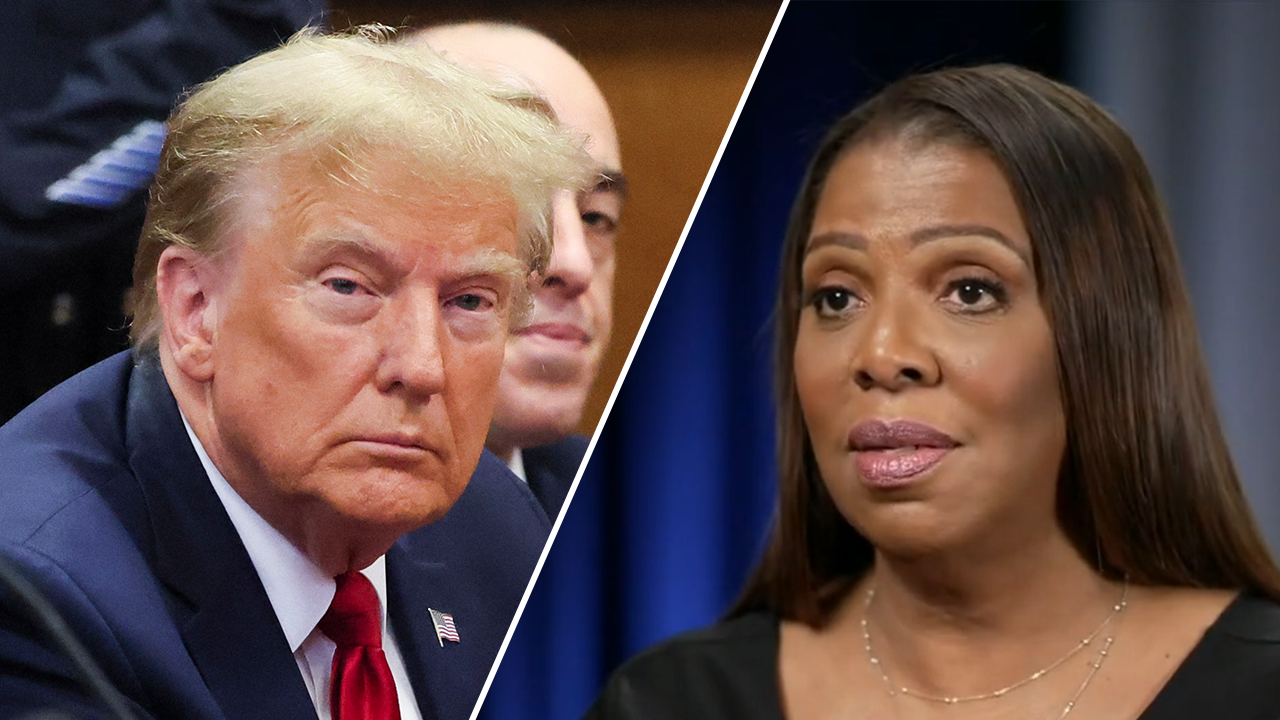
New York Attorney General Letitia James appeared to taunt former President Trump about the interest he may own in a civil fraud judgment.
Trump’s legal team on Monday appealed a Feb. 16 ruling from New York Judge Arthur Engoron’s finding him liable for more than $350 million in damages in the civil fraud case brought against him by James. Engoron ordered Trump to pay just over $354 million, with post-judgment interest accruing at nearly $112,000 per day.
“In a massive victory, we won our case against Donald Trump for engaging in years of incredible financial fraud to enrich himself. Trump, Donald Trump, Jr., Eric Trump, and his former executives must pay over $450 million in disgorgement and interest,” James wrote on X, celebrating on the same day of the judgment.
On Feb. 23, James, who has denied having a “personal vendetta” against Trump despite remarks suggesting otherwise, posted flatly, “$464,576,230.62.”
“+$114,553.04,” she added in another post the next day, referring to the potential added interest Trump may be on the hook for.
TRUMP APPEALS RULING IN MASSIVE NY CIVIL FRAUD CASE
Again, on Feb. 25, James posted, “+$114,553.04 = $464,805,336.70.”
New York Attorney General Letitia James said she is “prepared” to ask the judge to seize former President Trump’s assets if he cannot pay the $354 million judgment handed down in his civil fraud case. (ABC News/Screenshot/Brendan McDermid-Pool/Getty Images)
James’ case also targeted Trump’s family and the Trump Organization.
Engoron ruled that Trump and co-defendants – his adult sons, Donald Trump Jr. and Eric Trump and two former Trump Organization executives – were liable for “persistent and repeated fraud,” “falsifying business records,” “issuing false financial statements,” “conspiracy to falsify false financial statements,” “insurance fraud,” and “conspiracy to commit insurance fraud.”
The former president’s lawyers filed notices of appeal Monday, asking the state’s mid-level appeals court to overturn Engoron’s Feb. 16 verdict in James’ lawsuit and reverse staggering penalties that threaten to wipe out Trump’s cash reserves.
Former President Trump, center, surrounded by South Carolina Gov. Henry McMaster and Lt. Gov. Pamela Evette, on Feb. 24, 2024 in Columbia, South Carolina, before Trump defeated opponent Nikki Haley in the state’s Republican primary. (Win McNamee/Getty Images)
Trump’s lawyers wrote in court papers that they are asking the appeals court to decide whether Engoron “committed errors of law and/or fact” and whether he abused his discretion or “acted in excess” of his jurisdiction. A notice of appeal starts the appeals process in New York. Trump’s lawyers will have an opportunity to expand on their grievances in subsequent court filings.
TRUMP VISITS MANHATTAN COURT TO BLAST NYAG CASE, PRAISES APPELLATE RULING IN HIS FAVOR
Trump was not required to pay his penalty or post a bond in order to appeal, and appealing will not automatically halt enforcement of the judgment.
The Republican presidential frontrunner has until March 25 to secure a stay, a legal mechanism pausing collection while he appeals. Trump would receive an automatic stay if he puts up money, assets or an appeal bond covering what he owes. Trump’s lawyers could also ask the appeals court to grant a stay without obtaining a bond or with a bond for a lower amount.
New York Attorney General Letitia James addresses the verdict against former President Trump in a civil fraud trial on Feb. 16, 2024 in New York City. (Michael M. Santiago/Getty Images)
There was no indication on the court docket Monday that Trump had already posted an appeal bond or asked for a stay, according to The Associated Press.
“We trust that the Appellate Division will overturn this egregious fine and take the necessary steps to restore the public faith in New York’s legal system,” Trump lawyer Alina Habba said.
Trump maintains that he is worth several billion dollars and testified last year that he had about $400 million in cash, in addition to properties and other investments.
James, a Democrat, told ABC News that if Trump is unable to pay, she will seek to seize some of his assets.
Trump said Engoron’s decision, the costliest consequence of his recent legal battles, was “election interference” and “weaponization against a political opponent.” Trump said he was being punished for “having built a perfect company, great cash, great buildings, great everything.”
Fox News’ Anders Hagstrom and The Associated Press contributed to this report.
Read the full article from Here

Boston, MA
Celtics’ Jaylen Brown trade leaves Boston fans, community feeling bankrupt: ‘A huge void’

Jaylen Brown came to Boston in 2016 as a raw lottery pick out of California; he leaves a decade later, following a stunning trade to Philadelphia, as an NBA champion and an essential piece of the city’s social fabric.
“What this trade does is show young fans what sports heartbreak is,” Celtics superfan Chris Soldani told the Herald. “There is now a huge void, and a lot of people don’t know how to process this situation.”
Look no further than Randolph for proof. Immediately after learning about the trade, 6-year-old Giovanni “Gio” Jean cried uncontrollably while wearing a No. 7 Celtics jersey autographed by Brown.
His mother, Gigi Durand, captured the moment on video as Gio sobbed, “You are my favorite player in the whole NBA.” Holding up a handmade sign pleading for his idol to “come back one day,” the youngster asked his mother to mail it.
The footage went viral, racking up over 10 million views and drawing a direct response from Brown: “It’s ok lil bro,” he posted, adding a heart emoji. “We will always be friends.”
That instinct to connect directly with the fan base is exactly what drew superfans like Soldani to Brown.
In early May, Brown invited Soldani — known as “Caveman on Causeway” — and several others onto a Twitch livestream he hosted just after the 76ers eliminated Boston. The stream stirred controversy as the longtime Celtic described last year as the favorite of his career despite playing most of it without Jayson Tatum.
Soldani called the bond “one of the most unlikely connections.”
Under the blockbuster deal, Boston sends the 29-year-old 2024 Finals MVP to their bitter Atlantic Division rival for 36-year-old veteran Paul George and four draft picks. Fans say it will take time to overcome losing a superstar who doubled as one of Massachusetts’ most impactful civic anchors.
“With all the impact that Jaylen has on the city, and the youth, and putting money into the city,” Soldani said, “it truly bankrupts the city as a community.”
This spring, Boston Magazine ranked Brown the eighth most influential Bostonian, detailing his work hosting fundraising bowling events and education fairs in Roxbury.
That legacy echoes across local sports talk radio as fans process the gamble taken by front-office architect Brad Stevens — a decision complicated by reports that Brown feels his decade of service ended without the mutual respect he earned.
Gov. Maura Healey noted on social media that it’s “hard to imagine” the Celtics without Brown. She added, “You’ll always have a home in Boston.”
In 2019, Brown founded the 7uice Foundation, a nonprofit providing healthcare, education, and digital literacy resources to underserved youth through its STEM-focused Bridge Program camp.
The work recently drew criticism from the Massachusetts Fiscal Alliance, a state watchdog, after lawmakers approved a $700,000 state earmark for the charity.
“Jaylen Brown is expected to earn roughly $60 million this year,” the Alliance posted. “If he wants to support charitable work through his foundation, that’s commendable. But why are Massachusetts taxpayers being asked to subsidize the private foundation of a multi-millionaire?”
In 2024, Brown also launched the Boston XChange with teammate Jrue Holiday, an incubator aiming to generate $5 billion in wealth for communities of color by providing $100,000 in funding to 10 local businesses annually.
Superfan KJ Green, creator of the “Green Runs Deep” brand, cut straight to the raw reality: “I want to (expletive) die right now.”
Green, who also appeared on the May livestream, praised Brown for making fans feel seen and knowing them by name. “This guy cared about using his platform to build other people up,” Green said. “He helped so many businesses in Boston get to the next level.”
For special education teacher Kaiya Santos, who partnered with Brown in 2023 to redesign a basketball court at Fenelon Street Playground in Dorchester, the loss is personal. “It was clear that the project was not just about beautifying a court,” Santos told the Herald. “It was about the role the space would play in the community. Boston will miss him.”
Mayor Michelle Wu thanked Brown for “shifting the energy” and always “showing up” for the city, even as he became a “Celtics great.”
“We won’t forget the looks on young players’ faces as you pulled up unannounced to tournaments in the park,” Wu posted, “or the hope and determination of entrepreneurs and students reaching for their dreams through the opportunities you made possible. Because of your example, kids in Boston know that faith, consistency, hard work pays off.”
For now, the city seems unwilling to let go: Brown’s larger-than-life posters still hang untouched inside the TD Garden ProShop and throughout the busy North Station concourses.

Noah Kahan is appropriating Will Toledo’s culture. The viral folk star’s eventful Great Divide tour happened to stop by Pittsburgh last night while the furry convention was in town, and he was for some reason very excited about that, welcoming the furries and even trying on the head of an audience member’s furry costume.
“Pittsburgh: if you are caught between attending the worlds largest furry convention or my show tonight then please know you are welcome to combine the two,” Kahan wrote on X before the show. Responding to a poster who asked what his fursona would be, he posted “Squid man.”
“Furries are welcome. All the animal kingdom is welcome tonight,” Kahan then said onstage at PNC Park. “I don’t see any so far but I will be looking and asking a lot of questions after the show.” At the prop payphone booth that’s been a part of his show setup, he took a phone call from the “National Center For Furry Awareness” and learned furries do not necessarily have sex in their suits.
“The National Center For Furry Awareness? Oh, they don’t have sex… not necessarily? Okay, well that’s good to know.”
“If there are any furries in the crowd, say, ‘Hell yeah,’” he added to a mostly furryless crowd. Watch below.

As Hartford celebrated America’s 250th birthday Saturday, one of the city’s oldest attractions welcomed visitors for one of the few days each year when admission is free.
The Bushnell Park Carousel opened its doors at no cost as part of the city’s Independence Day festivities, giving families a chance to experience a piece of Hartford history while escaping the summer heat.
“It’s one of the most incredible pieces that we have here in downtown Hartford,” said Morgan Fippinger, executive director of the Bushnell Park Conservancy.
The carousel itself is older than many visitors realize.
“It is a 1914, so it’s a true antique carousel,” Fippinger said.
For many Hartford residents, the carousel has long been a fixture in Bushnell Park. For others, including newcomers to the city, it offered a chance to experience one of Hartford’s most recognizable landmarks for the first time.
Fippinger said the free ride day is one of the conservancy’s ways of participating in Hartford’s celebration of America’s 250th birthday.
“The free days when we have thousands of people in the park, it can be a lot,” Fippinger said. “It’s a lot of impact on the park and the infrastructure of the park. But also it’s an amazing time for so many people that are not necessarily always from Hartford, get to come in and see the amazing resources that Hartford has.”
While the Bushnell Park Conservancy cares for much more than the carousel, Fippinger said the attraction often serves as an introduction to the city’s rich history.
“There’s an amazing amount of history here, resources here,” Fippinger said. “And, you know, so we are kind of the eyes and ears for the City of Hartford.”
The air-conditioned carousel building also offered visitors a chance to cool off as temperatures climbed during the holiday celebration.
“We do want to make sure that everybody stays hydrated,” Fippinger said. “And the carousel building is air conditioned. So if people are feeling hot or feeling like they need to get cool, they can come in and take a ride. Plus, when you’re on the ride, it feels amazing.”
-
 Lifestyle30 minutes ago
But first, coffee: The drink that energized the American Revolution
-

 Technology38 minutes ago
NASA launched an emergency mission to stop the Swift Observatory from crashing to Earth
-

 World45 minutes ago
Tens of thousands of far-left protesters clash with police in anti-conservative party riots
-

 Politics48 minutes ago
Trump set to deliver ‘historic’ speech celebrating America’s 250th anniversary
-

 Health53 minutes ago
The ‘1776 Diet’: What Americans really ate during the nation’s founding
-

 Sports1 hour ago
Kylian Mbappé’s seventh goal of the World Cup lifts France past Paraguay in physical Round of 16 match
-
 Business1 hour ago
California is bringing back EV rebates. This is how to get one
-
 Entertainment1 hour ago
Comedy saved her life. Now Teruko Nakajima’s ‘Made in America’ is saving others

