New Hampshire
More NH water systems need to treat for PFAS chemicals under new federal rules

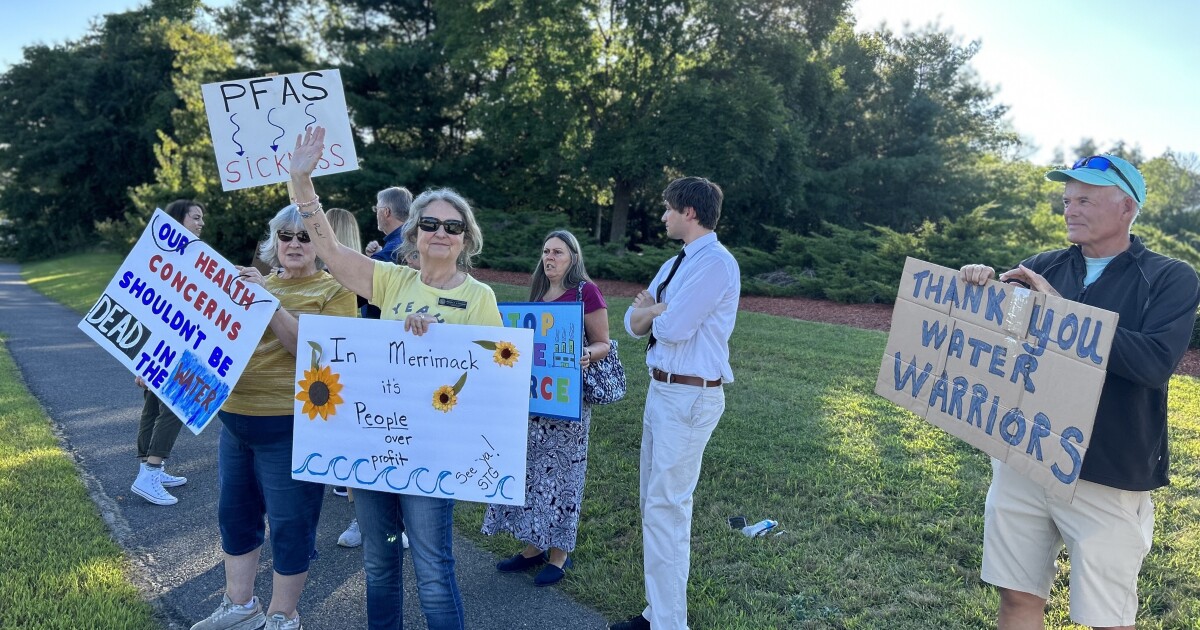
Advocates in New Hampshire are celebrating new federal regulations to limit PFAS chemicals in drinking water, after years of fighting for stronger protections for communities that have suffered from contaminated water.
That group of man-made chemicals have been used for decades in consumer products — especially those that are waterproof, stain resistant, or non-stick. They’re often called “forever chemicals,” because they persist and accumulate in the environment and in peoples’ bodies.
Studies show most people in the U.S. have some PFAS in their blood, and long-term exposure can cause cancer or other negative health effects.
New Hampshire was the first state to require local water systems, landfills, and wastewater plants to test for PFAS and treat water that had been contaminated on a regular basis. In 2019, the state adopted the strictest standards in the U.S. at the time.
But the federal regulations announced Wednesday limit certain kinds of PFAS to lower levels than New Hampshire does currently — limiting two main PFAS chemicals, PFOA and PFOS, to 4 parts per trillion, others to 10 parts per trillion, and implementing limits on mixtures of certain PFAS.
“This certainly isn’t the end of the road; there’s a lot more work to be done, but this is a humongous step in the right direction and one that will benefit so many people,” said Andrea Amico, a longtime advocate who started the group Testing for Pease after her family was exposed to PFAS on the former Pease Air Force Base on the Seacoast.
Next month, Amico said, it will have been a decade since she first learned about the contamination.
“I was shocked 10 years ago when I first learned about PFAS contamination in our public drinking water and couldn’t understand how these chemicals weren’t regulated, how there were no laws to protect people from drinking this,” she said. “Ten years is a long time. But I’m just really grateful that we’re at this point and that this is a huge milestone that we can continue to build off of.”
Implementing new standards
Under the new federal rules, regulated water systems will have three years to monitor for chemicals and five years to treat the water to reduce levels. That treatment could include installing technologies like granular activated carbon or reverse osmosis in contaminated water systems, or shutting down contaminated wells and finding uncontaminated sources of water.
The EPA says $9 billion will be available through the Bipartisan Infrastructure Law to fund PFAS remediation and another $12 billion is available for general drinking water improvements that could include PFAS.
In New Hampshire, state officials said the new regulations could double the number of water systems and private wells in New Hampshire that exceed legal standards.
New Hampshire Department of Environmental Services Commissioner Bob Scott said the state anticipated the new federal standards — but, he said, there could be barriers to implementing them.
“We expect that these lower federal drinking water standards will result in more water systems and private well owners needing financial assistance to be in compliance, which will require a greater commitment on behalf of the federal government than the funding mentioned in their announcement,” he said in a written statement.
State officials said addressing PFAS contamination in New Hampshire has already cost more than $300 million, a cost they say has fallen on state and local governments. In the statement from the Department of Environmental Services, officials said the cost of complying with the new regulations would be more than what state and federal assistance could cover.
In their fact sheet on the new rules, the EPA said the benefits of addressing PFAS exposure would justify the costs.
“Fewer people will get cancer or liver disease, pregnant women will have reduced risks, and more and children and infants will be stronger and grow healthier,” the agency said.
Federal officials estimated that compliance with the new rules would cost $1.5 billion per year nationally — a cost they said was equal to the avoided expenses of medical bills, income lost to illness and death.
For communities whose PFAS contamination comes from a specific source — like the Department of Defense, at the former Pease Air Force Base — the party that created the contamination should be responsible for the cost of cleaning it up, said Amico with Testing for Pease.
New Hampshire lawmakers have tried to implement other measures to limit the amount of PFAS residents are exposed to, including an effort this year to place restrictions on products with intentionally added PFAS, and another to require notice of PFAS contamination prior to selling property.
Laurene Allen, a co-founder of Merrimack Citizens for Clean Water, said the news of federal regulations was welcome. She’s hoping New Hampshire’s timeline for implementing them will be faster than other parts of the country.
“I’m really relieved and happy. And I also strongly urge the state of New Hampshire to adopt these standards as soon as possible, not to wait for the full phase in period, because we don’t need to. We are ahead of the nation, we have done the testing,” she said. “We can lead the nation. We can do right by the people of New Hampshire.”
She said the town of Merrimack’s success in addressing PFAS contamination in public water and minimizing local financial impacts shows that it is realistic and attainable to remediate on a larger scale.
“Lives are at stake here,” she said. “That’s what we have to remember.”



New Hampshire
Abandoned Camper Fire On South Main Street Knocked Down By Concord Fire And Rescue Teams

CONCORD, NH — The Concord Fire Department is investigating the cause of a camper fire on South Main Street late Friday night.
Around 11:30 p.m., fire and rescue teams were sent to South Main Street, not far from Langdon Avenue, for a report of a camper on fire. Dispatch said it was unknown if anyone was inside or if the camper was abandoned.
“We have a couple of calls on it,” a dispatcher said. “It’s fully involved.”
A few minutes later, the fire was confirmed, and firefighters worked to extinguish it. The battalion commander confirmed no one was inside, and it appeared to be abandoned. Dispatch said, if they recalled correctly, the camper had been there for “quite a while.”
News 603 posted videos from the scene on Facebook here:
And here:
The bulk of the fire was knocked down after about 20 minutes, with firefighters overhauling and dealing with “the hot spots.”
Not long after the overhaul update, firefighters were sent to a business on South Main Street, near the camper fire, in response to a report of an alarm activation.
After investigating, there did not appear to be an activation at the business, a commander said. Later, dispatch said the alarm appeared to restore itself automatically. Firefighters cleared the scene of the business alarm just after midnight on Saturday.

A 20-story tall, 1.3 million-pound Atlas V rocket will blast off from Florida this weekend, and Granite Staters waking up very early might able to see it if the clouds in the sky don’t cover it.
Teams with United Launch Alliance are prepping for the Atlas V rocket launch, the fifth Amazon Leo constellation mission. Liftoff is planned at 3:53 a.m. ET Sunday, March 29, 2026, from Cape Canaveral, Florida.
Pending weather conditions and cloud cover, the Atlas V-Amazon Leo predawn launch could be visible from Florida to New England, according to ULA. That is, if their city falls on the ULA Atlas V rocket launch visibility map (see below), and if they’re awake at the time of liftoff.
The Atlas V rocket will be equipped with five solid rocket boosters to launch the next batch of Amazon Leo broadband satellites (previously referred to as Project Kuiper) into low-Earth orbit, giving a great show to those watching.
However, weather could disrupt viewing, as the New Hampshire area on the visibility map is set for isolated snow showers before 10 p.m. on Saturday night as well as partly cloudy skies, the National Weather Service said.
Here’s what to know about ULA Atlas V rocket launch visibility from New Hampshire.
When will ULA Atlas V launch?
The United Launch Alliance Atlas V rocket will launch from Launch Complex 41 at Cape Canaveral Space Force Station in Florida in the early morning hours on Sunday, March 29. The 29-minute launch window will begin at 3:53 a.m.
The visibility map provided by ULA shows about when and where your best chances are to see the rocket as it streaks northeasterly into space.
Will New Hampshire be able to see the ULA Atlas V launch
New Hampshire, specifically just outside Concord, New Hampshire, falls in the semi-outer periphery of the visibility area for the ULA Atlas V rocket launch, according to ULA’s visibility map.
Estimated visibility will occur at launch +330 seconds, or about five minutes and 30 seconds, following the launch in Florida. However, viewing chances depend on weather conditions, and Concord, New Hampshire is currently set for isolated snow showers before 10 p.m. and then partly cloudy skies on Saturday night into Sunday morning, according to the National Weather Service. This might block visibility, as clear skies are essential for best views.
What is ULA Atlas V?
United Launch Alliance’s Atlas V rocket is a spacecraft with five solid rocket boosters that will send a batch of Amazon Leo broadband satellites into outer space, to low-Earth orbit.
How can you follow along live?
FLORIDA TODAY will offer live coverage via a live webcast with live tweets and updates for the rocket launch.

JUPITER ISLAND — Tiger Woods showed signs of impairment Friday at the scene of a car crash in which he struck another vehicle and rolled his Land Rover, authorities said.
Woods was arrested on suspicion of DUI. The Martin County Sheriff’s Office said Woods was not injured.
The crash occurred just after 2 p.m. not far from where Woods lives on Jupiter Island.
Woods’ manager at Excel Sports did not immediately respond to a text message seeking information.
This was at least the third time Woods has been involved in a car crash, most recently in February 2021 when his SUV ran off a coastal road in Los Angeles at a high rate of speed, leading to multiple leg and ankle injuries. Woods said later doctors considered amputation.
Woods has played 11 tournaments since that 2021 crash, not finishing closer than within 16 shots of the winner the four times he finished 72 holes.
He also was arrested on a DUI charge in 2017 when south Florida police found him asleep behind the wheel of his car that was parked awkwardly with damage to the driver’s side. Woods said he had taken a bad mix of painkillers. He later pleaded guilty to reckless driving.
Woods won his fifth Masters, and 15th major, in 2019. He has 82 wins on the PGA Tour, tied for the all-time record with Sam Snead.
Woods, 50, had been working his way back to golf from a seventh back surgery in September. He had not decided whether he could play in the Masters on April 9-12.
His last official tournament was the British Open in 2024. Woods ruptured his Achilles tendon in March 2025 and that kept him off the course all season even before the back surgery. He managed to play in his indoor TGL golf league on Tuesday night.
He has kept deeply involved in PGA Tour affairs as chairman of the Future Competition Committee that is restructuring the model of the tour.
Woods also faced a soft deadline at the end of the month to decide whether to become U.S. Ryder Cup captain for the 2027 matches in Ireland. Woods was offered the job for the last Ryder Cup and did not turn it down until June. The PGA of America wants a decision much sooner this time.
Copyright 2026 NPR

‘The Comeback’ is back. That’s something to Cherish

The best deals we’ve found from Amazon’s Big Spring Sale (so far)

Zelenskyy offers cutting-edge drone defense to Gulf allies as Ukraine seeks missile support

JD Vance says he was ‘obsessed’ with UFOs, believes aliens are actually ‘demons’

Hormone therapy boosts weight loss drug results by 35% in women, study finds

Florida High School Football Rankings: Top 25 teams – Oct. 21

How old is Bo Nix? What to know about Oregon quarterback ahead of 2024 NFL Draft

Cleary's 21 help Le Moyne down Central Connecticut State 69-64 in OT

99th annual Pony Swim held in Virginia

Indiana Members Credit Union announced as new anchor tenant at Bottleworks District
JD Vance says he was ‘obsessed’ with UFOs, believes aliens are actually ‘demons’
The EU's recipe for trade deals : easy on beef, tough on wine

Photos: ‘No Kings’ protests across the country

Jeffries declines to break with indicted Democrat after ethics panel’s guilty verdict

Hundreds of thousands march through London in stand against the far right
-

 Sports1 week ago
IOC addresses execution of 19-year-old Iranian wrestler Saleh Mohammadi
-

 New Mexico6 days ago
Clovis shooting leaves one dead, four injured
-

 Tennessee5 days ago
Tennessee Police Investigating Alleged Assault Involving ‘Reacher’ Star Alan Ritchson
-

 Technology7 days ago
YouTube job scam text: How to spot it fast
-

 Minneapolis, MN3 days ago
Boy who shielded classmate during school shooting receives Medal of Honor
-

 Texas1 week ago
How to buy Houston vs. Texas A&M 2026 March Madness tickets
-

 Science1 week ago
Record Heat Meets a Major Snow Drought Across the West
-

 Politics1 week ago
Schumer gambit fails as DHS shutdown hits 36 days and airport lines grow