Connect with us

New Hampshire

More NH water systems need to treat for PFAS chemicals under new federal rules

Published

on

More NH water systems need to treat for PFAS chemicals under new federal rules


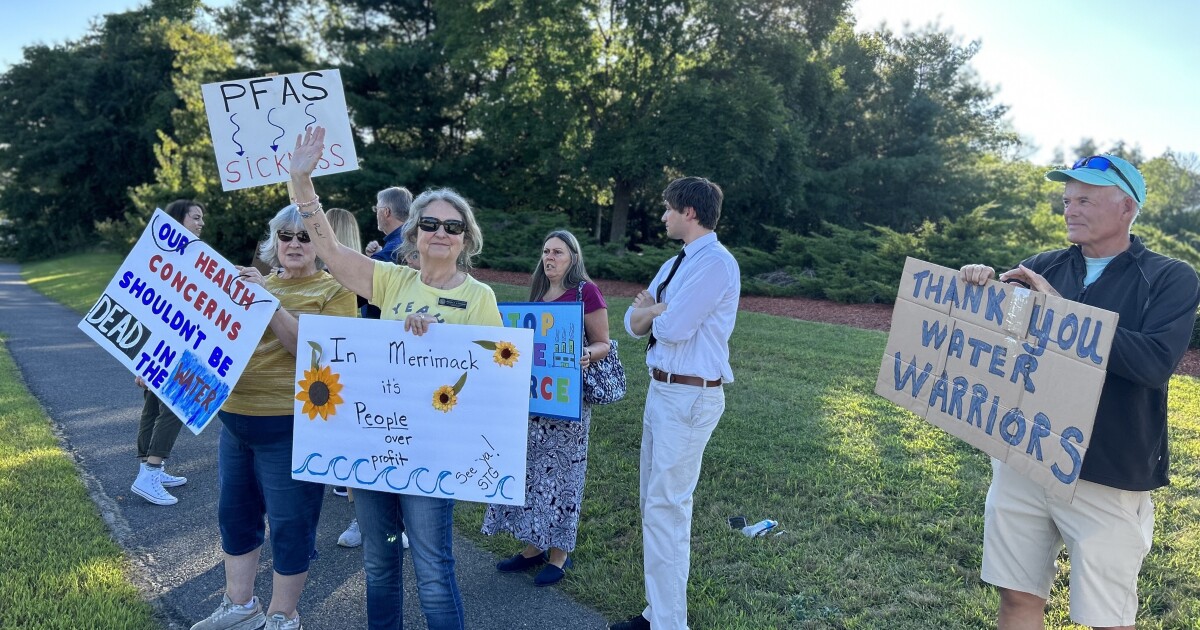
Advocates in New Hampshire are celebrating new federal regulations to limit PFAS chemicals in drinking water, after years of fighting for stronger protections for communities that have suffered from contaminated water.

That group of man-made chemicals have been used for decades in consumer products — especially those that are waterproof, stain resistant, or non-stick. They’re often called “forever chemicals,” because they persist and accumulate in the environment and in peoples’ bodies.

Studies show most people in the U.S. have some PFAS in their blood, and long-term exposure can cause cancer or other negative health effects.

New Hampshire was the first state to require local water systems, landfills, and wastewater plants to test for PFAS and treat water that had been contaminated on a regular basis. In 2019, the state adopted the strictest standards in the U.S. at the time.

Advertisement

But the federal regulations announced Wednesday limit certain kinds of PFAS to lower levels than New Hampshire does currently — limiting two main PFAS chemicals, PFOA and PFOS, to 4 parts per trillion, others to 10 parts per trillion, and implementing limits on mixtures of certain PFAS.

“This certainly isn’t the end of the road; there’s a lot more work to be done, but this is a humongous step in the right direction and one that will benefit so many people,” said Andrea Amico, a longtime advocate who started the group Testing for Pease after her family was exposed to PFAS on the former Pease Air Force Base on the Seacoast.

Next month, Amico said, it will have been a decade since she first learned about the contamination.

“I was shocked 10 years ago when I first learned about PFAS contamination in our public drinking water and couldn’t understand how these chemicals weren’t regulated, how there were no laws to protect people from drinking this,” she said. “Ten years is a long time. But I’m just really grateful that we’re at this point and that this is a huge milestone that we can continue to build off of.”

Implementing new standards

Under the new federal rules, regulated water systems will have three years to monitor for chemicals and five years to treat the water to reduce levels. That treatment could include installing technologies like granular activated carbon or reverse osmosis in contaminated water systems, or shutting down contaminated wells and finding uncontaminated sources of water.

Advertisement

The EPA says $9 billion will be available through the Bipartisan Infrastructure Law to fund PFAS remediation and another $12 billion is available for general drinking water improvements that could include PFAS.

In New Hampshire, state officials said the new regulations could double the number of water systems and private wells in New Hampshire that exceed legal standards.

New Hampshire Department of Environmental Services Commissioner Bob Scott said the state anticipated the new federal standards — but, he said, there could be barriers to implementing them.

“We expect that these lower federal drinking water standards will result in more water systems and private well owners needing financial assistance to be in compliance, which will require a greater commitment on behalf of the federal government than the funding mentioned in their announcement,” he said in a written statement.

State officials said addressing PFAS contamination in New Hampshire has already cost more than $300 million, a cost they say has fallen on state and local governments. In the statement from the Department of Environmental Services, officials said the cost of complying with the new regulations would be more than what state and federal assistance could cover.

Advertisement

In their fact sheet on the new rules, the EPA said the benefits of addressing PFAS exposure would justify the costs.

“Fewer people will get cancer or liver disease, pregnant women will have reduced risks, and more and children and infants will be stronger and grow healthier,” the agency said.

Federal officials estimated that compliance with the new rules would cost $1.5 billion per year nationally — a cost they said was equal to the avoided expenses of medical bills, income lost to illness and death.

For communities whose PFAS contamination comes from a specific source — like the Department of Defense, at the former Pease Air Force Base — the party that created the contamination should be responsible for the cost of cleaning it up, said Amico with Testing for Pease.

New Hampshire lawmakers have tried to implement other measures to limit the amount of PFAS residents are exposed to, including an effort this year to place restrictions on products with intentionally added PFAS, and another to require notice of PFAS contamination prior to selling property.

Advertisement

Laurene Allen, a co-founder of Merrimack Citizens for Clean Water, said the news of federal regulations was welcome. She’s hoping New Hampshire’s timeline for implementing them will be faster than other parts of the country.

“I’m really relieved and happy. And I also strongly urge the state of New Hampshire to adopt these standards as soon as possible, not to wait for the full phase in period, because we don’t need to. We are ahead of the nation, we have done the testing,” she said. “We can lead the nation. We can do right by the people of New Hampshire.”

She said the town of Merrimack’s success in addressing PFAS contamination in public water and minimizing local financial impacts shows that it is realistic and attainable to remediate on a larger scale.

“Lives are at stake here,” she said. “That’s what we have to remember.”

Advertisement


Source link

New Hampshire

Masked men with baseball bats terrorize 12-year-old during NH home invasion

Published

on

Masked men with baseball bats terrorize 12-year-old during NH home invasion


Two people are facing charges after they allegedly broke into a New Hampshire home on Tuesday wearing black masks and armed with baseball bats, all while a 12-year-old was inside.

Danville police said they received a call around 9 p.m. Tuesday for a report of a home invasion on Beatrice Street. A 12-year-old was home alone on a video chat with his friend when three people wearing black masks and armed with baseball bats broke through his front door. The 12-year-old’s friend quickly called 911.

According to police, the three people were attempting to locate the child’s father and threatened the father with serious bodily injury.

An officer soon arrived at the scene, set a perimeter, and called in two K9 units.

Advertisement

A search of the area didn’t initially turn up anything, but a K9 track led officers to another nearby home. Police interviewed the resident of the mobile home, identified as Nathan Wilder, who denied any involvement in the home invasion.

As the investigation continued, police learned that the original caller had heard from some other friends that one of the suspects in the home invasion had bragged about being involved. They determined that Nathan Wilder, John Wilder and a juvenile were the three people who had broken into the home.

John Wilder admitted to police that he had broken into the home on Beatrice Street and said that Nathan Wilder and a juvenile had assisted him.

Police were able to locate and seized three baseball bats, two ski masks and a few articles of clothing used in the crime.

John and Nathan Wilder were arrested and the juvenile who was involved was released to a parent.

Advertisement

John Wilder is charged with burglary with a weapon, criminal threat with a deadly weapon and criminal mischief. Nathan Wilder is charged with with burglary with a weapon and criminal threat with a deadly weapon. Both men are currently being held at the Rockingham County Jail awaiting arraignment.


Source link

Continue Reading

New Hampshire

Former NH legislator sentenced to decades behind bars for exploitation of toddlers

Published

on

Former NH legislator sentenced to decades behind bars for exploitation of toddlers


A former New Hampshire state representative was sentenced to more than 33 years in prison for involvement in a child exploitation case — almost double the mandatory minimum.

Stacie Marie Laughton, 42, pleaded guilty to three counts of sexual exploitation of children after soliciting and receiving nude photos of three toddlers from an ex-girlfriend who worked at a daycare.

Lindsay Groves, 41, of Hudson, N.H., was sentenced to almost 22 years in prison earlier this month after pleading guilty to the same charges as well as an additional count of distribution of child pornography.

According to court documents, Groves took the photos of the victims in 2023 at Creative Minds daycare in Tyngsboro, where she was a teacher, during designated bathroom breaks and nap times.

Advertisement

She then sent the photos to Laughton, who requested the images and asked that Grove touch one of the minor’s genitals. In the conversation included in the records, the pair sexualizes the victims.

“Did the girl give you an issue,” Laughton texted after receiving the photos.

“No… the boy didn’t either,” Groves texted back.

In a sentencing memorandum, Laughton’s counsel had argued that she should receive a shorter sentence than Groves and asked for the minimum mandatory sentence, which would have 15 years for each count to be served concurrently.

“Stacie Laughton is a complex 42-year-old woman,” the memo said, noting that she was the first openly transgender woman to be elected to the New Hampshire legislature.

Advertisement

The filing described Laughton’s history of mental health, substance abuse, sexual abuse, and trauma as mitigating factors the judge should consider.

“One of the few consistencies in Ms. Laughton’s life is her challenges with mental health illnesses,” the memo said. “She began receiving mental health treatment at the age of four and has been in and out of extensive treatment programs ever since.”

The death of Laughton’s wife in 2020 and a tumultuous relationship with Groves also added to her mental health struggles, the memo said, stating that the defendant drank every day and had tried heroin for the first time leading up to her arrest.

A doctor quoted in the filing said that Laughton likely had a low IQ, tied in part to her premature birth, as well as “normal sexual interests.”

“This finding shows both how caught up Ms. Laughton was in her relationship with Groves that she participated in activity counter to this and is … an important factor in considering whether Ms. Laughton would be a future threat upon release,” the memo said.

Advertisement

The filing described Laughton’s actions as “horrendous, reprehensible, and shocking,” but said that even though the crimes were “utterly inexcusable,” she should still receive a shorter sentence than her codefendant out of a sense of justice.

However, in their own sentencing memo, federal prosecutors requested Laughton receive 40 years in prison.

“These crimes only came to light when Laughton reported them in an apparent attempt to punish Groves for ending their relationship,” prosecutors wrote. “The defendant, of course, did not disclose her own role in the creation of the imagery.”

“She ultimately admitted that she told Groves to touch one child’s penis, and claimed that she was feeding Groves’s attraction to children,” their memo said.

The prosecutors said that Laughton’s voice was the “more prominent one” in the conversation about exploiting children.

Advertisement


Source link

Advertisement
Continue Reading

New Hampshire

Three seriously injured in head-on crash on I-293 in Hooksett, N.H. – The Boston Globe

Published

on

Three seriously injured in head-on crash on I-293 in Hooksett, N.H. – The Boston Globe


Three people suffered injuries in a two-vehicle collision early Tuesday morning in Hooksett, New Hampshire.Courtesy of New Hampshore State

Three people suffered serious injuries Tuesday in a two-vehicle crash in Hooksett, N.H., police said.

The head-on collision happened around 5:40 a.m. on Interstate 293 northbound, State Police said.

Police said that Timothy Hubbard, 43, of Rome, Maine, was traveling south when he lost control of his car and crossed the median into oncoming traffic, police said.

Hubbard, his passenger, and the other driver were taken to hospitals to be treated for serious injuries, police said. The injures were not believed to be life-threatening.

Advertisement

Police said speed was believed to be a factor in the crash, which is under investigation.


Hannah Goeke can be reached at hannah.goeke@globe.com.


Source link

Continue Reading
Advertisement

Trending