There’s a sign high on the wall inside George Brown’s woodshop at Pinkham Notch Visitor Center that reads “grand juction.”
After 10 years and roughly 600 signs, the missing “n” is simply a reminder for Brown, a member of the Appalachian Mountain Club and official “Sign Maker,” to take his time when carving out the newest directional signs that line New Hampshire’s trails and which keep hikers on the right track.
Brown, along with AMC staff and volunteers, helps maintain about 440 miles of trails in White Mountain National Forest — about 750 trail signs in all. When current signs wear out their welcome, become difficult to read, splinter or get chewed by bears or porcupines, staff and volunteers will note its ID number on its reverse and add it to a continuously updated database. That’s where Brown comes in.
Using a premeasured, pretreated white pine board sourced locally, Brown uses a “signmaking machine” — “I’m sure there’s a fancier name,” he says (it’s a Marlin 3-D Carving Machine) — to make a tiny mark in the wood for character placement. Then the machine helps him carve each character using standardized letters in plastic molds.
After chiseling the message, he squeezes a bit of ordinary house paint — chrome green to be exact — into the grooves, then uses the handle end of a small paintbrush to spread the paint and fill in the carved letters. The rest of the sign receives house paint in white.
Retired signs are returned to the woodshop; each year a few are auctioned off, some for a handsome price.
Here’s an inside look at Brown’s craft.
New Hampshire Magazine: I think it’s always a relief to see one of your signs — then you know you’re in the right place.
George Brown: I look at it like it’s an adventure. And it’s like a discovery as you hike along. And I think when people come to a junction with a sign, it kind of confirms “Oh, yeah, we’re in the right place, at the right time, we hope.”
George Brown examines a damaged, splitting sign that has spent years enduring harsh elements.
NHM: I didn’t realize each sign is numbered.
GB: That’s the actual sign number in the database. There are so many things about trail work that people take for granted — signs being one of them. There’s just a lot of cleaning drainage, building rock walls, brushing the trail and blazing it. A lot of people just don’t know. I can’t fault them.
NHM: How long does it take to make one sign from start to finish for you?
GB: Well, of course, it depends on the number of lines but on average, I would say between an hour and a half to two hours, and that includes layout, which is quite time-consuming. But then you got to spend time putting it together. Sanding it, painting it. And painting the letters, as you can see, is the most time-consuming, because it’s so fine.
NHM: How many coats of paint do they get?
GB: The white is three (coats). One prime, two finish. And the green is just one coat. We always buy top-quality paint, because we don’t want to do those letters twice. Once is enough.
NHM: These signs seem very consistent. Who came up with this style?

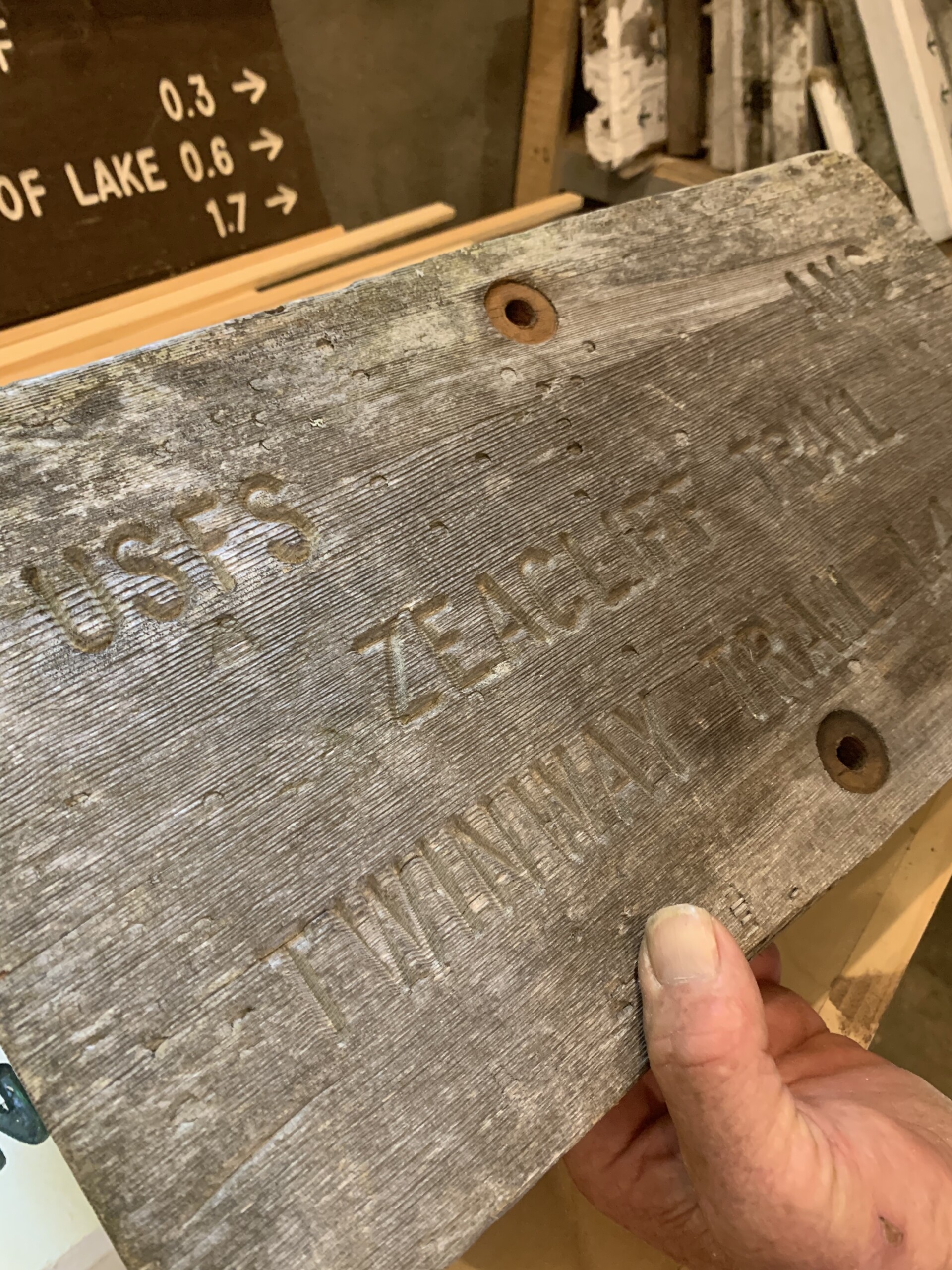
This wooden sign that was stationed on the Zeacliff Trail has a layer of patina from its time outdoors.
GB: These standards come from the owner of the White Mountain National Forest, which is the United States Forest Service. Most of the time making a sign is spent laying it out to make sure the trail name gets centered and that the text is all the way to the left and right like it’s supposed to be.
NHM: Do the distances on the signs ever need to be adjusted?
GB: Whenever I make a sign, I refer to the White Mountain Guide. You’ve seen that big thick volume? It tells me exactly where this sign is. I’ll look in the guide and make sure the distance is correct. Chances are, in fact, if you see any sign that is this thickness — five-quarter inch — it was one that I made.
NHM: How often are the signs replaced?
GB: I’m guessing 10 years, maximum 15. Ones that are in a somewhat sheltered location — this one is right around Lincoln Woods — this one will probably last 12 to 15 years, I bet.
NHM: What happens to the old, wornout signs?
GB: Every year, the AMC Trails Department will auction these off. It’s kind of fun to watch it. Someone paid like $1,800 last year (for one). I bet this one will get close to, if not more than, $1,800, because it was in the alpine zone. Anything that is above treeline and gets exposed to that kind of weather, which can be horrific, (is more valuable).
NHM: How long will you continue to do this?
Brown uses locally sourced, treated white pine as he measures the proper distances between characters.
GB: As long as I can, as long as they want me to. I really enjoy it. It’s a great job. There’s always a challenge, but you do have to think through laying things out and spacing and checking the text to make sure it’s accurate.
NHM: Do you ever get bored with this job?
GB: No, it’s a fun gig. I get to work here at Pinkham. … And it’s a great community here of staff that you get to know pretty well. I’ve got two golden retrievers, and they’ve got many friends here that come in and say hi.
NHM: I came across a picture of you hiking, and you had a new sign in your backpack. Do you always replace them?
GB: No, I used to put some up. But my knees really started bothering me lately. It’s just real hard for me to get there, and I miss it horribly. There’s a seasonal staff person who puts signs up, but he also has a team of volunteers that puts signs up and also help with the inventory and assess trail conditions.
NHM: Do you still go hiking?
GB: I do. I maintain the trail over in Evans Notch. I call it the undiscovered gem of the White Mountain National Forest. I look after the lower part of Royce Trail — the first mile follows a cold river stream. And of course, the dogs love it.
A new sign with chrome green paint in the letters awaits its marching orders.
NHM: That trail’s not too difficult?
GB: I was done by the end of the day. Because there’s a 2,000-foot elevation gain. So yeah, I still get out there, but I can’t do the 4,000-footers. I was on Emerald Bluff, a 2.4 mile hike along Israel Ridge Trail and Emerald Trail, a couple years ago, and I came to this beautiful outlook of Castle Ravine. And I had this real deep sense of remorse that I can’t do this anymore. And yet, right after that I said, “You know what, I feel just great that I was able to, that I can say that I did that.”