Plus special access to select articles and other premium content with your account – free of charge.
By entering your email and pushing continue, you are agreeing to Fox News’ Terms of Use and Privacy Policy, which includes our Notice of Financial Incentive.
Please enter a valid email address.
As drone sightings over New Jersey continue to raise questions, a new tool could bring answers about the source of these flying vehicles — if the government could get it off the ground.
Earlier this year, the Federal Aviation Administration (FAA) began requiring all unmanned aircraft systems to be equipped with Remote ID technology, which makes every equipped drone uniquely identifiable to authorities, like a license plate on a car.
Advertisement
The FAA announced that it would provide a database that could be accessed by local law enforcement, but nearly one year later, local authorities still can’t get into it themselves.
“The FAA is working on developing Remote ID data sharing capabilities for law enforcement so they can have access to FAA registration information,” the agency said in a statement to Fox News Digital.
DRONES SPOTTED ACROSS NORTHEAST LIKELY COMING FROM ‘INSIDE THE US,’ MILITARY EXPERT SAYS
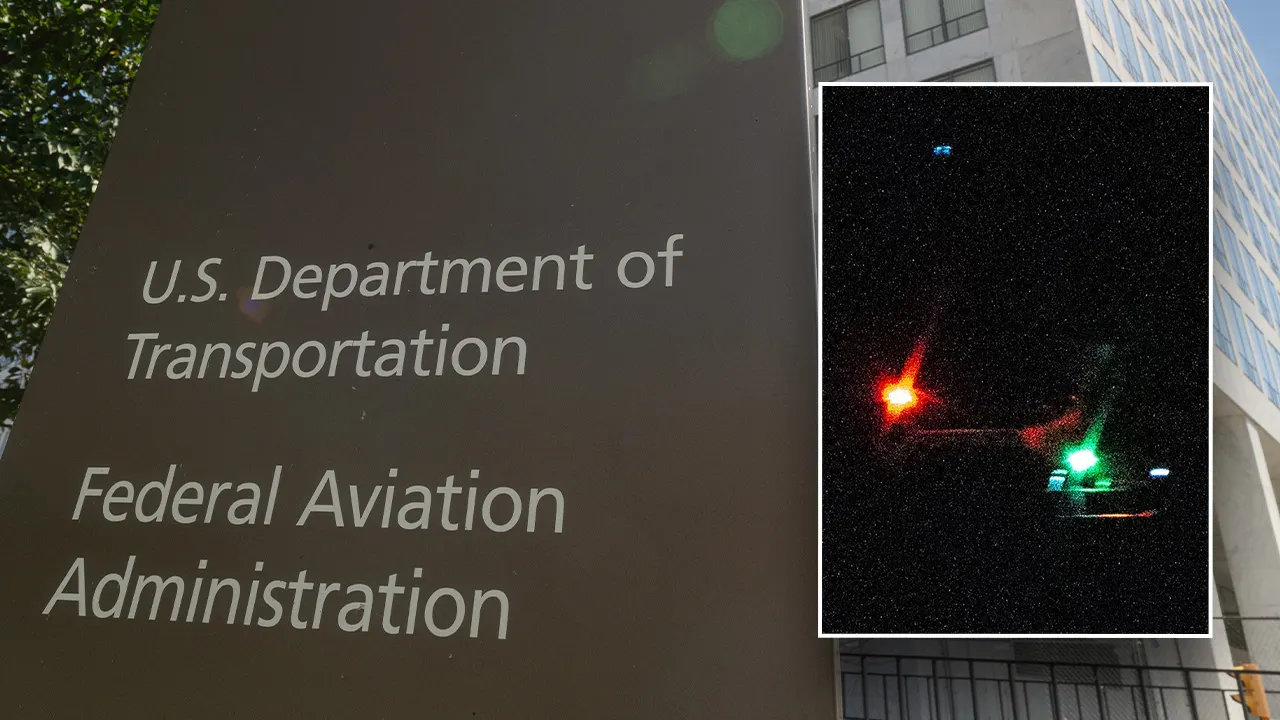
A sign marks the entrance to the FAA headquarters in Washington, D.C., on Oct. 7. (J. David Ake/Getty Images)
According to a report published in June by the Government Accountability Office (GAO), the FAA has not yet provided a way for law enforcement agencies to use Remote ID technology to respond to a potential threat or investigate suspicious drone activity.
Advertisement
A representative from New Jersey’s Belleville Police Department confirmed to Fox News Digital that its officers do not have access to the FAA’s Remote ID database as the state is dealing with dozens of reported drone sightings and growing public concern about the government’s inability to provide answers.
The East Brunswick Police Department also confirmed to Fox News Digital that it was “unaware of any of the FAA databases available for Remote ID.”
The FAA did not respond to questions about whether the Remote ID database is being shared with local authorities for the ongoing investigations in New Jersey.
DRONE MYSTERY: NEW JERSEY HOMEOWNERS THREATEN TO TAKE MATTERS INTO THEIR OWN HANDS IF GOVERNMENT DOESN’T ACT
The GAO’s report reveals that both the FAA and Department of Homeland Security (DHS) do not have a concrete timeline for the rollout of Remote ID access for law enforcement, resulting in potential delays when authorities are trying to access real-time data regarding drone activity.
Advertisement
Remote ID acts as a “digital license plate” by using a broadcast signal — similar to those used by manned aircraft — to relay a drone’s registration details, coordinates and altitude. Remote ID is typically built into the software of mainstream consumer drones or physically attached to the craft.
“As long as it has a GPS and Remote ID built into the software and into the system, it can be tracked just like any other aircraft,” James McDanolds, program chair at Sonoran Desert Institute’s School of Uncrewed Technology, told Fox News Digital.
Broadcasting the signal over radio waves, instead of the internet, would allow the signal to be accessed in areas with low internet connectivity.
MANY NEW JERSEY ‘DRONE’ SIGHTINGS ARE LAWFULLY OPERATED MANNED AIRCRAFT, WHITE HOUSE SAYS
Photos taken in the Bay Shore section of Toms River, New Jersey, show what appear to be large drones hovering in the area on Dec. 8.(Doug Hood/Asbury Park Press)
Advertisement
Currently, local authorities must go through an FAA Law Enforcement Assistance Program (LEAP) agent to request information regarding an incident, which would then be reviewed on a case-by-case basis. But the FAA has acknowledged an inability to effectively handle local law enforcement’s requests to the program for Remote ID data and is requesting funding from the federal government to cover the cost of expanding.
The FAA requested $21.8 billion in funding from the federal government for the upcoming year, according to the administration’s 2025 President’s Budget Submission. Additionally, the FAA has allotted $15.6 million of the budget for drone-related research and growth.
The FAA wants more money to hire more LEAP special agents whose jobs will focus on investigating drone activity.
The GAO’s report expressed concerns regarding the timeliness of these requests, citing the need for real-time data in potential emergency situations.
FAA TEMPORARILY RESTRICT DRONE FLIGHTS IN NEW YORK AMID CONCERNS OVER RECENTLY REPORTED SIGHTINGS
Advertisement
The DHS, FBI, FAA and Department of Defense on Monday issued a joint statement addressing the origins of the drones, citing the use of technology to identify the owners.
“Having closely examined the technical data and tips from concerned citizens, we assess that the sightings to date include a combination of lawful commercial drones, hobbyist drones, and law enforcement drones, as well as manned fixed-wing aircraft, helicopters, and stars mistakenly reported as drones,” the statement explains. “We have not identified anything anomalous and do not assess the activity to date to present a national security or public safety risk over the civilian airspace in New Jersey or other states in the Northeast.”
The FAA began receiving reports of drone activity in mid-November as unidentified aircraft were spotted throughout the Garden State, including Picatinny Arsenal Military Base and Trump National Golf Course Bedminster, resulting in temporary flight restrictions, known as TFRs, being placed over sensitive areas.
FAA ANNOUNCES TEMPORARY RESTRICTIONS ON DRONE FLIGHTS IN NEW JERSEY FOLLOWING INFLUX OF SIGHTINGS
A map depicts the various locations mystery drones have been spotted in the Northeast in December. (Fox News)
Advertisement
Civilians have reported drones of unusual size or build. Some with diameters of 6 feet have been spotted, according to New Jersey state Rep. Dawn Fantasia, who was briefed on the matter last week. However, the federal government has maintained that the drones are accounted for and continue to be used lawfully.
The FAA’s Part 107 rule states that drones are permitted to fly at night and must remain within 400 feet of ground level. Operating a drone without Remote ID can carry criminal penalties of up to $250,000 and a maximum of three years in jail, with civil penalties of up to $27,500.
Within the last few weeks, the FBI has received tips of more than 5,000 drone sightings, with fewer than 100 warranting additional investigation, according to an FBI official.
GOVERNMENT AGENCIES SAY JOINT INVESTIGATION INTO DRONE SIGHTINGS REVEALS NO THREAT: ‘WE RECOGNIZE THE CONCERN’
“To be clear, [authorities] have uncovered no such malicious activity or intent at this stage,” the DHS and FBI said in a joint statement on Thursday. “While there is no known malicious activity occurring in New Jersey, the reported sightings there do, however, highlight the insufficiency of current authorities.”
Advertisement
Fox News Digital’s Michael Dorgan and Morgan Phillips contributed to this report.
BOSTON (WHDH) – Celtics star forward Jayson Tatum responded to the team’s shocking trade of forward Jaylen Brown to the Philadelphia 76ers on Wednesday, reflecting on the near decade they spent together in Boston.
Tatum posted a tribute to Brown on his Instagram story Friday afternoon, writing, “9 years! Forever grateful for all that we accomplished together, for pushing me to be a better player. From first round exits to winning a chip together I’m thankful for it all. Nothing but love and respect for you as a player and as a person! Looking forward to see how you attack this next chapter of your career and wish you nothing but the best for you! Continue to be special.”
The trade will become official Monday once the league-wide moratorium is lifted. The Celtics will welcome nine-time NBA All-Star Paul George, who they received from the 76ers, as well as new signings Mitchell Robinson and Mike Conley Jr.
(Copyright (c) 2026 Sunbeam Television. All Rights Reserved. This material may not be published, broadcast, rewritten, or redistributed.)
Advertisement
Join our Newsletter for the latest news right to your inbox
We break down when Pittsburgh fireworks cross from fun into illegal
In Pennsylvania, it’s easier than ever to buy consumer fireworks, but using them inside Pittsburgh city limits is where the law tightens up.
In Pennsylvania, it’s easier than ever to buy consumer fireworks, but using them inside Pittsburgh city limits is where the law tightens up. For this week’s “Is It Legal?” series, the key distinction is that purchase and possession are generally allowed under state law, while where and how you launch them is restricted by local rules and safety regulations.
In Pittsburgh, residents can’t legally set off fireworks in public spaces like streets, sidewalks, parks or right-of-way areas. They’re also not supposed to launch them near buildings or vehicles, or in any way that directs fireworks toward people or property.
Advertisement
In rowhouse neighborhoods and dense blocks, that effectively rules out most front yards, alleys and tight backyards, because they sit too close to homes and parked cars to meet the distance and safety requirements. On top of that, noise and nuisance ordinances can come into play, especially late at night, giving police grounds to respond when fireworks are reported as a disturbance or hazard.
Officials stress that fireworks are explosives, not toys, and point to common risks: injuries from misfires, fires on roofs or in yards, and the impact on pets, older neighbors and veterans with PTSD. That’s why they consistently urge residents to skip DIY backyard launches and attend permitted, professional shows instead, where licensed operators, fire crews and safety plans are already in place.
More: Is it legal? Boating rules on Pittsburgh’s three rivers
More: Is it legal? What boaters can and can’t do on Pittsburgh’s rivers
Advertisement
More: Is it legal? Exploring ‘The Pittsburgh Left’
So, when viewers ask “Is it legal?” the answer is nuanced: Buying fireworks is broadly legal under state law, but setting them off in most Pittsburgh neighborhoods — especially in public spaces or close to buildings — is often not, and can quickly lead to citations or police visits rather than a celebration.
This article by Gabby Sartori was created with the assistance of Artificial Intelligence (AI). Journalists were involved in every step of the information gathering, review, editing and publishing process. Learn more.
The AGANORSA Leaf Aniversario Connecticut is now available in a new vitola, one that also comes in a metal tube.
It’s the second different toro for the line, though it will be difficult to confuse the two cigars. The AGANORSA Leaf Aniversario Connecticut Toro, the existing cigar, is a 6 1/4 x 52 box-pressed toro. The new AGANORSA Leaf Aniversario Connecticut Tubo is a 6 x 52 round toro. Blend-wise, the line uses an Ecuadorian Connecticut-seed wrapper over Nicaraguan tobaccos grown by AGANORSA. The line is made at the company’s factory in Nicaragua.
The AGANORSA Leaf Aniversario Connecticut Tubo has an MSRP of $19.99 and comes in boxes of 10 cigars.
Advertisement
“The Aniversario Connecticut Tubo offers a perfect combination of elegance, convenience, and flavor,” said Terence Reilly, vp of sales & marketing for AGANORSA Leaf, in a press release when the cigar was announced in March. “It’s an ideal cigar for both longtime fans of the brand and smokers discovering Aganorsa for the first time.”
Charlie Minato
I am an editor and co-founder of halfwheel.com/Rueda Media, LLC. Previously, I started TheCigarFeed, one of the two predecessors blogs of halfwheel. I have written about the cigar industry since 2010, covering everything from product launches to regulation to M&A. Beyond writing, I handle a lot of the behind-the-scenes stuff from weighing cigars to coordinating the tech. Outside of work, I enjoy playing tennis, watching boxing, falling asleep to the Le Mans 24, wearing sweatshirts year-round and eating gyros. echte liebe.