Maine
Grant program offers Maine caregivers a lifeline


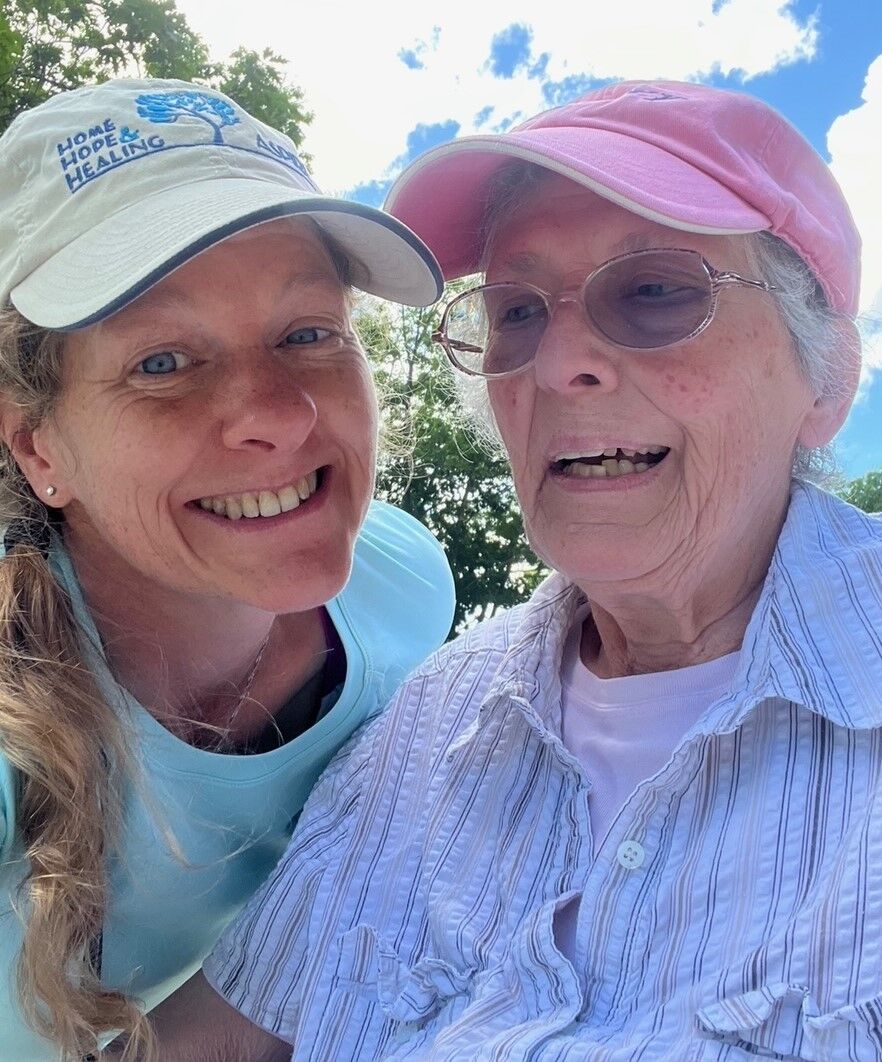
Kristy Basso sets a timer for 25 minutes any time she does a chore outside her West Paris home. As the primary caregiver for her 77-year-old mother, who has dementia, Basso is worried about leaving her mom alone for too long.
Earlier this year, when two of her five children, who are both in the military, were going to be stationed in the same place at the same time, Basso wanted to take a rare vacation. But she had to “jump through hoops” to find a caregiver who could watch her mom, Kathleen Parsons. That was only her second overnight trip since 2020.
With assistance from a pilot grant program called Respite for ME, Basso can now pay a caregiver to spend three hours with her mom every other week.
Although participants in Respite for ME say the program provides a welcome breather, it’s set to end on Sept. 30, and it will be up to the legislature to decide whether to permanently fund it.
“I’m kind of dreading that because I won’t be able to have someone come in anymore and I’ll just be more tired,” Basso said.
Respite for ME was funded through Gov. Janet Mills’ Maine Jobs & Recovery Plan, using $5.1 million in American Rescue Plan funds, and began enrolling caregivers in October 2022. The two-year program offers grants up to $5,171 to those providing care to a loved one at home.
In addition to paying for temporary caregivers, the funds can be used for counseling, training, financial guidance and assistive technology.
At least 23 nursing homes in Maine have closed over the past decade, and concerns about the quality of care at assisted-living facilities have grown.
As the state’s population — the oldest in the nation — continues to age, the responsibility to care for older adults could increasingly fall on family caregivers.
The Alzheimer’s Association estimates that 51,000 caregivers in the state provided 87 million hours of unpaid care last year, valued at $1.9 billion.
Drew Wyman, executive director of the Maine chapter of the Alzheimer’s Association, said caring for loved ones with dementia comes with an extra emotional toll.
“You don’t know what you’re going to get when you’re dealing with someone with cognitive decline,” he said. “And the bulk of this caregiving in Maine falls on family members.”
Taking care of yourself
Dr. Susan Wehry, who directs AgingME, a geriatrics workforce enhancement program at the University of New England, said data has shown that respite care is “vital.” She applauded Maine for giving participants a lot of latitude in how the respite dollars can be spent, noting that limiting grants to medical needs isn’t as effective.
“One of the self-defeating beliefs is ‘nobody can take as good of care of my husband as I can,’ ” Wehry said. “While that may or may not be true, it is also true that if you don’t take care of yourself, you won’t be able to take care of him for long, either.”
A state-funded respite program for low-income Mainers who care for someone with Alzheimer’s or dementia has been in effect for decades.
Respite for ME was intended to expand the program to include people caring for individuals over 60; those caring for people of any age with dementia; and those caring for adults with disabilities.
Relatives over age 55 who provide care to someone else’s children are also eligible. There is no income criteria, but the caregiver must not be getting paid for the care and must have suffered economic hardship because of the COVID-19 pandemic.
The grants are administered by the state’s five nonprofit areas on aging, including SeniorsPlus in western Maine.
Betsy Sawyer-Manter, president and CEO of SeniorsPlus, said she hopes to see the program continue, noting that those providing in-home care deserve support.
“This is a huge undertaking and with the continual growth of the older Mainer population as well as grandparents providing kinship care, it is vital for these unsung heroes,” she said.
So far, 1,072 participants have received a total of more than $2.3 million, according to the Department of Health and Human Services. An initial report published after the first year of the program found that three-quarters of the recipients at the time identified as women and 63 percent made less than $35,000 a year.
The labor of caregiving
After her mom was diagnosed with Alzheimer’s disease in 2017, Basso eventually gave up her job as a private-duty nurse to care for her full-time.
Her family doesn’t qualify for any of the state’s income-based waivers, so Basso provides the care without compensation. She said she’s fortunate to have income from her husband’s job: “If I was a single mom, I wouldn’t be able to do this at all.”
A recent survey of Maine caregivers found that more than half reported that caregiving was somewhat or very much a financial strain, and nearly 60 percent took time off work, went in late or left early to provide care.
A progress report on the Respite for ME program’s first year found that the funds improved the mental health of participating family caregivers. Half of them reported lower burden scores. High stress scores decreased 7 percent; high depression scores decreased 9 percent; high financial strain decreased 13 percent; and negative impacts on job performance decreased 16 percent.
In addition to some respite care, Basso has used the grant money to buy her mom a bidet, a handrail for the stairs and a bench for the shower.
Basso, who was a nurse for 20 years and worked in dementia wards of nursing homes, said her mom would qualify for a nursing home, but neither of them wanted that. Her mom also worked as a nurse and had made it clear she didn’t want to end up in a nursing home.
“While working in a nursing home, you’re always doing the best that you can. However, you end up having more patients than you can care for as well as you want to,” Basso said. “As a nurse, you have 30 people on your floor that you’re responsible for, and I know that my mother just wouldn’t thrive in an environment like that.”
She said she’s fortunate to have the skills and knowledge to care for her mom, but said there are times she loses patience and has to walk away for a moment. It’s like caring for a child, Basso said, but in reverse.
“I do it because I love her. She’s always loved me and it’s the best that I can do for her,” Basso said. “But it doesn’t mean that it’s easy.”
As nursing homes close, Basso expects more families will care for loved ones at home, which she worries could lead to more elder abuse and neglect. People who don’t have a background in caregiving may get frustrated more easily and lash out, she said.
Basso said there should be more resources so people understand how to deal with certain behaviors.
A survey by the Alzheimer’s Association found that two-thirds of dementia caregivers reported difficulty finding resources and support, Wyman said.
The organization offers a free 24-7 hotline (800-272-3900) staffed by clinicians and specialists that provides support and information for family caregivers, as well as free training sessions and virtual support groups.
Wehry said there’s been a recent shift in caregiver training to focus more on dementia-related behaviors and how to understand them. Her training program at UNE emphasizes the notion of “respite with, not respite from,” which means creating opportunities for caregivers to take a break with their loved one, such as eating at a “dementia-friendly restaurant.”
If society were more accepting of people with dementia, she believes, that would lessen the demand on family caregivers and reduce the need for respite services.
“There will be those times where you need a break. That’s OK,” Wehry said. “But a healthier society would be where you need fewer of those breaks because you’d be able to have a good life with the people that you’re supporting.”



LEWISTON (WGME) Nearly three years after the Lewiston mass shooting, the Maine Resiliency Center is asking the public to share how the tragedy has affected them and the community.
The nonprofit has launched a survey to better understand the impacts of the mass shooting in October 2023 and to help guide future support efforts.
The director of the Maine Resiliency Center said the ripple effects have spread widely and the organization wants to hear from anyone who has been affected.
“You could have been a service provider who is providing therapy or counseling for people; you could have been a funeral home director or city employee; you could be someone who lives in this community and knows somebody who is directly impacted or you could be directly impacted yourself. All of those opinions and information are really valuable to us as we look to support the broader community moving forward,” the director said.
To take part in the survey, go to maineresiliencycenter.org.

Politics
Our political journalists are based in the Maine State House and have deep source networks across the partisan spectrum in communities all over the state. Their coverage aims to cut through major debates and probe how officials make decisions. Read more Politics coverage here.
AUGUSTA, Maine — The Maine Supreme Judicial Court on Friday upheld Secretary of State Shenna Bellows’ decision to keep a referendum banning transgender girls from female school sports off the November ballot.
The high court ruled Bellows was “not only authorized but was constitutionally bound” when she moved in May to throw out more than 1,500 signatures gathered by out-of-state circulators who never agreed to submit to Maine’s jurisdiction.
The unanimous ruling from the six-justice panel closes out a monthslong legal fight that began when Bellows’ office invalidated more than 12,000 signatures submitted by Protect Girls’ Sports in Maine, leaving the petition 532 signatures short of the 67,682 needed to qualify.
The group, backed heavily by Republican megadonor Richard Uihlein, had argued Bellows overstepped her authority by enforcing a settlement that ended a 2023 First Amendment lawsuit over Maine’s ban on out-of-state circulators, rather than letting Maine voters decide whether to loosen the state’s residency rules for petition circulators.
The court rejected that argument, finding Bellows was bound by the Maine Constitution’s residency requirement for circulators except where a federal injunction narrowly excused her from enforcing it, and that four nonresident circulators who never checked a box consenting to Maine jurisdiction fell outside that carveout.
Justices also rejected the campaign’s fallback argument that one circulator’s belated affidavit, filed months after the Feb. 2 filing deadline, should have salvaged her roughly 61 signatures, citing a state law requiring circulator affidavits to be filed when the petition is.
The decision effectively ends the campaign’s bid for the 2026 ballot, though the court noted proponents could still gather the roughly 500 additional signatures needed to try again for the 2027 ballot.

A handful of mostly unknown Democrats, including a retired art teacher, a candidate’s husband and a finance executive, will soon have unprecedented influence over the U.S. Senate race.
Maine Democrats are slated to host a 600-member convention this month, with roughly 500 of those members selected by the party’s 16 county apparatuses. Being a county chair is usually a low-key position. After Graham Platner’s Wednesday announcement that he will leave the race following sexual assault allegations, they are suddenly in a position of power.
Here are the 16 people tasked with creating a delegation to pick who will face off against Republican Sen. Susan Collins.
Joseph Zamboni: Cumberland County
As Maine’s most populous county, Cumberland will have the largest delegation at the coming convention. Its party chair is health policy and law professor and pro-vaccine advocate. He currently serves as the chair of Portland’s zoning board and previously worked for the state and the federal Department of Health and Human Services.
Kathie Purdy: York County
York, the southernmost county, is the state’s second most populous. Its delegation will be led by Kathie Purdy, a former candidate for the state Legislature. She is a business owner in Saco and a bar manager in Ogunquit, according to her LinkedIn profile.
Harry Sanborn: Penobscot County
Alton resident Harry Sanborn is involved in local government, serving as a member of both the planning board and budget panel. He also serves as the town’s sexton. His wife, Laura, a former lawmaker and county commissioner, is a school board member for Regional School Unit 34.
Joanne Mason: Kennebec County
Kennebec’s Democratic Party chair is Joanne Mason, a nonprofit leader and the wife of Sheriff Ken Mason. According to her LinkedIn, she is president of the Family Violence Project, an Augusta-based nonprofit.
Carl Wilcox: Androscoggin County
From his social media history, Wilcox appears to be on the left of the party. In response to a white nationalist rally in DC last week, he posted that “billionaires control the media and the government sets the rules to funnel ever greater sums to the billionaire class,” echoing Platner’s anti-billionaire language. He hiked the entire Appalachian Trail in 2016.
Alison Willette: Aroostook County
Willette has relatively little online presence, but the Aroostook County Democrats downplayed the chair’s role in a Thursday Facebook post, writing, “the process is still being hashed out, but I assure you all counties have representation involved and it is NOT a ‘cherry picked by the chair’ process!”
Aroostook’s delegation, likely to be the seventh-largest, could be a source of support for former Senate President Troy Jackson, an Allagash native who is running to replace Platner in his populist mold.
Bruce Bryant: Oxford County
Oxford is one of the only counties with a chair that served in the state Legislature. Bruce Bryant was a Senator between 2002 and 2010. In 2024 he ran for state senate again, but lost to Republican Joseph Martin. On social media he voiced support for Troy Jackson when he was running for Governor.
Marcia Myers: Hancock County
Myers is a former news editor who now lives in Deer Isle. Her social media history shows posts invoking independent socialist Sen. Bernie Sanders and attending “No Kings” protests. She told MS NOW in June that Democrats in Hancock were “laser-focused on issues like healthcare and cost of living.”
Lise Ragan: Somerset County
Ragan is an Anson resident and former teacher who describes herself on Facebook as a “patriotic, very concerned American.” She told the Bangor Daily News she is “confident” the party can move forward with a new candidate for U.S. Senate.
Greg Marley: Knox County
Rockland resident Greg Marley is married to the city’s former mayor and current state Rep. Valli Geiger, a Platner ally running to replace him. In response to a post by The Midcoast Villager about Valli’s interest, Marley posted that he “stand[s] beside this extraordinary woman every step of the way.” Geiger had been a close ally of Platner, who she says encouraged her to run.
Marley is a clinical director of suicide prevention at Maine’s chapter of the nonprofit National Alliance on Mental Illness.
Stanley Paige Zeigler: Waldo County
Zeigler is a former merchant mariner and state representative. He represented part of Waldo County between 2016 and 2024. He has been involved with environmental organizations like the Sierra Club and the Maine Bike Coalition.
Keith Mestrich: Lincoln County
Lincoln County’s chair is set for one of the smallest delegations, but he may have something that other party leaders lack and that many party voters have shunned over the course of Platner’s campaign — money and connections.
Keith Mestrich got his start in labor organizing and eventually became CEO of Amalgamated Bank, a union-owned financial institution. He is now a founding partner of Percapita, a financial tech firm providing an employee benefit platform for low-income workers. He also serves as the chair of the National Trust for Local News, whose Maine arm owns The Portland Press Herald and sister papers.
Lisa Marin: Washington County
Washington County Democrats are led by a retired art teacher who worked at the Moosabec Community School District in Jonesport. The Downeast resident’s Facebook history shows that she has attended “No Kings” protests. She recently wrote a Press Herald op-ed condemning Republican gubernatorial nominee Bobby Charles.
Wayne Kinney: Franklin County
Kinney represents Farmington on the RSU 9 school board. His online presence is limited.
Deb Dagnan: Piscataquis County
Dagnan will lead the smallest county delegation. She had expressed skepticism about Platner after The New York Times published a story in June detailing claims of abuse by his ex-girlfriends. She told PBS ahead of the primary election that people were “waiting for the other shoe to drop after he gets the nomination.”
“Then what do we do?” she asked.
Daniel O’Connor is a Report for America corps member who covers rural government as part of the partnership between The Maine Monitor and the Bangor Daily News, with additional support from BDN and Monitor readers.
-

 Massachusetts6 minutes ago
Officials ID man and woman killed in Route 6 crash in Dartmouth
-

 Minnesota9 minutes ago
Minnesota weather: Warm Saturday with hotter days ahead
-

 Mississippi13 minutes ago
Tracking Mississippi State baseball players, signees picked in 2026 MLB Draft
-

 Missouri20 minutes ago
Missouri pushes for more nuclear energy to power the future
-
Montana23 minutes ago
Montana Lottery Mega Millions, Big Sky Bonus results for July 10, 2026
-

 Nebraska29 minutes ago
Nebraska has two players honored by the Big Ten Conference on Thursday
-

 Nevada36 minutes ago
Planetary parade this weekend — when to see it in Northern Nevada
-

 New Hampshire39 minutes ago
9 Most Hospitable Towns In New Hampshire

