Northeast
Maine man speaks out after wife is pulled waist-deep into quicksand: 'She couldn't get her legs free'

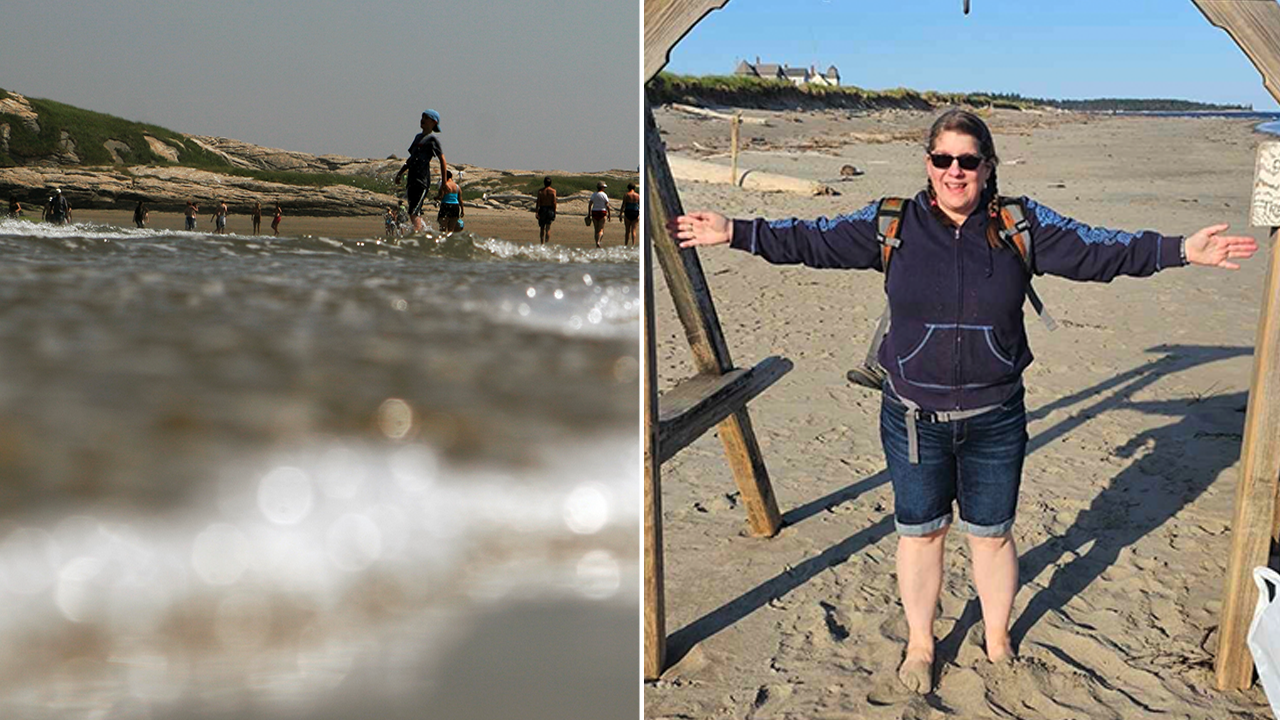
A Maine woman had a startling experience while walking on the water’s edge of a New England beach, and luckily she was not alone during the incident.
While at Popham Beach State Park in Phippsburg, Jamie Acord was soaking up the sun when, in a flash, she found herself sunk up to her hips in sand.
Her husband, Patrick Acord, 38, said that he and his wife were walking side by side when she dropped about 2.5 feet into what they later found out to be quicksand.
KITE SURFER USES ROCKS TO SPELL OUT ‘HELP’ IN SAND TO PROMPT RESCUE AT CALIFORNIA BEACH
“My wife fell in almost instantly,” he told Fox News Digital via email. “It only took a few seconds to pull her out after she realized she couldn’t get her legs free herself.”
Jamie and Patrick Acord were enjoying a walk on the beach until Jamie found herself trapped in quicksand at Popham Beach State Park in Phippsburg, Maine. (Patrick Acord via AP)
While a person being trapped in quicksand may sound like a scene out of a movie, it could in fact happen in real life.
“Sand movement resulting from beach dynamics has had a dramatic effect on Popham Beach, causing extreme shoreline change and dune erosion,” according to an article published online by the Maine Department of Agriculture, Conservation and Forestry.
MONTANA PHOTOGRAPHER CAPTURES ‘MIND-BLOWING’ IMAGES OF RARE WHITE BISON REPORTEDLY BORN AT YELLOWSTONE
Jamie Acord was rescued by her husband after getting stuck in quicksand on a Maine beach. (Patrick Acord via AP)
Jamie Acord had been collecting trash on the beach, so her hands were full when she began to sink, according to the Associated Press (AP).
She screamed to her husband, Patrick, “I can’t get out!” the AP reported.
Patrick Acord sprung into action, pulling his wife from the sand trap in seconds while more sand poured back in.
For more Lifestyle articles, visit www.foxnews/lifestyle.
“I couldn’t feel the bottom…I couldn’t find my footing,” Jamie Acord told the AP.
Popham Beach State Park is Maine’s busiest state park beach, according to Maine.gov. (AP Photo/Pat Wellenbach, File)
Quicksand is a mixture of fine sand, clay and salt water, according to an article published by Live Science.
It has a density of about 2 grams per milliliter, while humans have a density of about 1 gram per milliliter, according to National Geographic. “At that level of density, sinking in quicksand is impossible. You would descend about up to your waist, but you’d go no further,” the online magazine continued.
“People who are caught in supersaturated sand remain buoyant — people don’t sink in quicksand — allowing them to float and wriggle themselves to safety,” Jim Britt, conservation and forestry spokesperson at the Maine Department of Agriculture, told the AP.
Patrick Acord said he and Jamie did speak to a park ranger after the incident.
“He said they had received a handful of similar complaints but none where someone sunk this deep, and usually they were in an area where supersaturated sand is more common – such as near the mouth of the river that flows out next to the beach,” Patrick Acord told Fox News Digital.
Jame Acord (pictured right) told the AP that she became stuck in quicksand at Popham Beach State Park in Maine while walking on the beach with her husband, who was able to pull her out safely. She was left with some small scratches, her husband told Fox News Digital. (AP Photo/Pat Wellenbach, File/Patrick Acord via AP)
Luckily, Jamie Acord was left with just a few small scratches on the top and bottom of her foot after the frightening experience, Patrick Acord said.
Popham Beach visitors are now being encouraged to talk with state park staff to learn updates on area conditions and additional safety tips – “something especially helpful if guests are not familiar with the area or if conditions have recently changed,” FOX Weather reported.
The Maine Department of Agriculture, Conservation and Forestry released an advisory following Jamie Acord’s quicksand incident.
“While this picturesque spot [Popham Beach State Park] is perfect for outdoor recreation, a few simple precautions can help ensure your visit remains enjoyable and safe,” officials with the government organization wrote online, followed by tips if you should ever find yourself stuck in sand.
Safety tips from the Maine Department of Agriculture, Conservation and Forestry:
Stay calm – “Panicking can make the situation worse. Take a deep breath and assess your surroundings.”
Ditch extra weight – “If carrying a backpack or heavy gear, set it aside to lighten your load.”
Lean back – “Distribute your weight more evenly by leaning back slightly. This technique helps prevent further sinking.”
Move slowly – “Quick, jerky movements can cause you to sink deeper. Move your legs slowly and deliberately.”
Crawl to safety – “If standing up isn’t an option, crawl on your hands and knees to distribute your weight more evenly and reach firmer ground.”
Fox News Digital reached out to the Maine Department of Agriculture, Conservation and Forestry for additional comment.
The Associated Press contributed to this report.
Read the full article from Here


VINALHAVEN, Maine (WGME) — Two boaters are charged and a third is dead after he went overboard in Downeast Maine.
Just before 5 Thursday, Maine Marine Patrol says a boater fell overboard in “Hurricane Sound” near Vinalhaven.
He’s identified as 57-year-old Marshal Ames.
Marine Patrol says before they arrived, a good Samaritan from Hurricane Island was able to reach Ames and began CPR, but he was pronounced dead by first responders.
Officers say when the other crewmembers arrived on shore, they got into a fight with them.
The crew members, 39-year-old Geoffrey Barrett and 27-year-old Theodore Lane, are facing charges including assault.
The Maine State Police major crimes unit is now part of the investigation.

A Massachusetts man is facing multiple charges for allegedly engaging in inappropriate communications and exposing himself to children.
Orate Kyle Graham, 20, of Bridgewater, was arrested this week on two counts of disseminating obscene material to a minor and one count of accosting or annoying another person.
Bridgewater police said they were made aware Tuesday of allegations involving interactions between several girls age 12 and 13 and an individual known to them only as “Jay.” The individual said he was 17 years old during conversations with the girls through FaceTime and in person.
Through an investigation, police identified “Jay” as Graham, and also found that he had regularly engaged in interactions with the minor victims. During those interactions, he allegedly exposed himself and asked the girls to expose themselves to him.
He was arrested Thursday and taken to the Plymouth County House of Correction, where he was held on $25,000 bail. The case remains under investigation by Bridgewater police and the Plymouth District Attorney’s Office.

Recently published data reflect the ongoing increases in the price of child care and decreases in access to care in New Hampshire, placing additional economic strain on Granite State families seeking affordable and high-quality care for their children. The price of child care for a family with an infant and a four-year old seeking center-based care averaged about $30,000 in 2025, up from $22,500 in 2017, while the number of licensed center and home-based child care providers has declined by 120 since 2017.
The national organization Child Care Aware of America (CCAoA) released its 2025 annual report on May 13, 2026. The report outlines the state-by-state early childhood education landscape, including both the price of care and provider supply within each state. In New Hampshire, these data were collected through the CCAoA’s New Hampshire Child Care Resource and Referral Agency and the New Hampshire Department of Health and Human Services (DHHS). Together, these data provide valuable, and updated, insights into the state’s early childhood care landscape and the challenges Granite State families face in accessing and affording child care services.
Rising price of early childhood education in NH
Based on analysis conducted by CCAoA, the average price of child care in New Hampshire in 2025 remains high for Granite State families. The average price of care for an infant and toddler in center-based care was $16,462 and $15,262, respectively, in 2025. For home-based care, the 2025 average price was $12,017 for an infant and $11,732 for a toddler. Furthermore, for a family with an infant and toddler making approximately the median income for a married couple with two children under age 5 in New Hampshire, the price of center-based care for their children would amount to approximately 25% of their family income. This financial burden is even greater for a single or unmarried mother, earning the median income of approximately $52,000 in New Hampshire, as paying the full average price of center-based child care for an infant and toddler would consume 61% of family income.
Additionally, these prices in care have increased substantially over time. From 2017 to 2025, the average enrollment price of center-based care and home-based care increased 32% and 30%, respectively. The largest increase in tuition prices during this period was 33% for toddlers and 4-year-olds in center-based care, as well as for 4-year-olds in home-based care. These increases in tuition prices outpaced inflation during the same period.
For many Granite State families, the price for child care tuition will represent their greatest annual expense, particularly for families with multiple children and those living in rural regions of the state. According to Economic Policy Institute’s Family Budget Calculator, a family with two adults and two children living in Coos County, the New Hampshire county with the lowest cost of living, would spend on average 2.5 times more for center-based care for an infant and toddler than they would on housing. As affordability challenges and the overall cost of living continue to rise, some families may have to contend with difficult tradeoffs among essential household and family expenses, including child care services.
Although care for infants and toddlers are often the most expensive forms of care, child care-related expenses do not end once children enter kindergarten. Many families continue paying for before- and after-school programs, summer care, and school vacation coverage for years afterward. As a result, the costs outlined in this analysis likely represent only one portion of the broader child care expenses many Granite State families face.
Childcare supply challenges persist
While the price of child care tuition in New Hampshire remains high, the number of licensed providers has declined over time. The CCAoA’s report indicated that, in 2025, there were 613 licensed center-based programs and 104 home-based programs across New Hampshire. However, since 2017, the number of licensed center-based and home-based programs decreased by 10% and 32%, respectively. The greater closure rate in home-based programs across the State may have a disproportionate impact on families with low and moderate incomes seeking more affordable care options, as well as families in rural regions, communities of color, and families seeking non-traditional hour care, who rely more on this type of care to fill the gaps in available care from other providers. This decrease in number of providers, particulars those in home-based settings and in rural regions of the State, has likely placed further strain on family’s access to care, as they may have to travel longer distances for child care services.
Alongside the overall decline in child care providers during this period, the number of center-based programs participating in the New Hampshire Quality Rated Improvement System, or Granite Steps for Quality (GSQ), a statewide program designed to assess and improve the quality of care services in early childhood education settings, has decreased 16%. Of the remaining 99 providers that participated in the GSQ in 2025, only four reached the highest level of quality, or step 4 of the GSQ. These findings suggest that, as families navigate New Hampshire’s shrinking child care supply landscape in the State, they are encountering fewer options that offer recognized high-quality care services.
Families and providers continue to face growing financial pressures
The average tuition prices reported in the CCAoA’s analysis of the New Hampshire Early Childhood Education landscape do not necessarily reflect the cost of care all families pay for enrollment, or the cost providers pay for delivery of care services. Many families with low and moderate incomes qualify for the New Hampshire’s Child Care Scholarship Program (NHCCSP), a federal-State fiscal partnership that helps Granite State families afford child care through a tiered voucher system. Families who are eligible to participate in the NHCCSP may pay a weekly “cost share” of anywhere from $0 to 7% of their family income, with different tiers of eligibility depending on those family income levels. Families enrolled in the NHCCSP may also be charged a “co-payment” by the provider if tuition exceeds the weekly standard rates set by DHHS. In 2024, State policymakers expanded NHCCSP income eligibility for families, resulting in a significant increase in the number of families enrolled in the program, though this growth has slowed in recent months.
Beyond the increase in eligibility for families in the 2024 expansion, policymakers also increased reimbursement rates for participating providers. While the provider reimbursement rates are set through the State’s Child Care Market Rate Survey, the prices only account for enrollment tuition prices. Consequently, these rates only capture what providers estimate families are willing and able to pay, but do not necessarily account for the provider costs for delivering high-quality care services and operating costs, including facility expenses, workforce and staff compensation, staff training, professional development training, as well as other costs. To supplement this gap in revenue, some providers turn to additional revenue streams such as grants, donations, and fundraising initiatives.
The rising price of child care tuition, coupled with the declining supply of providers in recent years, reflects the growing financial pressures families and child care providers face in New Hampshire. While programs such as the NHCCSP have an important and necessary role in reducing these barriers, additional State funding initiatives and policy strategies may be needed to more adequately address these challenges and provide meaningful financial relief for families seeking to access child care.
The New Hampshire Fiscal Policy Institute is sharing these articles with the partners in The Granite State News Collaborative. NHFPI is an independent nonprofit organization that explores, develops and promotes public policies that foster economic opportunity and prosperity for all New Hampshire residents. For more information visit nhfpi.org. These articles are being shared by partners in The Granite State News Collaborative. For more information visit collaborativenh.org.
-

 Indiana7 minutes ago
Madam Walker Legacy Fest block party celebrates Black excellence with food, music, and community
-

 Iowa9 minutes ago
Blocked Iowa HHS director resigns but is appointed deputy director
-
 Kansas15 minutes ago
1 man dies after being shot June 9 in Kansas City, Missouri; police working to identify person of interest
-

 Kentucky21 minutes ago
Tornado ripped through Florence area during storms, NWS confirms
-

 Louisiana24 minutes ago
How Louisiana nitrogen gas executions could be affected by court ruling on Alabama
-

 Maine30 minutes ago
Two charged with assault after boater dies overboard in Hurricane Sound
-

 Maryland36 minutes ago
Two Injured In Waldorf Shooting, One Flown To Trauma Center – The BayNet
-

 Michigan39 minutes ago
Michigan QB Bryce Underwood on Year 1’s challenges and what’s next

