Connect with us

Northeast

Judge reveals earliest potential start times for Luigi Mangione’s federal murder trial

Published

on

Judge reveals earliest potential start times for Luigi Mangione’s federal murder trial

NEWYou can now listen to Fox News articles!

Luigi Mangione returned to court Friday in a bid to have the most serious charges he faces thrown out of his federal case — as supporters gathered outside of the courthouse for a hearing that could determine whether the potential death penalty remains in play.

The motion to drop two of the four federal charges against Mangione, including the most serious, murder through use of a firearm, would eliminate the potential death penalty if granted.

While the judge did not issue a ruling after attorneys presented arguments on both sides of the issue, she did set a tentative timeline for Mangione’s federal trial. No definitive date was set, however.

Judge Margaret Garnett said jury selection could begin in the week of Sept. 8. If it’s a capital case, opening statements would likely be in January 2027. If she grants the defense motion and removes capital charges, opening statements would begin in October.

Advertisement

POLICE SERGEANT DENIES HEARING LUIGI MANGIONE MOTHER’S ALLEGED DAMNING STATEMENT ABOUT CEO KILLING

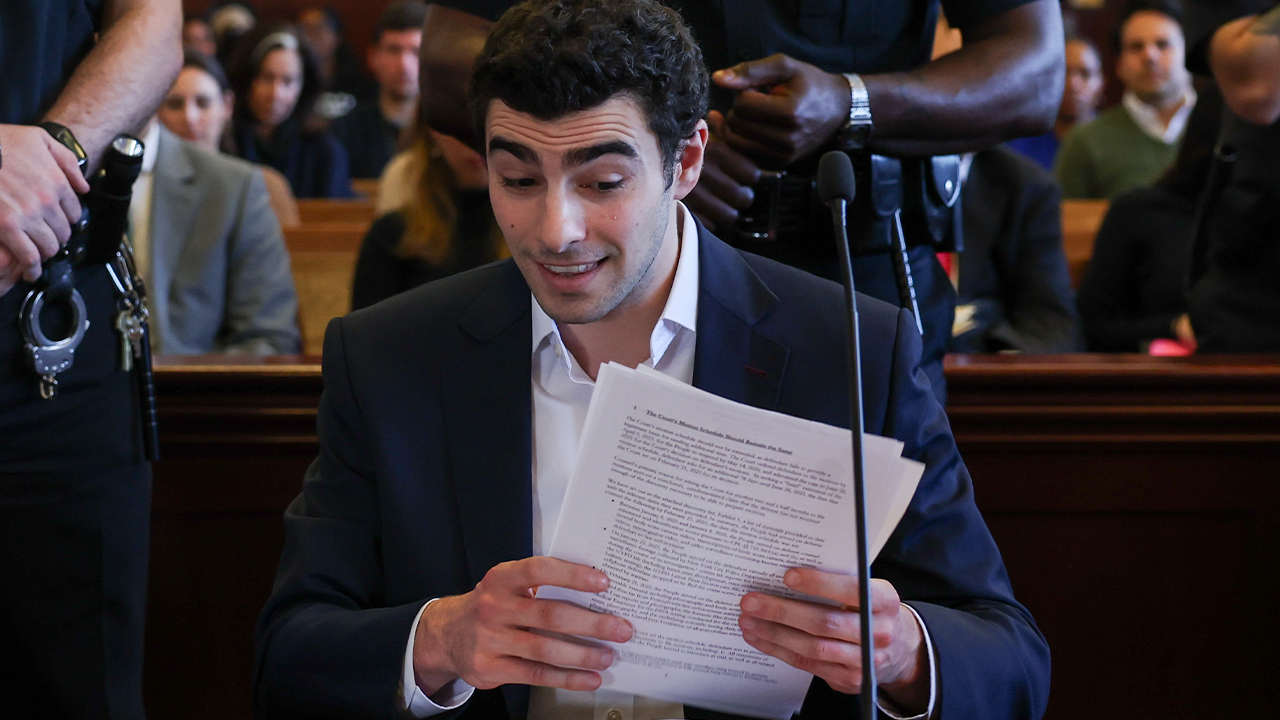
Luigi Mangione appears in Manhattan Supreme Court for a suppression hearing as both sides prepare to wrap up arguments on Dec. 18, 2025. (Curtis Means for Daily Mail via Pool)

Earlier this week, federal public defender Paresh Patel joined Mangione’s legal team as a special counsel for the Friday hearing. Patel is a Maryland-based appellate attorney and made the defense’s arguments against the charges in court.

Patel argued that the federal stalking charges against Mangione don’t meet the requirements to justify the more serious charge of murder through use of a firearm because stalking, on its own, isn’t a violent crime. 

Assistant U.S. Attorney Jun Xiang, giving oral arguments on behalf of the prosecution, countered that the victim’s death is an appropriate element to justify the charge.

Advertisement

An electronic advertising truck in support of Luigi Mangione drives past Federal Court where a suppression hearing is underway, Friday, January 9, 2026. (Rashid Umar Abbasi for Fox News Digital)

UnitedHealthcare CEO Brian Thompson was shot in the back multiple times, on video, by a man prosecutors allege is Mangione.

In one example given by Xiang, he described a gang hit on a house, in which a member tossed a grenade in to kill one person. Additional victims inside died. He argued that the defendant needs to know that his conduct places the victim in fear of reasonable bodily injury.

When the hearing wrapped up around 1:30 p.m., the judge said she would issue a ruling later.

She told the parties to aim for jury selection at the beginning of September, with the trial starting later that fall or early winter, with a January start at the latest.

Advertisement

FOLLOW THE FOX TRUE CRIME TEAM ON X

An electronic advertising truck in support of Luigi Mangione drives past Federal Court where a suppression hearing is underway, Friday, January 9, 2026. (Rashid Umar Abbasi for Fox News Digital)

Separately, federal prosecutors have rejected “meritless” arguments from accused assassin and former Ivy Leaguer Mangione’s legal team claiming Attorney General Pam Bondi has a conflict of interest and should have recused herself due to prior ties to a lobbying firm, ahead of a key hearing in his federal case.

The defense, in previous filings, has accused Bondi of “prejudice” against the defendant and claimed that her former position as a partner at Ballard Partners, a lobbying firm with ties to UnitedHealthcare, should lead to her recusal.

WATCH: Luigi Mangione supporters arrive before key hearing in assassination case

“When Ms. Bondi left Ballard Partners to become the Attorney General in 2025, the very first defendant she personally selected to be executed was the man accused of killing the CEO of her former client,” defense attorney Karen Friedman Agnifilo wrote in a December filing.

Advertisement

Prosecutors, however, called her claims “incomplete and misleading.”

Luigi Mangione supporters outside Federal Court in Manhattan, N.Y., January 9, 2026 where a suppression hearing is underway. (Rashid Umar Abbasi for Fox News Digital)

Bondi no longer works there, they wrote, is not being paid by the firm or its clients and was not influenced by any “corporate interests” when the DOJ decided to seek the death penalty against Mangione if he is convicted.

Although his lawyers have dropped their motion to suppress statements he made to police before and after his arrest at a Pennsylvania McDonald’s, the defense is still hoping to suppress damning evidence recovered from Mangione’s backpack without a search warrant.

Luigi Mangione supporters outside Federal Court in Manhattan, N.Y., January 9, 2026 where a suppression hearing is underway. Rashid Umar Abbasi for Fox News Digital (Rashid Umar Abbasi for Fox News Digital)

Advertisement

SIGN UP TO GET TRUE CRIME NEWSLETTER

Federal prosecutors have countered that the suspected murder weapon and allegedly incriminating journals inside would have inevitably been discovered later — even if Altoona police hadn’t searched it at the scene.

The judge said she did not see the need for an evidentiary hearing that the defense requested on the matter.

UnitedHealthcare CEO Brian Thompson is pictured in an undated portrait provided by UnitedHealth. The executive was shot from behind and killed on his way to an investor conference in New York City in what prosecutors have described as a politically motivated assassination. (AP Photo/UnitedHealth Group via AP)

SEND US A TIP HERE

Advertisement

Federal prosecutors had opposed the idea of holding one.

Legal experts have said police do not typically need one when they search a bag as part of the arrest process, and prosecutors said everything in the bag would have been inevitably obtained later when they obtained their search warrants.

LIKE WHAT YOU’RE READING? FIND MORE ON THE TRUE CRIME HUB

A member of the NYPD Crime Scene Unit takes a picture of a shell casing found at the scene where UnitedHealthcare CEO Brian Thompson was shot and killed in Midtown Manhattan in New York City on Dec. 4, 2024. (REUTERS/Shannon Stapleton)

Luigi Mangione pictured in a Pennsylvania booking photo. (Pennsylvania Department of Corrections)

Advertisement

CLICK HERE TO DOWNLOAD THE FOX NEWS APP

Surveillance video shows a man approach the 50-year-old Thompson from behind and gun him down outside a Manhattan hotel that was supposed to host a shareholder conference later that morning.

The Minnesota resident was a married father of two.

Fox News’ Brendan McDonald contributed to this report.



Read the full article from Here

Advertisement
Continue Reading
Click to comment

Leave a Reply

Your email address will not be published. Required fields are marked *

This site uses Akismet to reduce spam. Learn how your comment data is processed.

Boston, MA

Tech entrepreneur Paul English gives $1m to kick-start AI program in Boston Public Schools – The Boston Globe

Published

on

Tech entrepreneur Paul English gives m to kick-start AI program in Boston Public Schools – The Boston Globe


Tech entrepreneur Paul English knows that ponying up $1 million will make just about anyone pay attention.

He saw it firsthand in 2017 when he proposed kick-starting a Martin Luther King memorial to then-mayor Marty Walsh. The end result: The Embrace, a memorial on the Boston Common honoring King and wife Coretta Scott King that was finished in 2023.

Now, English is trying to work some of that million-dollar magic with a new mayor, Michelle Wu. And this time, it’s to help Boston Public Schools. (English is a proud Boston Latin School alum.) On Thursday, English joined Wu, schools superintendent Mary Skipper, and UMass Boston chancellor Marcelo Suárez-Orozco at the Eliot K-8 Innovation Upper School to announce his latest venture: $1 million to train 25 teachers, one at each BPS high school, this summer in AI. The teachers would share what they learned with students in their respective schools.

It started out with a seemingly innocuous question, posed last year by Boston magazine to 21 prominent local leaders: If you were mayor of Boston, what’s the one thing you would do to improve the city?

For English, the answer was simple: ensure every kid who graduates BPS is proficient in AI. After the article was published, English said he heard from colleagues in the tech scene, from as far away as California, that he was on to something.

So he drafted a conceptual AI proficiency plan and reached out to Wu about it in January, agreeing to donate $1 million to get it going.

The next step is drawing up the curriculum for the teachers who will attend the sessions at UMass Boston, where English founded an AI center. Toward that end, English is working with Ellen Rubin at Glasswings Ventures to establish an advisory board of industry experts. Topics will include AI ethics, hallucinations, and using AI to improve the classroom experience.

Advertisement

Meanwhile, English said he’s reaching out to OpenAI and to Anthropic to ask them to donate computing resources. “If I were them, it’s a no brainer,” English said. “Boston’s the first [major] city in the country to do this. Why wouldn’t they be on the ground floor.”

It’s the latest example of how English is trying to give back to the community where he grew up. He made most of his millions through the sale of travel firm Kayak to Booking Holdings in 2013, and is currently developing consumer apps with his Boston Venture Studio.

A million-dollar pledge is a sign to be taken seriously. It helped open the doors with Walsh, and he believes it did so with Wu as well.

“It’s not an extraordinary amount of money,” English said. “But in the big picture, they pay attention.”

This is an installment of our weekly Bold Types column about the movers and shakers on Boston’s business scene.

Advertisement

Jon Chesto can be reached at jon.chesto@globe.com. Follow him @jonchesto.


Source link

Continue Reading

Pittsburg, PA

Wabtec Announces First Quarter 2026 Earnings Release Date – Today in Pittsburgh

Published

on

Wabtec Announces First Quarter 2026 Earnings Release Date – Today in Pittsburgh


Wabtec Corporation, a leading transportation technology company, has announced that it will release its first quarter 2026 financial results on Friday, April 25, 2026. The company will host a conference call the same day to discuss the results with investors and analysts.

Why it matters

As a major player in the transportation industry, Wabtec’s quarterly earnings provide insight into the overall health and performance of the sector. The company’s results are closely watched by investors and industry analysts to gauge trends and outlook.

The details

Wabtec, which stands for Westinghouse Air Brake Technologies Corporation, is a global provider of equipment, systems, digital solutions, and value-added services for the freight and transit rail industries. The company’s products are used on virtually every class of locomotive, freight car, passenger transit vehicle, and specialty rail equipment in service worldwide.

Advertisement
  • Wabtec will release its Q1 2026 financial results on Friday, April 25, 2026.
  • The company will host a conference call the same day to discuss the results.

The players

Wabtec Corporation

A leading global provider of transportation technology equipment, systems, and services for the freight and transit rail industries.

Got photos? Submit your photos here. ›

What’s next

Investors and analysts will be closely watching Wabtec’s Q1 2026 earnings report for signs of how the transportation industry is performing and any insights into the company’s future outlook.

The takeaway

Wabtec’s quarterly earnings are an important barometer for the overall health of the transportation technology sector, providing valuable data points for investors and industry observers.


Source link

Advertisement
Continue Reading

Connecticut

Food workers at CT service plazas secure landmark union contract

Published

on

Food workers at CT service plazas secure landmark union contract


A first-of-its-kind labor agreement will cover hundreds of fast food workers at 23 Connecticut highway service plazas, marking a rare union foothold in the fast food industry and a milestone for labor organizers nationwide.

The deal, reached between 32BJ SEIU and Applegreen, the primary operator of the plazas, runs from April 1, 2026, through March 1, 2031, and follows years of organizing and worker complaints about wages and conditions. Applegreen did not respond to a request for comment.

Gov. Ned Lamont, who helped broker the contract, praised the agreement, saying the workers “deserve good pay and benefits” and calling the contract recognition of the role they play serving travelers across the state.

“For these fast food workers who work in the Connecticut rest stop plazas, the chance to have a union is something pretty unique for this group of workers,” said Manny Pastreich, president of 32BJ SEIU.

Advertisement

“There are basically no fast food workers in this country who have union representation,” Pastreich said.

The agreement covers workers at plazas along Interstate 95, the Merritt Parkway and other major corridors, after a campaign that began in 2019 and culminated in a union vote late last year.

More predictable schedules, more control over daily life

The contract guarantees more consistent hours and advance scheduling, addressing one of the most common concerns among fast food workers.

“People can know what their hours are in advance. They can get the hours they need and can depend on,” Pastreich said.

Pastreich said predictable scheduling will bring immediate stability to workers who often struggle with inconsistent hours.

Advertisement

“Something that so many of us take for granted is having control over the schedule of our lives, often in the fast food industry is not true,” he said. “So I think that this is a huge step forward.”

He said that stability can help workers manage child care, attend school and better plan their daily lives.

Addressing long-standing workplace concerns

Workers began organizing in 2019 after raising concerns about pay, benefits and working conditions, including allegations of substandard wages and unsafe environments.

The agreement also creates formal workplace protections, including a grievance process, arbitration rights and stronger enforcement of wage standards under state law.

“They 1774882326 have a process to fix problems big and small,” Pastreich said.

Advertisement

“The other thing they have is the 6,000 members in Connecticut of 32BJ and the entire labor movement now behind them,” he said.

Pastreich said that broader support can be critical when serious issues arise on the job.

Could this deal reshape organizing in fast food?

The agreement comes as labor groups search for ways to organize in an industry that has historically resisted unionization.

“The issue of why workers in America don’t have a union has nothing to do with the fact that they don’t want the union,” Pastreich said. “The real challenge to winning the union is overcoming intense employer opposition.”

Pastreich said the Connecticut deal could serve as a model for similar efforts elsewhere.

Advertisement

“I think this group of 300 workers … that’s what 32BJ does … is stand there to give those workers a voice on the job that, alone, they really wouldn’t be able to make the change that they want,” he said.

Immigrant workers at the center of the effort

Pastreich says immigrant workers played a central role in organizing the service plaza workforce, reflecting broader trends within the union.

“At this moment of time when the federal administration is attacking immigrants and trying to drive divisions …our union…was founded by immigrants,” Pastreich said.

“It has always been a majority immigrant union, and continues to this day to be a majority immigrant union,” he said.

“That is who we are…and honestly, are the backbone of the work that this country does,” Pastreich said.

Advertisement

This story was first published March 27, 2026 by Connecticut Public.


Source link

Continue Reading
Advertisement

Trending