There’s a running joke in one of my group chats that Cole Young looks like a Disney prince who decided to play baseball instead (show me the lie). In tonight’s series opener against the Pirates, Young Prince Cole had a game fit for a golden era Disney film. Making his first-ever appearance as a big-leaguer in PNC Park, where the Pittsburgh-born Young grew up attending games, and in front of a host of friends, family, and former coaches – including his coach at North Allegheny High, Andrew Heck – Young had a go-ahead homer that would be the game-winner for the Mariners in a narrow 3-2 victory over the Pirates.
Northeast
House GOP lawmakers grill ex-New York Gov. Andrew Cuomo over COVID nursing home deaths

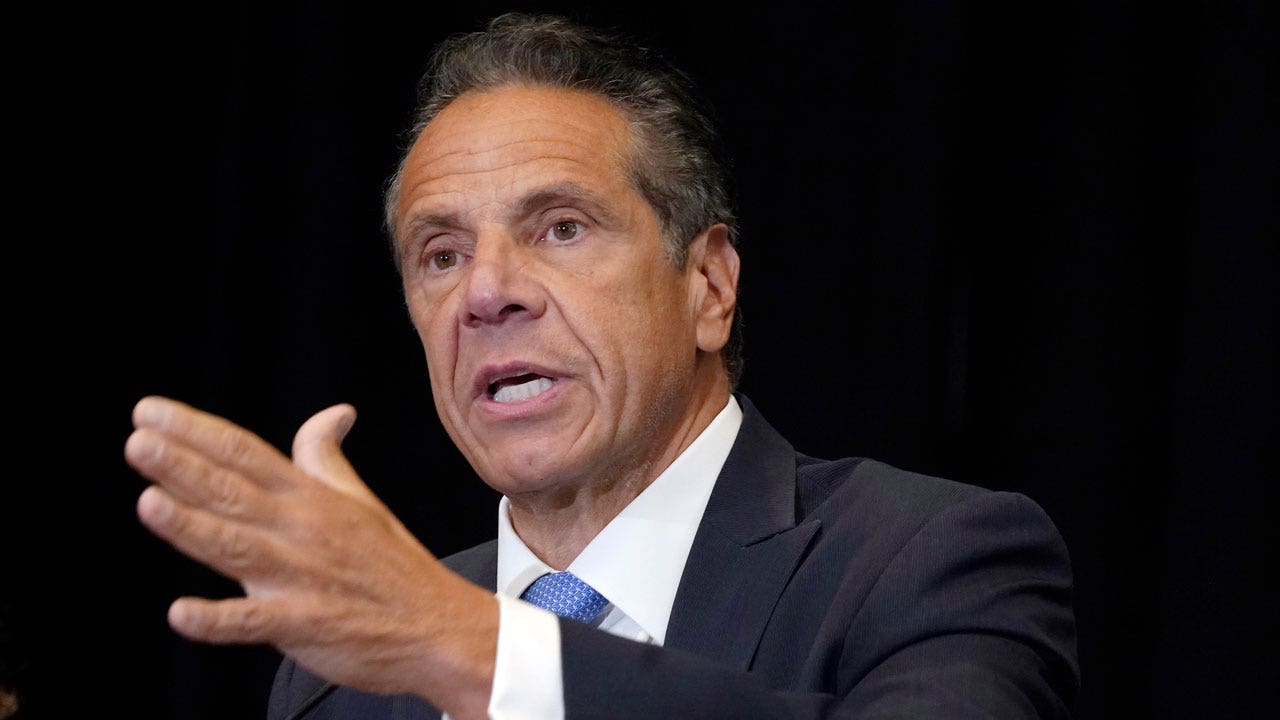
Former New York Gov. Andrew Cuomo faced a tough grilling from House GOP lawmakers Tuesday over his handling of COVID-19 in nursing homes during the height of the pandemic.
Cuomo visited Capitol Hill for a closed-door interview with the House select subcommittee investigating the coronavirus pandemic.
Lawmakers zeroed in on a March 25, 2020, executive order by the governor that restricted nursing homes from refusing to admit or readmit residents “solely based on confirmed or suspect[ed] diagnosis of COVID-19.”
A report released in March 2022 by the New York state comptroller found Cuomo’s Health Department “was not transparent in its reporting of COVID-19 deaths in nursing homes” and it “understated the number of deaths at nursing homes by as much as 50%” during some points of the pandemic.
CUOMO FINALLY FORCED TO TELL WHOLE TRUTH ABOUT COVID-19 DECISIONS THAT COST THOUSANDS OF LIVES
Rep. Brad Wenstrup, chairman of the COVID-19 select subcommittee, grilled former New York Gov. Andrew Cuomo behind closed doors Tuesday. (Getty Images)
Cuomo has pushed back on these claims, insisting New York’s health department was following Centers for Disease Control and Prevention (CDC) and Centers for Medicare and Medicaid Services (CMS) guidance issued by the Trump administration before Cuomo’s order.
A report released in March 2022 by the New York state comptroller found former New York Gov. Andrew Cuomo’s Health Department “was not transparent in its reporting of COVID-19 deaths in nursing homes.” (AP Photo/Richard Drew, File)
In his opening remarks, Cuomo said “any serious review must stop asking political questions and start asking fact-based ones.” He pointed out that New York was “No. 39 in terms of pro rata nursing home deaths [despite the state] being ground zero for COVID.”
He also accused the Trump administration of targeting Democrat-led states “despite both red and blue states issuing” the same guidelines.
GOP lawmakers held a post-hearing press conference at which they accused Cuomo of deflecting blame.
LIBERAL NY TIMES COLUMNIST ADMITS MEDIA, PUBLIC HEALTH WERE ‘TOO DISMISSIVE’ ON LAB LEAK THEORY
“I felt like the governor was defensive throughout most of the day, often putting blame on other people rather than himself. [He] didn’t seem to be taking a lot of responsibility for the things that were happening,” Chair Brad Wenstrup, R-Ohio, said.
Rep. Mike Lawler, R-N.Y., called Cuomo a “phony” and a “fraud” who “put our most vulnerable population at risk, resulting in the death of over 15,000 seniors.
“And it was Andrew Cuomo who covered it up,” Lawler added. “It wasn’t just the directive which was bad enough and idiotic and resulted in the death of the 15,000-plus seniors. It was Andrew Cuomo, for political purposes, who directed the state government to cover up the death toll.”
Former New York Gov. Andrew Cuomo has been accused of mishandling his state’s response to COVID-19. (AP Photo/Mary Altaffer, File)
GOP conference Chair Elise Stefanik, R-N.Y., said Tuesday’s deposition “was a step in delivering accountability and delivering long overdue answers to those families who are still mourning the loss of their loved ones.”
Speaking to reporters after the deposition, Cuomo said the federal government was ultimately to blame for the severity of the pandemic.
“We have two very different opinions on what happened during COVID,” Cuomo told a reporter. “I think the federal government failed this nation. And it was abysmal. How did COVID get to the U.S. in December and nobody knew? How did it take so many months before we had … basic testing in place? How did we have a president running around saying, ‘It’s going to be gone when the weather gets warm?’ … who then admits to a reporter that he purposely downplayed it?”
Rich Azzopardi, a spokesman for Cuomo, told Fox News Digital the governor “presented fact-based evidence that New York, at the end of the day, was the 39th state for pro rata in nursing home deaths in 2020 despite the fact that it started off the hardest hit.”
“We worked day and night to protect New Yorkers and save lives even though the ‘experts’ kept changing the facts on the ground. We were grappling with international PPE shortages and no national response,” Azzopardi said. “The fact that this partisan farce was allowed to go on, and they continue telling their fact-less stories, especially in order to help their marginal members who weren’t even at the hearing, tells you what a joke this was.”
Wenstrup subpoenaed Cuomo in March to appear before his committee. A letter accompanying the subpoena said Cuomo’s testimony “is vital to our investigation into the effectiveness of federal guidance and regulations implemented during the COVID-19 pandemic regarding the protection of nursing home residents.”
“Further, this investigation may inform legislation to enhance the federal scientific guidance process, including the drafting, publication, and implementation of guidances originating from CMS or CDC,” the letter said.
Fox News Digital’s Elizabeth Elkind contributed to this report.
Read the full article from Here

Continue Reading

Three days after an alleged carjacker hit and killed a woman in Boston’s Mattapan neighborhood, members of the community came together to honor her life.
A candlelight vigil was held Tuesday evening for 32-year-old Mabinty Janneh of Dorchester. She died after being hit Saturday afternoon on Blue Hill Avenue.
Ibraim Matos, 37, of Hyde Park, is charged with murder in the crash. He allegedly stole a vehicle and drove it onto the sidewalk, fatally hitting Janneh.
Ibraim Matos of Hyde Park has been charged with murder in the deadly crash.
Heartbroken family, friends and community members gathered near the site of the crash to remember Janneh Tuesday.
“We need justice for Mabinty,” said her aunt, Mbalu Tarawally.
“I just felt like I needed to be present,” said Rev. Dr. Barbara Simmons. “If the family lost a person, the least I can do is come here and show my face.”
“She was young, vibrant. Hard worker. Wants to do everything,” said Ahmad Thorley, a family member of Janneh.
The suspect in a deadly carjacking and crash in Boston’s Mattapan neighborhood appeared in court to face charges including murder.
Witnesses said Matos dragged Janneh several hundred feet after hitting her.
The stolen Toyota RAV4 crashed into an MBTA bus, and people at the pulled Matos out of the car and holding him there until police arrived.
Matos pleaded not guilty Monday to charges of leaving the scene of personal injury and death and motor vehicle homicide by reckless operation, along with murder and carjacking. His defense attorney spoke briefly on Monday, saying they will evaluate “where we stand” in a few weeks after the mental health evaluation.

The Mariners scored all their runs via the longball tonight, even though only two made it over the fence: they made 11 outs in the air, along with a pair of hard-hit lineouts, but the balls consistently died at the warning track. Meanwhile, the Pirates managed to scrape out a lead on George Kirby, first going up 1-0 in the second on a combination of an Endy Rodríguez double and a Marcell Ozuna RBI single, both hits coming on four-seamers that caught too much plate.
Pittsburgh would add on another run in the bottom of the third, although this wasn’t as much Kirby’s fault. Brandon Lowe singled on a curveball that was well-located, and then would come around to score on a weakly-hit ball off the bat of Nick Gonzales that J.P. Crawford couldn’t field cleanly. Today was the first day Crawford has looked shaky at third after being impressive in his first few turns at the position, but he was far from the only one performing some shaky defense, as even the normally sure-handed Colt Emerson threw one away, and Josh Naylor struggled to corral some of those wilder throws.
To his credit, Kirby was able to navigate around those hiccups and also some self-inflicted traffic. He and Cal Raleigh made a good adjustment after the first couple of innings, realizing the Pirates were keyed in on his fastball, and Kirby found the command over his sweeper, which had been somewhat all over the place in the early innings. Kirby leaned heavily on the sweeper over the rest of his outing, throwing it 46% of the time – normally he uses the pitch under 30% of the time, while halving the use of his fastball. All five of his strikeouts today came on the sweeper.
“It seemed like they had a pretty good gameplan of swinging first pitch, and I don’t blame ‘em,” said Kirby. “But I feel like I settled in pretty good once I got that slider working.”
The Mariners offense has been stingy with giving Kirby run support, but Cal Raleigh came through with his first homer after coming back from his stint on the IL, punishing a mistake slider Pirates starter Mitch Keller hung on the plate and finally getting a ball over the fence at PNC Park, a 393-footer to right center.
The Mariners would do just enough to get past the Pirates in the seventh inning, spurred on by the hometown kid, Cole Young. Luke Raley led off with a hustle double, lacing a sinker into center and running hard enough to beat Jake Mangum’s throw in. He needn’t have hustled quite so hard, though. With Young due up, 0-for-2 on the day so far with a pair of groundouts (including an inning-ending GIDP), the Pirates elected to leave in the righty Keller instead of going to the bullpen. Keller made a mistake pitch, leaving a sweeper right in Young’s lefty loop zone, and Young – who said he was just trying to hit a single into right to score the run – instead hit play on a highlight reel that will be replayed at every family gathering to come for years, crushing a go-ahead home run that went right past the section of his family and friends.
“I knew I got it good, so it had a chance,” said Young postgame. “t’s really special. I got my whole family, all my friends in the stands…It was a super surreal moment. It was great. I just kind of blacked out a little bit.”
“Just glad I got the job done,” he added, because once the son of a blue-collar rust belt city like Pittsburgh, always the lunchpail-toter.
The Mariners couldn’t add on after that despite some more traffic on the bases, leaving the back end of the bullpen just one measly run to work with. José A. Ferrer was terrific, putting down his assigned hitters in the seventh 1-2-3, Eduard Bazardo had to work a little harder, but was able to work around a single from lefty Ryan O’Hearn and a semi-intentional walk to Marcell Ozuna to keep the score intact. He might not have had a clean inning, but he did pick up a Pitching Ninja highlight:
Armed with that same one-run lead, Andrés Muñoz had the ninth and looked maybe the best he has all season: his fastball was up a full two ticks, averaging 100.7 and touching 102. He struck out the side, including Spencer Horwitz, who walks more than he strikes out, and ended his night on a filthy bit of sequencing to Brandon Lowe where he went down with a slider for a foul followed by high heat.
But tonight belongs to the Prince of Pittsburgh, Cole Young. In a season that’s been plagued by injuries, Young has been the Mariners’ iron man, playing every day. He’s been the steady lighthouse in an infield that’s been beset by injuries and mistakes both rookie and veteran, even flexing back to shortstop when needed despite the difficulties he experienced making the full-time shift to second base last year. Because of his availability and steady hand at the keystone, he’s essentially been unbenchable, meaning that as teams load up on lefties to serve the Mariners a bottomless buffet of southpaws, Young hasn’t been granted the day off, even as he’s gone through fallow periods with the bat.
Tonight, in front of friends and family and the high school baseball coaches who helped shape the player he is today, Young was rewarded with a fairy-tale moment. His high school coach even got the home run ball. Heck offered to give it back to Cole, but Cole told him to keep it, because what matters even more than the happily ever after are the people who helped you get there in the first place.

A man has been arrested for murder in connection with the death of a Duxbury, Massachusetts woman, months after her body was found in a Connecticut home under suspicious circumstances.
This week, the Connecticut Office of the Chief Medical Examiner determined the cause of death for Janina Brooke Murphy to be blunt force injury of head and the manner, homicide.
On Tuesday, Connecticut State Police arrested 28-year-old Cole Werhan of Burlington, Connecticut and charged him with murder.
Brooke Murphy, as she is referred to by her mother, was found at the bottom of a staircase in March inside the Burlington, Connecticut home where she was living. At the time, Connecticut State Police called the 26-year-old’s death suspicious.
“Another detective got on the phone. He said, ‘I want you to know something. Your daughter didn’t just fall down the stairs. She had wounds all over her,’” Brooke’s mother, Beth Murphy, told WBZ.
Murphy said her daughter and Werhan were dating, and she is determined to seek justice. “It’s confirmed, it wasn’t an accident. So that part, really, that’s tough,” Murphy said.

Murphy described her daughter as kind and artistic.
“So many people said she was my best friend. Like, pretty much everybody said Brooke was my best friend. She had a heart of gold,” Murphy said.
Brooke Murphy’s 27th birthday fell on June 17. Connecticut State Police said they are continuing to actively investigate the circumstances surrounding her death.
Werhan was held on a $5,000,000 cash bond and is scheduled to appear in Torrington Superior Court in Connecticut on Wednesday morning.
-

 Los Angeles, Ca18 minutes ago
‘What’s going on with our society?’ Elderly L.A. street vendor violently beaten
-

 Detroit, MI38 minutes ago
Trailblaze Detroit: Blazing New Trails while Backpacking Metro Detroit | Visit Detroit | Visit Detroit
-

 San Francisco, CA48 minutes ago
Giants open to moving big names before Trade Deadline
-

 Dallas, TX53 minutes ago
Reports: Mavericks acquire Sergio De Larrea in four-team Draft night trade
-

 Miami, FL1 hour ago
Miami Gardens police make arrest in cold case murder from 2019
-

 Boston, MA1 hour ago
Woman killed in Mattapan carjacking crash honored at vigil
-

 Denver, CO1 hour ago
Nuggets trade 26th pick in NBA Draft to Spurs, moving out of first round
-

 Seattle, WA1 hour ago
NBA Commissioner says Las Vegas, Seattle remain expansion targets for 2028-29 season

