Northeast
Fourth victim dies after fiery crash near western New York concert

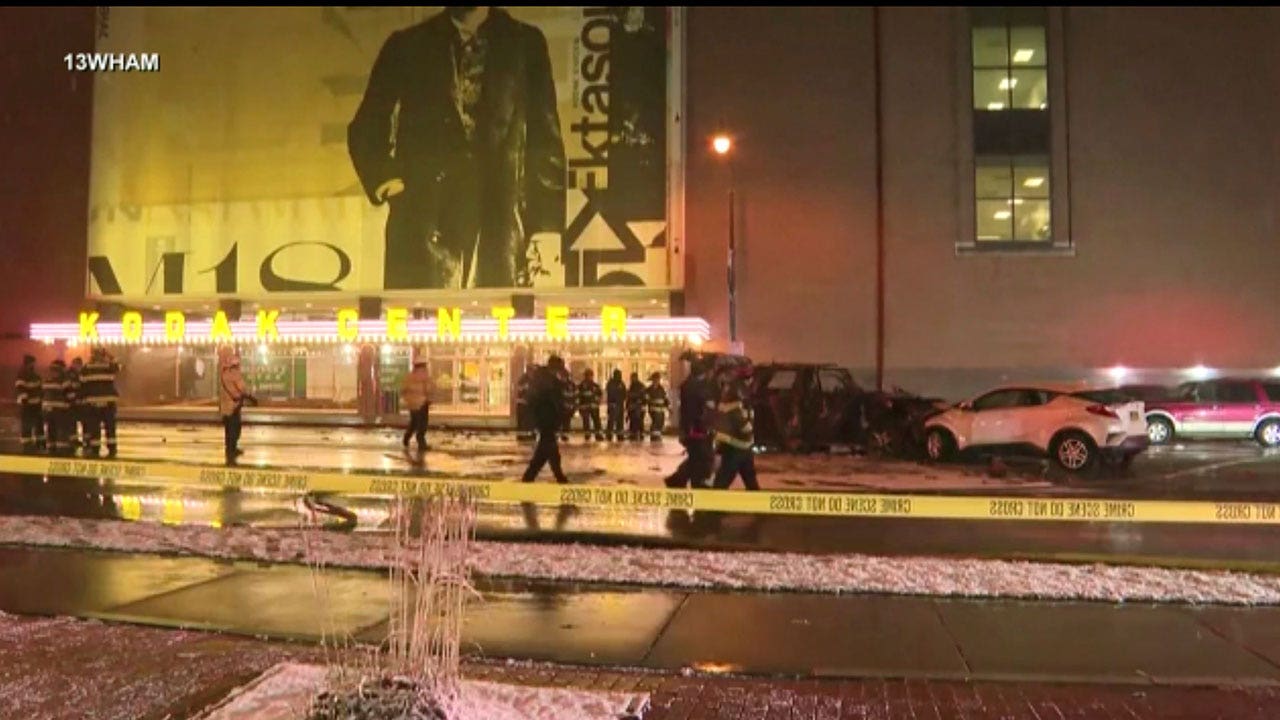
A fourth person has died nearly two weeks after a driver crashed an SUV packed with gas cans near a crowd of New Year’s concertgoers in western New York, but authorities said Friday they may never know the motive for what they call an intentional attack.
Rochester police revealed Friday that motorist Michael Avery, 35, spent several hours in parking lots and other spots near the Kodak Center on the night of the fiery wreck, which killed him, two passengers in another car and a pedestrian who died earlier this week. Avery even went up to the theater and bought a ticket to the show, but didn’t go in, Police Chief David Smith said at a news conference.
Along with gasoline-filled canisters, investigators found a replica gun and lighters in Avery’s rented Ford Expedition, Smith said. There was also a 20-page journal with sporadic entries that appeared to be several years old and unrelated to the crash, the chief said.
COLD CASES CRACKED IN 2023: UNSOLVED MYSTERIES THAT FOUND RESOLUTION
Rochester Mayor Malik Evans said that Avery mounted a planned “assault on innocent people” and that his actions made plain “that he wanted to do more.”
Rochester police investigate a fatal fiery crash outside the Kodak Center in Rochester, N.Y. early Monday, Jan. 1, 2024. A Ford Expedition struck a Mitsubishi Outlander, sending both vehicles “through a group of pedestrians that were in the crosswalk,” the statement said. (WHAM-TV via AP)
“We may never know why he decided to carry out this act,” Evans said.
Investigators have searched Avery’s hotel room, storage unit, his own car — parked at Rochester’s airport — and more. Authorities are working their way through hundreds of hours of surveillance video and have interviewed people who knew him. Investigators haven’t found any co-conspirators, any ties to “extremist ideologies” or indeed any motive so far, Smith said.
He said Avery, a sometime delivery driver who lived in the Syracuse area, had had behavioral problems. But his family saw no immediate signs of trouble last month, Smith said.
FIERY NEW YORK CRASH KILLS 2, INJURES 5 FOLLOWING CONCERT IN ROCHESTER
Avery spent the last few days of December in the Rochester area, buying and filling multiple gas cans, police said.
Then, around 1 a.m. on Jan. 1, he drove the Ford Expedition into an oncoming traffic lane and appeared to be headed for a crosswalk filled with people leaving a show by the jam band moe.
The SUV hit a ride-hail vehicle, and both careened into the crosswalk. Two ride-hail passengers, friends Justina Hughes and Joshua Orr, were killed, and several other people were injured, many of them pedestrians.
One of the injured, Dawn Revette, 54, died Wednesday, Smith said. Revette lived in Rochester.
The police chief said one person is still hospitalized, with injuries that aren’t considered life-threatening.
Read the full article from Here


PITTSBURGH — The Pittsburgh Pirates made a recent move to their rotation, which has resulted in a surprising move from one player.
The Pirates announced that they placed right-handed pitcher Carmen Mlodzinski on the restricted list and recalled right-handed pitcher Cam Sanders from Triple-A Indianapolis ahead of their series finale vs. the Minnesota Twins at PNC Park on May 31.
A player going on the restricted list means that they either left the team without a valid reason, or could be announcing retirement, but may consider returning in the near future to play later on.
It is a shocking decision, as there was no indication something like this was happening and makes a big change to the Pirates pitching staff moving forward.
Why Pirates May Have Placed Mlodzinski on Restricted List
This case with Mlodzinski is likely the former, although not confirmed, as he was in the clubhouse ahead of the game, so something may have happened closer to first pitch.
Pirates manager Don Kelly announced postgame in the 10-9 win on May 30 that Mlodzinski would follow right-handed starting pitcher Braxton Ashcraft in the series finale.
Mlodzinski was a part of the Pirates starting rotation for the first two months of the season, but Jared Jones recently came off the injured list and took his role in the rotation, with the Pirates sending Mlodzinski back to the bullpen.
He said following the decision that he would talk with his agency and those close to him, so he may have decided to depart the team after this.
“Obviously just excited to have Jared back with us,” Mlodzinski said. “I can honestly say I’m just still communicating with the organization and the people in my corner, whether that’s my family or my agency, about what is next. I really don’t have any comments after that.”
How This Changes Pirates Pitching Staff
Mlodzinski has been an effective relief pitcher with the Pirates, with a 2.63 ERA over 140.1 innings pitched and 94 appearances.
The Pirates had plans for Mlodzinski as a bulk reliever, but someone that can also fill any role, including in high-leverage situations and as a middle reliever, something the team has seriously needed.
His departure hurts a Pirates bullpen that has really looked for consistent arms that can get outs, preserve leads and give the team a chance to make a comeback late.
Sanders has struggled in his time in MLB with the Pirates, with a 9.26 ERA over 11 appearances, a .300 batting average allowed and a 2.20 WHIP.
The Pirates can make a few decisions on Mlodzinski, who could technically still comeback, but it looks like they will trade him at this point.
Make sure to visit Pirates OnSI for the latest news, updates, interviews and insight on the Pittsburgh Pirates!
 Add us as a preferred source on Google
Follow

ENFIELD, Conn. (WFSB) – Police arrested a Connecticut man on Sunday morning after he allegedly stole bottles and cans from a Connecticut Children’s Hospital donation bin.
Officers received a call at around 8 a.m. for a report of a larceny from a “Cans For Kids” donation bin at located on Raffia Road, according to the police department.
Police said they used used local surveillance cameras and municipal license plate readers to identify a vehicle and suspect.
Officials identified the individual as Joshua Wilcox of Broad Brook
With the help of Wethersfield police officers, Wilcox was found and detained. Enfield police arrested Wilcox and charged him with sixth-degree larceny and first-degree criminal trespass.
It was also revealed that this is the second incident involving Wilcox at the same location, police said.
No further details were released.
Eyewitness News will provide more details as soon as they become available.
Copyright 2026 WFSB. All rights reserved.

KENNEBUNK, Maine (WGME) — A car caught on fire on the Maine turnpike Saturday.
It happened in Kennebunk in the southbound lanes of the turnpike.
A car caught on fire on the Maine turnpike Saturday. (Courtesy of Kennebunk Fire Rescue)
You can see a large cloud of black smoke coming from the scene.
Nobody was hurt.
JOIN THE CONVERSATION (1)
Firefighters were able to extinguish the flames.
-

 Denver, CO6 minutes ago
Denver hockey’s Johnny Hicks wins DU Pioneers’ Male Athlete of the Year
-

 Seattle, WA9 minutes ago
Vikings stealing Nolan Teasley from Seahawks might be even worse than it appears
-

 San Diego, CA14 minutes ago
Dining Out — series Part 1: A look at the evolution of La Jolla’s restaurant scene
-

 Milwaukee, WI21 minutes ago
Milwaukee Panthers Putting Together a Great Run in the NCAA Tournament – World Baseball Network
-

 Atlanta, GA24 minutes ago
Victim, suspect identified in deadly Atlanta train stabbing
-

 Minneapolis, MN29 minutes ago
Chaka Khan Opens Prince Tribute Week At First Avenue In Minneapolis
-

 Indianapolis, IN36 minutes ago
3 Colts Cut/Trade Candidates Ahead of June 1st Checkpoint
-

 Pittsburg, PA39 minutes ago
Pirates Shockingly Place Carmen Mlodzinski on Restricted List

