Northeast
Fetterman’s new book details explosive feud with Gov Josh Shapiro over parole board dispute

NEWYou can now listen to Fox News articles!
Sen. John Fetterman, D-Pa., called Pennsylvania Gov. Josh Shapio a “f—— a——” during a hot mic moment amid a heated Zoom hearing, his new memoir reveals.
Fetterman, who was the state’s lieutenant governor at the time, recalled delivering the outburst after Shapiro delivered a “very long-winded and unnecessary” speech justifying his decision to vote against commuting the sentences of Lee and Dennis Horton, the New York Post reported.
The Lee brothers had been convicted of second-degree murder in a fatal 1993 robbery and shooting.
FETTERMAN FIRES BACK AT NEWSOM AFTER SHUTDOWN CRITICISM, REFUSES TO ‘PLAY CHICKEN’ WITH THE LIVES OF AMERICANS
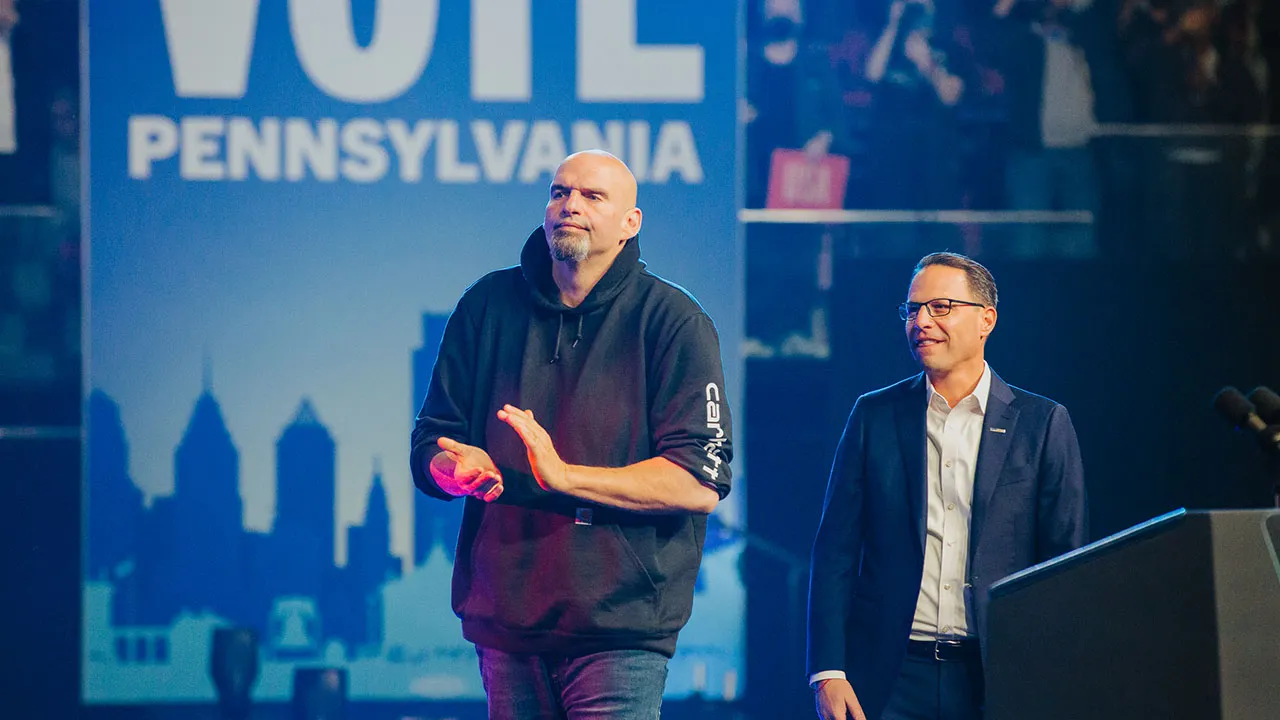
Sen. John Fetterman, D-Pa., and Pennsylvania Gov. Josh Shapiro arrive to speak during a Democratic National Committee (DNC) rally in Philadelphia. (Getty Images)
The hearing was part of the Pennsylvania’s Board of Pardons meeting when Shapiro expressed concerns that transcripts from the siblings’ original trial were missing, Fetterman wrote in the memoir, titled: “Unfettered.”
In response, Fetterman became angry. At one point during a private meeting, he threatened to run for governor in 2022 and pull Shapiro into a primary.
“I told him there were two tracks — that one and the one in which he ran for governor and I ran for the Senate (which was the one I preferred),” Fetterman wrote in his new book, “Unfettered,” as excerpted by The Philadelphia Inquirer.
“I had no interest in friction, only in what I felt was justice,” he added.
The book reportedly details how Shapiro’s people reached out to Fetterman.
“He wanted me to retract things I had said and to deny the rumors about the private meeting taking place,” Fetterman wrote. “That wasn’t going to happen.”
In December 2020, the board voted to commute the Hortons’ sentences. Fetterman eventually invited Dennis Horton to be his guest at the 2023 State of the Union address.
FETTERMAN SAYS HE KNOWS AND LOVES TRUMP VOTERS: ‘I’M THE ONLY DEMOCRAT IN MY FAMILY’
Sen. John Fetterman, D-Pa., talks with West Point cadets in the Senate in 2024. (Tom Williams/CQ-Roll Call, Inc via Getty Images)
However, his relationship with Shapiro never recovered.
“I sincerely wish him the best,” Fetterman wrote of the governor. “He is a credit to the state and may one day be a credit to the country. I remember fondly the days when we were nobodies trying to climb the ladder. Even if we no longer speak.”
The roots of the feud on the parole board stemmed from who was granted parole or a pardon.
“I truly believed with all my heart that nobody I ever supported for a pardon was a danger to society. I was willing to stake my political career on it,” Fetterman wrote. “[Shapiro] was far more cautious, and at a certain point, I began to think that what was influencing him was not mere caution but political ambition.”
At one meeting, Shapiro voted against parole in 12 of 15 cases, causing Fetterman to break his reading glasses in frustration, the senator recalled.
“I believe what drove him to delay and deny applications was not the facts of a given case as much as a fear that someone whose sentence he’d commuted would go on to commit terrible violence on the outside,” Fetterman wrote.
Pennsylvania Gov. Josh Shapiro speaks at the Celebration of Freedom Ceremony during a “Wawa Welcome America” event on July 4, 2023, in Philadelphia. (Gilbert Carrasquillo/GC Images)
Fox News Digital has reached out to Shapiro’s office for comment.
On Capitol Hill, Fetterman has clashed with his fellow Democrats because of his stance on working with the Trump administration and his support for Israel.
Read the full article from Here



Pennsylvania was recognized as one of the top state pavilions at America’s 250th birthday celebration, receiving one of the event’s “Best in Show” honors during the closing ceremony at the Great American State Fair on the National Mall.
The recognition comes just weeks after Senators Dave McCormick (R-PA) and John Fetterman (D-PA) partnered with U.S. Secretary of Agriculture Brooke Rollins and a coalition of 55 Pennsylvania organizations, businesses, and industry partners to ensure the Commonwealth had a pavilion at the Great American State Fair. The bipartisan effort was made possible entirely through private partnerships without the use of a single taxpayer dollar.
Joining Senators McCormick and Fetterman in this effort were the Pennsylvania Chamber of Business and Industry, PennAg Industries Association, and the Pennsylvania Manufacturers’ Association (PMA), alongside more than 50 additional Pennsylvania organizations, businesses, and industry partners whose support helped bring the Commonwealth’s exhibit to life.
“Pennsylvania’s story is America’s story, and this recognition is a tribute to everyone who helped bring that story to life,” said Senator McCormick. “From Independence Hall and Valley Forge to our farms, factories, and innovators, the Commonwealth has shaped our nation for 250 years. I’m grateful to Senator Fetterman, Secretary Rollins, and our outstanding Pennsylvania partners for ensuring Pennsylvania had a presence worthy of our history.”
“I’m incredibly proud of all the Pennsylvanians that showed up to make sure our Commonwealth had the spotlight it deserved right there on the National Mall during America’s 250th birthday. It earned this recognition,” said Senator Fetterman. “What makes Pennsylvania truly awesome are the men, women, and children who call it home. Our farmers, steelworkers, small business owners, and so many more. Those who visited the pavilion got to see a glimpse of some of the very best of us and our history, and I’m grateful to Senator McCormick, Secretary Rollins, and all who made this a massive success.”
The Pennsylvania pavilion highlights the Commonwealth’s central role in America’s story — from the signing of the Declaration of Independence and the sacrifices at Valley Forge to Gettysburg, the Arsenal of Democracy, and the Commonwealth’s continued leadership in agriculture, manufacturing, energy, innovation, and small business. Visitors also explored exhibits featuring many of Pennsylvania’s iconic companies and products, spotlighting the industries and communities driving the Commonwealth’s economy today.
During the closing ceremony, Freedom 250 recognized several outstanding state pavilions from across the country. Pennsylvania received one of the event’s “Best in Show” honors, recognizing the Commonwealth’s exhibit as one of the premier state pavilions at the Great American State Fair.
Representatives from Senator McCormick’s office accepted the Best in Show award during a recognition ceremony on the Freedom Stage Friday afternoon at the Great American State Fair.


RI’s best Italian restaurants: Federal Hill to South County our favorites
From Federal Hill to South County, the best Italian restaurants across Rhode Island.
Journal Staff
How did Federal Hill gain its reputation for Italian food?
Start with a look at a timeline of restaurants and markets in Providence and you’ll get it.
1914: Camille’s is opened at 174 Atwells Ave. by Pasquale Parolisi as Marconi’s Restaurant. It moves to its current space in a small part of a mansion on Bradford Street in 1919. In 1952, it is renamed Camille’s Roman Gardens by Jack Parolisi in honor of his wife.
1916: Brothers Luigi and Gaetano open Scialo Bros. Bakery on Federal Hill. Gaetano returned to Italy in 1925, and Luigi ran it until his death at 103 in 1993 when daughters Carol Gaeta and Lois Ellis began to run the bakery. New owners took over in 2021.
1922: Giuseppe DeGiulio and his wife, Maria, open Joe’s Acorn Market on Atwells Avenue. Their sons, Joseph, Gerald and John DeGiulio, retired the business in 2002.
1924: Angelo Mastrodicasa opens Angelo’s Civita Farnese on Federal Hill. Angelo’s begins as a lunchroom frequented by men who immigrated from Italy and are working to earn enough to bring their families over. The restaurant is now operated by Jamie Antignano, fourth generation.
1952: Tony’s Colonial begins selling imported and domestic Italian foods on Federal Hill in Providence. Tony and Elina “Gina” DiCicco have been running it since 1969.
1953: Caserta’s Pizza opens on Spruce Street. They made a name with the “Wimpy Skippy,” more than a spinach pie.
1955: Joe Marzilli’s Old Canteen opens on Federal Hill. It’s run by Joe and then son Sal Marzilli until 2025.
1972: Alan Costantino buys Venda Ravioli. It quadruples in size as a food emporium when it moves to its current location at 275 Atwells Ave. in 2001.
Antonelli’s Poultry on DePasquale Plaza is said to have opened in the late 19th century. What’s certain is that Christopher Morris ran Antonelli’s beginning in 1969 until his death in 2024.
Historic Federal Hill
It’s hard to believe that Federal Hill was used mainly for grazing cattle until the 1820s. But that’s the history. It was only in the mid-1800s that it became home to many of Providence’s artisans and working class. A wave of Irish immigrants moved into Federal Hill in the 1840s.
But as Italian immigrants began to arrive in large numbers in the 1880s, the neighborhood took on a different flavor.
All things Italian became the main attraction.
Federal Hill attracts shoppers from all over the state
Joan Nathan is a Providence native and a groundbreaking writer who links food with culture and has won the biggest prizes for culinary writing, especially about Jewish foods. She recounted the appeal of Federal Hill from her youth.
Nathan, 82, recalls her father taking her shopping on Federal Hill, where the foods were exotic to her. Stores sold freshly made mozzarella, homemade clam sauces, linguine and cookies. Sausage would hang from the rafters and olives were sold out of barrels.
People came from all over the state to shop on Federal Hill, she said.
Years later, in 1984, Nathan wrote “An American Folklife Cookbook” and returned to Federal Hill for research. One chapter featured the DeGiulio family, who were the owners of Joe’s Acorn Market in Providence. Their family history as butchers went back 700 years in Italy. They brought that to Providence.
They weren’t alone.
Many Italian immigrants arriving in the late 1800s and early 1900s, brought their skills as bakers and their cooking skills along with their favorite foods. Most came from Campania, the region that includes Naples. They brought their local Italian cooking, mostly Neapolitan, with accents from Sicily, Calabria, Puglia and Abruzzi.
As they settled on Federal Hill, they opened cafés and markets. Maybe they started with a pushcart. Eventually, restaurants followed, many of them.
A wave of them opened in the 1980s, building on a 20-year period of growth. They included The Grotto Azzura, later the Blue Grotto (1980); Roma (1983); Plaza Grille (1987); Cassarino’s (1988); Andino’s (1989); and L’Epicureo, which added table service to Joe’s Quality Market (1991).
In the news
The world noticed. Mary Ann Esposito filmed segments of her long-running “Ciao Italia” on Federal Hill in 1989. Bobby Flay arrived in 2001 to film “FoodNation” for the Food Network.
National Geographic just named Federal Hill as one of the eight best Little Italy neighborhoods in the United States, along with those in Boston, New York, Chicago, San Francisco, San Diego, Philadelphia and Cleveland.
Two years ago, Travel & Leisure reported on the most authentic Little Italys, placing Federal Hill at No. 3 behind Boston’s North End and San Diego.
Spoiler: It’s all about the food.
Editor’s note: This story was first published in June 2025.
Powerball, Mega Millions jackpots: What to know in case you win
Here’s what to know in case you win the Powerball or Mega Millions jackpot.
Just the FAQs, USA TODAY
The Vermont Lottery offers several draw games for those willing to make a bet to win big.
Those who want to play can enter the MegaBucks and Lucky for Life games as well as the national Powerball and Mega Millions games. Vermont also partners with New Hampshire and Maine for the Tri-State Lottery, which includes the Mega Bucks, Gimme 5 as well as the Pick 3 and Pick 4.
Drawings are held at regular days and times, check the end of this story to see the schedule.
Here’s a look at July 10, 2026, results for each game:
Winning Vermont Mega Millions numbers from July 10 drawing
02-39-44-46-56, Mega Ball: 23
Check Vermont Mega Millions payouts and previous drawings here.
Winning Gimme 5 numbers from July 10 drawing
03-13-17-34-35
Check Gimme 5 payouts and previous drawings here.
Winning Pick 3 numbers from July 10 drawing
Day: 1-7-5
Evening: 0-6-8
Check Pick 3 payouts and previous drawings here.
Winning Pick 4 numbers from July 10 drawing
Day: 8-2-6-4
Evening: 7-4-8-8
Check Pick 4 payouts and previous drawings here.
Winning Millionaire for Life numbers from July 10 drawing
14-42-46-47-57, Bonus: 05
Check Millionaire for Life payouts and previous drawings here.
Feeling lucky? Explore the latest lottery news & results
Are you a winner? Here’s how to claim your lottery prize
For Vermont Lottery prizes up to $499, winners can claim their prize at any authorized Vermont Lottery retailer or at the Vermont Lottery Headquarters by presenting the signed winning ticket for validation. Prizes between $500 and $5,000 can be claimed at any M&T Bank location in Vermont during the Vermont Lottery Office’s business hours, which are 8a.m.-4p.m. Monday through Friday, except state holidays.
For prizes over $5,000, claims must be made in person at the Vermont Lottery headquarters. In addition to signing your ticket, you will need to bring a government-issued photo ID, and a completed claim form.
All prize claims must be submitted within one year of the drawing date. For more information on prize claims or to download a Vermont Lottery Claim Form, visit the Vermont Lottery’s FAQ page or contact their customer service line at (802) 479-5686.
Vermont Lottery Headquarters
1311 US Route 302, Suite 100
Barre, VT
05641
When are the Vermont Lottery drawings held?
- Powerball: 10:59 p.m. Monday, Wednesday, and Saturday.
- Mega Millions: 11 p.m. Tuesday and Friday.
- Gimme 5: 6:55 p.m. Monday through Friday.
- Lucky for Life: 10:38 p.m. daily.
- Pick 3 Day: 1:10 p.m. daily.
- Pick 4 Day: 1:10 p.m. daily.
- Pick 3 Evening: 6:55 p.m. daily.
- Pick 4 Evening: 6:55 p.m. daily.
- Megabucks: 7:59 p.m. Monday, Wednesday and Saturday.
- Millionaire for Life: 11:15 p.m. daily
What is Vermont Lottery Second Chance?
Vermont’s 2nd Chance lottery lets players enter eligible non-winning instant scratch tickets into a drawing to win cash and/or other prizes. Players must register through the state’s official Lottery website or app. The drawings are held quarterly or are part of an additional promotion, and are done at Pollard Banknote Limited in Winnipeg, MB, Canada.
This results page was generated automatically using information from TinBu and a template written and reviewed by a Vermont editor. You can send feedback using this form.
-

 Oregon3 minutes ago
Razor clam harvesting set to close soon on north Oregon Coast
-

 Pennsylvania10 minutes ago
Pennsylvania Wins “Best in Show” at The Great American State Fair – Tri-State Alert
-

 Rhode Island13 minutes ago
How Federal Hill became Rhode Island’s iconic Little Italy food hub
-

 South-Carolina18 minutes ago
Editorial: SC Legislature left DUI and THC bills for dead; DUI restrictions can be revived
-

 South Dakota25 minutes ago
South Dakota GFP Commission Holds July Meeting
-

 Tennessee28 minutes ago
Forward Chris Washington Talks First Month With Tennessee Basketball | Rocky Top Insider
-

 Texas33 minutes ago
Texas Man Finds Hidden GPS Tracker in His New Truck: “They Didn’t Want Me To Find This”
-

 Utah40 minutes ago
Voices: America at 250 could use a little more Utah

