Northeast
Education Department finds New York agencies ‘violated’ Civil Rights Act with ban on Native American mascots

NEWYou can now listen to Fox News articles!
An investigation by the Department of Education’s Office for Civil Rights (OCR) into two New York state agencies has found that both violated Title VI of the Civil Rights Act over a ban on Native American-inspired mascots and logos – an issue thrust into the national spotlight because of one Long Island school district.
The Department of Education released a press release of its findings on Friday, just a month after first launching the probe into the New York Department of Education and the New York State Board of Regents.
Secretary of Education Linda McMahon testifies before a House Committee on Appropriations subcommittee budget hearing on the US Department of Education on Capitol Hill, Wednesday, May 21, 2025, in Washington. (AP Photo/Rod Lamkey, Jr.)
“The Trump Administration will not stand idly by as state leaders attempt to eliminate the history and culture of Native American tribes,” U.S. Secretary of Education Linda McMahon, who visited Massapequa High School on Friday, said.
“Rather than focus on learning outcomes, the New York Department of Education and Board of Regents has set its sights on erasing Massapequa’s history – while turning a blind eye to other districts’ mascots that are derived from or connected to other racial or ethnic groups. We will stand with the people of Massapequa until commonsense is restored and justice is served, and until New York comes into compliance with federal law.”
The investigation was brought about when the Native American Guardians Association (NAGA) filed a complaint in April after claiming that the state agencies forced Massapequa School District, home of the Chiefs, to retire its mascot.
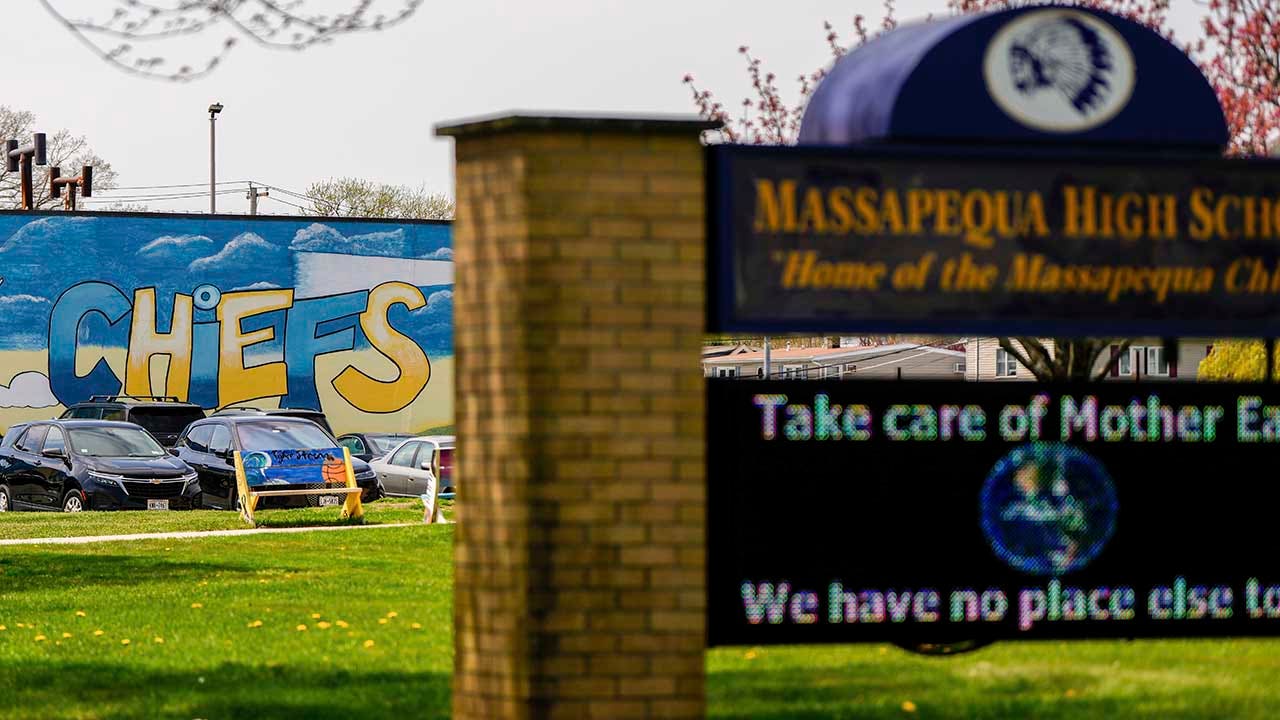
A mural for the Massapequa Chiefs school sports teams, where, according to media reports, the Trump administration has launched an investigation into New York officials threatening to withhold state funding for the town of Massapequa for failure to comply with a state mandate removing Native American names from school logos, is seen painted on a building next to the high school in Massapequa, New York, May 1, 2025. (Reuters/Shannon Stapleton)
“The Native American Guardians Association stands firm in asserting that the preservation of Native themes and imagery in New York public schools is not only a matter of cultural dignity but a fundamental civil right for all students. We call on federal and state leaders to help us defend these dwindling expressions or our presence and contributions,” Vice President of NAGA Frank Blackcloud said in a statement at the time.
TRUMP RIPS ‘RIDICULOUS’ CALLS FOR NEW YORK HIGH SCHOOL TO CHANGE NATIVE AMERICAN MASCOT
“Maintaining a respectable presence in NY State schools is vital to educational equity, historical truth, and the civil rights of all American Indians.”
The Department of Education also found that while Native American-inspired mascots, names and logos were not permitted under the policy, others that “appear to have been derived from other racial or ethnic groups” were, making the policy “discriminatory.”
The district sued the state in September, claiming its First Amendment rights were violated, but a federal judge ruled against it. Rebranding, including changing the name and logo, would cost roughly $1 million, district officials claimed.
A view of the Massapequa High School marquee, in Massapequa, N.Y., Friday, April 25, 2025. (AP Photo/Julia Demaree Nikhinson)
President Donald Trump became aware of the issue last month and encouraged the Department of Education to look into the ban, which he called “an affront to our great Indian population.”
The 2022 mandate requires all public schools to retire Native American mascots and logos or risk the loss of federal funding. Four schools on Long Island have since filed lawsuits.
The Department of Education announced Friday as part of its investigation that proposed resolution to the violations includes rescinding the ban on “Indigenous names, mascots, and logos,” issuing a memorandum to public schools informing them of the changes, and issuing apology letters to Indigenous tribes acknowledging that the actions of the two agencies “silenced the voices of Native Americans and attempted to erase Native American history.”
A marquee outside the Massapequa High School is backdropped by a “Chiefs” mascot mural, in Massapequa, N.Y., Friday, April 25, 2025. (AP Photo/Julia Demaree Nikhinson)
The Department of Education said failure to comply with the resolution plan risks further action by the Department of Justice and the potential loss of federal funding.
Fox News Digital’s Ryan Gaydos and Jackson Thompson contributed to this report.
Follow Fox News Digital’s sports coverage on X, and subscribe to the Fox News Sports Huddle newsletter.
Read the full article from Here


One autumn evening in 2020, the late poet Louise Glück walked into the snug dining room of the Somerville Peruvian restaurant Celeste. Glück found her usual table — the one between the two air conditioning vents — and greeted her usual server, Gonzalo, who waited on her every time she stopped in for ceviche de pescado and an IPA. But this evening was different from the others.
Glück had been awarded the Nobel Prize in Literature the day before and, amid a wave of public attention, craved the normalcy of enjoying a meal at one of her favorite restaurants. Ahead of Glück’s standing reservation, Celeste’s founders Maria Rondeau and chef JuanMa Calderon had filled the dining room with friends to ensure the new Nobel Laureate could dine in peace. A tabletop bouquet was the only memento marking her achievement.
“All she wanted was to be at Celeste and not think about anything else,” said Rondeau. “At the same time, we were nervous. We’d waited on the same lady every day, but now she was something else. It was a moment of joyous togetherness.”
Glück’s connection to Celeste is uniquely intense — so intense, in fact, that Rondeau and Calderon’s new restaurant opening in Back Bay, Rosa y Marigold, shares a name with Glück’s last published work. It’s also a particularly profound example of how Boston writers have long found comfort, camaraderie and sometimes safety in the city’s bars, cafes and restaurants.
From the bygone Harvard Square Spanish spot Irunåa where Robert Lowell hosted post-workshop office hours to the old Ground Round off Soldiers Field Road where reporters for The Boston Globe, Boston Magazine and the Boston Phoenix grabbed drinks after media-league softball games, local eateries have literally and figuratively fueled generations of Boston academics, journalists, novelists and poets. So, we asked some of these writers to tell us where they typically go for a coffee, a meal, a conversation, or a moment of peace.
Zarlasht Niaz, novelist
Zarlasht Niaz recently came to Boston from Minneapolis to begin her tenure as the Boston Public Library’s 2025-26 writer-in-residence. The Afghan American writer is managing an online literary journal that centers writing from and about Afghanistan while working on her debut novel-in-verse. Despite her newcomer status, she has already found some gastronomic staples.
Niaz regularly stops into BPL’s Newsfeed Café for arepas from the Somerville-based Venezuelan catering company Carolicious; lattes from a talented, unnamed barista — “When that person’s working, I get really excited,” said Niaz — and live public radio programming from the other NPR affiliate in town.
She also frequents Anoush’ella’s South Boston location, whose Eastern Mediterranean flavors call to mind home food. “They have these salads with a lot of different herbs and they remind me of the salads I grew up eating,” said Niaz. Turmeric House in Braintree hits similarly. “A perfect cup of chai. A perfect kebab. Yeah, I can’t wait to go back.”
Stephen Greenblatt, literary historian

Having devoted decades to unpacking the work of Renaissance writers, particularly William Shakespeare, it’s no wonder that the National Book Award and Pulitzer Prize-winning literary historian Stephen Greenblatt gravitates toward cuisine that could’ve conceivably appeared in “Julius Caesar.”
The Cambridge Italian staple Giulia is his undisputed go-to. “I know Italian food quite well, because we spend quite a lot of time in Rome,” said Greenblatt. “Guilia is unusually creative.” He often orders the pappardelle with wild boar topped with black trumpet mushrooms and parmigiano.
“The chef, Michael Pagliarini, is extremely talented and alert to what really good Italian food is like,” he said.
Greenblatt also ventures to the eastern edges of the Mediterranean basin when visiting Oleana (which recently received a Michelin Guide recommendation), but his dessert of choice there is decidedly American. “I like Oleana quite a lot, particularly for the wonderful baked Alaska, which is, I think, one of the great desserts that one can get,” said Greenblatt.
Golden, poet and photographer
Golden moved to Boston in 2018 following a celebrated poetry slam guest performance at Haley House in Roxbury and quickly became a fixture within the local literary scene. In the time since, the Black, gender-nonconforming trans writer and photographer has turned out two collections of poetry and images, served as Boston’s 2020-21 artist in residence, and earned a handful of high-profile fellowships. Golden is now relocating to their home state of Virginia to pursue an MFA, but they depart with close community ties, including connections to a couple of keystone Jamaica Plain restaurants.
“When I first moved to Boston, I lived on Centre Street by Jackson Square and we would always go to Galway House,” said Golden. “They have affordable, consistent food and a lot of community members I know love going there.”
The Haven, one of the Boston area’s only Scottish spots, is another JP essential for Golden. “I love the Haven Burger — it’s one of my favorites. And I love a good French fry and you can’t go wrong with that there,” Golden said. “I love filling food and food that you can enjoy with friends. That’s where my brain goes when I’m deciding where to eat.”
Laura Zigman, novelist
The fiction of Laura Zigman often hinges on the heightened emotionalism that comes with navigating life’s highs and lows, beginning with her debut 1997 novel “Animal Husbandry,” which was optioned and became the basis for a romantic comedy starring Ashley Judd and a young Hugh Jackman. But when it comes to going out for a drink or something to eat, Zigman looks to avoid drama at all costs.
Bar Enza, located in the Charles Hotel near Harvard Square, is her ideal venue for meeting friends. “They have really nice wine and cocktails, even though I really don’t drink anymore,” Zigman said. “When you come in for a drink, they’ll give you a velvet banquette that’s beautiful where you can talk and actually hear each other and I just love it.”
For coffee, Zigman prefers George Howell Coffee nestled inside the nearby Lovestruck Books. The location itself is freighted with Cambridge cafe history, standing not far from where Howell’s original Coffee Connection once operated between 1975 and 1996 before Starbucks acquired and rebranded it and its 18 local sister stores.
“Coffee Connection was one of those places that I just lived in when I was a teenager,” said Zigman. “They had French roast, French presses, and big barrels of coffee beans with burlap covers. The new George Howell inside Lovestruck is great — it’s cozy, smells like coffee, and it’s pink and red inside.”
Paul Tremblay, novelist
Brookline Booksmith near Coolidge Corner is a key location for the multi-time Bram Stoker Award-winning horror novelist Paul Tremblay. He visited the shop for the first time early in his writing career to attend a Stewart O’Nan reading and, in the years since, has gone back numerous times to do readings of his own and participate in author events.
Virtually every trip Tremblay makes to Brookline Booksmith goes hand-in-hand with a stop at Hamilton Restaurant and Bar, whose distinctive red awning with a silhouette of its namesake Founding Father casts a shadow on Beacon Street less than a block away.
“Invariably, before the event starts, usually at 7 p.m., all the writers involved and sometimes their family too will meet at Hamilton,” said Tremblay. “It’s such a relaxed vibe — a pub-style place with friendly staff, good food and drink, and, when the weather is warm, a nice outdoor space.”
When Tremblay is nearer to home in the Greater Boston suburbs, he regularly visits Northern Spy, a Canton-based restaurant from the owners of Loyal Nine that serves New England cuisine and operates out of Paul Revere’s historic Rolling Copper Mill.
“It’s a newer restaurant and it’s got a beautiful interior,” he said. “For people who dare trek outside of Boston and want to meet, it’s a go-to place.”
Megan Marshall, biographer
Megan Marshall arrived in the Boston area in 1973 and has since seen slews of writer-saturated restaurants come and go. She remembers meeting the eminent editor Justin Kaplan at the long-defunct Harvard Square fondue place, Swiss Alps, to get guidance on her biography of Elizabeth, Mary and Sophia Peabody, which eventually earned her the Pulitzer Prize. And she recalls grabbing coffee and cinnamon toast from a drugstore with an old-fashioned soda fountain that once stood on Boylston Street in between research sessions at the Massachusetts Historical Society.
These days, Marshall often finds herself at the Cambridge French patisserie Praliné. “They’re such lovely people there and they speak French, which makes me feel cosmopolitan and their croissants are, I think, the best in the Boston area,” said Marshall.
She also enjoys Praliné’s imported French loose-leaf tea, Mariage Frères. “I get little boxes of it to give as presents. People I know who have spent time in Paris say, ‘Oh, you must be just back from Paris,’ because there’s this impression that you can only get Mariage Frères there,” she said. “But you can get it at Praliné and impress anybody you know who’s Parisian.”


Three hours and nine minutes. That’s how long the average Connecticut resident spends in the emergency department at any one visit. With cuts in Medicaid, that time will only get longer.
On July 4, 2025, President Donald Trump passed the Big Beautiful Bill, which includes major cuts to Medicaid funding. Out of nearly 926,700 CT residents who receive Medicaid, these cuts could remove coverage for up to 170,000 people, many of whom are children, seniors, people with disabilities, and working families already living paycheck-to-paycheck.
This is not a small policy change, but rather a shift with life-altering consequences.
When people lose their only form of health insurance, they don’t stop needing medical care. They simply delay it. They wait until the infection spreads, the chest pain worsens, or the depression deepens. This is not out of choice, but because their immediate needs come first. Preventable conditions worsen, and what could have been treated quickly and affordably in a primary care office becomes an emergency medical crisis.
That crisis typically lands in the emergency department: the single part of the healthcare system that is legally required to treat everyone, insured or not. However, ER care is the most expensive, least efficient form of healthcare. More ER use means longer wait times, more hospital crowding, and more delayed care for everyone. No one, not even those who can afford private insurance, is insulated from the consequence.
Not only are individual people impacted, but hospitals too. Medicaid provides significant reimbursements to hospitals and health systems like Yale New Haven and Hartford Healthcare, as well as smaller hospitals that serve rural and low-income regions. Connecticut’s hospitals are already strained and cuts will further threaten their operating budget, potentially leading to cuts in staffing, services, or both.
 100vw, 771px”/><figcaption class=) Vicky Wang
Vicky WangWhen there’s fewer staff in already short-staffed departments and fewer services, care becomes less available to those who need it the most.
This trend is not hypothetical. It is already happening. This past summer, when I had to schedule an appointment with my primary care practitioner, I was told that the earliest availability was in three months. When I called on September 5 for a specialty appointment at Yale New Haven, the first available date was September 9, 2026. If this is the system before thc cuts, what will it look like after?
The burden will fall heaviest on communities that already face obstacles to care: low-income residents, rural towns with limited providers, and Black and Latino families who are disproportionately insured through Medicaid. These cuts will deepen, not close, Connecticut’s health disparities.
This is not just a public health issue, but also an economic one. Preventative care is significantly cheaper than emergency care. When residents cannot access affordable healthcare, the long-term costs shift to hospitals, taxpayers, and private insurance premiums. The country and state may “save” money in the short term, but we will all pay more later.
It is imperative that Connecticut takes proactive steps to protect its residents. The clearest path forward is for the state to expand and strengthen community health centers (CHCs), which provide affordable primary care and prevent emergency room overcrowding.
Currently, the state supports 17 federally qualified CHCs, serving more than 440,000 Connecticut residents, which is about 1 in 8 people statewide. These centers operate hundreds of sites in urban, suburban, and rural areas, including school-based clinics, mobile units, and service-delivery points in medically underserved towns. About 60% of CHC patients in Connecticut are on Medicaid, while a significant portion are uninsured or underinsured, which are populations often shut out of private practices.
Strengthening CHCs would have far-reaching impacts on both access and system stability. These clinics provide consistent, high-quality outpatient and preventive care, including primary care, prenatal services, chronic disease management, mental health treatment, dental care, and substance-use services. This reduces the likelihood that patients delay treatment until their condition becomes an emergency. CHCs also serve large numbers of uninsured and underinsured residents through sliding-fee scales, ensuring that people can still receive care even if they lose Medicaid coverage.
By investing in community health centers, Connecticut can keep its citizens healthy, reduce long waits, and ensure timely care even as federal cuts take effect.
Access to healthcare should not depend on ZIP code, income level, or politics. It is the foundation of community well-being and a prerequisite for a functioning healthcare system.
The clock is ticking. The waiting room is filling. Connecticut must choose to care for its residents before the wait becomes even longer.
Vicky Wang is a junior at Sacred Heart University, majoring in Health Science with a Public Health Concentration. She is planning to pursue a master’s in physician assistant studies.

Everything Dan Campbell Said After Detroit Lions Loss to Steelers

Fortune Tech: The sheer scale | Fortune

Dallas’ 12 most popular food and restaurant stories in 2025

6 Boston writers share their go-to bars, cafes and restaurants

Win over Broncos should allow Jaguars to think about ‘super’ heights

Florida High School Football Rankings: Top 25 teams – Oct. 21

Cleary's 21 help Le Moyne down Central Connecticut State 69-64 in OT

How old is Bo Nix? What to know about Oregon quarterback ahead of 2024 NFL Draft

99th annual Pony Swim held in Virginia

Video: ‘It Didn’t Have to Happen This Way:’ U.Va. Faculty Call for Review of Police Response to Protests

DHS responds after reports CISA chief allegedly failed polygraph for classified intel access

EU plans to raise €90 billion in joint debt for Ukraine — here’s how

Lawmakers threaten Attorney General Bondi with contempt over incomplete Epstein files

DNI Gabbard warns ‘Islamist ideology’ threatens Western freedom at AmFest

Algeria bill seeks to criminalise French colonial rule: What to know
-

 Iowa1 week ago
Addy Brown motivated to step up in Audi Crooks’ absence vs. UNI
-

 Iowa1 week ago
How much snow did Iowa get? See Iowa’s latest snowfall totals
-

 Maine6 days ago
Elementary-aged student killed in school bus crash in southern Maine
-

 Maryland1 week ago
Frigid temperatures to start the week in Maryland
-

 South Dakota1 week ago
Nature: Snow in South Dakota
-

 New Mexico5 days ago
Family clarifies why they believe missing New Mexico man is dead
-

 Detroit, MI7 days ago
‘Love being a pedo’: Metro Detroit doctor, attorney, therapist accused in web of child porn chats
-

 Education1 week ago
Opinion | America’s Military Needs a Culture Shift