Connect with us

Northeast

‘Baby Mary’ mom caught living suburban family life 40 years after leaving newborn to die in woods

Published

on

‘Baby Mary’ mom caught living suburban family life 40 years after leaving newborn to die in woods

Forty years after she left her newborn to die in a wooded New Jersey area on Christmas Eve, Mary Catherine Snyder Crumlich was living a suburban life in South Carolina with her husband and sons, social media shows. 

But earlier this month, 57-year-old Crumlich was sentenced to a year behind bars for manslaughter in the death of the infant Mendham Township Police called “Baby Mary” during their decades-long investigation, the Morris County Prosecutor’s Office announced. 

Mendham Township Police Chief Ross Johnson told Fox News Digital a DNA profile was established for the baby girl in 2014 and “a lot of great police work” solved the decades-old cold case.

Crumlich was just 17 when she left the child, her umbilical cord still intact, wrapped inside a towel in a plastic bag, which two young boys playing in a stream found and reported to police, the prosecutor’s office said. The death was ruled a homicide after a coroner determined the child had died before she was placed in the bag, police said. 

CHILD WHO SURVIVED 47-HOUR ABDUCTION FROM STATE PARK CREDITED FOR AIRTIGHT CASE AGAINST CAPTOR

Advertisement

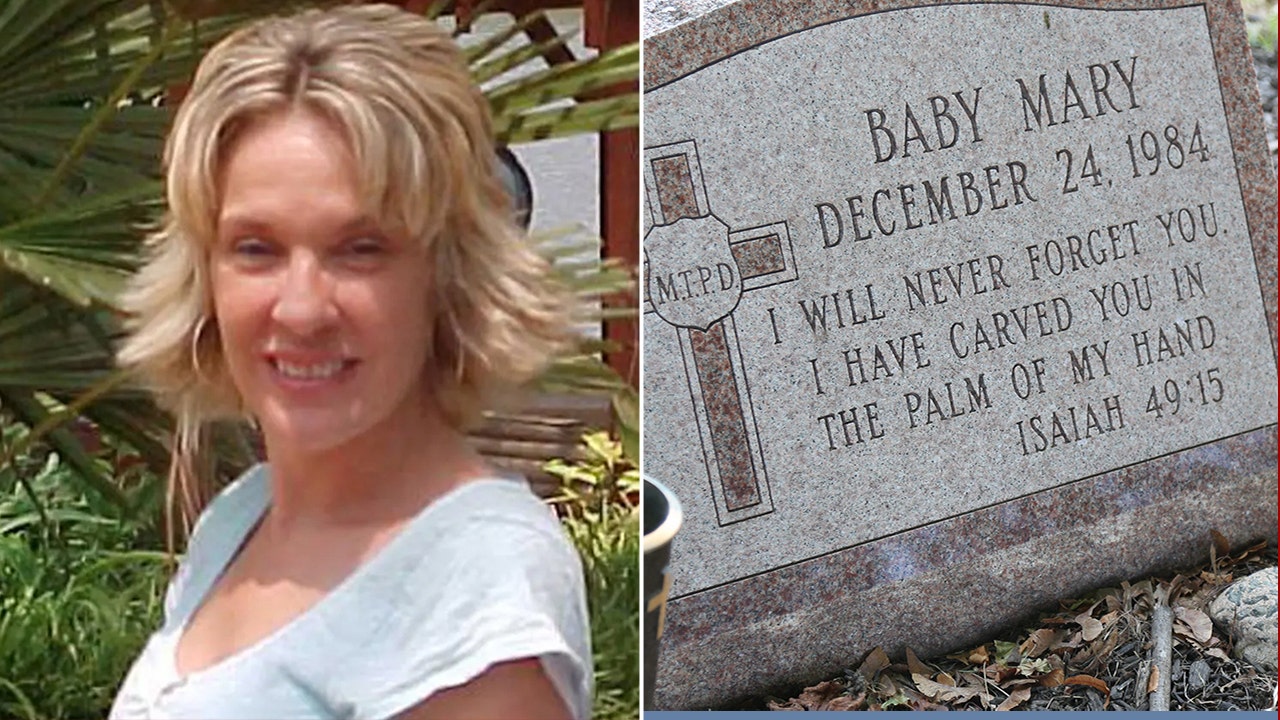
Mary Snyder Crumlich, 57, had moved from Mendham Township, N.J., to South Carolina, where she was living with her family when she was arrested for manslaughter in the death of her newborn daughter on Christmas Eve 1984.  (Cath Snyder-Crumlich/Facebook)

The baby girl’s identity was not known, but the Rev. Michael Drury at St. Joseph Church baptized her, Johnson told Fox News Digital. Each year on Christmas Eve, Johnson said, officers would visit the grave for a memorial service. 

SIGN UP TO GET TRUE CRIME NEWSLETTER

“It became part of our yearly tradition. We didn’t want Baby Mary to be forgotten,” Johnson said on Friday. “[It was] such a horrible act, really senseless in every sense of the word. We wanted to make sure she was remembered every Christmas Eve. … It’s just completely unnecessary. Even in the ’80s, there were so many resources in our area. It didn’t need to go down that way for sure.”

SCOTT PETERSON DEFENSE DROPS MOTION TO SEAL IN BID FOR NEW TRIAL AFTER PROSECUTORS NOTE FILES MOSTLY PUBLIC

Advertisement

The Mendham Township’s Police Department chaplain, the Rev. Michael Drury, named the infant Jane Doe “Mary” and baptized her, prosecutors said. Each year, a memorial service was held at her grave on Christmas Eve. (Chris Pedota/NorthJersey.com/USA Today Network)

When a DNA profile was established for the child, her case was reopened by the Morris County Cold Case Unit. With the help of a genealogist, Johnson said, detectives looked for families living in the area who had daughters between 16 and 19 years old and whose racial and ethnic backgrounds matched the girl’s. 

“There was never a belief that it was just some random person from out of town,” Johnson said. “The spot was so specific, it would have to be someone from the area.”

FOLLOW THE FOX TRUE CRIME TEAM ON X

Detectives interviewed dozens of families and chased a litany of tips and theories. Finally, they found a match for Baby Mary’s DNA, an area man who had died by suicide years earlier, in 2009 or 2010, Johnson said. 

Advertisement

“It is our firm belief he had no knowledge of this. That’s why his name hasn’t been anywhere,” Johnson said. “We had no evidence that he had any idea that he was the father of that particular child, let alone that Crumlich was even pregnant.

“Maybe he wouldn’t have done that if he knew,” he added. “Maybe if he had a kid, if the kid didn’t die, the story would be different.”

GET REAL TIME UPDATES DIRECTLY ON THE TRUE CRIME HUB

Through his family, they zeroed in on Crumlich, who had moved to suburban Columbia, South Carolina. 

On Facebook, she is pictured attending her son’s baseball games and weddings. Later, she posted photos babysitting her grandchildren. 

Advertisement

“I can’t imagine living with something like that. There are consequences.”

— Mendham Township Police Chief Ross Johnson

She was arrested April 23 last year and charged as a juvenile due to her age at the time of the offense. If she had been convicted as an adult, the prosecutor’s office said, it would have been on a second-degree manslaughter charge. 

Law enforcement was unable to refer to her by name until her conviction earlier this month, according to state laws for juvenile defendants. On April 3, Johnson said, Crumlich began a 364-day sentence at Morris County Correctional Facility. 

It was not immediately apparent who represented Crumlich in her case.

Johnson said he hopes Crumlich “finds closure on her end” after her prison sentence.

Advertisement

“I can’t imagine living with something like that. There are consequences,” he said. “It’s good to see that she carried on with her life, [but] she lives with this every day to some degree. I’m happy, even for her sake, that we could bring closure to this. The reality is that she left a newborn baby out in the woods. She did that, and we felt it was very important to bring that to justice.”


Johnson said he was “left with more questions than answers” even after the case was resolved.

“I really do hope one day when she gets out of jail she does come public with the whole story,” Johnson said. “But I don’t think that will ever happen.”


Read the full article from Here

Advertisement
Continue Reading
Click to comment

Leave a Reply

Your email address will not be published. Required fields are marked *

This site uses Akismet to reduce spam. Learn how your comment data is processed.

New Hampshire

Building back history: Program trains young people to help preserve NH’s landmarks

Published

on

Building back history: Program trains young people to help preserve NH’s landmarks


New Hampshire is full of historic homes, barns and churches that are at risk of falling apart. These structures often need a contractor who understands historic building techniques like timber framing or slate roofing, but there’s a shortage of people who know how to do that work. Advocates fear that gap could mean many historic buildings falling into decay or eventually disappearing.

“Whether it be stonework or blacksmithing, timber framing, window glazing, wooden shingles – all these trades are in demand,” stone mason Kevin Fife said. “But there’s less and less people that do it.”

Fife is one of the people who volunteers for a program that is trying to train more young people for careers in these historic trades. The New Hampshire Preservation Alliance’s Career Exploration in the Old Building Trades is a week-long program where high school students can spend their winter or spring break learning these skills hands-on.

Joshua Adams,17, signed up for the workshops during New Hampshire schools’ vacation week last month. He took Fife’s workshop on how to build a dry stack stone wall, meaning one without mortar or cement holding the stones together.

Advertisement

“I wasn’t really too sure about this one,” he said. “But I’m having a wonderful time here with the stone wall building.”

Joshua is in the construction program at the Concord Regional Technical Center where he learns electrical installation, plumbing and welding, but he’d never learned about some of these historic trades. He was interested in a barn repair class he took, where he learned about old-school timber framing and how buildings were once constructed without nails – just wooden pegs keeping the beams together.

He said he expect that learning these kinds of historic building skills could line him up for a lot of jobs.

“Around here, especially in places like New Hampshire and New England, there’s so much historical stuff,” Joshua said. “I used to go to historical places, museums, with my grandfather all the time. There was just so much work to be done, but I think people just aren’t pursuing it.”

A class at Canterbury Shaker Village works on repairing a colonial roof.

Regional industry surveys show young people aren’t joining the historic trades workforce nearly as fast as tradespeople are retiring. That means the people who still do this work often have years-long waitlists for clients, which could lead to some people deciding that repair work isn’t worth the wait.

Advertisement

“That can mean loss of old windows, loss of old plaster, loss of an old porch that really gives the building its character,” Jennifer Goodman, executive director of the New Hampshire Preservation Alliance, said. “On another level, we can see that there could be demolitions and total loss of buildings if there aren’t enough people around to do this work.”

The Canterbury Shaker Village is one of the places that will be hiring the next generation of tradespeople. The village was settled in the 1700s by followers of the Christian Shaker movement. The structures across the village – now a museum – date back centuries and are in constant need of maintenance.

To build the preservation workforce, the Preservation Alliance workshops are open to not only construction and carpentry students, but also people who are new to the building industry entirely.

Rowan McGrath, 18, said he knew how to use a drill, but not much more about construction. A computer engineering student at Concord Regional Tech Center, he is attending the spring workshops to give him career options in the future.

“AI: it’s a big thing that’s going to probably take over tech,” Rowan said. “So [with these skills] I have something I can rely on as a backup, and it makes pretty good money.”

Advertisement

Fife, the stone mason, said this line of work is rewarding. He’s made a career of maintaining the stone structures people put together centuries ago. He grew up in Canterbury, and his family goes back generations here.

“I like to do it the traditional way because that’s a part of our ancestry, our heritage, and that’s why people come to New England,” Fife said. “It’s just more fitting.”

If there are enough people who can do the work, they can keep history standing a bit longer.


Source link

Advertisement
Continue Reading

New Jersey

NJ Burglars Target These 10 Hiding Spots First

Published

on

NJ Burglars Target These 10 Hiding Spots First


Do you have a secret spot in your home where you hide your valuables?

Do you think that it’s very safe and a would-be burglar wouldn’t think to check?

Unfortunately, that spot may not be as safe as you would hope. Burglars have a few spots in your home they will check first after they break in, and it very well may be your “super safe secret spot.”

Toru Kimura for Unsplash

Advertisement
Toru Kimura for Unsplash

Do you hide things in your sock or underwear drawer?

It may be a good way to hide things from your kids, but obviously, a burglar is going to check there first.

Keep Scrolling to Find Out The Other 9 Places

How Common is Burglary in New Jersey

The majority of crimes in New Jersey are property crimes like burglary and vehicle theft. In 2021, NJ residents reported 103,761 property crimes.

This breaks down to a property crime rate of 11 crimes per 1,000 residents.

Though this crime rate is below the national average, you still have a 1-in-89 chance of becoming a victim of property crime. Criminals in New Jersey often target homes to steal electronics, jewelry, and other expensive items.

Advertisement

Reconsider Where You Are Hiding Your Valuables

I hope you are never the victim of a burglary, but if you are, at least you can make it a little harder for a crook to find your valuables.

Reader’s Digest recently talked with Chris McGoey of McGoey Security Consulting and Robert Siciliano, a security analyst with Hotspot Shield.

Using information from these two experts, the magazine determined that these are the 10 spots burglars are most likely to check.


Andrey Pipov for Unsplash

Advertisement
Andrey Pipov for Unsplash

10 ‘Secret Spots’ Burglars Check First When Invading New Jersey Homes

Gallery Credit: Eddie Davis

Local Favorites: Top 10 Atlantic City Casino Restaurants

Gallery Credit: Eddie Davis


Source link

Continue Reading

Pennsylvania

Pennsylvania Supreme Court ruling on cast vote records creates uncertainty for counties

Published

on

Pennsylvania Supreme Court ruling on cast vote records creates uncertainty for counties


Source link

Continue Reading
Advertisement

Trending
