Plus special access to select articles and other premium content with your account – free of charge.
By entering your email and pushing continue, you are agreeing to Fox News’ Terms of Use and Privacy Policy, which includes our Notice of Financial Incentive.
Please enter a valid email address.
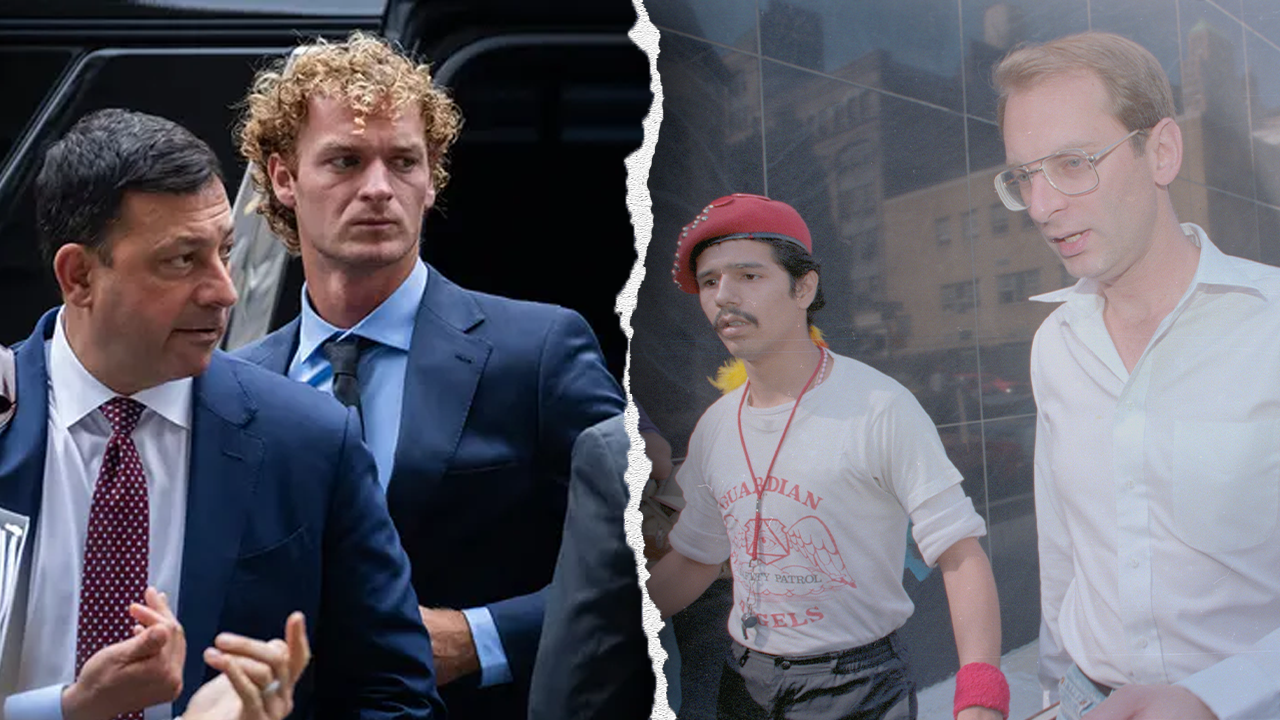
Bernhard Goetz, then a 37-year-old electronics technician, defended himself from a group of would-be robbers on a New York City subway car Dec. 22, 1984.
Four decades later, another New York straphanger argued self-defense to beat homicide charges in another Big Apple subway vigilante case.
Advertisement
In May 2023, Daniel Penny, a 26-year-old Marine veteran who was studying architecture at a New York college, placed 30-year-old Jordan Neely in a headlock to stop a violent outburst that frightened passengers and involved threats about killing them and going to prison for life.
Jurors found Penny not guilty of criminally negligent homicide earlier this month after prosecutors asked the judge to dismiss the most serious charge of manslaughter.
DANIEL PENNY FOUND NOT GUILTY IN SUBWAY CHOKEHOLD TRIAL
Bernhard Goetz, who shot four youths on a crowded subway because he felt he was about to be robbed, was cleared of all attempted murder charges. He was convicted on only one of 13 counts, third-degree weapons possession.(Bettmann via Getty images)
The trials of Goetz and Penny were both highly politicized and scrutinized because of the subjects’ races. Goetz and Penny are both White. Neely and the four men Goetz shot are Black. Legal scholars have spent years discussing whether Goetz would have shot White teens under similar circumstances. Penny’s defense repeatedly accused prosecutors of trying to unfairly inject racial undertones into a trial that did not involve hate crime charges.
Advertisement
Both cases also reflect deeply held public sentiment that crime was getting out of control in New York City. Goetz had been mugged multiple times in the past, which is why he said he was carrying a handgun. Penny put Neely in a chokehold after a spate of subway incidents involving mentally ill homeless people attacking passengers, telling police, “These guys are pushing people in front of trains and stuff.”
Violent crime dropped dramatically in New York City in the late 1990s and 2000s, but some crimes, robberies in particular, have risen again after a wave of anti-police rioting in 2020 and left-wing political movement to “defund the police.”
KYLE RITTENHOUSE TRIAL ‘A SHAM AT BEST,’ SUBWAY VIGILANTE BERNIE GOETZ SAYS: ‘SATISFY A MOB’
Daniel Penny returns to the courtroom after a break during his trial in Manhattan Criminal Court Dec. 3, 2024, in New York City. (Michael M. Santiago/Getty Images)
Goetz was acquitted on attempted murder charges but spent 8½ months in jail for possessing the handgun he used to defend himself without a license.
Advertisement
The case involved four teens — Darrell Cabey, James Ramseur, Troy Canty and Barry Allen. The first two were armed with sharpened screwdrivers, which they claimed were not weapons but tools to break into coin boxes in arcade games, according to court records.
They got on a Manhattan-bound No. 2 train in the Bronx and surrounded Goetz after he boarded at the 14th Street station in Manhattan and sat down by himself.
Goetz had an unlicensed .38-caliber pistol in his belt loaded with five rounds.
Bernhard Goetz leaves the courthouse.(Rick Maiman/Sygma via Getty Images)
The teens approached Goetz, and without displaying any weapons, Canty told him, “Give me $5.”
Advertisement
Rather than being robbed, Goetz pulled out the gun and fired four shots – striking Canty in the chest and Allen in the back. Another round went through Ramseur’s arm and into his side. The fourth shot missed Cabey. Goetz waited a moment, then fired his last shot at Cabey, severing his spinal cord and leaving him paralyzed.
WATCH ‘SCANDALOUS: THE SUBWAY VIGILANTE’ ON FOX NATION
A No. 2 train subway car in the aftermath of the Bernhard Goetz shooting at Manhattan’s Chambers Street Station Dec. 22, 1984.(Carmine Donofrio/NY Daily News Archive via Getty Images)
“I said, ‘You seem to be all right, here’s another,’” Goetz later told detectives. “If I was a little more under self-control … I would have put the barrel against his forehead and fired.”
He added that if he’d been carrying more bullets, he would have kept shooting.
Advertisement
The conductor stopped the train and radioed police. Goetz jumped off the train and fled on foot.
STREAM DANIEL PENNY’S EXCLUSIVE INTERVIEW ON FOX NATION
Screenshot from bystander video showing Jordan Neely being held in a chokehold on the New York City subway.(Luces de Nueva York/Juan Alberto Vazquez via Storyful)
The case sparked a media frenzy, and Goetz surrendered to police in Concord, New Hampshire, nine days later. He told them he’d been illegally carrying a pistol since 1981, when he had been “maimed” during a prior mugging. He also said that, on multiple occasions, he’d warded off other would-be robbers by brandishing the weapon and not firing.
Advertisement
Because of those prior attacks, he said, he knew the teens on the train wanted to rob him based on their behavior and the looks on their faces. Before the case went to trial, at least two of the teens reportedly admitted they were going to rob him, but a court considered those statements hearsay.
Goetz did not immediately respond to a request for comment for this story.
BOSTON (WHDH) – Celtics star forward Jayson Tatum responded to the team’s shocking trade of forward Jaylen Brown to the Philadelphia 76ers on Wednesday, reflecting on the near decade they spent together in Boston.
Tatum posted a tribute to Brown on his Instagram story Friday afternoon, writing, “9 years! Forever grateful for all that we accomplished together, for pushing me to be a better player. From first round exits to winning a chip together I’m thankful for it all. Nothing but love and respect for you as a player and as a person! Looking forward to see how you attack this next chapter of your career and wish you nothing but the best for you! Continue to be special.”
The trade will become official Monday once the league-wide moratorium is lifted. The Celtics will welcome nine-time NBA All-Star Paul George, who they received from the 76ers, as well as new signings Mitchell Robinson and Mike Conley Jr.
(Copyright (c) 2026 Sunbeam Television. All Rights Reserved. This material may not be published, broadcast, rewritten, or redistributed.)
Advertisement
Join our Newsletter for the latest news right to your inbox
We break down when Pittsburgh fireworks cross from fun into illegal
In Pennsylvania, it’s easier than ever to buy consumer fireworks, but using them inside Pittsburgh city limits is where the law tightens up.
In Pennsylvania, it’s easier than ever to buy consumer fireworks, but using them inside Pittsburgh city limits is where the law tightens up. For this week’s “Is It Legal?” series, the key distinction is that purchase and possession are generally allowed under state law, while where and how you launch them is restricted by local rules and safety regulations.
In Pittsburgh, residents can’t legally set off fireworks in public spaces like streets, sidewalks, parks or right-of-way areas. They’re also not supposed to launch them near buildings or vehicles, or in any way that directs fireworks toward people or property.
Advertisement
In rowhouse neighborhoods and dense blocks, that effectively rules out most front yards, alleys and tight backyards, because they sit too close to homes and parked cars to meet the distance and safety requirements. On top of that, noise and nuisance ordinances can come into play, especially late at night, giving police grounds to respond when fireworks are reported as a disturbance or hazard.
Officials stress that fireworks are explosives, not toys, and point to common risks: injuries from misfires, fires on roofs or in yards, and the impact on pets, older neighbors and veterans with PTSD. That’s why they consistently urge residents to skip DIY backyard launches and attend permitted, professional shows instead, where licensed operators, fire crews and safety plans are already in place.
More: Is it legal? Boating rules on Pittsburgh’s three rivers
More: Is it legal? What boaters can and can’t do on Pittsburgh’s rivers
Advertisement
More: Is it legal? Exploring ‘The Pittsburgh Left’
So, when viewers ask “Is it legal?” the answer is nuanced: Buying fireworks is broadly legal under state law, but setting them off in most Pittsburgh neighborhoods — especially in public spaces or close to buildings — is often not, and can quickly lead to citations or police visits rather than a celebration.
This article by Gabby Sartori was created with the assistance of Artificial Intelligence (AI). Journalists were involved in every step of the information gathering, review, editing and publishing process. Learn more.
The AGANORSA Leaf Aniversario Connecticut is now available in a new vitola, one that also comes in a metal tube.
It’s the second different toro for the line, though it will be difficult to confuse the two cigars. The AGANORSA Leaf Aniversario Connecticut Toro, the existing cigar, is a 6 1/4 x 52 box-pressed toro. The new AGANORSA Leaf Aniversario Connecticut Tubo is a 6 x 52 round toro. Blend-wise, the line uses an Ecuadorian Connecticut-seed wrapper over Nicaraguan tobaccos grown by AGANORSA. The line is made at the company’s factory in Nicaragua.
The AGANORSA Leaf Aniversario Connecticut Tubo has an MSRP of $19.99 and comes in boxes of 10 cigars.
Advertisement
“The Aniversario Connecticut Tubo offers a perfect combination of elegance, convenience, and flavor,” said Terence Reilly, vp of sales & marketing for AGANORSA Leaf, in a press release when the cigar was announced in March. “It’s an ideal cigar for both longtime fans of the brand and smokers discovering Aganorsa for the first time.”
Charlie Minato
I am an editor and co-founder of halfwheel.com/Rueda Media, LLC. Previously, I started TheCigarFeed, one of the two predecessors blogs of halfwheel. I have written about the cigar industry since 2010, covering everything from product launches to regulation to M&A. Beyond writing, I handle a lot of the behind-the-scenes stuff from weighing cigars to coordinating the tech. Outside of work, I enjoy playing tennis, watching boxing, falling asleep to the Le Mans 24, wearing sweatshirts year-round and eating gyros. echte liebe.