Connect with us

News

Why the next president's judicial appointments will impact climate action

Published

on

Why the next president's judicial appointments will impact climate action

Environmental activists rally in front of the U.S. Supreme Court in 2022 after it ruled against the Obama administration’s plan to cut climate-warming emissions at the nation’s power plants. The Supreme Court has since further limited the power of federal agencies like the Environmental Protection Agency.

Drew Angerer/Getty Images


hide caption

toggle caption

Advertisement

Drew Angerer/Getty Images

Nerdy question for all of you policy wonks out there: What did the Obama administration’s landmark climate regulation on the nation’s power plants — the Clean Power Plan — and the Trump administration’s more lenient replacement of it — the Affordable Clean Energy Rule — have in common?

Both were seen as major industry-changing regulations. Both were lauded by some and reviled by others.

And neither went into effect.

Advertisement

“Basically any environmental rule of any magnitude is challenged in the courts,” said Lisa Heinzerling, a law professor at Georgetown University and a senior adviser to former President Barack Obama’s Environmental Protection Agency (EPA). “The courts have the final word.”

As President Biden and former President Donald Trump vie for a second term amid what’s sure to be one of the hottest years in recorded history, NPR’s Climate Desk has looked at both candidates’ records on climate change and what to expect if either is elected. Trump is promising to “drill, baby, drill,” and weaken regulations on oil and gas development. Biden is promising to create more jobs with an energy transition away from climate-warming fossil fuels.

But given the litigious nature of environmental law and the U.S. Supreme Court’s recent decisions, particularly one limiting the power of federal agencies, legal experts say one of the election’s most consequential aspects for the climate would be the judicial appointments either candidate makes.

The president has the power to nominate federal judges for lifelong terms. Not only to the Supreme Court, but also to federal appellate and district courts, which see tens of thousands of cases each year. Pending Senate approval, those appointments shape the country’s judiciary and the government’s ability to implement laws for decades.

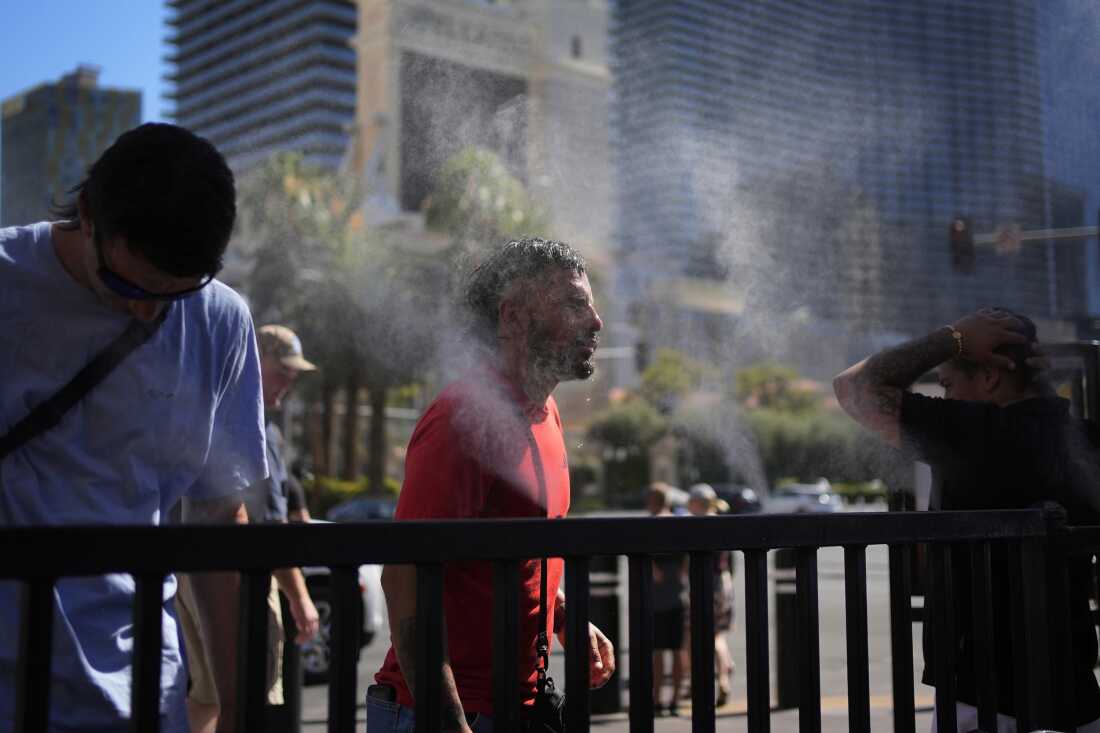
People cool off in misters along the Las Vegas Strip, Sunday, July 7, 2024, in Las Vegas. Used to shrugging off the heat, Las Vegas residents are now eyeing the thermometer as the desert city is on track Wednesday to set a record for the most consecutive days over 115 degrees (46.1 C) amid a lingering hot spell that's expected to continue scorching much of the U.S. into the weekend.

People cool off in misters along the Las Vegas Strip during a deadly, record-breaking heatwave. Heatwaves are growing in intensity, frequency and duration as climate change intensifies.

John Locher/AP

Advertisement


hide caption

toggle caption

John Locher/AP

Advertisement

“Almost all cases involving some type of environmental action ultimately go to a court of appeals,” said Jeff Holmstead, an attorney with the law firm Bracewell LLC, who worked on air issues at the EPA under former President George W. Bush.

Biden has appointed 201 judges, including one justice to the Supreme Court. Trump appointed 234, including three Supreme Court justices, giving conservatives a 6-3 majority on the nation’s highest court.

Since then, the Supreme Court has ruled against agencies’ ability to cut climate-warming emissions, to protect the nation’s wetlands and ephemeral streams and to limit air pollution for states downwind of power plants and factories.

“I think it is clearer than ever that folks who believe fervently that we should protect public health from environmental harms really can’t make progress if they have a hostile judiciary waiting,” said Cara Horowitz, executive director of the Emmett Institute on Climate Change and the Environment at the UCLA School of Law. “The work becomes a lot harder when you have a Supreme Court sitting at the end of every litigation road that’s hostile to the administrative state and environmental regulations.”

Recent SCOTUS decision could greatly affect climate regulation

For the last 40 years, the American judicial system has operated with the understanding that if a law is ambiguous, the courts should defer to the expertise of the federal agency implementing it, as long as that implementation is reasonable.

Advertisement

In other words, if a law like the Clean Air Act isn’t crystal clear, the courts would defer to experts and scientists at federal agencies, like the EPA, to fill in the gaps when writing regulation and implementing laws.

In its recent term, the Supreme Court’s conservative majority threw out what’s known as the Chevron deference in a ruling on two related cases. Writing for the majority, Chief Justice John Roberts argued that “courts must exercise their independent judgment in deciding whether an agency has acted within its statutory authority.”

Legal experts say the decision could affect the government’s ability to regulate food, medicine, telecommunication and worker safety, among others. But the implications for environmental regulations are particularly stark. That’s because the Clean Air Act, the Clean Water Act and the Endangered Species Act were purposely written vaguely to accommodate for future problems.

“Many of these laws were passed in the 1970s when we were gaining an understanding of various environmental issues, and when Congress wrote these laws, they imparted on agencies a very capacious authority to account for the best available science,” said Erik Schlenker-Goodrich, executive director of the Western Environmental Law Center. “And the best available science emerges over time.”

The Endangered Species Act, which protects imperiled plants and animals like the Key Deer, is more than 50 years old. Federal agencies are tasked with using old environmental statutes to deal with modern problems, fueling much of the environmental litigation seen in federal courts.

The Endangered Species Act, which protects imperiled plants and animals like the Key Deer, is more than 50 years old. Federal agencies are tasked with using old environmental statutes to deal with modern problems, fueling much of the environmental litigation seen in federal courts.

Ryan Kellman/NPR

Advertisement


hide caption

toggle caption

Ryan Kellman/NPR

Advertisement

Scientists’ understanding of emerging environmental problems like climate change, PFAS and plastic pollution is constantly evolving. Government agencies are tasked with protecting people from those problems using existing laws.

“So when Supreme Court justices are saying we’re going to freeze things as we knew them back in the 1970s, what they’re essentially saying is agencies can’t account for the science, agencies can’t adapt to the science and agencies cannot protect the public’s interest,” Schlenker-Goodrich said.

Proponents of the Supreme Court’s decision argue the Chevron deference gave federal agencies too much power.

“The fact that a statute was silent on an issue doesn’t mean that Congress intended to let the agency sort of read it however it wants,” Holmstead said.

Agency attorneys “are acting like anybody else’s attorneys,” said Damien Schiff, a senior attorney focused on environmental law at the Pacific Legal Foundation, a conservative public interest law group. “They’re just simply advocates articulating a view, but it’s not necessarily privileged in terms of its accuracy or propriety just because it’s being articulated by a government agency.”

Advertisement

Schiff, whose law firm filed an amicus brief calling for the end of Chevron, said the change is part of a broader shift in the court’s approach to law that could help groups on the left and those on the right, making it easier “for private parties to try to vindicate their rights against government entities.”

JJ Apodaca, executive director of the Amphibian and Reptile Conservancy, said the shift means instead of relying on federal scientists, “with Ph.D.s and master degrees,” decisions will now be made by judges who, “have political affiliations and in many cases, haven’t taken a science or biology class since high school.”

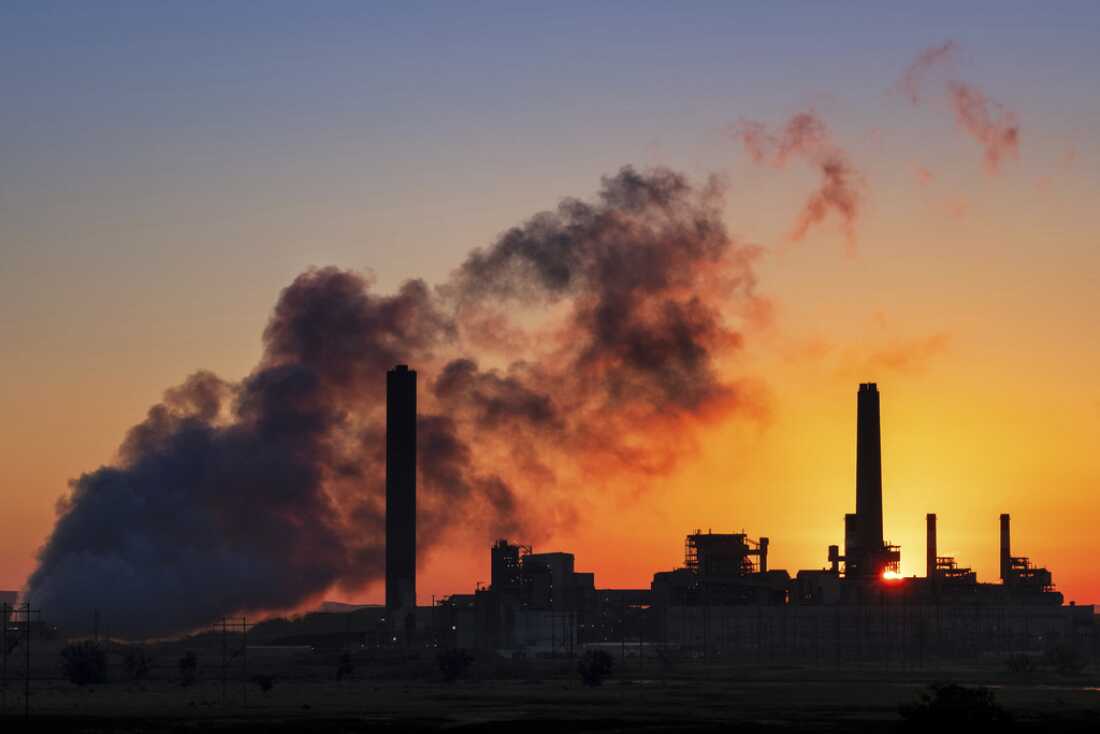
A coal-fired power plant is silhouetted against the morning sun.

The Obama and Biden administration’s have tried using the Clean Air Act to limit climate-warming emissions from the nation’s power plants, but their efforts have been held up or blocked in courts.

J. David Ake/AP


hide caption

Advertisement

toggle caption

J. David Ake/AP

The politics of the judiciary

An impartial judiciary has been a cornerstone of American democracy since its inception.

Trump’s term led to the most conservative Supreme Court in more than 90 years, but it also allowed Republican leadership to place more than 230 other judges in federal district and appellate courts — which issue “the bulk of the federal legal decisions in this country,” Heinzerling said.

Advertisement

Earlier this year, a federal appeals court ended a long-running lawsuit by young plaintiffs in Oregon who argued the U.S. government’s contribution to climate change violated their constitutional rights. In 2022, a U.S. district court restored endangered species protections to gray wolves in 44 states.

Those lower courts often get the benefit of the doubt, Heinzerling said. “Which means they can have a huge influence on what the regulatory landscape looks like.”

In his first campaign, Trump vowed to appoint judges in the mold of the late conservative Justice Antonin Scalia. Three-quarters of his appointees were men and roughly 84% were white, according to the Pew Research Center. An analysis by The Washington Post in May found that Biden has placed more non-white federal judges than any president in history. Nearly two-thirds are women.

“When he talks about rights and liberties, [Biden] knows that in the end those rights and liberties are decided by federal judges, so the makeup of the federal judiciary is connected to everything else we do,” former White House chief of staff Ron Klain told NPR last year.

Biden has had less say on the makeup of the Supreme Court, filling only one opening during his first term — Justice Ketanji Brown Jackson — and legal experts say it’s unlikely he’d be able to shift it in a second term. The court’s two oldest justices, Clarence Thomas and Samuel Alito, are both conservative and unlikely to retire if Biden is reelected. If Trump wins in November, critics fear he could replace both with younger justices, locking in the court’s conservative majority for decades to come.

Advertisement

Regardless of who wins, legal experts say, the Supreme Court’s recent decisions will make it harder for the federal government to tackle environmental problems like climate change, barring new legislation from Congress.

“[Chevron] makes it harder for agencies to use old laws to address new problems,” said Sam Sankar, senior vice president for programs at the environmental firm Earthjustice. “But that doesn’t mean that we can’t address the threats of climate, and we will. Problems are getting bad enough that Congress, even the right wing, is going to start needing to react to these things in federal lawmaking.”

“The question is,” he added, “how much do we lose and how much does it cost us to try to address the problems we’ve got?”

News

A New Worry for Republicans: Latino Catholics Offended by Trump

Published

on

A New Worry for Republicans: Latino Catholics Offended by Trump

When Stuart Sepulvida arrives at St. Francis de Sales Roman Catholic Parish in Tucson, Ariz., for Mass, which he attends most mornings, he passes a display honoring local soldiers and encouraging parishioners to pray for their safety. Hundreds of small cards record their names: Robles, Arenas, Grajeda. A portrait of Pope Leo XIV hangs across the lobby.

Mr. Sepulvida, 81, is a Vietnam veteran whose patriotism and Catholicism are deeply intertwined. He voted for President Trump three times but has never felt more betrayed by an American president than when Mr. Trump denounced Pope Leo as “weak on crime” and “terrible for foreign policy.”

“It was very disturbing to me to hear both of them clashing like they did,” Mr. Sepulvida said, standing outside the church one morning this week. Now, he is reconsidering whether he will vote Republican this year.

The Republican Party is struggling to hold onto the support from Hispanic voters who helped propel Mr. Trump back into the White House in 2024. Yet as many party leaders have acknowledged the urgent need to stop the backsliding among Latinos, the president has enraged many of even his strongest supporters by clashing with the pope.

On Easter Sunday, Pope Leo, the first U.S.-born pontiff, spoke of the need to “abandon every desire for conflict, domination and power, and implore the Lord to grant his peace to a world ravaged by wars.” Within days, Mr. Trump, who has led the United States into a war with Iran, said the pope was “catering to the radical left” and posted an AI-generated image portraying himself as a Jesus figure. Mr. Trump later deleted the image, saying he thought it depicted him as a doctor.

Advertisement

“It just isn’t what a president should do,” Mr. Sepulvida said. “The pope speaks for his people. He is beyond politics.”

Mr. Trump won 55 percent of Catholic voters in the 2024 election, compared to 43 percent who voted for former Vice President Kamala Harris, according to Pew Research Center. The most sizable gains came from Hispanic Catholics. While Joseph R. Biden Jr. won their votes by a 35-point margin in 2020, the Democratic advantage shrunk to 17 points in 2024. Now, just 18 percent of Hispanic Catholics said they support most or all of President Trump’s agenda, according to a poll from Pew released earlier this year.

If the president’s quarrel with the pope sours more Latinos on the Republican Party, it could affect midterm races across the country, including in South Florida and South Texas, where Republicans have notched important victories in predominantly Hispanic districts in recent years.

In Arizona’s Sixth Congressional District, which stretches from north of Tucson to the Mexican border, voters were still grappling with the fallout this week.

The district is roughly evenly divided among Republicans, Democrats and independent voters. Nearly a third of the district is Hispanic, and there is a significant population of members of the Church of Jesus Christ of Latter-day Saints, as well as a large Catholic community with deep history in the region. It also has one of largest numbers of military veterans of all congressional districts in the country.

Advertisement

“The president is looking for a lot of attention from everything,” said Maria Ramos, 60, who regularly attends weekday Mass at St. Francis. A registered independent, she usually votes for Democrats but often declines to cast a ballot if she views a candidate as too liberal. “He believes he can put God in his place. He’s meddling in countries that he’s not in control of — he wants to control the world.”

“It is not just a very serious lack of respect — it is a mortal sin,” she said, shaking her head. One word comes to her mind again and again, she said: disgust.

Like so many others in southern Arizona, Ms. Ramos has several relatives who serve in the military — a path they saw to both serve the country and as an entry into the stable middle class. Many of them, she said, voted for Mr. Trump for president.

The Tucson district is now widely seen as one of the most competitive in the country. Republican Juan Ciscomani narrowly won the district in 2022, in part by emphasizing his biography as a Mexican immigrant and a devoted father of six children. He is also an evangelical Christian, a group that has driven much of the growth among Hispanic Republican voters in recent years.

Mr. Ciscomani declined a request for an interview, but when a local radio host asked Mr. Ciscomani what he thought of Mr. Trump’s comments “as a man of faith,” the congressman declined to criticize the president but said, “You can trust that you won’t see any meme like that coming out of my account.”

Advertisement

JoAnna Mendoza, the Democrat challenging Mr. Ciscomani this fall, has made her 20-year career in the U.S. Navy and Marines a key aspect of her story on the campaign trail. While she rarely speaks about her religious background and no longer considers herself a practicing Catholic, she said she briefly considered becoming a nun as a teenager. She criticized Mr. Ciscomani for not condemning the president’s remarks.

“You can’t make faith a central part of your campaign and then allow this to stand,” she said in an interview.

Across Tucson, Latino Catholics, regardless of their past voting preferences, were similarly quick to condemn the president’s remarks.

When Cecilia Taisipic, 71, heard about it, she said, she winced with shame about her vote for him in 2024.

“I thought he would make the country better, but apparently it’s the opposite,” she said as she left Mass at St. Francis earlier this week. She is so fed up with politics, she said, that she is unlikely to vote at all this year. “When it comes to my faith, I don’t like anybody to challenge it. Now I don’t want to hear anything on the news. I just want to pray.”

Advertisement

Matilde Robinson Bours, 63, teaches a weekly Spanish Bible study class at St. Thomas the Apostle Parish, and like nearly all of the women in her class, she immigrated from Mexico decades ago. She has voted for Republicans in nearly every election since she became a citizen. Though she has never liked President Trump, she said, his comments about the pope enraged her more than anything else he has said or done in the past.

“This surpassed everything, every social and political norm — this is personal to all Catholics,” she said. “The arrogance and ego is disgusting. To think that he is God? The pope has every right and responsibility to talk about peace.”

Still, Ms. Robinson Bours said, nothing will stop her from supporting Republicans again this year. She has been delighted that her adult children have stopped supporting Democrats in recent elections.

“Almost everyone I know thinks the way I do,” she said.

Patricia Martinez, 86, who has attended the same Bible study as Ms. Robinson Bours for years, shook her head in disagreement. She said she cannot imagine voting for a Republican who supports Mr. Trump.

Advertisement

“This is different — this shows he is out of his mind,” said Ms. Martinez. “We have to have basic respect and teach that to people in this country.”

Patrick Robles, a 24-year-old native of Tucson, spent years alienated from the Roman Catholic Church, but returned to his faith more recently. “The craziness of the world sort of caused me to seek some sort of answers,” he said. Now, he attends Mass at the St. Augustine Cathedral in downtown Tucson, a few blocks from the office where he works as an aide to Representative Adelita Grijalva, a Democrat.

Mr. Robles said he saw Mr. Trump’s battle with the pope as both a personal affront and a political opportunity.

“The president is basically trying to draw a line between Catholics and what we perceive to be patriotism,” he said. “I believe we can be both.”

Last week, he texted one of his uncles who has supported Mr. Trump in every election asking him what he thought.

Advertisement

“I’m afraid we need divine intervention,” the uncle replied.

Continue Reading

News

After 2 failed votes, Mike Johnson unveils new plan to extend key U.S. spy powers

Published

on

After 2 failed votes, Mike Johnson unveils new plan to extend key U.S. spy powers

Speaker of the House Mike Johnson, R-La., takes questions at a news conference at the Capitol on Tuesday.

J. Scott Applewhite/AP


hide caption

toggle caption

Advertisement

J. Scott Applewhite/AP

Speaker Mike Johnson, R.-La., is forging ahead with his latest proposal to renew a key American spy power. His bill, revealed Thursday, is largely unchanged from a previous plan which failed in a series of overnight votes earlier this month.

The program at center of the debate, Section 702 of the Foreign Intelligence Surveillance Act (FISA), is set to expire on April 30.

FISA 702 allows U.S. intelligence agencies to intercept the electronic communications of foreign nationals located outside of the United States. Some of the nearly 350,000 foreign targets whose communications are collected under the provision are in touch with Americans, whose calls, texts and emails could end up in the trove of information available to the federal government for review.

Advertisement

For almost two decades, privacy-minded lawmakers from both parties have sought to require specific court approval before federal law enforcement can conduct a targeted review of an American’s information gathered through the program. The lack of any such warrant requirement helped sink an effort last week to extend the program for 18 months, as well as a separate vote on a five-year renewal. 

Trump officials, like those in past administrations, have argued that such a warrant requirement would overburden law enforcement and endanger national security. Johnson’s latest proposal would reauthorize the program for three years, but does not include a warrant requirement. Instead, the bill calls for the FBI to submit monthly explanations for reviews of Americans’ information to an oversight official as well as criminal penalties for willful abuse, among other tweaks.

“I am willing to risk the giving up of my Rights and Privileges as a Citizen for our Great Military and Country,” the president wrote on Truth Social last week, advocating for the program to be extended without changes. “I have spoken with many in our Military who say FISA is necessary in order to protect our Troops overseas, as well as our people here at home, from the threat of Foreign Terror Attacks. It has already prevented MANY such Attacks, and it is very important that it remain in full force and effect.”

Glenn Gerstell, who served as general counsel at the National Security Agency during the Obama and first Trump administration, says Johnson’s reforms look like an attempt to find a middle ground.

“There’s not a lot of really substantive changes to the statute, but some gestures are made to people who are worried about privacy and civil liberties,” Gerstell said. “It seems like a pretty reasonable compromise that is going to be satisfactory to the national security agencies and yet at the same time represents some gesture to the privacy advocates.”

Advertisement

“This is not a reform bill and it’s not a compromise,” Elizabeth Goitein, a privacy advocate and senior director of the Liberty and National Security Program at the Brennan Center for Justice at New York University, wrote on X. “It’s a straight reauthorization with eight pages of words that serve no serious purpose other than to try to convince members that it’s NOT a straight reauthorization.”

A bipartisan reform deal is still out of reach

Connecticut Rep. Jim Himes, the top Democrat on the House Intelligence committee, told NPR on Wednesday, before the release of Johnson’s new proposal, that lawmakers were working on a bipartisan solution. He said House Minority Leader Hakeem Jeffries, D-N.Y., was in touch with Johnson on the issue.

“There’s a lot of work being done here,” Himes said. “We’re sort of working out a process that will be inclusive rather than exclusive.” Himes said he was negotiating with Rep. Jamie Raskin, a Maryland Democrat and constitutional law scholar, on a reform proposal they hoped could preserve and reform the program — reauthorizing it with bipartisan support.

But Johnson’s new bill appears to fall short of the inclusive approach Himes hoped for.

NPR obtained a memo written by Raskin to his colleagues urging them to oppose the bill, which he said “continues the disastrous policy of trusting the FBI to self-police and self-report its abuses of Section 702 and backdoor searches of Americans’ data.”

Advertisement

“FBI agents can still collect, search, and review Americans’ communications without any review from a judge,” Raskin wrote.

FBI agents must receive annual training on FISA and are generally barred from searching for information about people in the U.S. if the goal of the search is to investigate general criminal activity, rather than find foreign intelligence information, and those searches need approval from a supervisor or an attorney. 

Republican hardliners — who sunk Johnson’s last reauthorization attempt — also don’t all appear to be on board for Johnson’s latest revision. Rep. Scott Perry of Pennsylvania, a past chair of the Freedom Caucus, said “we’re not there yet” in a video he shared to X on Thursday.

“I didn’t take an oath to defend FISA, I didn’t take an oath to defend the intelligence community,” Perry said. “We can’t have them spying on American citizens and, when they do, there has to be accountability and I haven’t seen any that I’m satisfied with yet.”

The House Rules committee meets Monday morning, the first step toward advancing the renewal bill toward a vote.

Advertisement
Continue Reading

News

Trump Says Israel and Lebanon Agree to Extend Cease-Fire by Three Weeks

Published

on

Trump Says Israel and Lebanon Agree to Extend Cease-Fire by Three Weeks

President Trump announced a three-week extension of a cease-fire between Israel and Lebanon that had been set to expire in a few days, after hosting a meeting between Israeli and Lebanese diplomats at the White House on Thursday.

Hezbollah, the Iranian-backed militant group that has been attacking Israel from southern Lebanon, did not have representatives at the meeting and did not immediately comment on the announcement. The prime minister of Israel and the president of Lebanon also did not comment.

A successful peace agreement would hinge upon Hezbollah halting attacks, which Lebanon’s government has little power to enforce because it does not control the militia. Lebanon’s military has mostly stayed out of the fighting and is not at war with Israel.

The cease-fire, which was scheduled to end on April 26, would last until May 17 if it takes effect as Mr. Trump described it. Before the cease-fire was brokered last week, nearly 2,300 people were killed in Lebanon and 13 in Israel. Since then, the number of Israeli airstrikes and Hezbollah attacks have been dramatically reduced, though the two sides have continued exchanging fire.

The Lebanese Ambassador to the United States, Nada Hamadeh, credited Mr. Trump for extending the cease-fire, saying that “with your help and support, we can make Lebanon great again.” Mr. Trump replied, “I like that phrase, it’s a good phrase.”

Advertisement

Asked about the potential of a lasting peace agreement between Israel and Lebanon, Mr. Trump said that “I think there’s a great chance. They are friends about the same things and they are enemies on the same things.”

But Lebanon and Israel have periodically been at war since Israel’s founding in 1948. Israel has invaded Lebanon for the fifth time since 1978, incursions that have destabilized the country and the delicate balance of power between Muslim, Christian and Druze communities.

In the hours before the president’s announcement on social media, Israel and Hezbollah were trading attacks in southern Lebanon, testing the existing cease-fire.

Mr. Trump said the meeting at the White House had been attended by high-ranking U.S. officials, including Vice President JD Vance, Secretary of State Marco Rubio and the U.S. ambassadors to Israel and Lebanon.

Earlier on Thursday, an Israeli strike near the southern Lebanese city of Nabatieh killed three people, according to Lebanon’s health ministry. Hezbollah claimed three separate attacks on Israeli troops who are occupying southern Lebanon, though none were wounded or killed.

Advertisement

Hezbollah set off the latest round of fighting last month by attacking Israel soon after the start of the U.S.-Israeli bombing campaign in Iran. Israel responded to Hezbollah’s attacks by launching airstrikes across Lebanon and widening a ground invasion of the country’s south.

Continue Reading
Advertisement

Trending