News
U.S. men's gymnastics team breaks 16-year Olympic drought with a team bronze


Members of the U.S. men’s gymnastics team pose with their bronze medal following the men’s team final on Monday. It’s the first Olympic medal for the U.S. in the event since 2008.
Paul Ellis/AFP via Getty Images
hide caption
toggle caption
Paul Ellis/AFP via Getty Images
NPR is in Paris for the 2024 Summer Olympics. For more of our coverage from the games head to our latest updates.
PARIS — The moment that Stephen Nedoroscik’s feet touched the floor — one last perfect dismount in the final routine of a flawless night — the U.S. men’s gymnastics team erupted in joy.
It didn’t matter that the medal was bronze, not gold. The achievement was monumental all the same: the first team medal for U.S. men’s gymnastics in the Olympics since 2008. Accordingly, there were plenty of hugs to go around.
“There’s that one meme online where there’s a guy on a podium popping champagne, biting the medal, taking all the pictures. And then they zoom out, and he’s on third. But that’s what it felt like today,” said gymnast Paul Juda. “We ended the drought 16 years in the making, and I can’t be happier for everybody.”
The U.S. men were nearly perfect in the team final, which was held Monday before a crowd of nearly 15,000 people in Paris’s Bercy Arena. The performance was a triumph after a disappointing fifth-place finish Saturday in the qualifying rounds, in which the Team USA gymnasts, by their own admission, had failed to live up to their expectations.
In fact, it was the team’s only returning Olympian, Brody Malone, who’d had the worst performance on Saturday. Malone fell once on the pommel horse, then twice on the horizontal bar. The painful errors ultimately cost him a chance to compete for an individual all-around medal later this week.
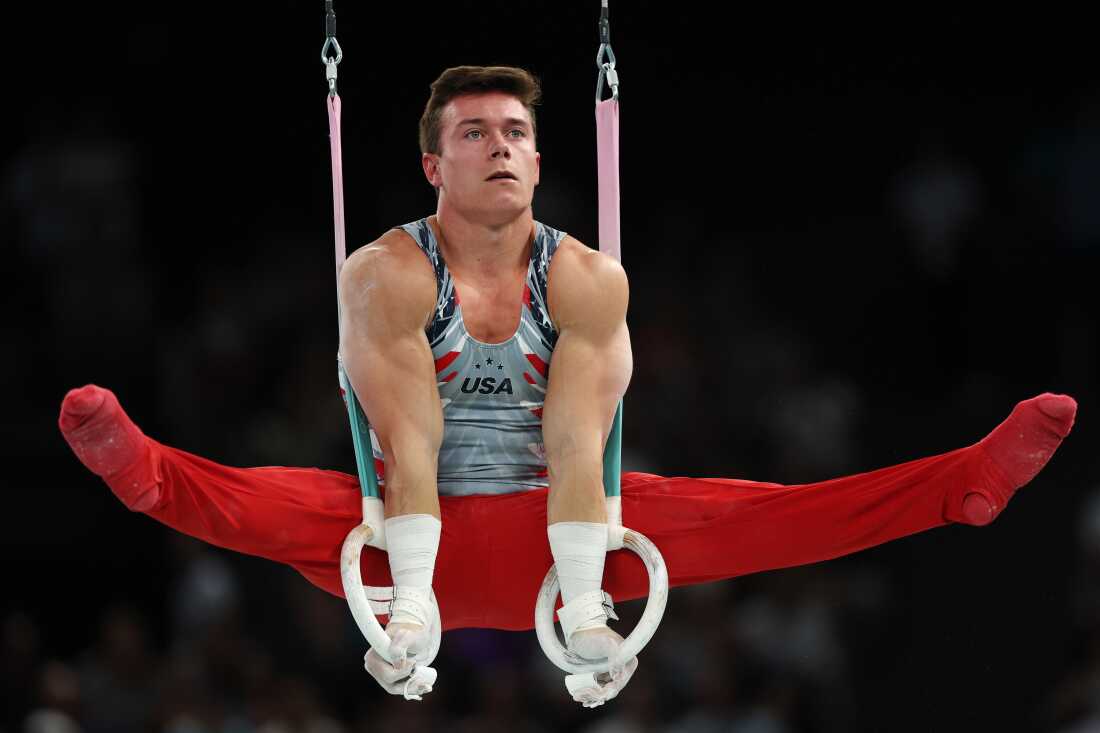
American Brody Malone competes on the rings at Bercy Arena on Monday during the men’s gymnastics team final at the Paris Summer Olympics.
Jamie Squire/Getty Images
hide caption
toggle caption
Jamie Squire/Getty Images
But on Monday, Malone was the hero. He, like the rest of the team, finished the night without a major error. The crowd roared when he completed his horizontal bar routine without a fall. His improvement alone was worth about 2.5 extra points for the United States.
“You just got to forget about it,” Malone said Monday. “It was over and done with. There’s nothing I can do about it. I just had to focus on the next day, and that’s what we did. And it ended up working out great.”
Alongside Nedoroscik, Juda and Malone were Asher Hong and Frederick Richard, the 20-year-old TikTok star who also stepped up his performance on Monday night.
Richard had prepared a more difficult horizontal bar routine that he had intended to perform in an event final, but after he failed to qualify, he decided to deploy it Monday instead. “In our team meeting, the coaches said, ‘You look amazing, do it,” he said. “And it paid off.”
Japan took gold and China won silver. Russia, a traditional powerhouse in men’s gymnastics, did not field a team this year as the vast majority of its athletes were excluded from the Games over the country’s war in Ukraine.

It has been a long journey back to the podium for the U.S. men’s gymnastics. To be competitive on the international stage has required a sea change in the way the men’s team designed their routines, which are scored for both the difficulty of what was attempted and the gymnast’s execution.
“We were so far behind in difficulty,” Brett McClure, the men’s high performance director said last week. “I believe that this team’s legacy is being able to close the gap in such a short amount of time.” McClure was part of the 2004 Olympic team in Athens, where the U.S. men won a silver medal. At the next Olympics, in Beijing in 2008, the men won a bronze — their last team medal for 16 years.
Now, the program’s long-term strategy has its eyes set even further ahead, to the 2028 Summer Games in Los Angeles. “We’re trending in the right direction,” McClure said Monday. “If we want to get better and push for first place in L.A., then this is going to be extremely motivating.”
“I think there’s still a lot to be done,” said Sam Mikulak, a three-time Olympian gymnast who is now a coach. “I’m sure they were up on that podium in third place and they were so happy, so grateful. But I think they were like, ‘Man, it would be cool if we had our national anthem playing too.’ So I think that bodes well for the future.”

Frederick Richard of the USA competes in the floor exercise during the Gymnastics Men’s Team Final on Monday at the Paris Summer Olympics.
Hannah Peters/Getty Images
hide caption
toggle caption
Hannah Peters/Getty Images
An hour after the medal ceremony, Richard said that the bronze still felt “unreal,” but that he had already started to realize how historic their effort was.
“They used to have pictures in my gym of the past Olympic teams that medaled, and I always looked at that, like, ‘Man, what if I was one of those people one day?’ And now we are,” Richard said.
Richard and Juda have just one day of rest before participating in the men’s individual all-around final, which is set to take place Wednesday at 11:30 a.m. Eastern time.
The only member of the team to qualify for an event final was Nedoroscik, whose score of 15.200 on pommel horse during qualifying rounds tied for first. He will compete in that final on Saturday.


new video loaded: The Rise of Deadly Trucks and S.U.V.s
By Michael H. Keller, Danielle Ivory, Irineo Cabreros, Eli Murray, Gabriel Blanco and Joey Sendaydiego
June 22, 2026

Demonstrators hold a sign saying “PROTECT MINORITY VOTING RIGHTS” outside the U.S. Supreme Court in Washington, D.C., in 2025.
Jemal Countess/Getty Images for Legal Defense Fund
hide caption
toggle caption
Jemal Countess/Getty Images for Legal Defense Fund
By declining to take up a lower court ruling, the U.S. Supreme Court has dealt another blow to the Voting Rights Act.
The court announced Monday that it will not review an Arkansas-based lawsuit, leaving in place a 2025 appeals panel ruling that ends a long-used tool for protecting minority voters from discrimination under the landmark law in seven mainly Midwestern states.
That ruling found that in the states covered by the 8th U.S. Circuit Court of Appeals — Arkansas, Iowa, Minnesota, Missouri, Nebraska, North Dakota and South Dakota — private individuals and groups do not have the right to sue to enforce what’s known as Section 208 of the Voting Rights Act, which generally allows voters with a disability or inability to read or write to get help with voting from a person of their choice.
The Supreme Court’s move comes almost two months after its conservative supermajority issued a major ruling that further weakened the Voting Rights Act, setting off a groundswell in redistricting across the country.


In May, shortly after that undermining of Section 2 protections against racial discrimination in redistricting, the high court decided not to weigh in on what the legal world calls a “private right of action,” sending back to lower courts two cases brought by Black voters in Mississippi and Native American voters in North Dakota.
For decades, enforcement of these sections of the Voting Rights Act has mainly been driven by lawsuits by private individuals and groups.
But after conservative Justice Neil Gorsuch issued a single-paragraph opinion in 2021 questioning a private right of action, Republican officials in multiple states have raised a novel legal argument: Only the U.S. attorney general, they contend, has the right to bring lawsuits under these parts of the Voting Rights Act.
Such an interpretation of the law is likely to lead to a dramatic decline in voting rights lawsuits because of the Justice Department’s limited resources and shifting priorities under different presidential administrations.

The case that the justices decided not to take up was brought by the immigrant advocacy group Arkansas United, which has provided Spanish-language interpreters at polling sites to assist voters with limited English proficiency. The group challenged an Arkansas law that bans a person who is not a poll worker from helping more than six voters cast ballots. In 2022, a federal judge ruled that the state law violates Section 208 of the Voting Rights Act. But after GOP state officials appealed, an 8th Circuit panel found last year that private groups, like Arkansas United, do not have the right to bring this kind of lawsuit.
So far, the 8th Circuit — which also found that there is no private right of action under Section 2 — is the only federal appeals court to break with decades of precedent on this legal issue.
Edited by Benjamin Swasey

new video loaded: California Governor Declares State of Emergency for L.A. Warehouse Fire
transcript
transcript
California Governor Declares State of Emergency for L.A. Warehouse Fire
A fire that broke out on Wednesday at a cold storage facility in Los Angeles continued to burn on Sunday. Gov. Gavin Newsom declared an emergency.
-
We do realize that at times there are large amounts of smoke coming off this building, and that is to be expected. Now, the good news is, all of our air monitoring has shown that there are no additional toxic chemicals or hazards within that smoke other than normal structure fire smoke. That said, no smoke is good smoke. There are smoke advisories and particulate matter advisories out there around the community, spanning for several miles around this incident. We are going to continue to aggressively fight this fire and minimize the impact to the community as much as possible.

By Cynthia Silva
June 21, 2026
-

 Ohio50 seconds ago
Ohio won’t vote on banning data centers this fall
-

 Oklahoma8 minutes ago
Oklahoma National Guard announces loss of specialist
-

 Oregon11 minutes ago
Oregon Gov. Tina Kotek appoints Nathan Lichvarcik to Lane County Circuit Court bench
-

 Pennsylvania16 minutes ago
Records show watchdog’s elder abuse probe kept secret as Shapiro’s office claims confidentiality
-

 Rhode Island23 minutes ago
Pawtucket set to build hundreds of housing units as the next phase of the Tidewater Landing development begins – The Boston Globe
-
 South-Carolina26 minutes ago
Magnificent Messi makes history, breaks all-time World Cup scoring record
-

 South Dakota28 minutes ago
South Dakota Cattlemen’s Foundation raises $292,620 for Feeding SD at annual gala
-

 Tennessee32 minutes ago
Rural Tennessee needs family doctors. Can $200K lure them to the state’s small towns? | Chattanooga Times Free Press

