News
Trump Asserts a Muscular Vision of Presidential Power on First Day Back


After President Trump left the White House in 2021, critics of his norm-breaking use of executive power implored Congress to tighten legal limits on when presidents can unilaterally reshape American government with the stroke of a pen. But lawmakers largely did not act.
On Monday, as Mr. Trump took the oath of office to begin his second term, he asserted a muscular vision of presidential power. He not only revived some of the same expansive understandings of executive authority that were left unaddressed, but went even further with new claims of sweeping and inherent constitutional clout.
Among a blizzard of executive orders, Mr. Trump instructed prosecutors not to enforce a law that bans the popular social media app TikTok until its Chinese owner sells it. President Joseph R. Biden Jr. had signed the measure into law after it passed with broad bipartisan support, and the Supreme Court unanimously upheld it.
Whatever the law’s merits, the Constitution says presidents “shall take care that the laws be faithfully executed.” Mr. Trump offered no clear explanation for how he has any legitimate power to instead suspend the law, making only a vague gesture toward his “constitutional responsibility” for national security, foreign policy “and other vital executive functions.”
Unilateral actions like emergency declarations and executive orders cannot create new legal powers for a president. Instead, they are a vehicle by which presidents exercise legal authority they already have, either because the Constitution has bestowed it upon their office or because Congress passed a law creating it.
That said, there are often disputes about the proper interpretation of the scope and limits of executive power. It is not uncommon for a president to use an executive order to take some action whose legal legitimacy is contested, leading to court fights that ultimately come before the Supreme Court.
It is not clear that anyone opposed to suspending the TikTok law would have standing to sue. But many of Mr. Trump’s moves concerned immigration law, making it very likely that legal challenges will follow and the legitimacy of his executive power claims will land before judges.
In several orders, Mr. Trump invoked his constitutional role as the military’s commander in chief, portraying migrants as invaders while blurring the line between immigration law enforcement and war powers.
“As commander in chief, I have no higher responsibility than to defend our country from threats and invasions, and that is exactly what I am going to do,” he said in his inaugural speech.
Among those orders, Mr. Trump declared that newly arriving migrants may not invoke a law allowing them to request asylum. As a basis, he said the Constitution gave him “inherent powers” to “prevent the physical entry of aliens involved in an invasion into the United States,” in addition to citing a few vague provisions of immigration laws.
Another such order directed the U.S. Northern Command, which oversees military operations in continental North America, to swiftly draw up a plan for a “campaign” to seal the border “by repelling forms of invasion including unlawful mass migration, narcotics trafficking, human smuggling and trafficking, and other criminal activities.”
Mr. Trump and his advisers have talked about invoking the Insurrection Act to use troops as additional immigration agents at the border. But the order referred only to his constitutional power as commander in chief, raising the possibility that he is envisioning using troops for a military operation rather than to act as law enforcement.
Some of the orders were a return to fights over executive power that surfaced during Mr. Trump’s first term.
On Monday, Mr. Trump reprised a move from 2019 by declaring a national emergency at the border. He also invoked a statute that allows presidents, during an emergency, to redirect military funds for construction projects related to the exigency. His purpose, in 2019 and again now, was to spend more taxpayer money on a border wall project than lawmakers authorized.
Is there really an emergency that an extended border wall would address, and that would justify circumventing Congress’s role in deciding where to direct taxpayer money?
A wall does not address the main border problem in recent years: the overwhelming number of migrants requesting asylum, flooding the system and leading to lengthy backlogs for hearings. And over the past seven months, illegal crossings have plunged to the lowest levels since the summer of 2020, during the early phase of the coronavirus pandemic.
But facts matter little to whether or when it is legal for presidents to invoke emergency power, declarations that are governed by the National Emergencies Act of 1976.
That law does not tightly define the circumstances under which presidents may determine that an emergency exists, leaving them with essentially unfettered discretion to unlock exigent powers for themselves. But previous presidents adhered to norms of self-restraint.
In his first term, critics challenged the legal legitimacy of Mr. Trump’s border wall spending, but the Supreme Court never resolved the dispute before Mr. Biden took office and canceled the projects. So any new legal challenge would have to start from scratch.
In the wake of Mr. Trump’s first term, House Democrats in 2021 passed a bill that would have tightened limits on presidential use of emergency powers, part of a package of reforms they called the “Protecting Our Democracy Act.” But Republicans opposed the measure as a partisan attack on a president who was no longer in office anyway, rendering it dead on arrival in the Senate.
Mr. Trump’s absence from the presidency, however, turned out to be temporary.
In the show of force upon his return to office, he also declared a national energy emergency so that, as he said in his inaugural speech, “we will drill, baby, drill.” No president has declared that type of emergency before, and it empowers him to suspend legal protections for the environment and to speed up permits for new oil and gas projects.
The nation’s energy situation hardly seems like an emergency: The United States is producing more oil than any country ever has, in no small part because of the fracking boom and because of thousands of new permits to drill on federal lands issued by the Biden administration — outpacing Mr. Trump’s first-term record. Prices for gasoline, natural gas and electricity are relatively low compared with their historical levels.
But the order said Mr. Trump had determined that Biden administration policies had “driven our nation into a national emergency, where a precariously inadequate and intermittent energy supply, and an increasingly unreliable grid, require swift and decisive action.” He also cited a growing need for electricity to run computer servers for artificial intelligence projects.
Elizabeth Goitein, a director of the Brennan Center for Justice’s Liberty and National Security Program who has written extensively on presidential emergency power, predicted that many of Mr. Trump’s planned actions would be challenged in court.
“Emergency powers should never be used to address longstanding problems like unlawful migration that can and should be addressed through legislation,” said Ms. Goitein, who was among those calling on Congress to curb presidential power. “The bad news is that Congress failed to enact reforms to the National Emergencies Act that would have helped prevent such abuses.”
There is no dispute that Mr. Trump had legitimate authority to take other unilateral actions. The Constitution clearly gives presidents unfettered authority to grant pardons to people for federal criminal offenses or to commute their sentences, for example, so there is little doubt Mr. Trump had the power to grant clemency to all of the nearly 1,600 people charged or convicted of crimes in connection with the Capitol riot.
But Mr. Trump appeared to put forward novel or expansive interpretations of legal authorities in other ways.
He ordered his administration to make recommendations about whether to designate certain transnational gangs and drug cartels as “foreign terrorist organizations,” stretching a law that is intended for groups that use violence for geopolitical and ideological purposes to criminal groups that, while also violent, are motivated by profit.
He also set in motion the possibility of invoking the Alien Enemies Act of 1798 to summarily expel immigrants suspected of being members of drug cartels and transnational criminal gangs without full due process hearings. That law’s text seems to require a link to the actions of a foreign government, so it is not clear whether the courts will allow Mr. Trump to invoke it to deny deportation hearings to people.
Mr. Trump is also seeking to change the basic understanding of a provision of the Constitution’s 14th Amendment that grants citizenship to most babies born on American soil and “subject to the jurisdiction” of the U.S. government. That provision has long been understood to include infants born to undocumented parents.
In an order, Mr. Trump invoked a theory developed by conservatives who want to curtail so-called birthright citizenship because they see it as a magnet for illegal immigration. By that rationale, the provision could be interpreted to not apply to babies whose parents are not American citizens or lawful permanent residents, even though visitors or undocumented people are subject to the jurisdiction of government prosecutors if they break the law.
Mr. Trump instructed agencies to refrain from issuing citizenship-affirming documents — like passports and Social Security cards — to infants born to undocumented immigrants or to parents lawfully but temporarily visiting the United States, starting with births 30 days from now.
Hours later, critics, including a coalition of Democratic-controlled states, brought multiple court challenges against it. Mr. Trump, the coalition asserted, sought to breach “this well-established and longstanding constitutional principle by executive fiat.”
It was yet another legal claim that seemed destined to come before the Supreme Court.



The US congressman Ro Khanna says armed Israeli settlers detained him during a visit to the Israel-occupied West Bank recently, describing the experience as a first-hand view of the realities faced by Palestinians living under occupation.
In an interview with Reuters on Thursday from a Palestinian village, the progressive US House Democrat from California said his detention happened the previous day while his delegation visited an area of the southern West Bank that has experienced repeated attacks by Israeli settlers.
Khanna recounted how settlers carrying US-made M4 rifles surrounded the group’s van.
“We were at a village that Israeli settlers had destroyed – they had destroyed the school, they had destroyed that village, and we were just looking at it,” Khanna said.
Referring to the Israel Defense Forces, which is funded in part by US military aid, Khanna continued: “And these hoodlums … detain us. They block off the road. And then they call the IDF and the IDF is on their side, not on the side of the Americans.”
Khanna also told Reuters, “I saw the arrogance in the eyes of those settlers, 21- and 22-year-olds with guns, laughing that they had detained us, the arrogance of those young IDF soldiers that my tax dollars are funding – having no respect for the fact that they were detaining Americans, no respect that there was an American congressperson in that bus, and laughing when our translator told them that there are Americans there and the American embassy is concerned.”
Khanna aide Cameron Kasky wrote on X that he was there when the congressman’s group was detained, saying: “The IDF showed up to back up the settlers, not the US congressman.”
Khanna added that the encounter illustrated “the arrogance of power – of a power that has had no accountability, total impunity – and it’s created a toxic culture of oppression”.
The New York Times first reported Khanna’s account on Saturday morning. He told the outlet: “I felt powerless in that situation, which is not an easy thing, as I have a lot of privilege in life.
“Imagine how people feel every day, Palestinians under the occupation, if they could make an American congressperson feel powerless for 90 minutes.”
Khanna said he and his group were ultimately able to continue traveling after contacting the US embassy and Israeli police.
The Israeli military said troops and police responded after receiving a report that settlers were obstructing vehicles near Khirbet Zanuta, according to Reuters.
Khirbet Zanuta is a Palestinian hamlet whose residents were forced to leave in the wake of violent settler raids after the Hamas attacks on Israel in October 2023.
Asked by Reuters whether he intends to run for president, Khanna replied: “I’m strongly considering it. And I’m more resolved to consider it after this trip.”
More than 700,000 Israelis reside in settlements across the occupied West Bank including East Jerusalem. The United Nations considers Israeli settlements in the West Bank to be illegal, and Israel has faced repeated criticism over violence and other actions by settlers in the territory.
Since Israel took control of the West Bank in 1967, restrictions imposed there have prevented the territory from developing a self-sustaining economy. Those restrictions intensified significantly after the deadly 7 October 2023 Hamas attacks on Israel.
Nearly 300,000 Palestinians have lost employment in the West Bank and Israel.
A June report issued by a UN independent international commission of inquiry concluded that “Israeli authorities and security forces have deliberately targeted Palestinian children resulting in genocide, crimes against humanity, and war crimes in the Gaza Strip and war crimes in the West Bank”.
According to data from human rights organisation Yesh Din, no Israeli has been indicted for the killing of a Palestinian since October 2023.
Khanna has been one of the most outspoken critics in the US Congress of the war in Gaza and the occupation of the West Bank, often clashing with his own party’s establishment. In May, he released a video criticizing the Democratic National Committee’s incomplete postmortem report on the defeat that the party suffered at the hands of Donald Trump in the 2024 presidential election.
The postmortem did not mention Gaza. In his video, Khanna said: “As someone who campaigned in Michigan and Wisconsin, let me tell you – one of the reasons we lost is our blank check to Israel and [prime minister Benjamin] Netanyahu while they committed genocide in Gaza.
“We must speak and confront hard truths if this party is to win” the 2028 presidential election, he added.
Reuters contributed reporting
The fans see the games, the crowds, the food and the beer. But behind every World Cup watch party is a team working long before kickoff and well after the final whistle. We go behind the scenes at a beer hall in Brooklyn to see what it takes to serve a room full of soccer fans on game day.

Members of the group Patriot Front ride the subway as a commuter looks on, in Washington, D.C., on July 4.
Cheney Orr/Reuters
hide caption
toggle caption
Cheney Orr/Reuters
The sight of hundreds of masked men roaming the streets of Washington, D.C., on July Fourth weekend, wearing khakis, blue shirts and uniform patches, was chilling to some of the city’s residents.
For many Americans, it was the first they heard about Patriot Front, a white nationalist organization that was born out of the deadly 2017 Unite the Right rally in Charlottesville, Va. A now-viral Reuters photo prompted reflections on the experience of a lone African American woman who was photographed in a Metro subway car, surrounded by white supremacists.
The planned demonstration of force was timed to bring a fringe group of extremists into public view as the nation marked 250 years of its independence. Indeed, the stunt succeeded in earning the group media coverage across mainstream outlets, amplifying its brand and potential to reach new recruits. On this occasion, the members refrained from engaging in violence and property damage, projecting an image of law-abiding, orderly activism.
But those who are closely familiar with Patriot Front’s history and operations warn: Don’t believe what you see.
“That is not who they are in private,” said Len Kamdang, director of the Criminal Justice Project at the Lawyers’ Committee for Civil Rights Under Law. “Although they were on their best behavior [last] weekend, this is a dangerous group that commits acts of violence all over the country.”
Patriot Front’s history of violence and property damage
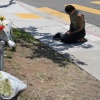
Kamdang’s organization sued members of Patriot Front for vandalizing a public mural dedicated to the tennis legend and Black activist Arthur Ashe in Richmond, Va., in 2021. Ashe, who was inducted into the International Tennis Hall of Fame in 1985, was born in Richmond and his legacy is a continuing source of pride to members of that community.
“A couple of Patriot Front members showed up under cover of night and vandalized the mural,” Kamdang said. “They painted white stencils all over. … They literally tried to whitewash him and they put their symbols of hate all over — their stencils, their slogans. And all the while they were caught on video. And that video leaked using some of the most horrible language that you can imagine.”
In many jurisdictions, law enforcement can seek additional hate crime charges or sentencing enhancements in cases where illegal acts appear to have been motivated by racial bias. But in this case, Kamdang said, Patriot Front members faced no criminal charges and their identities were only revealed when online activists later infiltrated the group and leaked internal records.

In another civil case, Patriot Front was ordered to pay almost $2.76 million to an African American musician whom they assaulted in Boston in 2022, at another July flash rally they staged. Despite a police detective concluding that the attack “appeared to be more likely than not motivated in whole or in part by Anti-Black bias,” nobody was criminally prosecuted.
Neo-Nazi ideology in patriotic colors
In 2020, Kristofer Goldsmith said that a fellow veteran invited him to partner up on infiltrating Patriot Front. Goldsmith, who later established the Task Force Butler Institute to recruit Army veterans to counter fascist groups through open source online research, was not closely familiar with the group at the time.
“Frankly, when my friend used the term ‘neo-Nazi,’ I thought he was using hyperbole,” Goldsmith said. “It wasn’t until I saw them doing things like debating the merits of national socialism versus fascism versus monarchy that I truly understood that neo-Nazi was not hyperbole, that these people actually praise Hitler. … These people have dedicated their lives to promoting white nationalist, fascist and genocidal ideology.”
Patriot Front’s founder, Thomas Rousseau, was formerly a leader of a group called Vanguard America, which was prominent in planning and a presence at the 2017 Unite the Right rally. That gathering, the largest public white nationalist event in generations, turned fatal when one extremist drove a car through a crowd of counterprotesters, killing Heather Heyer. Ultimately, Goldsmith said that rally further smeared public perception of the white nationalist movement as violent and un-American — lessons that Rousseau took to heart.
“Rousseau needed to rebrand Vanguard America,” Goldsmith said. “So he basically stole all of its assets, its digital assets … and made it into Patriot Front and literally painted everything in red, white and blue so that it would be more attractive.”
The group has also shown up at natural disaster sites, namely in Central Texas last summer, ostensibly to assist local residents. Goldsmith said these missions and the group’s outward aesthetic are meant to project an idea of patriotism and service. He said the group maintains a strict code of conduct. Among other things, they do not display swastikas or give Hitler salutes in public.
“The goal of their propaganda, of their public actions like this, is to beat MAGA and conservatives and Republicans into defending them and to saying, ‘I don’t see anything wrong with this group. They clearly love America,’” he said.
Patriot Front described as a “cult” and a “pyramid scheme”
The show of force in D.C. has raised questions about the group’s financing, and whether members’ travel was sponsored by outside individuals or groups. In fact, Goldsmith and Kamdang said that members of Patriot Front appear almost entirely to shoulder the cost of operations and Rousseau’s lifestyle. They said it’s most likely that those who traveled to D.C. had to cover their costs themselves.
“All of them funnel resources to the top,” Kamdang explained about the group’s general financial structure. “In order to be a Patriot Front member, you have to engage in acts of what they call ‘activism.’ And usually what that means is vandalism: putting up banners, spreading the slogans of hate all over the country. And in order to do that, they will have stickers, stencils, branding. All of that has to be approved from the top down, and all of it has to be purchased from the top down. So all the members who do this multiple times a month send cash to Thomas Rousseau for essentially stickers and stencils.”
Goldsmith said that from his time infiltrating the group, the costs could run up to hundreds of dollars a month per member. Kamdang, who said that attorneys are actively seeking to collect judgment in the settlement over the Arthur Ashe mural, noted that Rousseau appears not to hold any additional paying jobs.
“This seems to be what he’s doing full time,” Kamdang said. “So he appears to be being propped up full time by his members.”
Goldsmith likened the financial operation to a pyramid scheme. But he said even more substantial than the financial investment that Patriot Front members are required to make to retain membership is the control they give up over their time and personal choices.
“I describe it as a cult, not to be offensive, but because it is like Rousseau needs to have complete control of all of his members,” Goldsmith said. “[The group] requires its members to give up all of their lives, all of their relationships. All of their priorities in life need to be focused towards growing the organization or continuing the organization [and] enriching its leadership. So, it’s costly.”
NPR reached out to Patriot Front for comment. The group did not respond by deadline.
Goldsmith also noted that Rousseau often gives lengthy speeches that members are expected to listen to, via online platforms.
To Kamdang, the publicity that Patriot Front earned through the group’s D.C. stunt presents a danger: It amplified a presentation of the group that was deliberately crafted to make Patriot Front appear orderly and patriotic.
“I think the reason why it got a lot of attention is because Patriot Front was very careful in their language,” he said. “They try to mask their replacement theory, the white supremacy and in ‘Americana’ terms and patriotism. But that is not who these guys are.”
-

 Rhode Island5 minutes ago
RISP Warwick Arrests July 10: Threatening Officials, DUI – WarwickPost.com
-

 South-Carolina12 minutes ago
Editorial: There’s an easy solution to SC budget impasse, but legislators won’t like it
-

 South Dakota15 minutes ago
10 North Dakota Small Towns With Unmatched Friendliness
-

 Tennessee20 minutes ago
Former Tennessee Football Position Coach Beats Out Vols For Commitment of Elite Recruit | Rocky Top Insider
-

 Texas27 minutes ago
This Week in Texas: $1500 for every Texas Household, ICE accountability, politics in sports
-

 Utah30 minutes ago
Utah woman’s viral video helps raise more than $174K for Navy veteran she spotted at airport
-

 Vermont35 minutes ago
802 Homes to release free home design catalog aimed at lowering construction costs
-

 Virginia42 minutes ago
Southwest, Central Virginia Weather | 6 p.m. – July 11, 2026

