Connect with us

News

The explosive history of fireworks, from ancient China to Revolutionary America

Published

on

The explosive history of fireworks, from ancient China to Revolutionary America

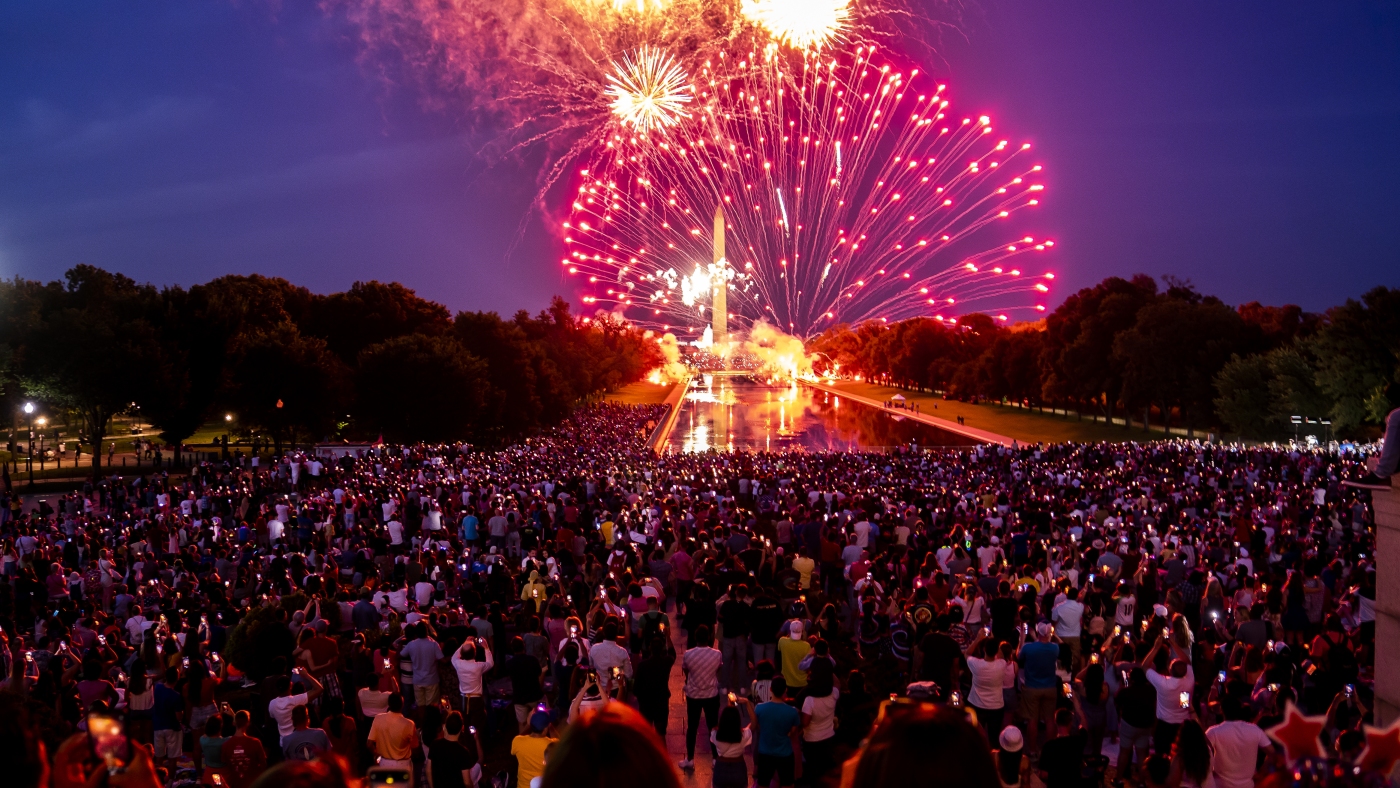
Spectators watch as fireworks erupt over the Washington Monument on July 4, 2022, in Washington, D.C.

Nathan Howard/Getty Images


hide caption

toggle caption

Advertisement

Nathan Howard/Getty Images

If you don’t see them, you hear them. On any July Fourth or New Year’s Eve, it’s common to experience the loud pop of a firework or see it colorfully explode into the sky and hang there briefly.

Pyrotechnic amusements from sparklers to Roman candles have long been a staple of celebrations in the U.S. and beyond, helping to mark national holidays, sporting events and more.

“They have become a global phenomenon, and they have become almost, if you like, the accepted way in which big events are celebrated,” said John Withington, author of the upcoming book, A History of Fireworks from Their Origins to the Present Day.

Advertisement

But the elaborate, computer-controlled displays of contemporary fireworks shows are a long way from the medium’s simpler beginnings in ancient China.

Fireworks began in ancient China before spreading West

The thinking goes that someone living in China around the first century B.C. threw a piece of bamboo on a fire and it exploded with a bang. Bamboo stalks contain air pockets that can expand and blow up in extreme heat. According to Withington, Chinese travelers would carry bamboo on journeys in case they needed to create a loud noise to scare away wild animals.

The next major development came around the ninth century, when gunpowder was invented. Chinese fabricators loaded up bamboo stalks with gunpowder to create perhaps the world’s first manufactured fireworks, and later began using paper tubes as well, History.com said. These were deployed to ward off evil spirits and celebrate births and weddings, according to the Smithsonian.

By the 12th century, fireworks were being lit for entertainment purposes in China’s imperial court, Withington said. Rudimentary fireworks then made their way to Europe around the 14th century, where Italian artists constructed displays resembling theatrical sets called “machines” and set off fireworks inside them.

Fireworks became even more complex thanks to advances in chemistry. The 19th century saw potassium chlorate used to elicit brilliant colors in fireworks, such as red and green, and enhance their brightness, according to Withington.

Advertisement

Over the years, innovations in technology led to some curious suggestions for how fireworks could help solve modern problems. Whalers experimented with rocket-powered harpoons in the late 1800s, and inventor Gerhard Zucker attempted to use pyrotechnic rockets to deliver mail in the 1930s.

A July Fourth tradition

Europeans who made their way to the Americas brought fireworks with them. It’s possible that Capt. John Smith, who was saved by Pocahontas according to legend, set off fireworks in Jamestown in 1608.

On July 3, 1776, the day after the Continental Congress voted for independence from Great Britain, John Adams wrote a letter to his wife, Abigail, imagining future celebrations of the occasion. (Though Congress voted for the Declaration of Independence on the 2nd, it was approved, signed and printed on the 4th.) Adams suggested those observances should include “illuminations,” or fireworks.

“It ought to be solemnized with Pomp and Parade, with Shews, Games, Sports, Guns, Bells, Bonfires and Illuminations from one End of this Continent to the other from this Time forward forever more,” Adams wrote.

The following year, one of the first organized July Fourth celebrations was held in Philadelphia and included a fireworks display. “The evening was closed with the ringing of bells, and at night there was a grand exhibition of fireworks (which began and concluded with thirteen rockets) on the Commons, and the city was beautifully illuminated,” a story in the Pennsylvania Evening Post reported.

Advertisement

To critics, however, fireworks weren’t just a flashy racket — they were also deadly. On Independence Day of 1903, more than 460 people were killed in fireworks accidents, according to Withington.

A Pennsylvania attorney named Charles Pennypacker wrote in a letter to the Philadelphia Inquirer that year that Americans should hold a “quiet and sane observance” of the holiday. They could take a trolley ride, sit under a tree or bake a cake, Pennypacker suggested.

It didn’t go over too well with some. “On July 3, 1904, so the day before Independence Day,” Withington said, “some local young people gathered outside his house and started letting off fireworks and generally creating mayhem.”

Still, the “Safe and Sane” movement gained traction among some city officials who hoped to create calmer July Fourth celebrations. Chicago’s mayor outlawed the discharge of fireworks, while Santa Fe held a beauty pageant in place of the typical festivities, according to Smithsonian Magazine.

Fireworks today

The interest in fireworks never fizzled out, and they remain available across almost the entire U.S. today.

Advertisement

Only Massachusetts bans all forms of consumer fireworks, according to the American Pyrotechnics Association (APA). Every other state and the District of Columbia permit the sale of some or all types of fireworks.

According to the APA, fireworks remain popular. Consumers bought 246.5 million pounds of fireworks last year and 436.4 million pounds the year before that, industry figures show.

Yet they continue to pose a safety risk both to professionals working with commercial-grade fireworks and those lighting the odd firecracker for fun.

According to a recent report by the Consumer Product Safety Commission, 9,700 people were treated in emergency rooms for fireworks injuries last year, eight of whom died. Two-thirds of the injuries occurred in the weeks before and after July 4.

But safety experts say there are some best practices people can follow to have a blast without getting hurt, such as lighting fireworks outside, not holding lit fireworks in your hand and not using fireworks when impaired by alcohol or drugs.

Advertisement

According to KCUR, fireworks can also pose a risk to human health by producing particulate matter and other pollutants and harm the environment by releasing carbon dioxide into the atmosphere.

News

Map: 4.9-Magnitude Earthquake Shakes Louisiana

Published

on

Map: 4.9-Magnitude Earthquake Shakes Louisiana

Note: Map shows the area with a shake intensity of 4 or greater, which U.S.G.S. defines as “light,” though the earthquake may be felt outside the areas shown.  All times on the map are Central time. The New York Times

A light, 4.9-magnitude earthquake struck in Louisiana on Thursday, according to the United States Geological Survey.

The temblor happened at 5:30 a.m. Central time about 6 miles west of Edgefield, La., data from the agency shows.

U.S.G.S. data earlier reported that the magnitude was 4.4.

As seismologists review available data, they may revise the earthquake’s reported magnitude. Additional information collected about the earthquake may also prompt U.S.G.S. scientists to update the shake-severity map.

Advertisement

Source: United States Geological Survey | Notes: Shaking categories are based on the Modified Mercalli Intensity scale. When aftershock data is available, the corresponding maps and charts include earthquakes within 100 miles and seven days of the initial quake. All times above are Central time. Shake data is as of Thursday, March 5 at 8:40 a.m. Eastern. Aftershocks data is as of Thursday, March 5 at 10:46 a.m. Eastern.

Continue Reading

News

Donald Trump has no ‘phase two’ plan for Iran war, says US senator

Published

on

Donald Trump has no ‘phase two’ plan for Iran war, says US senator

To read this article for free

Register now

Once registered, you can:

• Read free articles
• Get our Editor’s Digest and other newsletters
• Follow topics and set up personalised events
• Access Alphaville: our popular markets and finance blog

Continue Reading

News

Man accused of plot to assassinate Trump testifies Iran pressured him, says Biden and Haley were other possible targets

Published

on

Man accused of plot to assassinate Trump testifies Iran pressured him, says Biden and Haley were other possible targets

The allegation sounded like the stuff of spy movies: A Pakistani businessman trying to hire hit men, even handing them $5,000 in cash, to kill a U.S. politician on behalf of Iran ‘s powerful paramilitary Revolutionary Guard.

It was true, and potential targets of the 2024 scheme included now-President Donald Trump, then-President Joe Biden and former presidential candidate and ex-U.N. Ambassador Nikki Haley, the man told jurors at his attempted terrorism trial in New York on Wednesday. But he insisted his actions were driven by fear for loved ones in Iran, and he figured he’d be apprehended before anything came of the scheme.

“My family was under threat, and I had to do this,” the defendant, Asif Merchant, testified through an Urdu interpreter. “I was not wanting to do this so willingly.”

Merchant said he had anticipated getting arrested before anyone was killed, intended to cooperate with the U.S. government and had hoped that would help him get a green card.

U.S. authorities were, indeed, on to him – the supposed hit men he paid were actually undercover FBI agents – and he was arrested on July 12, 2024, a day before an unrelated attempt on Trump’s life in Butler, Pennsylvania.  During a search, investigators said they found a handwritten note that contained the codewords for the various aspects of the plot, CBS News previously reported

Advertisement

Merchant did sit for voluntary FBI interviews, but he ultimately ended up with a trial, not a cooperation deal.

“You traveled to the United States for the purpose of hiring Mafia members to kill a politician, correct?” Assistant U.S. Attorney Nina Gupta asked during her turn questioning Merchant Wednesday in a Brooklyn federal court.

“That’s right,” Merchant replied, his demeanor as matter-of-fact as his testimony was unusual.

The trial is unfolding amid the less than week-old Iran war, which killed Iranian Supreme Leader Ayatollah Ali Khamenei in a strike that Trump summed up as “I got him before he got me.” Jurors are instructed to ignore news pertaining to the case.

The Iranian government has denied plotting to kill Trump or other U.S. officials.

Advertisement

Merchant, 47, had a roughly 20-year banking career in Pakistan before getting involved in an array of businesses: clothing, car sales, banana exports, insulation imports. He openly has two families, one in Pakistan and the other in Iran – where, he said, he was introduced around the end of 2022 to a Revolutionary Guard intelligence operative. They initially spoke about getting involved in a hawala, an informal money transfer system, Merchant said.

Merchant testified that his periodic visits to the U.S. for his garment business piqued the interest of his Revolutionary Guard contact, who trained him on countersurveillance techniques.

The U.S. deems the Revolutionary Guard a “foreign terrorist organization.” Formally called the Islamic Revolutionary Guard Corps, the force has been prominent in Iran under Khamenei.

Merchant said the handler told him to seek U.S. residents interested in working for Iran. Then came another assignment: Look for a criminal to arrange protests, steal things, do some money laundering, “and maybe have somebody murdered,” Merchant recalled.

“He did not tell me exactly who it is, but he told me – he named three people: Donald Trump, Joe Biden and Nikki Haley,” he added.

Advertisement

In 2024, multiple sources familiar with the investigation told CBS News Merchant planned to assassinate current and former government officials across the political spectrum.

Merchant allegedly sketched out the plot on a napkin inside his New York hotel room, prosecutors said, and told the individual “that there would be ‘security all around’ the person” they were planning to kill.

“No other option”

After U.S. immigration agents pulled Merchant aside at the Houston airport in April 2024, searched his possessions and asked about his travels to Iran, he concluded that he was under surveillance. But still he researched Trump rally locations, sketched out a plot for a shooting at a political rally, lined up the supposed hit men and scrambled together $5,000 from a cousin to pay them a “token of appreciation.”

This image provided by the Justice Department, contained in the complaint supporting the arrest warrant, shows Asif Merchant. 

Advertisement

AP


He even reported back to his Revolutionary Guard contact, sending observations – fake, Merchant said – tucked into a book that he shipped to Iran through a series of intermediaries.

Merchant said he “had no other option” than to play along because the handler had indicated that he knew who Merchant’s Iranian relatives were and where they lived.

In a court filing this week, prosecutors noted that Merchant didn’t seek out law enforcement to help with his purported predicament before he was arrested. He testified that he couldn’t turn to authorities because his handler had people watching him.

Prosecutors also said that in his FBI interviews, Merchant “neglected to mention any facts that could have supported” an argument that he acted under duress.

Advertisement

Merchant told jurors Wednesday that he didn’t think agents would believe his story, because their questions suggested “they think that I’m some type of super-spy.”

“And are you a super-spy?” defense lawyer Avraham Moskowitz asked.

“No,” Merchant said. “Absolutely not.”

Continue Reading
Advertisement

Trending