News
Taliban Frees an American, George Glezmann, Held in Afghanistan Since 2022


The Taliban on Thursday released George Glezmann, an American held since 2022 in Afghanistan, Secretary of State Marco Rubio said.
Mr. Glezmann, an Atlanta native, was a Delta Air Lines mechanic who was detained while visiting Afghanistan as a tourist in December 2022. The State Department had officially designated him a wrongful detainee.
Mr. Glezmann boarded a Qatari aircraft in Kabul, the Afghan capital, to fly to Doha, Qatar, with U.S. and Qatari officials on Thursday. Qatar maintains close ties with the ruling Taliban government in Afghanistan and has hosted talks between it and U.S. officials. Negotiations between the first Trump administration and Taliban insurgents for a U.S. troop withdrawal from Afghanistan occurred in Doha.
In his announcement of Mr. Glezmann’s release, Mr. Rubio thanked the Qatari government for its help. Adam Boehler, who had been President Trump’s pick for special envoy for hostage affairs, took part in the negotiations with the Taliban.
The meeting in Kabul between American and Taliban officials was the first known in-person contact of any significance between the two governments since Mr. Trump took office in January. Mr. Boehler was accompanied on the trip by Zalmay Khalilzad, the special envoy for Afghanistan reconciliation in the first Trump administration and a former ambassador to Afghanistan, Iraq and the United Nations.
Mr. Boehler arrived at the meeting in Kabul dressed in a gray jacket, black sweater and black baseball cap. Mr. Khalilzad wore a navy suit and purple-and-red floral tie. They sat at a wooden table across from Amir Khan Muttaqi, the foreign minister of Afghanistan, and other Afghan officials, photographs of the meeting showed.
The Taliban toppled a U.S.-backed Afghan government in August 2021 and returned to power after President Joseph R. Biden Jr. executed the troop withdrawal that Mr. Trump had negotiated in his first term. The United States does not have diplomatic relations with the Taliban and has imposed sanctions on its officials. Moderate Taliban officials are seeking to normalize relations with the United States.
The United States does not maintain a presence in Kabul, unlike European countries, which have been more successful in negotiating releases of their citizens with the Taliban.
Mr. Rubio said on Thursday that Mr. Glezmann’s release was “also a reminder that other Americans are still detained in Afghanistan.”
The State Department said it was still seeking the return of six American detainees in Afghanistan and the remains of one U.S. citizen. The agency has not labeled them wrongfully detained, although one State Department official said the Americans were unjustly detained.
A wrongful detention designation means the U.S. government tries to prioritize freeing that citizen.
The department has focused on Mahmood Shah Habibi, an Afghan American businessman who was taken from his vehicle near his home in Kabul in August 2022, according to an F.B.I. report. Mr. Habibi worked for the Asia Consultancy Group, a telecommunications company based in Kabul.
The Taliban government released two Americans, Ryan Corbett and William Wallace McKenty, in late January in a prisoner swap arranged by the Biden administration. U.S. officials released Khan Mohammed, a member of the Taliban who had been imprisoned for life in California on charges of drug trafficking and terrorism. Mr. Biden gave a conditional commutation to Mr. Mohammed before he left office.
Christina Goldbaum contributed reporting from Damascus, Syria.



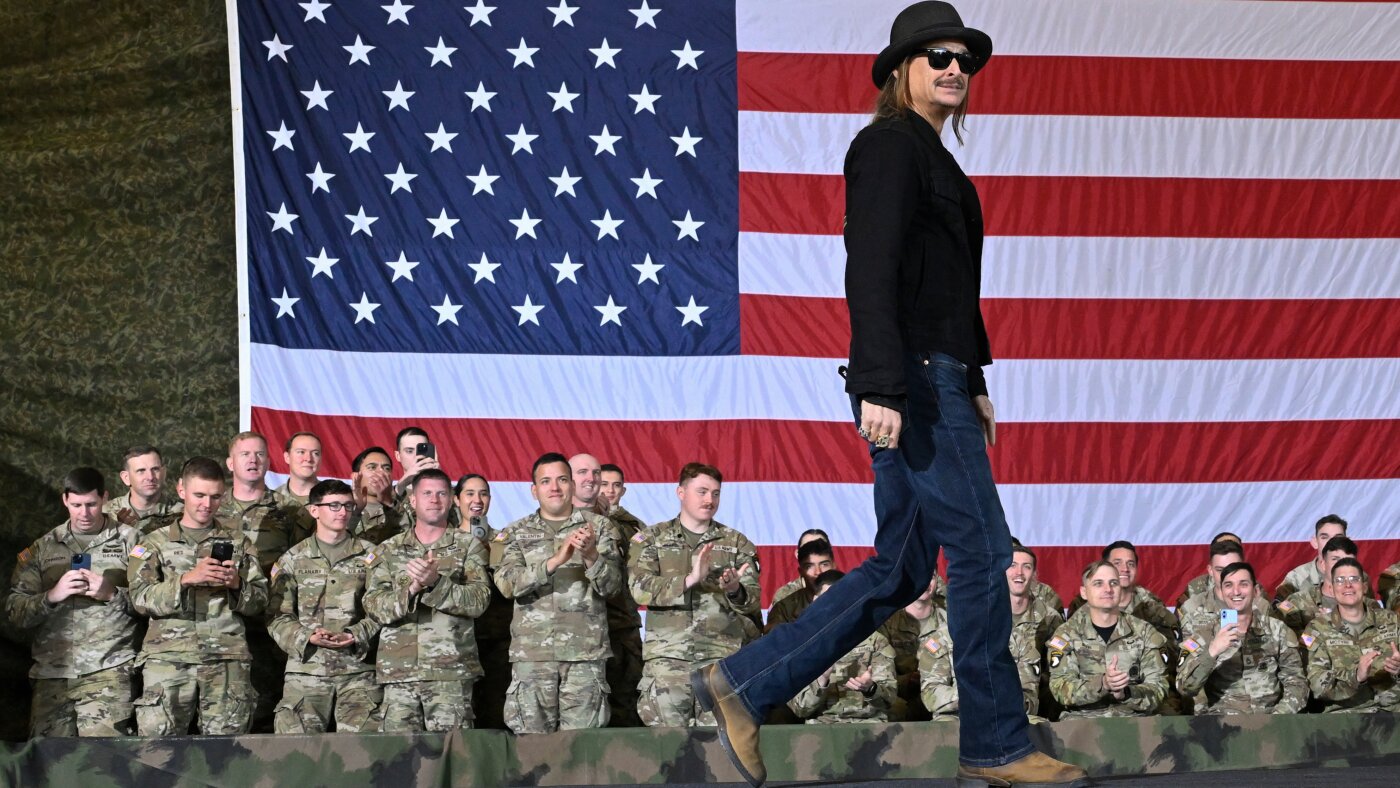
FILE – Kid Rock comes on stage to speak and introduce Vice President JD Vance during a visit to Fort Campbell, Ky., Nov. 26, 2025.
John Amis/AP
hide caption
toggle caption
John Amis/AP
NASHVILLE, Tenn. — The Army has launched an administrative review after two AH-64 Apache helicopters on a training run hovered near the hillside home of Kid Rock as the outspoken supporter of President Donald Trump saluted their crews.
Kid Rock posted two videos on social media on Saturday. Each shows a helicopter hovering alongside his swimming pool while the entertainer claps, salutes and raises his fist in the air. The Nashville skyline can be seen in the background.
“This is a level of respect,” Kid Rock posted, that the “Governor of California will never know. God Bless America and all those who have made the ultimate sacrifice to defend her.”
California Gov. Gavin Newsom is a Democrat who has repeatedly sparred with the Republican president.
There was no official request to the Army from Kid Rock for the helicopters to come to his house on Saturday, Maj. Jonathon Bless, public affairs officer for the 101st Airborne Division, said on Monday. The division is located at nearby Fort Campbell, on the Tennessee-Kentucky border, and its helicopters often make training runs over the Nashville area.
The helicopters also overflew a Nashville “No Kings” protest against the Trump administration on Saturday, but Bless said the training run had nothing to do with the protest.
Bless also provided a written statement from the Army.
“Army aviators must adhere to strict safety standards, professionalism, and established flight regulations. An administrative review is underway to assess the mission and verify compliance with regulations and airspace requirements. Appropriate action will be taken if any violations are found,” the statement reads.

Federal judge Paul Friedman seemed skeptical of the new press policy implemented by the Pentagon last week, calling aspects of it “weird” and Kafkaesque.
Friedman struck down key aspects of the previously implemented Pentagon media policy on 20 March, but at the latest hearing on Monday stopped short of ruling on a motion filed by the New York Times to force compliance of his decision.
Friedman was particularly skeptical about the ways in which press space was being provided to the seven New York Times reporters, whom he previously ruled should have their press access badges returned.
The Times, along with dozens of other news organizations, chose not to sign the new restrictions implemented by the Pentagon last fall and returned their long-held passes. The Times sued the Trump administration over the policy.
Julian Barnes, one of the Times reporters at issue, had attested that he was told that library space was available for the journalists to use while the Pentagon built out a new space on the Pentagon grounds for all credentialed media workers to use. But, he wrote in a statement, “the Pentagon Press Office staff indicated that they were unsure how we could access the library.”
“How weird is that?” Friedman, a district court judge, said on Monday. “Is it catch-22? Is it Kafka? What’s going on? That hardly seems consistent with right of access and the first amendment.” (Lawyers for the government responded that a decision had been made to allow the Times reporters to use a Pentagon shuttle to reach the library.)
Theodore J Boutrous Jr, a lawyer representing the Times, charged that the administration was “brazenly, blatantly flouting the court’s order” by announcing the closure of the press space known as Correspondents’ Corridor and by creating a new policy that requires journalists to be escorted around the building by a Pentagon staff member.
“Nothing will stop them,” he said. “Not a court order. Not an injunction.”
With the new requirement requiring escorts, Boutrous said Pentagon press credentials were now “worthless”.
“They’ve made the press credentials that we fought so hard to get back a meaningless piece of plastic,” he added. “They’ve violated the first amendment.”
As he had during a previous hearing, the judge expressed alarm that journalists could be penalized for asking questions of military officials, which he said they had the right to do – and that a Pentagon employee could simply decline to answer.
The new policy includes language stating that, by offering anonymity to a Pentagon employee, a journalist would be demonstrating knowledge that the employee was not authorized to disclose the information, thereby putting their press pass at risk.
But the judge seemed skeptical that a source using anonymity suggested that they were leaking classified information. “Aren’t there lots of reasons why people in government ask for anonymity?” he asked. “People ask for anonymity because they’re afraid of retribution” or “because their bosses won’t like it”, he said, suggesting that it could create a “chilling effect”.
Timothy Parlatore, who played a central role in designing the revamped press restrictions announced last fall, told reporters after the hearing that the new restrictions didn’t bar questions – but prevented journalists from trying to force reluctant staffers to reveal information after they had indicated they would not do so.
“What we’re talking about here are when they go to department employees and they say: ‘Hey, can you tell me about this?’ And the employee’s like: ‘No, I don’t want to talk to you.’ And they say: ‘Well, what if I give you anonymity? Will you talk to me then?’ Then they’re trying to get somebody to talk who’s already said that they don’t want to talk,” he said.
He also said that the Pentagon did not plan to go through articles and try to determine who the anonymous sources were – but would act if an employee conveyed that a reporter had asked them to disclose classified information, something that would be barred under the language of the new policy. “Anytime a person with a security clearance has somebody that approaches them to try to solicit that information, they’re supposed to report that,” he said.
Parlatore, asked about the judge’s invocation of the Joseph Heller novel Catch-22, said it was based on “creative misinterpretations by the New York Times lawyers” and “a fictional interpretation of the policy”.
The goal of the press policy, Parlatore said, was to reduce leaks of classified information. “There was a significant amount of leaks of classified information and that was something that the department has an obligation, a statutory obligation, to try to stop,” he said.
Parlatore claimed that the policy had already paid dividends in a decrease of leaked classified information.
At the end of the hearing, the judge asked a lawyer for the government, Sarah Welch, to submit – by the end of the day – a brief explaining the case law basis for creating a new press policy in response to a court order striking down the crux of the previous policy.
Amid the US war on Iran, “time is of the essence”, Boutrous, the Times lawyer, said. “There is a war going on and the American people are being shut down from information.”

new video loaded: Iran to Allow More Oil Ships Through Strait of Hormuz, Trump Says
transcript
transcript
Iran to Allow More Oil Ships Through Strait of Hormuz, Trump Says
President Trump said that Iran had agreed to release 20 more cargo ships of oil through the Strait of Hormuz starting on Monday.
-
They gave us as a tribute, I don’t know, I can’t define it exactly, but they gave us, I think, out of a sign of respect, 20 boats of oil, big, big boats of oil, going through the Hormuz Strait. And that’s taking place starting tomorrow morning, over the next couple of days. A lot of boats.

By Jiawei Wang
March 30, 2026

Video: Uncovering the World’s Newest and Deadliest Drugs

‘Hannah Montana’ still straddles the best of both worlds : Pop Culture Happy Hour

Another Starlink satellite has inexplicably exploded

Iran’s internet blackout hiding strike damage and suppressing dissent, Israeli officials say

Fugitive illegal alien convict on the run after attempting to strike ICE officer with vehicle: DHS

Florida High School Football Rankings: Top 25 teams – Oct. 21

How old is Bo Nix? What to know about Oregon quarterback ahead of 2024 NFL Draft

Cleary's 21 help Le Moyne down Central Connecticut State 69-64 in OT

99th annual Pony Swim held in Virginia

Indiana Members Credit Union announced as new anchor tenant at Bottleworks District
Fugitive illegal alien convict on the run after attempting to strike ICE officer with vehicle: DHS

EU to urge Israel to scrap death penalty bill as ‘grave regression’
Army reviewing after helicopters hovered alongside Kid Rock’s swimming pool as he saluted

Emanuel pushes back on ‘straight White man’ question, says ideas matter most in 2028

French police make two more arrests over foiled attack on Bank of America
-

 Sports1 week ago
IOC addresses execution of 19-year-old Iranian wrestler Saleh Mohammadi
-

 Miami, FL5 days ago
Jannik Sinner’s Girlfriend Laila Hasanovic Stuns in Ab-Revealing Post Amid Miami Open
-

 South-Carolina2 days ago
South Carolina vs TCU predictions for Elite Eight game in March Madness
-

 New Mexico1 week ago
Clovis shooting leaves one dead, four injured
-

 Politics1 week ago
Schumer gambit fails as DHS shutdown hits 36 days and airport lines grow
-

 Minneapolis, MN5 days ago
Boy who shielded classmate during school shooting receives Medal of Honor
-

 Tennessee1 week ago
Tennessee Police Investigating Alleged Assault Involving ‘Reacher’ Star Alan Ritchson
-

 Science1 week ago
Record Heat Meets a Major Snow Drought Across the West