News
She was the target of an Iranian assassination plot. She now lives in its shadow
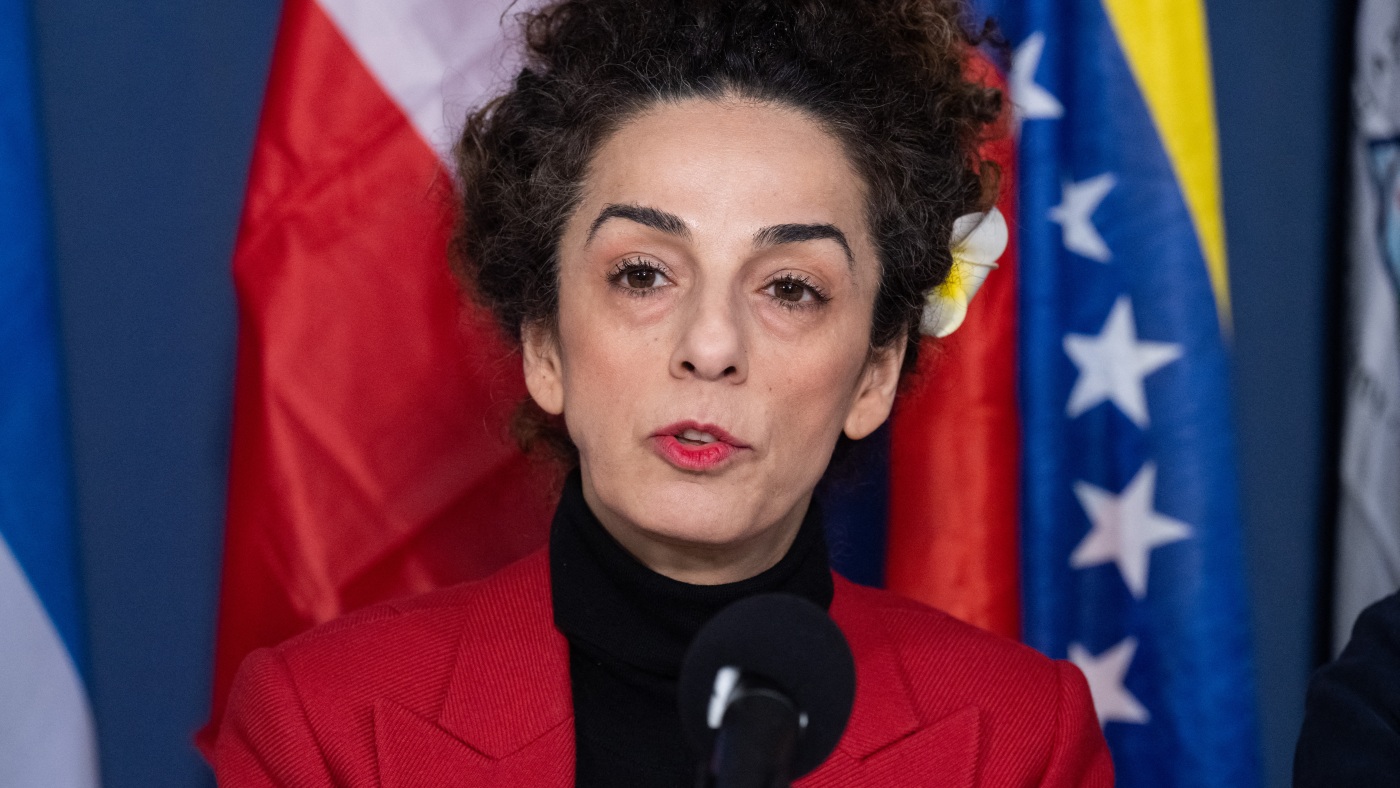
Iranian rights activist Masih Alinejad speaks during a press conference in March in association with the World Liberty Congress to urge action on political prisoners around the world, at the National Press Club in Washington, D.C.
Saul Loeb/AFP via Getty Images
hide caption
toggle caption
Saul Loeb/AFP via Getty Images
Masih Alinejad is lucky to be alive.
In late July 2022, a hitman was standing on the front porch of her home in Brooklyn, N.Y. The man, bearded and wearing a black T-shirt and baggy black shorts, had allegedly been hired as part of a plot hatched in Iran to assassinate Alinejad, a dissident and outspoken critic of the Iranian regime.
The only thing separating him from Alinejad was her front door.
Alinejad was home at the time, on a Zoom call with the Russian chess champion and political activist Gary Kasparov and the Venezuelan opposition leader Leopoldo Lopez.
“I was in a very deep conversation. It was very tense, and we were talking about initiating a new organization, so that’s why I didn’t want to leave the meeting,” Alinejad said. “So when I heard someone knocking at the door, I was like, OK, after the meeting, so I didn’t open the door.”
That Zoom call likely saved her life.
When she didn’t answer the door, the suspect returned to his car and drove off, running a stop sign near her house. The police pulled him over and found an AK-47-style rifle in the back seat of his car. He was arrested, and from there the FBI unraveled what prosecutors say was a murder-for-hire scheme directed from Iran to assassinate Alinejad.
“I actually asked the FBI what happened that I’m alive now,” Alinejad told NPR. “They said ‘You were lucky.’ “
She was lucky, in part, because the FBI was aware Iran was targeting her, but the bureau didn’t know that the man on her porch was part of the alleged assassination plot or that he was armed with a gun, she said.
The murder-for-hire scheme to kill Alinejad is one of at least four state-sponsored plots that the Justice Department says it has foiled in the past several years. It is part of a growing trend in which foreign governments look to silence critics overseas.
The threats against her have turned her life upside down
Alinejad was recalling her ordeal over dinner in downtown Washington, D.C., in May. She had just arrived from New York for a brief visit following the death of Iran’s president, Ebrahim Raisi, in a helicopter crash.
Alinejad, who was born in Iran and now lives in exile in the U.S., is a journalist, activist and outspoken critic of Iran’s government. For the past decade, she has waged a campaign against the country’s compulsory headscarf, or hijab, for women.
She has gained a massive audience on social media — some 10 million followers across platforms. Her activism has angered Iran’s leaders and put her in the regime’s crosshairs.
The U.S. Justice Department said in 2021 that it had foiled an Iranian plot to kidnap Alinejad in New York City, whisk her by speedboat to Venezuela and then transport her to Iran, where she most likely would have faced trial.
Two years later, the department announced that it had foiled another plot directed from Iran, but this time to assassinate Alinejad. A federal indictment charged four alleged members of an Eastern European criminal organization with ties to Iran of being tasked with killing her. It was one of those four men, Khalid Mehdiyev, who was on her front porch and later arrested.
Mehdiyev and two of his codefendants are in U.S. custody and have pleaded not guilty. A trial is scheduled for next year.
Since the kidnapping scheme was first exposed, Alinejad and her family have moved from one FBI safehouse to another — almost 20 over the past four years, she said. Sometimes they have advance warning; sometimes they only have an hour or so to pack their bags.
It is a temporary, disorienting way to live.
“Sometimes, during the night, I wake up and I don’t know where I am,” she said. “It’s like I wake up and I don’t know, this is my house? This is a hotel? It’s a safehouse? So it’s not easy.”
She and her husband, Kambiz Foroohar, had to sell their Brooklyn house after the foiled assassination plot. It was too well known and no longer safe, the authorities told them.
The couple is now looking to buy a place in New York City, but it’s hard to get past a co-op board, Alinejad said, when a quick Google search reveals that the Iranian government is trying to kill you.
“Who is going to sell a co-op to a person being followed by killers?” she said. “So we are getting our reference letters from neighbors, from colleagues to actually convince the members of the board, members in the co-op that please, accept us, we are good people, ignore the killers.”
The threat against her life did not end with the foiled plots. American officials have told her that Iran is still actively trying to kill her, she said.
The FBI declined to comment for this story. Iran’s U.N. mission did not respond to a request for comment.
The threat against Alinejad doesn’t just affect her. It affects her friends. It affects her family, including her husband.
Like Alinejad, Foroohar said that the constant moving from safehouse to safehouse has been one of the toughest challenges.
It has meant, at times, that he’s been separated from his children, who are Alinejad’s stepchildren. It feels like they are living in an Airbnb all the time.
The couple doesn’t hang artwork on the walls or put out family photos, he says, because they never know how long they’ll be in one place.
“Every location that we are in is sterile for us,” Foroohar said over coffee at a New York café. “And I want that messy, chaotic feel of a home where albums are everywhere, pictures are everywhere, books are everywhere, you know? It’s just, like, a mess that is your mess and it’s your home.”
Foroohar said that when the FBI first showed them photos that they were under surveillance by Iranian operatives, he and Alinejad were in shock. It felt like they themselves were characters in a movie, he said.
He knew Iran’s leaders didn’t like Alinejad’s activism, but Foroohar said he never thought they’d try to kill her.
“That’s a very radical step to take,” he said.
Still, the couple has been able to find humor in their predicament.
“You can’t really talk about it on a day-to-day basis with people because it doesn’t happen to everyone,” he said. “You can talk about the Knicks game. You can talk about the Yankees, or you can talk about the weather. But, ‘Oh yeah, by the way, there’s a guy with a machine gun outside my house’ — that’s a conversation killer.”
Foroohar knows better than anyone how the threat on Alinejad’s life has taken a toll on her. He tells a story to illustrate how.
He and Alinejad were out together in New York one day, he said, when a man threw liquid into her face.
“For a brief moment, she thought, ‘Oh my god, this is acid,’” he said. “She thought, ‘My face is going to burn.’ And she rushed into a shop, got some bottled water and was just pouring water over her face.”
It turned out the liquid wasn’t acid. It was coffee. But Alinejad lives with the fear that anywhere she goes, he said, danger may lurk behind every door.
“Sometimes someone walks too closely behind us, she gets nervous,” he said. “Or she gets in the elevator, someone else walks in and she walks out. These have small effects.”
He calls these “moments of nervousness.” Still, most of the time, he said, Alinejad is “ready to fight the good fight.”
How will it end?
Alinejad said she knows her work has taken a toll on her family. It’s forced Foroohar to spend less time with his children. Some friends have distanced themselves from Alinejad out of fear for their own safety.
“I always carry the guilt on my shoulder when I see that my husband doesn’t have a normal life, when I see that he misses his children, he doesn’t have his art, when I see that anywhere I go, he gets almost a heart attack if I don’t answer his phone call,” she said.
Sometimes she asks herself whether it’s worth it — putting herself, her family and friends in potential danger. And the answer she comes back to, she said, is yes.
“I’m not carrying any weapon. I don’t have guns and bullets,” she said. “But the regime, they have guns, bullets, everything, they are scared of me. That gives me power, you know? It gives me hope.”
Alinejad doesn’t know how this all ends, or whether it ever does.
But she says right now, she still has her voice and she is going to keep using it.

News
A New Worry for Republicans: Latino Catholics Offended by Trump
When Stuart Sepulvida arrives at St. Francis de Sales Roman Catholic Parish in Tucson, Ariz., for Mass, which he attends most mornings, he passes a display honoring local soldiers and encouraging parishioners to pray for their safety. Hundreds of small cards record their names: Robles, Arenas, Grajeda. A portrait of Pope Leo XIV hangs across the lobby.
Mr. Sepulvida, 81, is a Vietnam veteran whose patriotism and Catholicism are deeply intertwined. He voted for President Trump three times but has never felt more betrayed by an American president than when Mr. Trump denounced Pope Leo as “weak on crime” and “terrible for foreign policy.”
“It was very disturbing to me to hear both of them clashing like they did,” Mr. Sepulvida said, standing outside the church one morning this week. Now, he is reconsidering whether he will vote Republican this year.
The Republican Party is struggling to hold onto the support from Hispanic voters who helped propel Mr. Trump back into the White House in 2024. Yet as many party leaders have acknowledged the urgent need to stop the backsliding among Latinos, the president has enraged many of even his strongest supporters by clashing with the pope.
On Easter Sunday, Pope Leo, the first U.S.-born pontiff, spoke of the need to “abandon every desire for conflict, domination and power, and implore the Lord to grant his peace to a world ravaged by wars.” Within days, Mr. Trump, who has led the United States into a war with Iran, said the pope was “catering to the radical left” and posted an AI-generated image portraying himself as a Jesus figure. Mr. Trump later deleted the image, saying he thought it depicted him as a doctor.
“It just isn’t what a president should do,” Mr. Sepulvida said. “The pope speaks for his people. He is beyond politics.”
Mr. Trump won 55 percent of Catholic voters in the 2024 election, compared to 43 percent who voted for former Vice President Kamala Harris, according to Pew Research Center. The most sizable gains came from Hispanic Catholics. While Joseph R. Biden Jr. won their votes by a 35-point margin in 2020, the Democratic advantage shrunk to 17 points in 2024. Now, just 18 percent of Hispanic Catholics said they support most or all of President Trump’s agenda, according to a poll from Pew released earlier this year.
If the president’s quarrel with the pope sours more Latinos on the Republican Party, it could affect midterm races across the country, including in South Florida and South Texas, where Republicans have notched important victories in predominantly Hispanic districts in recent years.
In Arizona’s Sixth Congressional District, which stretches from north of Tucson to the Mexican border, voters were still grappling with the fallout this week.
The district is roughly evenly divided among Republicans, Democrats and independent voters. Nearly a third of the district is Hispanic, and there is a significant population of members of the Church of Jesus Christ of Latter-day Saints, as well as a large Catholic community with deep history in the region. It also has one of largest numbers of military veterans of all congressional districts in the country.
“The president is looking for a lot of attention from everything,” said Maria Ramos, 60, who regularly attends weekday Mass at St. Francis. A registered independent, she usually votes for Democrats but often declines to cast a ballot if she views a candidate as too liberal. “He believes he can put God in his place. He’s meddling in countries that he’s not in control of — he wants to control the world.”
“It is not just a very serious lack of respect — it is a mortal sin,” she said, shaking her head. One word comes to her mind again and again, she said: disgust.
Like so many others in southern Arizona, Ms. Ramos has several relatives who serve in the military — a path they saw to both serve the country and as an entry into the stable middle class. Many of them, she said, voted for Mr. Trump for president.
The Tucson district is now widely seen as one of the most competitive in the country. Republican Juan Ciscomani narrowly won the district in 2022, in part by emphasizing his biography as a Mexican immigrant and a devoted father of six children. He is also an evangelical Christian, a group that has driven much of the growth among Hispanic Republican voters in recent years.
Mr. Ciscomani declined a request for an interview, but when a local radio host asked Mr. Ciscomani what he thought of Mr. Trump’s comments “as a man of faith,” the congressman declined to criticize the president but said, “You can trust that you won’t see any meme like that coming out of my account.”
JoAnna Mendoza, the Democrat challenging Mr. Ciscomani this fall, has made her 20-year career in the U.S. Navy and Marines a key aspect of her story on the campaign trail. While she rarely speaks about her religious background and no longer considers herself a practicing Catholic, she said she briefly considered becoming a nun as a teenager. She criticized Mr. Ciscomani for not condemning the president’s remarks.
“You can’t make faith a central part of your campaign and then allow this to stand,” she said in an interview.
Across Tucson, Latino Catholics, regardless of their past voting preferences, were similarly quick to condemn the president’s remarks.
When Cecilia Taisipic, 71, heard about it, she said, she winced with shame about her vote for him in 2024.
“I thought he would make the country better, but apparently it’s the opposite,” she said as she left Mass at St. Francis earlier this week. She is so fed up with politics, she said, that she is unlikely to vote at all this year. “When it comes to my faith, I don’t like anybody to challenge it. Now I don’t want to hear anything on the news. I just want to pray.”
Matilde Robinson Bours, 63, teaches a weekly Spanish Bible study class at St. Thomas the Apostle Parish, and like nearly all of the women in her class, she immigrated from Mexico decades ago. She has voted for Republicans in nearly every election since she became a citizen. Though she has never liked President Trump, she said, his comments about the pope enraged her more than anything else he has said or done in the past.
“This surpassed everything, every social and political norm — this is personal to all Catholics,” she said. “The arrogance and ego is disgusting. To think that he is God? The pope has every right and responsibility to talk about peace.”
Still, Ms. Robinson Bours said, nothing will stop her from supporting Republicans again this year. She has been delighted that her adult children have stopped supporting Democrats in recent elections.
“Almost everyone I know thinks the way I do,” she said.
Patricia Martinez, 86, who has attended the same Bible study as Ms. Robinson Bours for years, shook her head in disagreement. She said she cannot imagine voting for a Republican who supports Mr. Trump.
“This is different — this shows he is out of his mind,” said Ms. Martinez. “We have to have basic respect and teach that to people in this country.”
Patrick Robles, a 24-year-old native of Tucson, spent years alienated from the Roman Catholic Church, but returned to his faith more recently. “The craziness of the world sort of caused me to seek some sort of answers,” he said. Now, he attends Mass at the St. Augustine Cathedral in downtown Tucson, a few blocks from the office where he works as an aide to Representative Adelita Grijalva, a Democrat.
Mr. Robles said he saw Mr. Trump’s battle with the pope as both a personal affront and a political opportunity.
“The president is basically trying to draw a line between Catholics and what we perceive to be patriotism,” he said. “I believe we can be both.”
Last week, he texted one of his uncles who has supported Mr. Trump in every election asking him what he thought.
“I’m afraid we need divine intervention,” the uncle replied.
News
After 2 failed votes, Mike Johnson unveils new plan to extend key U.S. spy powers
Speaker of the House Mike Johnson, R-La., takes questions at a news conference at the Capitol on Tuesday.
J. Scott Applewhite/AP
hide caption
toggle caption
J. Scott Applewhite/AP
Speaker Mike Johnson, R.-La., is forging ahead with his latest proposal to renew a key American spy power. His bill, revealed Thursday, is largely unchanged from a previous plan which failed in a series of overnight votes earlier this month.
The program at center of the debate, Section 702 of the Foreign Intelligence Surveillance Act (FISA), is set to expire on April 30.
FISA 702 allows U.S. intelligence agencies to intercept the electronic communications of foreign nationals located outside of the United States. Some of the nearly 350,000 foreign targets whose communications are collected under the provision are in touch with Americans, whose calls, texts and emails could end up in the trove of information available to the federal government for review.

For almost two decades, privacy-minded lawmakers from both parties have sought to require specific court approval before federal law enforcement can conduct a targeted review of an American’s information gathered through the program. The lack of any such warrant requirement helped sink an effort last week to extend the program for 18 months, as well as a separate vote on a five-year renewal.
Trump officials, like those in past administrations, have argued that such a warrant requirement would overburden law enforcement and endanger national security. Johnson’s latest proposal would reauthorize the program for three years, but does not include a warrant requirement. Instead, the bill calls for the FBI to submit monthly explanations for reviews of Americans’ information to an oversight official as well as criminal penalties for willful abuse, among other tweaks.
“I am willing to risk the giving up of my Rights and Privileges as a Citizen for our Great Military and Country,” the president wrote on Truth Social last week, advocating for the program to be extended without changes. “I have spoken with many in our Military who say FISA is necessary in order to protect our Troops overseas, as well as our people here at home, from the threat of Foreign Terror Attacks. It has already prevented MANY such Attacks, and it is very important that it remain in full force and effect.”

Glenn Gerstell, who served as general counsel at the National Security Agency during the Obama and first Trump administration, says Johnson’s reforms look like an attempt to find a middle ground.
“There’s not a lot of really substantive changes to the statute, but some gestures are made to people who are worried about privacy and civil liberties,” Gerstell said. “It seems like a pretty reasonable compromise that is going to be satisfactory to the national security agencies and yet at the same time represents some gesture to the privacy advocates.”
“This is not a reform bill and it’s not a compromise,” Elizabeth Goitein, a privacy advocate and senior director of the Liberty and National Security Program at the Brennan Center for Justice at New York University, wrote on X. “It’s a straight reauthorization with eight pages of words that serve no serious purpose other than to try to convince members that it’s NOT a straight reauthorization.”
A bipartisan reform deal is still out of reach
Connecticut Rep. Jim Himes, the top Democrat on the House Intelligence committee, told NPR on Wednesday, before the release of Johnson’s new proposal, that lawmakers were working on a bipartisan solution. He said House Minority Leader Hakeem Jeffries, D-N.Y., was in touch with Johnson on the issue.
“There’s a lot of work being done here,” Himes said. “We’re sort of working out a process that will be inclusive rather than exclusive.” Himes said he was negotiating with Rep. Jamie Raskin, a Maryland Democrat and constitutional law scholar, on a reform proposal they hoped could preserve and reform the program — reauthorizing it with bipartisan support.
But Johnson’s new bill appears to fall short of the inclusive approach Himes hoped for.
NPR obtained a memo written by Raskin to his colleagues urging them to oppose the bill, which he said “continues the disastrous policy of trusting the FBI to self-police and self-report its abuses of Section 702 and backdoor searches of Americans’ data.”
“FBI agents can still collect, search, and review Americans’ communications without any review from a judge,” Raskin wrote.
FBI agents must receive annual training on FISA and are generally barred from searching for information about people in the U.S. if the goal of the search is to investigate general criminal activity, rather than find foreign intelligence information, and those searches need approval from a supervisor or an attorney.
Republican hardliners — who sunk Johnson’s last reauthorization attempt — also don’t all appear to be on board for Johnson’s latest revision. Rep. Scott Perry of Pennsylvania, a past chair of the Freedom Caucus, said “we’re not there yet” in a video he shared to X on Thursday.
“I didn’t take an oath to defend FISA, I didn’t take an oath to defend the intelligence community,” Perry said. “We can’t have them spying on American citizens and, when they do, there has to be accountability and I haven’t seen any that I’m satisfied with yet.”
The House Rules committee meets Monday morning, the first step toward advancing the renewal bill toward a vote.
News
Trump Says Israel and Lebanon Agree to Extend Cease-Fire by Three Weeks
President Trump announced a three-week extension of a cease-fire between Israel and Lebanon that had been set to expire in a few days, after hosting a meeting between Israeli and Lebanese diplomats at the White House on Thursday.
Hezbollah, the Iranian-backed militant group that has been attacking Israel from southern Lebanon, did not have representatives at the meeting and did not immediately comment on the announcement. The prime minister of Israel and the president of Lebanon also did not comment.
A successful peace agreement would hinge upon Hezbollah halting attacks, which Lebanon’s government has little power to enforce because it does not control the militia. Lebanon’s military has mostly stayed out of the fighting and is not at war with Israel.
The cease-fire, which was scheduled to end on April 26, would last until May 17 if it takes effect as Mr. Trump described it. Before the cease-fire was brokered last week, nearly 2,300 people were killed in Lebanon and 13 in Israel. Since then, the number of Israeli airstrikes and Hezbollah attacks have been dramatically reduced, though the two sides have continued exchanging fire.
The Lebanese Ambassador to the United States, Nada Hamadeh, credited Mr. Trump for extending the cease-fire, saying that “with your help and support, we can make Lebanon great again.” Mr. Trump replied, “I like that phrase, it’s a good phrase.”
Asked about the potential of a lasting peace agreement between Israel and Lebanon, Mr. Trump said that “I think there’s a great chance. They are friends about the same things and they are enemies on the same things.”
But Lebanon and Israel have periodically been at war since Israel’s founding in 1948. Israel has invaded Lebanon for the fifth time since 1978, incursions that have destabilized the country and the delicate balance of power between Muslim, Christian and Druze communities.
In the hours before the president’s announcement on social media, Israel and Hezbollah were trading attacks in southern Lebanon, testing the existing cease-fire.
Mr. Trump said the meeting at the White House had been attended by high-ranking U.S. officials, including Vice President JD Vance, Secretary of State Marco Rubio and the U.S. ambassadors to Israel and Lebanon.
Earlier on Thursday, an Israeli strike near the southern Lebanese city of Nabatieh killed three people, according to Lebanon’s health ministry. Hezbollah claimed three separate attacks on Israeli troops who are occupying southern Lebanon, though none were wounded or killed.
Hezbollah set off the latest round of fighting last month by attacking Israel soon after the start of the U.S.-Israeli bombing campaign in Iran. Israel responded to Hezbollah’s attacks by launching airstrikes across Lebanon and widening a ground invasion of the country’s south.
-
Indianapolis, IN4 minutes agoBlack-owned bank makes history, opens in Indianapolis
-
Pittsburg, PA10 minutes agoEnthusiasm continues for 2nd day of NFL Draft in Pittsburgh
-
Augusta, GA16 minutes agoCrews battle brush fire on I-520 in North Augusta
-
Washington, D.C22 minutes ago3 fallen Mississippi officers honored at national law enforcement memorial in Washington, D.C. – SuperTalk Mississippi
-
Cleveland, OH28 minutes agoCleveland Heights receives Ohio History Fund grant for scanning initiative
-
Austin, TX34 minutes agoCamp Mystic warned of safety plan problems as it seeks to reopen this summer after deadly 2025 flood
-
Alabama40 minutes agoAlabama Alliance of Community Hospitals: The Gum family grows – a community hospital story
-
Alaska46 minutes agoOpinion: Alaska takes care of its own. Why are our leaders in Washington forgetting the workers who take care of us?