News
Newsom, Democrats use cuts, reserves and ‘fiscal emergency’ declaration to solve California budget deficit
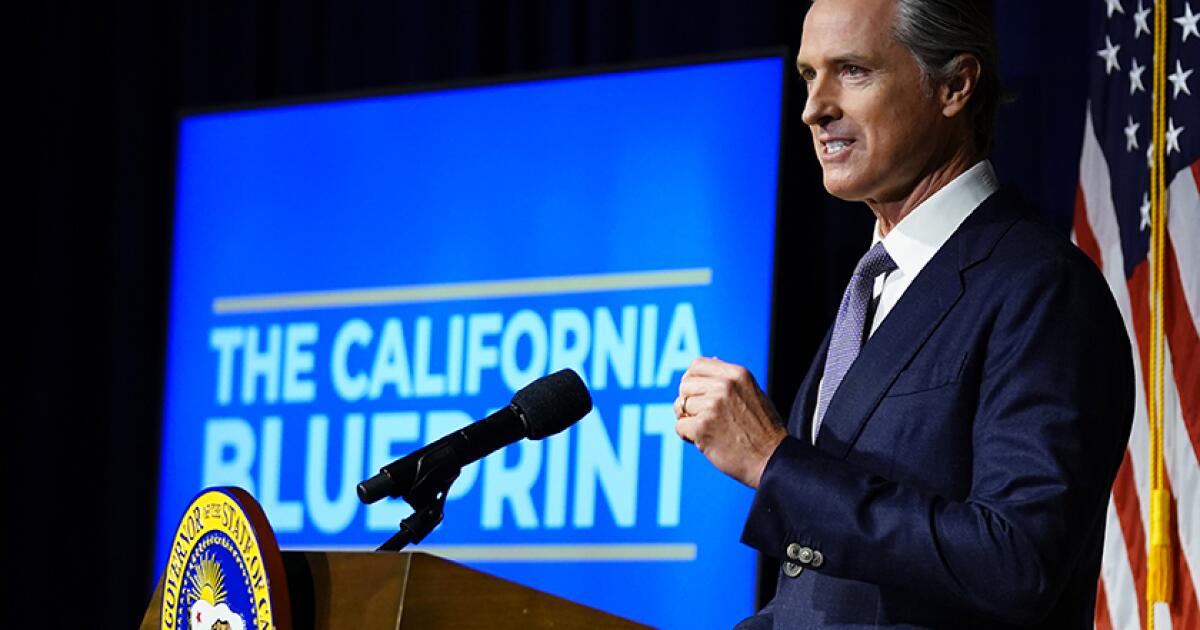
Gov. Gavin Newsom and Democratic lawmakers struck a deal Saturday to make $16 billion in cuts, declare a statewide fiscal emergency and pull money from the state’s rainy-day reserves to balance a $46.8-billion budget deficit in California.
The agreement for a $297.7-billion spending plan is the result of weeks of contentious negotiations with labor unions and business interests after weaker than anticipated revenues forced Newsom and lawmakers to scale back California’s progressive policy agenda. The shortfall inspired a tug-of-war over coveted state dollars that has caused rifts between the governor and some of his closest allies at the Capitol.
Among the more high-profile changes, the 2024-25 budget plan delays a minimum wage increase for healthcare workers until at least October, cuts $1.1 billion for affordable housing and slashes $750 million in funding for the state prison system.
California’s business community also took a hit with the three-year suspension of nearly $15 billion in tax breaks a year earlier than Newsom initially proposed.
“This agreement sets the state on a path for long-term fiscal stability — addressing the current shortfall and strengthening budget resilience down the road,” Newsom said in statement. “We’re making sure to preserve programs that serve millions of Californians, including key funding for education, health care, expanded behavioral health services, and combatting homelessness.”
The deficit marks a dramatic reversal of California’s financial standing from a projected $100-billion surplus two years ago and creates a challenging political narrative for Newsom, who often boasts of the state being an essential economic engine for the nation.
The governor is required by law to declare a statewide budget emergency before he can take money from the reserves to solve the deficit. But an emergency declaration gives fodder to critics who have accused Democrats of mismanaging the state’s finances and overspending.
Despite the shortfall, the California economy remains strong and the state has more revenue to spend than when he took office.
“This is not a revenue problem,” said David Crane, president of Govern for California, a nonprofit that seeks to oppose the influence of labor unions on state government. “The deficit is a result of expenditures.”
In April, Newsom touted the fact that the California economy held its position as the fifth largest in the world, saying the state “continues to punch above its weight.”
The state government’s financial problem can be blamed, in part, on poor revenue projections that led Newsom and lawmakers to allocate more money for programs than they had available to spend.
The state’s progressive tax structure leaves government dependent on revenue from income taxes paid by chief executives and other top Golden State earners, which are subject to stock market fluctuations and difficult to predict. The delay of the 2022 tax filing deadline, from April to November, also forced California leaders to craft the current budget without having a full understanding of how much state tax revenues had dropped.
Newsom anticipated California’s deficit to grow when he signed the budget last year and said he dedicated much of the new money in his spending plan to one-time funding increases that he could easily halt if revenue fell. The cuts include $500 million for a loan program to fund affordable student housing at colleges and a reduction of $485 million for work study programs for students.
Yet the governor and lawmakers have been criticized for choosing to pull money from the state’s rainy-day fund — $5.1 billion in 2024-25 and $7.1 billion planned the following year — to avoid deeper cuts. Democrats also plan to take $900 million from a safety net reserve account next year.
Tapping into the state’s piggy bank now has raised concerns about what could happen to state programs serving California’s neediest if the economy falls into recession and state revenues drop even lower.
Democrats at the state Capitol released a broad overview of some of the cuts the Legislature will vote on next week before the budget takes effect on July 1.
Newsom and lawmakers said the agreement includes proposed legislation requiring the state, in the future, to set aside surplus funds for subsequent budget years as a means to protect against the revenue swings and a constitutional amendment in 2026 to grow the state’s rainy-day fund. Details were not shared with the announcement.
Here’s what we know so far about the agreement:
Pushing off a healthcare minimum wage hike
Newsom signed a bill into law last year to give healthcare workers a minimum-wage increase to $25 per hour. He waited a few weeks to explain that he wouldn’t allow the law to take effect if the state budget crisis worsened.
At the time, the Department of Finance estimated that the law could cost the state $2 billion. Labor unions said the cost was closer to $300 million, if the state required hospitals to cover much of the cost.
Newsom’s concerns, which he said he shared with unions before he signed the law, set off months of private negotiations over when to raise wages and how to pay for the increase.
Those talks finally ended with the budget agreement, which delays the pay hike from taking effect until Oct. 15 at the earliest, instead of this month as originally planned.
The start date for the pay hike hinges on one of two scenarios: state revenues in the first quarter of the fiscal year coming in 3% above projections, or more federal funding for hospitals through a quality-assurance fee. If neither happens, the increase could be delayed beyond October.
Lawmakers and the governor are essentially using the quality-assurance fee as a mechanism to assure hospitals can pay for the increase. Hospitals pay quality-assurance fees, the federal government matches the money and then remits the funding back to hospitals.
The federal increase requested by the state is expected to cover 30% of the cost of the higher wages for hospitals.
The budget pegs the state cost for the program at $600 million in 2024-25.
No solution on battle over MCO tax
The question of how to use the proceeds of a tax on managed care organizations, known as the MCO tax, turned out to be the most difficult to answer in budget negotiations. So challenging, in fact, that talks fizzled out and Newsom threatened to oppose a ballot measure backed by some of his closest allies.
The tax applies to health insurance providers that charge fixed monthly payments for services and acts as a mechanism to allow California to collect billions in additional federal funds for Medi-Cal, California’s healthcare system for low-income residents.
Newsom and lawmakers renewed the tax last June and agreed to use some of the proceeds to raise reimbursement rates to providers who serve Medi-Cal patients. For years, doctors have waged an unsuccessful campaign to raise rates, arguing that the reimbursements are too low, result in a shortage of doctors willing to accept patients and restrict access to care.
But Newsom reversed course and proposed taking more than $6 billion from the Medi-Cal rate increases over multiple years and using the funding instead to avoid cuts to the program.
The change pitted Newsom against a coalition led by the California Medical Assn. and Planned Parenthood, two groups that have supported the governor’s causes and backed his campaigns.
The coalition called for the governor to stick to the agreement he made in 2023 to raise rates for providers. They also are leading a charge to pass a measure on the 2024 ballot that would permanently establish an MCO tax to fund higher reimbursement rates.
The governor wants the coalition to take the measure off the ballot. He wants the funds to be flexible so the state can use the money if necessary to support the Medi-Cal system in the future.
The coalition has so far declined to take the measure off the ballot, afraid Democrats would divert the funding again. The talks ended in a stalemate.
The final state budget includes $6.9 billion next year to support the Medi-Cal system.
Newsom and lawmakers agreed to offer a smaller pot of money for “provider rate increases and investments” from the MCO tax, but far less money than was previously set aside. The budget includes $133 million in 2024-25 and a plan to raise that to $728 million in 2025-26 and $1.2 billion the following year.
Democrats said the MCO funding would become “inoperable,” essentially eliminated, if the measure is approved on the 2024 ballot.
The governor threatened to campaign against the measure as the talks soured, setting up the possibility that Newsom could challenge his supporters in the November election.
A pause on business tax breaks
The budget deal limits total tax credits for businesses in the state to $5 million per filer and pauses a net operating loss tax deduction for businesses with income of more than $1 million in 2024, 2025 and 2026.
In a concession to the business community, Newsom and lawmakers are allowing companies to receive refunds for the tax credits after the limits end.
Newsom originally proposed halting and capping the tax breaks beginning in 2025. But Democrats in the Legislature pushed to apply the changes a year earlier, allowing them to avoid cuts to other programs.
The administration said the changes to the tax breaks will increase revenues by nearly $15 billion through 2026.
The early start could hurt businesses who were planning to deduct losses from their 2024 taxes and now have to scramble to scale back on employees or inventory to cover the cost of an unexpectedly higher bill. The limit also marks the second time in five years that the state has capped tax credits, which could turn away companies that operate in California.
Big cut to prisons
Lawmakers previously proposed an additional $1 billion in cuts to the Department of Corrections and Rehabilitation, which included at least $12 million in reductions to the governor’s project to transform San Quentin. Newsom’s proposed cuts had included $80.6 million in savings from the newly announced deactivation of 46 housing units at 13 state prisons.
The final agreement drops funding for corrections by $750 million total, including cuts to operations and savings from eliminating vacant jobs.
Newsom supports another round of homelessness grants
In late May, Democrats in the Legislature proposed spending $1 billion more than the governor had budgeted on a sixth round of Homeless Housing, Assistance and Prevention grants to local governments to combat the homelessness crisis. At the same time, lawmakers proposed cutting $100 million in funding to clean up homeless encampments in the current budget year.
The final budget deal appears to show a compromise.
The deal includes $1 billion in additional homelessness grants, which the governor and lawmakers said would be tied to new accountability measures to make sure local governments use the funding appropriately. The agreement also provides $150 million next year for encampment grants.
Broadband internet access for all — a little later
The pandemic exposed the need to improve access to broadband internet in homes across California when K-12 education shifted from the classroom to remote learning. Low-income families and those who live in rural areas often lack the same connectivity as more wealthy communities.
Newsom has sought to make internet access more equitable under a “broadband for all” initiative.
The spending plan delays $550 million in funding for “last mile” work, which connects the network to homes, until the 2027 budget year. The budget agreement still offers $250 million next year for a program to expand and improve the fiber-optic network under “middle-mile” projects, and Democrats intend to provide a total of $2 billion for last-mile work over multiple years.
A funding delay for public schools
Under Proposition 98, approved by voters in 1988, California has a minimum funding guarantee for schools and community colleges.
Earlier this year, Newsom proposed an unusual maneuver to go back and recharacterize funding in 2022-23 to reflect the lower-than-expected state revenue.
The California Teachers Assn. said the change would have ultimately reduced funding for schools by about $12 billion over two years. The union ran a television ad criticizing Newsom’s proposal to pressure him to reverse course.
Newsom and teachers ultimately agreed late last month to a complicated solution that suspends the minimum funding guarantee and delays $5.5 billion in funding until future years.

News
Bus riders to Montgomery retrace old steps while fighting a new fight
A man sings a spirtual song during a voting rally, Saturday, May 16, 2026, in Montgomery, Ala.
Mike Stewart/AP
hide caption
toggle caption
Mike Stewart/AP
MONTGOMERY, Ala.— In 1965, Black Americans peacefully demonstrated for voting rights and were beaten by Alabama state troopers before returning two weeks later to complete their march under federal protection. Keith Odom was a toddler then.
Now 62 years old, the union man and grandfather of three retraced some of their final steps. On Saturday, he came from Aiken, South Carolina, to Atlanta, where he joined several dozen other activists on two buses to Montgomery, Alabama. A few hours later, he stepped off his bus and onto Dexter Avenue, where the original march concluded.
“The history here — being a part of it, seeing it, feeling it,” said Odom, who is Black.

His voice trailed off as he saw the Alabama Capitol and a stage that sat roughly where the Rev. Martin Luther King Jr. concluded the original march.
Odom lamented that he and his fellow bus riders were not simply commemorating that seminal day in the Civil Rights Movement. Instead they came to renew the fight. The 1965 effort helped push Congress to send the Voting Rights Act to Democratic President Lyndon B. Johnson to sign, securing and expanding political power for Black and other nonwhite voters for more than a half-century.
Saturday’s “All Roads Lead to the South” rally was the first mass organizing response after a U.S. Supreme Court ruling that severely diminished that landmark law. Striking down a majority Black congressional district in Louisiana, the justices concluded in a 6-3 ruling that considering race when drawing political lines is in itself discriminatory. That spurred multiple states, including Alabama, to redraw U.S. House districts in ways that make it harder for Black voters, who lean overwhelmingly Democratic, to elect lawmakers of their choice.
“I’m not trying to live a life that’s going backwards,” Odom said. “I want to go forward, for my grandchildren to be able to go forward.”
Keith Odom, a forklift driver from Aiken, S.C., looks out from his bus seat as he arrives in Montgomery, Ala., for a voting rights rally Saturday, May 16, 2026.
Bill Barrow/AP
hide caption
toggle caption
Bill Barrow/AP
An old political battle is new again
The passenger rosters and the scene when riders arrived in Montgomery sounded the echoes and rhymes of past and present.
“I talked to my grandmother before I came, and she was so excited,” said Justice Washington, a Kennesaw State University student named because her mother and grandmother had faith in the American system. “My grandmother told me she did her part, and now it’s time for me to do mine.”
No one on the Atlanta buses had reached voting age when the Voting Rights Act became law. The youngest attendee was born as Democrat Barack Obama was elected the first Black president in 2008.
Kobe Chernushin is 18, white and just graduated high school in Atlanta’s northern suburbs. He is an organizer with the Georgia Youth Justice Coalition and spent the day filming Khayla Doby, a 29-year-old executive for the organization, doing standups for the group’s followers on social media.
“I believe in the power of showing up,” he said.

The buses launched from the congressional district in Georgia once represented by John Lewis, bloodied on the Edmund Pettus Bridge in Selma, Alabama, when he was 25. Lewis died in 2020, but some on the buses Saturday celebrated that a proposed federal election overhaul is named for him. If some Democrats get their way, the bill would override the U.S. Supreme Court, reinvigorate the Voting Rights Act and outlaw the kind of gerrymandering competition that Republican President Donald Trump has instigated.
“I’m here because of the same forces that pulled on John Lewis when he was a student,” said Darrin Owens, 27. He has worked for former Vice President Kamala Harris and now trains Democratic candidates.
“Political activism is personal,” Owens said, explaining that he attended Saturday as a citizen, not a political professional. “Sometimes those lines are blurred, and as a Black person in America, a Black person living in a Southern state, I’m committed to action that stops what I consider to be un-American, this possibility that the person who represents me is someone who is not from my community and does not understand me or my community.”
When he arrived, Owens saw no federal authorities on Montgomery’s streets. A wounded, recovering Lewis did during the second march in 1965.
This time many of the Alabama troopers and local officers who walked the area were Black.
The buses and sandwich lunches had been arranged by Fair Fight Action, a legacy of the political network built by Georgia Democrat Stacey Abrams, who became a national figure in her unsuccessful runs in 2018 and 2022 to become the first Black woman elected governor in U.S. history. No Black woman has yet achieved that feat.
Bee Nguyen, left, talks to Carole Burton, center, and Tondalaire Ashford at a voting rights rally Saturday, May 16, 2026, in Montgomery, Ala.
Bill Barrow/AP
hide caption
toggle caption
Bill Barrow/AP
Different generations share their stories
At different points, Montgomery has branded itself as the cradle of the Confederacy and the cradle of the modern Civil Rights Movement.
“It feels like our country is stuck in this pattern of making progress, then there’s a huge backlash, and then people have to go through the same battle again just to get to where we were,” said Phi Nguyen, the 41-year-old daughter of Vietnamese refugees. She is now a civil rights lawyer in Atlanta.
She stood across from the church where a young King led the Montgomery Bus Boycott in 1955 and not far from where Jefferson Davis took the oath of office in 1861 as the slavery-defending Confederate president.
Nguyen and her sister Bee, a 44-year-old who served in the Georgia General Assembly and ran for statewide office, met two other women as they walked. Carole Burton and Tondalaire Ashford are 72-year-old Montgomery residents who have been friends since they were in a segregated junior high school and then newly desegregated Sidney Lanier High School.
“I don’t call it ‘integration,’” Ashford said, pointing at her dark skin. “It was never real integration, and it’s not like we can ever just blend in.”
Burton described them as being “in the second wave” of Black students. “It wasn’t easy,” she said. “And we had to support each other.”
They remember their parents not being able to vote in the era of poll taxes, literacy tests and other racist restrictions that the Voting Rights Act eventually outlawed. But they smiled as they swapped family histories with the Nguyens.
Burton said immigrants, descendants of enslaved persons and Native Americans have different but overlapping paths. “We just want to be treated like people with the same rights and opportunities the country has promised us,” she said. “They’ve never fully lived up to it.”
Aaron McGuire sings a spirtual song during a voting rally, Saturday, May 16, 2026, in Montgomery, Ala.
Mike Stewart/AP
hide caption
toggle caption
Mike Stewart/AP
Conflicting legacies are at stake
To Odom, who had begun his journey Saturday in South Carolina, the current U.S. Supreme Court reinforced that history by refusing to see some race-conscious election policy as a way to ensure fair representation, not simply the “technical right to vote.”
He recalls decades of his life being represented by Strom Thurmond, a segregationist Democratic governor who became a “Dixiecrat” presidential candidate and U.S. senator — by now as a Republican — into the 21st century. Odom said he fears his state losing U.S. Rep. Jim Clyburn, a senior member of the Congressional Black Caucus, through redistricting.
“They want to take away that legacy when we’re still living with Strom’s?” Odom said.
Odom said he is also worried that the young people who participated Saturday are not a vanguard but outliers.
“I was talking to a 20-year-old co-worker about this trip,” he said. “She told me she supported me but didn’t want to do it or work for anybody” running for office. “She wondered what any of them are going to do for her.”
Nonetheless, he said on the way home, “I’m still going to tell her what I saw and what I heard.”
News
Louisiana Sen. Bill Cassidy loses in Republican primary, does not advance to runoff
One observer of the current Senate race in Louisiana noted that Sen. Bill Cassidy could lose his reelection bid.
Annie Flanagan for NPR
hide caption
toggle caption
Annie Flanagan for NPR
Sen. Bill Cassidy lost Saturday’s Louisiana Republican primary according to a race call by the Associated Press.
Cassidy, who served two terms in the Senate, was one of seven Republican senators who voted to convict President Trump after the January 6th insurrection at the Capitol. That vote put him at odds with Trump and his MAGA coalition, ultimately leading Trump to push Rep. Julia Letlow to run against Cassidy.
Cassidy’s bid for a third term was viewed as a test of Trump’s grip on the party–and of what voters want from their representatives in Washington. The primary pitted Cassidy, a veteran lawmaker, former physician and chair of the powerful Senate health committee, against Letlow, a political newcomer and a millennial MAGA loyalist.
A detailed view of a hat that reads, Run Julia Run, is seen at a campaign event for Rep. Julia Letlow (R-LA) on May 6, 2026 in Franklinton, Louisiana.
Tyler Kaufman/Getty Images
hide caption
toggle caption
Tyler Kaufman/Getty Images
A former college administrator, Letlow won a special election in 2021 for the House seat her late husband, Luke, was set to assume before he died from COVID in 2020.
In Congress, Letlow sponsored a bill to collect oral histories from the pandemic and has focused on education and children. She introduced the “Parents Bill of Rights Act,” which would allow parents to review classroom materials like library books and require schools to notify parents if their child requests different pronouns, locker rooms or sports teams.
She also serves on the powerful appropriations committee and has embraced Trump’s agenda.
Letlow, who came first in Saturday’s primary, will face Louisiana state Treasurer John Fleming in the runoff on June 27. Cassidy came in third.
The election result is a victory for President Trump who has put Republican loyalty to the test on the ballot so far this year in Indiana state senate primaries and in Cassidy’s race.
Another major test of Trump’s influence comes in Kentucky’s primary on Tuesday when Republican Rep. Thomas Massie, who has found himself at odds with the president, faces a challenger endorsed by Trump.
News
Brass bands in Beijing make way for sticker shock at home as Trump returns to escalating inflation
WASHINGTON (AP) — President Donald Trump returned from the spectacle of a Chinese state visit to a less than welcoming U.S. economy — with the military band and garden tour in Beijing giving way to pressure over how to fix America’s escalating inflation rate.
Consumer inflation in the United States increased to 3.8% annually in April, higher than what he inherited as the Iran war and the Republican president’s own tariffs have pushed up prices. Inflation is now outpacing wage gains and effectively making workers poorer. The Cleveland Federal Reserve estimates that annual inflation could reach 4.2% in May as the war has kept oil and gasoline prices high.
Trump’s time with Chinese leader Xi Jinping appears unlikely to help the U.S. economy much, despite Trump’s claims of coming trade deals. The trip occurred as many people are voting in primaries leading into the November general election while having to absorb the rising costs of gasoline, groceries, utility bills, jewelry, women’s clothing, airplane tickets and delivery services. Democrats see the moment as a political opportunity.
“He’s returning to a dumpster fire,” said Lindsay Owens, executive director of Groundwork Collaborative, a liberal think tank focused on economic issues. “The president will not have the faith and confidence of the American people — the economy is their top issue and the president is saying, ‘You’re on your own.’”
The president’s trip to Beijing and his recent comments that indicated a tone-deafness to voters’ concerns about rising prices have suggested his focus is not on the American public and have undermined Republicans who had intended to campaign on last year’s tax cuts as helping families.
Trump described the trip as a victory, saying on social media that Xi “congratulated me on so many tremendous successes,” as the U.S. president has praised their relationship.
Trump told reporters that Boeing would be selling 200 aircraft — and maybe even 750 “if they do a good job” — to the Chinese. He said American farmers would be “very happy” because China would be “buying billions of dollars of soybeans.”
“We had an amazing time,” Trump said as he flew home on Air Force One, and told Fox News’ Bret Baier in an interview that gasoline prices were just some “short-term pain” and would “drop like a rock” once the war ends.
Inflationary pain is not a factor in how Trump handles Iran
Trump departed from the White House for China by saying the negotiations over the Iran war depended on stopping Tehran from developing nuclear weapons. “I don’t think about Americans’ financial situation. I don’t think about anybody. I think about one thing: We cannot let Iran have a nuclear weapon,” Trump said.
That remark prompted blowback because it suggested to some that Trump cared more about challenging Iran than fighting inflation at home. Trump defended his words, telling Fox News: “That’s a perfect statement. I’d make it again.”
The White House has since stressed that Trump is focused on inflation.
Asked later about the president’s words, Vice President JD Vance said there had been a “misrepresentation” of the remarks. White House spokesman Kush Desai said the “administration remains laser-focused on delivering growth and affordability on the homefront” while indicating actions would be taken on grocery prices.
But as Trump appeared alongside Xi, new reports back home showed inflation rising for businesses and interest rates climbing on U.S. government debt.
His comments that Boeing would sell 200 jets to China caused the company’s stock price to fall because investors had expected a larger number. There was little concrete information offered about any trade agreements reached during the summit, including Chinese purchases of U.S. exports such as liquefied natural gas and beef.
“Foreign policy wins can matter politically, but only if voters feel stability and affordability in their daily lives,” said Brittany Martinez, a former Republican congressional aide who is the executive director of Principles First, a center-right advocacy group focused on democracy issues.
“Midterms are almost always a referendum on cost of living and public frustration, and Republicans are not immune from the same inflation and affordability pressures that hurt Democrats in recent cycles,” she added.
Democrats see Trump as vulnerable
Democratic lawmakers are seizing on Trump’s comments before his trip as proof of his indifference to lowering costs. There is potential staying power of his remarks as Americans head into Memorial Day weekend facing rising prices for the hamburgers and hot dogs to be grilled.
“What Americans do not see is any sympathy, any support, or any plan from Trump and congressional Republicans to lower costs – in fact, they see the opposite,” Senate Democratic leader Chuck Schumer of New York said Thursday.
Vance faulted the Biden administration for the inflation problem even though the inflation rate is now higher than it was when Trump returned to the White House in January 2025 with a specific mandate to fix it.
“The inflation number last month was not great,” Vance said Wednesday, but he then stressed, “We’re not seeing anything like what we saw under the Biden administration.”
Inflation peaked at 9.1% in June 2022 under Biden, a Democrat. By the time Trump took the oath of office, it was a far more modest 3%.
Trump’s inflation challenge could get harder
The data tells a different story as higher inflation is spreading into the cost of servicing the national debt.
Over the past week, the interest rate charged on 10-year U.S. government debt jumped from 4.36% to 4.6%, an increase that implies higher costs for auto loans and mortgages.
“My fear is that the layers of supply shocks that are affecting the U.S. economy will only further feed into inflationary pressures,” said Gregory Daco, chief economist at EY-Parthenon.
Daco noted that last year’s tariff increases were now translating into higher clothing prices. With the Supreme Court ruling against Trump’s ability to impose tariffs by declaring an economic emergency, his administration is preparing a new set of import taxes for this summer.
Daco stressed that there have been a series of supply shocks. First, tariffs cut into the supply of imports. In addition, Trump’s immigration crackdown cut into the supply of foreign-born workers. Now, the effective closure of the Strait of Hormuz has cut off the vital waterway used to ship 20% of global oil supplies.
“We’re seeing an erosion of growth,” Daco said.
-
News2 minutes agoBus riders to Montgomery retrace old steps while fighting a new fight
-
New York2 hours agoVideo: Debris Falls Onto Car on Busy New York City Highway
-
Los Angeles, Ca2 hours agoLong Beach to hold new pride festival after previous one canceled
-
Videos2 hours agoDoes a Labour leadership race mean another UK Brexit debate? | BBC Newscast
-
Detroit, MI2 hours ago4 Reasons Detroit Lions 2026 NFL Schedule Is Very Promising
-
San Francisco, CA2 hours agoWhere to watch San Francisco Giants vs Athletics : TV channel, start time, streaming for May 17
-
Dallas, TX2 hours ago4 New Dallas Cowboys Players Who Could Make or Break the 2026 Season
-
Miami, FL2 hours agoMiami residents sue Trump over planned presidential library