News
Latinos are the fastest-growing fanbase in the NFL. What's the league's playbook?


Fans cheer before an NFL football game between the Los Angeles Chargers and the Kansas City Chiefs in Mexico City in 2019. The NFL plans to play as many as eight international games beginning next season. The NFL’s two largest international markets are Mexico and Brazil,
Rebecca Blackwell/AP
hide caption
toggle caption
Rebecca Blackwell/AP
Raúl Allegre arrived in Washington state from Torreón, Coahuila, in 1977 as a high school foreign exchange student. The school’s football coach immediately noticed the Mexican fútbolero, who had an aptitude for using his foot. That season, as a senior, Allegre learned how to kick a football for the first time.
Historically, Mexican immigrants haven’t always embraced the U.S. pigskin sport, known in Mexico as simply “Americano.” Even rarer? That a teenage Mexican citizen in the 70s would have any desire — let alone pathway — to play in the National Football League.

Raul Allegre (2), shown here attempting a field goal against the Philadelphia Eagles in 1987, is the most decorated Mexican-born kicker in NFL history. He won two Super Bowls as the star booter for the New York Giants in 1987 and ’91 en route to a nine-season career.
G. Paul Burnett/AP
hide caption
toggle caption
G. Paul Burnett/AP
Allegre went on to become the most decorated Mexican-born kicker in NFL history, eventually winning two Super Bowls as the star booter for the New York Giants in 1987 and ’91 en route to a nine-season career.
Though he wasn’t the first Mexican-born player to suit up on the gridiron — that was Tom Fears, a wide receiver from Guadalajara who led the league in receptions after being drafted to the Los Angeles Rams in 1948 — Allegre was certainly one of the very few to make it across the border and onto the field.

The Los Angeles Rams high-powered passing combination, probably football’s best, gets together at Redlands, Calif., as the NFL titleholders began drills July 23, 1952. From left: quarterback Bob Waterfield and ends Elroy Hirsch and Tom Fears.
Harold Filan/AP
hide caption
toggle caption
Harold Filan/AP
“The NFL hadn’t internationalized back then,” says Allegre. “Today, the market in Mexico and Latin America is enormous. That didn’t exist in the ’70s when I was growing up. There were some Latinos like Tom Flores, Max Montoya, Anthony Muñoz. But even then, many of the Latino players didn’t register as Latinos.”

Members of the Cincinnati Bengals offensive line include wide receiver Steve Kreider (86), right guard Max Montoya (65) and left tackle Anthony Munoz (78) during an NFL game in 1981.
AP
hide caption
toggle caption
AP
In 2024, that’s no longer the case. The NFL is beginning to shift its league’s perception — formerly as one of American pride, militarism, and rigid conservatism (see: the backlash on Colin Kaepernick’s infamous kneel in 2016) — to one of global inclusivity, community values and mindfulness (see: the Washington Commanders changing their franchise name and logo in 2020). It hasn’t been a perfect transition, but it’s clear the NFL is seizing an opportunity to re-brand and reach more fans, especially outside of the States.
In November during an NFL game in Germany, commissioner Roger Goodell stated the league would like to play as many as eight international games beginning next season. Currently, the NFL’s two largest international markets are Mexico and Brazil, with a reported 39.5 and 35.9 million fans, respectively. Germany, China and the United Kingdom round out the top five, each with less than 20 million supporters.
In terms of overall viewership growth, Latinos lead the way. League sources confirmed Latino viewers (both English- and Spanish-speaking) have spiked by 11%. Spanish broadcasts alone have jumped 34% compared to previous years. Those numbers are good enough to outpace any other demographic of measurable fan growth.
This Christmas, Netflix México has announced its first-ever live stream of NFL games. So what happened between the time when Allegre first took aim at the uprights as one of the few Latin American-born players of his day until now — when multiple Latino-heritage players, as well as a diverse array of Spanish-speaking fans, have joined the NFL’s ranks?
NFL en español
The NFL hasn’t always translated easily to fans outside of the States. In fact, it required an entirely new vocabulary to be learned by non-English speaking audiences.

Fernando Von Rossum is credited with literally translating the game for Spanish-only fans. Throughout 60 years, he announced NFL games for Mexican broadcast networks. Von Rossum’s groundlaying work led to being honored by the Pro Football Hall of Fame in Canton, Ohio. Earlier this year he became the first and only Spanish-speaking recipient of the prestigious Ralph Hay Pioneer Award. In Mexico, he’s viewed as the godfather of NFL fandom.
“What’s a quarterback? There is no word for that in Spanish. So he called it the ‘mariscal de campo’,” says Antonio Ramos, a Mexican-born broadcaster in Spanish for the Carolina Panthers. “A fumble? That’s ‘balon suelto.’ He basically tropicalized every NFL term without losing its essence, so we could understand it and make it our own.”
In an era when the NFL didn’t have much of a global presence, Von Rossum expanded the game’s accessibility for Spanish-speaking fanatics. He’s the reason football became more familiar, and more interesting, to generations of Latin Americans, including both Ramos and Allegre.
Unlike the U.S., where English-language NFL games are shown multiple times a week, Spanish-speaking fans haven’t traditionally had that viewership luxury. To put things in perspective, Telemundo became the first Spanish broadcast network in the U.S. to air the Super Bowl exclusively in Spanish. That was in 2022.

The flags of Mexico and the United States cover the field before an NFL football game between the Los Angeles Chargers and the Kansas City Chiefs Nov. 18, 2019, in Mexico City.
Eduardo Verdugo/AP
hide caption
toggle caption
Eduardo Verdugo/AP
Since then, the NFL has inked multiple deals with Spanish-speaking networks, and regularly airs games in Mexico and countries throughout Latin America. The league even hosts annual games in places like Mexico City and São Paulo, Brazil.
Ramos never imagined that as a child. He could only watch certain games on special occasions and says he learned the rules of football by playing NFL Madden — the popular video game franchise — as a teenager in Mexico. Now, Ramos is six seasons into his career with the Carolina Panthers (a team that, coincidentally, boasts the league’s only Latino-heritage head coach in Dave Canales, as of this writing). Though backing the Panthers might still be an aberration in Mexico (most fans cheer for legacy teams like the Dallas Cowboys or Pittsburgh Steelers), Ramos’ is adamant the league has made significant strides to reach a new generation of foreign NFL proponents like him.

The Carolina Panthers’ Dave Canales, the league’s only Latino-heritage head coach, talks to referees before an NFL game against the Denver Broncos in October.
Jack Dempsey/AP
hide caption
toggle caption
Jack Dempsey/AP
“I feel like [Latino appreciation] is real now. It’s not just Hispanic Heritage Month or treated as a joke,” says Ramos. “Teams are really investing in stadium production and the community like I’ve never seen, not just marketing with a few advertisements or social media posts in Spanish. This is constant and permanent and you see Latinos have more of a voice now. It’s genuine.”
Today’s NFL is “Por La Cultura”
For the modern sports fan, watching the NFL — let alone any league in any country — is more attainable than ever. With the internet, social media apps, and a slew of streaming services, fans no longer have to be stateside to know who Aaron Rodgers or Lamar Jackson is. This accessibility has allowed the NFL to reach a larger Spanish segment.
Since 2019, Javier Farfan has been the quarterback — or, el mariscal de campo — overseeing a massive push to highlight the league-wide spectrum of Latinidad.
A New York-raised Ecuadorian-American, Farfan initially joined the NFL as their Global Brand and Consumer Marketing Consultant. For Latino-heritage players and fans — whether Spanish-speaking, English-speaking, or bilingual — having Farfan lead the charge has been game-changing.

Kansas City Chiefs running back Isaiah Pacheco runs the ball against the Las Vegas Raiders in an NFL football game last month in Las Vegas.
Jeff Lewis/AP
hide caption
toggle caption
Jeff Lewis/AP
With “Por La Cultura” — a marketing gambit initiated by Farfan that celebrates mixed-heritage and international players like the San Francisco 49ers’ Fred Warner (a Mexican-American All-Pro linebacker whose birth name is Federico) and the Kansas City Chiefs’ Isaiah Pacheco (a Puerto Rican running back who snagged his first Super Bowl last season) — the NFL’s ambassadorial efforts are reaching a historic level of Latino amplification.
In their 2023 video series, “Hometown Heroes,” Latino players like Colombian-American Christian Gonzales and Mexican Alijah Vera-Tucker are filmed going back to their hometowns and retracing their journeys. This season, the league introduced “Cross-Border Pride,” where select players flew to visit their families and fans in Brazil, the Caribbean and Mexico.

New York Jets guard Alijah Vera-Tucker during an NFL game against the Denver Broncos in October. Vera-Tucker, from Mexico, is one of several players being filmed going back to their hometowns and retracing their journeys.
David Zalubowski/AP
hide caption
toggle caption
David Zalubowski/AP
“Pacheco going back to Puerto Rico was a blessing. He was able to see his grandparents for the first time in 10 years,” Farfan says. “Football has allowed him to connect with his heritage.”
Outside of that, the league implemented an International Player Pathway program in 2017, which produced Mexico’s Isaac Alarcon and the Dominican Republic’s Bayron Matos, among others. It’s a far cry from the days of players like Chad Ochocinco — a flamboyant wide receiver born Chad Johnson, who, to be clear, has absolutely no Latin heritage, but legally changed his last name to incorrectly spell out his jersey number, 85. Unironically, Ochocinco brought more attention to Latinos in the NFL than Latino players themselves — because there weren’t many to do so.
Now, there are over 40 players of Latino descent currently on the field. That’s the most-ever, going back to 1927 when Cuban-born quarterback Ignacio “Lou” Molinet debuted for the Frankford Yellow Jackets as the first Latino athlete in the pre-merger NFL.
It’s not just about centering NFL players’ experiences, though. More than anything, the league’s efforts seem targeted at casual fans and future Latino participants with initiatives like Latino Youth Honors, Mundo NFL, ‘Tochito’ (or, flag football), and the International Games.

Detroit Lions linebacker Alex Anzalone (34) and Honorary captain Diana Flores, Flag Football Ambassador, on the sideline before the game against the Tampa Bay Buccaneers on Sept. 15, 2024.
Rick Osentoski/AP
hide caption
toggle caption
Rick Osentoski/AP
“We’re fueling this from a grassroots perspective,” says Farfan. “Flag football in the [2028] Olympics is going to be a big moment for us. It’s helping to reinforce that engagement, especially as Latinos. The NFL has made efforts to work with community centers to sanction and support flag football games [abroad] for 20 years. The output of that is a Mexican star, Diana Flores. That’s the amount of impact we’ve been able to see. We’re reinforcing and supporting that journey [with] flag football in indigenous communities in Mexico.”
The NFL has even partnered with niche Mexican streetwear brands and local artisans for “Orígenes,” a design project to spotlight creative fandoms beyond the border. It seems to be paying off.
“We did a lot of work to go after Spanish speakers. There have been more games than ever before in Spanish,” Farfan says. “Their perception of the game, the teams, and the league itself has increased significantly. They’re more likely to follow our channels to learn more. We’re creating an ecosystem of support with other people and folks to tell that story. That’s the strategy. Creating an ecosystem. Having that conversation about players and fans who have those experiences.”
For Farfan, Ramos, Allegre, and countless others, the NFL is finally becoming more of what they’ve always dreamt of: a National Football League that finally includes more Latinos.



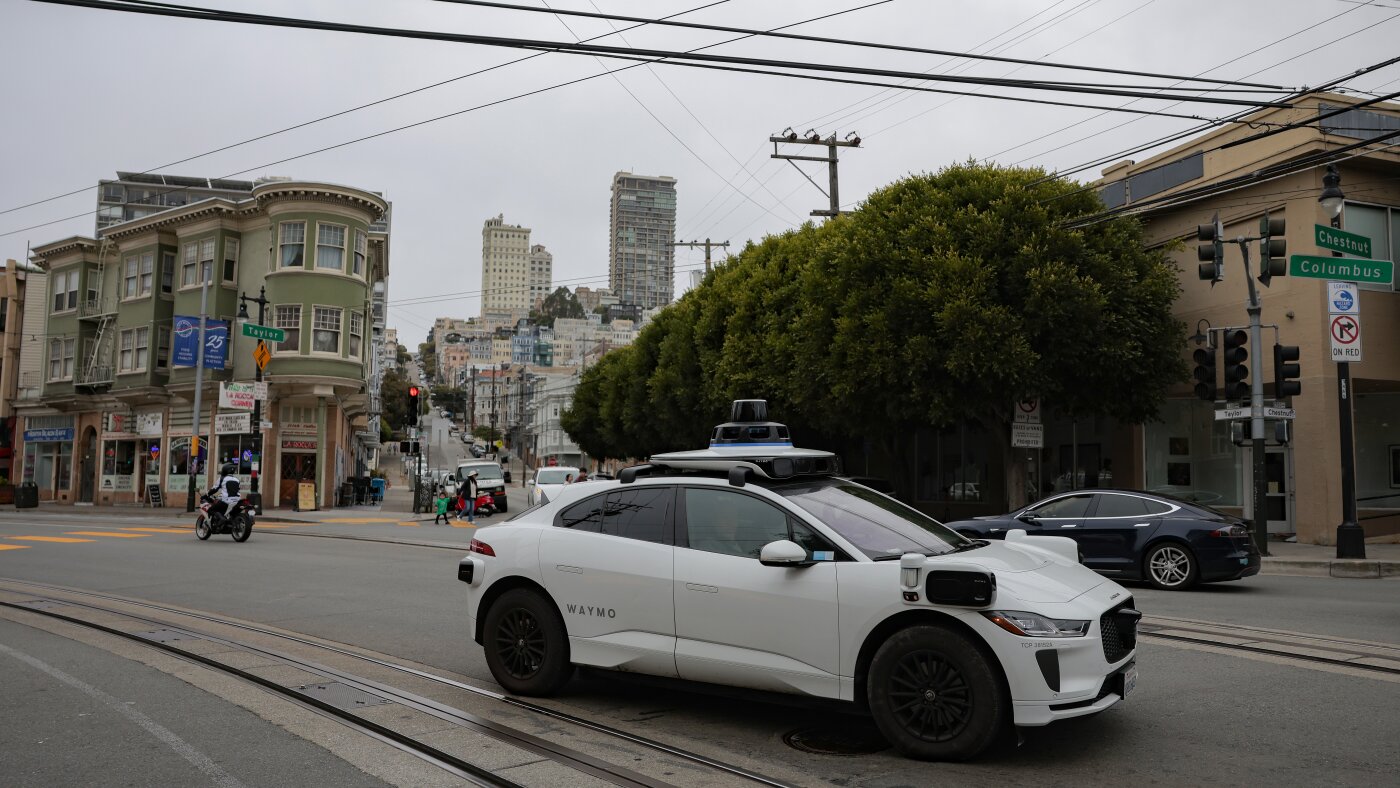
A Waymo robotaxi drives in San Francisco’s North Beach neighborhood this week.
Heather Diehl/Getty Images
hide caption
toggle caption
Heather Diehl/Getty Images
Police in San Mateo, Calif., posted Monday on social media that they had apprehended a pair of teenagers from a Waymo driverless robotaxi after the company alerted authorities to suspected criminal activity. It’s the latest incident involving video surveillance of passengers and others by autonomous vehicles — raising questions about the limits of privacy in such vehicles.

The Facebook post by the San Mateo County Police said: “Parents do you know where your teens are? @waymo does!”
The 15-year-olds were allegedly drinking alcohol and shooting toy guns from the car, according to the police. They said Waymo’s systems detected behavior that then triggered a safety response, after which the company disabled the vehicle and contacted police.
Waymo’s cars, equipped with an array of cameras, microphones and other sensors to monitor passengers and other nearby vehicles, are becoming more common in cities across the United States. Experts say the detention of the two teens in San Mateo highlights a potential — but not inevitable — trade-off between privacy and convenience. It also questions the extent to which companies similar to Waymo are required to hand over private data, including audio and video of passengers, in situations where a crime is suspected.
NPR reached out to Waymo, which is owned by Alphabet, the parent company of Google, for comment on the details of the San Mateo incident and how the company responded, but did not hear back. But on its website, the company says that as many as 29 cameras in its autonomous cars provide an all-around view and “are designed with high dynamic range and thermal stability, to see in both daylight and low-light conditions, and tackle more complex environments.”
“There already exist laws that govern duty to report or even duty to protect” for carriers such as Waymo, according to Alessandro Acquisti, a professor of information technology at the MIT Sloan School of Management. “The privacy problems arise when and if driverless carrier companies used such laws or ethical obligations as a pretext for blanket, indiscriminate accumulation of identifiable data for unspecified future purposes.”
That includes not just monitoring people inside the cars, but outside too. Take, for example, a hit-and-run investigation last year in Los Angeles. Media reported that the police inquiry was aided by video captured by a Waymo taxi that had a clear view of the crime. Critics suggested at the time that authorities were using the company’s vehicles as a mobile surveillance platform. And during 2025 protests in Los Angeles against Immigration and Customs Enforcement crackdowns, demonstrators vandalized Waymos, apparently angry that video recorded by the vehicles could be used by police, although there is no evidence that happened.
In a transparency report, Google says it received nearly 290,000 requests from governments worldwide in the first six months of 2025 for disclosure of user information across all its platforms, including Waymo. The company says that in more than 80% of the requests in those six months, some information was disclosed. “Google carefully reviews each request to make sure it satisfies applicable laws. If a request asks for too much information, we try to narrow it, and in some cases we object to producing any information at all,” the company says.
In an email to NPR, San Mateo Police Department spokesperson Jeanine Luna said that detaining the teens in the Waymo on Monday was “wholly appropriate” under the circumstances. “We received the call of a ‘firearm’ being shot from a moving vehicle,” she said. “Furthermore, the occupants were described as being possibly ‘intoxicated.’” she said.
“Being that the vehicle was disabled (the occupants had every right to exit the vehicle before police arrival, but they did not), a high-risk traffic stop was conducted to ensure the safety of all involved,” Luna added. “They were not arrested and were released to their parents, however, potential charges are still pending dependent on what the video from inside the vehicle shows.”
Autonomous taxis represent an ethical gray area
Robotaxis began to roll out across the U.S. in December 2018, when Waymo launched in Phoenix. These services have been used for less than a decade — so the norms surrounding them aren’t settled, experts agree.
The Facebook post may make Waymo passengers wonder what triggers a police intervention, says Irina Raicu, director of the Internet Ethics program at Santa Clara University. She has used Waymo’s driverless taxis and says ethically, the privacy issues surrounding them sit in a gray area. “There’s something about being in a car without another person that makes you think it’s private.”
“With all these recording devices, we don’t see them, [and] they’re not these obvious things being stuck in our faces,” Raicu adds.
That brings up a key issue: informed consent, Acquisti says.
“It is not clear the extent to which passengers … are reminded that when they step into the car, that they are being monitored, and most likely they are not told in its entirety how the data will be used,” he says.
Bruce Schneier, a cybersecurity and privacy expert and professor at the Munk School at the University of Toronto, believes that Waymo does have a compelling interest in protecting its vehicles. He compares monitoring a robotaxi via cameras to a human taxi driver keeping an eye on passengers in the rearview mirror.
“Maybe the driverless car comes back … and it has all of its cushions slashed, and it’s like, ‘Who the hell did that? Let’s go and look at the tape,’” Schneier suggests. “You can’t have sex in the back of a taxi, right? Someone would say, ‘Stop it.’”
He concludes that some supervision makes sense. In an Uber rideshare, he notes, “most of the time there’s a camera recording the back seat.” (Uber says on its website that it allows drivers to install such cameras for the purpose of “fulfilling transportation services.”)

Waymo robotaxis, while a fairly common sight in the San Francisco Bay Area, are still a novelty in much of the country. And many people are hesitant to ride in one, according to a Pew Research Center poll published this month. The survey found that only 5% of Americans had ever ridden in a driverless car. Meanwhile, 71% of those polled said they would feel uncomfortable in one, with only 7% saying they would be “extremely or very comfortable” riding in one.
For that reason, experts who spoke with NPR said they were optimistic that it’s not too late to shift gears on privacy norms and policies surrounding these vehicles.
Acquisti doesn’t see why privacy measures can’t be built into driverless vehicles.
“I would immediately challenge the notion that people have to be monitored,” he says, noting that privacy-preserving technologies exist and can be installed.
“Driverless cars are coming, but they don’t have to come in this particular incarnation,” Raicu says. “They’re still being designed and redesigned. It’s early days.”

Donald Trump has terminated the remaining members of the independent, federal commission that assists election administration officials nationwide just a few months before the midterm elections, multiple outlets reported Thursday.
The remaining three commissioners of the four-member bipartisan commission were forced out on Thursday in different ways. The one Republican appointee resigned and the other two, Democratic appointees were notified of their terminations via email from the White House presidential personnel office.
“On behalf of President Donald J Trump, I am writing to inform you that your position as Commissioner of the Election Assistance Commission is terminated, effective immediately. Thank you for your service,” the email, seen by Reuters, said.
The White House did not immediately respond to a request for comment.
The Election Assistance Commission serves as a “national clearinghouse of information on election administration”, accredits testing laboratories and certifies voting systems, and maintains the national mail-voter registration form developed by the National Voter Registration Act of 1993, according to the commission’s website. The terminations follow Trump and top administration officials’ advocacy to change vote-by-mail requirements and investigations into the 2020 election outcome, which Trump lost to Democrat Joe Biden.
“It is irresponsible and dangerous that this Administration remains dead set on causing chaos for our election officials across this country,” Arizona secretary of state Adrian Fontes said in a Thursday statement. “This move undermines the integrity of nonpartisan election administration.”
The 2002 law that established the commission, the Help America Vote Act, states the president can appoint replacements to the commission.
It is unclear how Trump will move ahead with the commission.
Reuters contributed reporting

Former U.S. Olympian David Hearn (left) walks with his attorney Norman Eisen to speak to reporters and protesters gathered after his arraignment at the Superior Court of the District of Columbia in Washington, D.C. on Thursday.
Finn Gomez/Getty Images
hide caption
toggle caption
Finn Gomez/Getty Images
Former U.S. Olympic canoeist David Hearn pleaded not guilty to damaging the Lincoln Memorial Reflecting Pool in D.C. Superior Court Thursday morning.
Federal prosecutors charged Hearn with a single count of destruction of property causing more than $1,000 in damage to the pool.

Hearn has previously claimed, which his attorneys repeated during a short press conference outside the court, that he simply touched the water in the pool out of curiosity.
The Trump administration had just completed a $14 million renovation of the pool.
But shortly after the work finished, peeling paint and algae gathered in the water. The remodel has been largely criticized as a massive failure and waste of taxpayer dollars.

Superior Court Judge Carmen McLean released Hearn on his own recognizance. His next hearing is scheduled for Aug. 5.
Norm Eisen, one of Hearn’s attorneys, spoke to reporters outside of court following the hearing. He said the administration is using Hearn as a “scapegoat … for their own failures.”
“It is not a crime to touch the reflecting pool, to touch water in the United States of America,” he said.
Prosecutors say there is a host of evidence against Hearn.
This is a developing story.
-

 New Jersey6 minutes ago
NJ Legislators Are Considering a Bill That Could Ban Tesla Robotaxis Due to Their Tech Choice
-

 New Mexico9 minutes ago
New gay bar opens in Nob Hill
-
North Carolina14 minutes ago
Explore on the water: How, where to kayak in Raleigh
-

 North Dakota21 minutes ago
Schulz to transition from ND Parks and Recreation to ND Department of Corrections and Rehabilitation
-

 Ohio24 minutes ago
Marion lecture to focus on expanding youth learning programs
-
 Oklahoma29 minutes ago
‘THE SPIRIT OF OKLAHOMA!’ Cherokee artist restores landmark to honor father’s legacy
-

 Oregon36 minutes ago
Oregon ‘mega-mansion’ sits unfinished 30 years later
-

 Pennsylvania39 minutes ago
Here’s how to see Big Boy, the world’s largest steam locomotive, in western Pennsylvania

