



Connect with us

News

It's easy to believe young voters could back Trump at young conservative conference

Published

on

It's easy to believe young voters could back Trump at young conservative conference

People arrive before Republican presidential candidate former President Donald Trump speaks at the “People’s Convention” of Turning Point Action Saturday in Detroit.

Carlos Osorio/AP


hide caption

toggle caption

Advertisement

Carlos Osorio/AP

Sporting a “Pretty Girls Vote Republican” baseball cap and several buttons, including one reading “Gun Rights are Women’s Rights,” Lauren Kerby was surprised to be asked who she plans to vote for in the fall.

“Obviously Trump,” she said with a laugh. “I came here for a reason.”

Here is the ‘People’s Convention’, run by Turning Point Action, the advocacy wing of Turning Point USA, one of the largest national organizations focused on engaging students on conservative issues.

Advertisement

Turning Point – which rose out of concerns about free speech on college campuses, has grown into an unapologetically pro-Trump machine, focused on organizing for the former president ahead of the 2024 election.

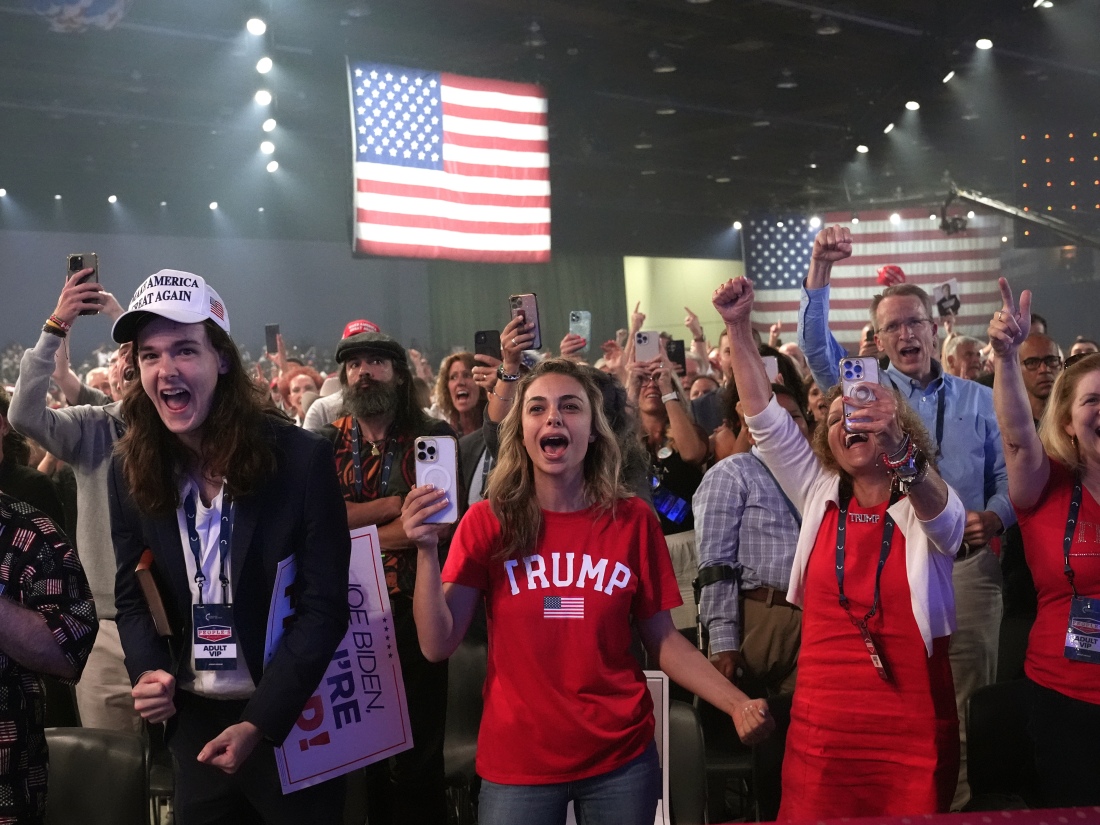
It hosts events like these, attracting voters like Kerby and hundreds of others like her who want to party, young conservative style.

And this is certainly a Trump show. At the Huntington Place Convention Center in downtown Detroit, a bejeweled presidential seal with Trump’s face in the center rests on the hood of a gold-painted Mercedes-Benz. At a nearby booth among dozens, vendors are selling “America First” cowboy hats and shirts reading, “Voting Convicted Felon, 2024.”

The festivities this year come as Turning Point Action works to significantly expand its organizing presence in key swing states ahead of the general election, including Michigan, home to this year’s conference.

Just five months out, enthusiasm for Trump is high among younger attendees. NPR spoke with more than a dozen voters under 30, who remain committed to Trump, motivated by to vote for him largely because of his isolationist ideas and focus on the economy and immigration.

Advertisement
Supporters cheer as Republican presidential candidate former President Donald Trump speaks at the “People's Convention” of Turning Point Action Saturday in Detroit.

Supporters cheer as Republican presidential candidate former President Donald Trump speaks at the “People’s Convention” of Turning Point Action Saturday, June 15, 2024 in Detroit. (AP Photo/Carlos Osorio)

Carlos Osorio/AP


hide caption

toggle caption

Carlos Osorio/AP

Advertisement

Their unwavering support stands in contrast to sentiment of many younger Democratic voters, who remain unsure or unenthused about backing President Biden again.

Trump took the stage Saturday night as the event headliner. He ticked through his proposed second-term agenda and criticized Biden’s record, making little mention of the youth-focused nature of the event, outside of publicly thanking Turning Point founder and longtime supporter, Charlie Kirk, who is a millennial.

“[Kirk’s] got his army of young people,” Trump said. “These are young patriots. They don’t want to see… what’s been happening in our country.”

The former president’s remarks came after two days of speeches from conservative firebrands and high-profile Trump allies, including Republican National Committee co-chair and Trump’s daughter in law Lara Trump, former presidential candidate Vivek Ramaswamy, Rep. Matt Gaetz (R-Fla.) and Rep. Marjorie Taylor Greene (R-Ga.)

Advertisement

This year’s conference also comes just over two weeks after a New York jury found Trump guilty of criminal charges, a decision that could negatively impact his chances with younger voters. The latest Harvard youth poll, published in March, found a potential guilty verdict increased Biden’s lead by 10 percentage points among young Americans overall.

Much like their unwavering support in the election, though, voters at the event are unphased by his conviction. His mugshot is displayed on the posters and t-shirts of attendees.

To 20-year-old James Hart, the verdict has little effect.

“I don’t really think, at this point, anyone’s feelings changed. I think everyone knows who they’re going to vote for. We know Trump. Trust me – we know Joe Biden,” said Hart. “We know their policy. We know how they’re going to act. And I trust Trump.”

Where young conservatives stand

For Kerby from Berkeley, Mich., supporting Trump partially stems from his push for isolationism, including limiting U.S. aid to Ukraine in its war with Russia.

Advertisement

“He’s focused on what’s happening here,” she said, pointing instead to Trump’s focus on reducing illegal immigration.

“Not saying that other places don’t matter, but we should matter first,” Kerby’s friend, Elaina Luca, 21, added. “When you’re in a family, you make sure that your family is okay first.”

Luca is also backing Trump. As a mom with two young kids, she’s most concerned about rising prices.

“When I drive around and see a nice house, I like to look up how much it’s sold for,” she explained. “In today’s economy, it’s like, ‘Oh, wow, how did these people even afford that? …And it’s like, ‘Oh no, they bought it in 2012 for like $150,000 and now it’s worth like $1 million.”

“How am I supposed to get a house to raise my children to live in?” she wondered aloud, “I don’t want to pay for a house for the rest of my life.”

Advertisement

Turning Point’s 2024 strategy

Former President Donald Trump walks on to the stage to give the keynote address at Turning Point Action's

Former President Donald Trump walks on to the stage to give the keynote address at Turning Point Action’s “The People’s Convention” on Saturday in Detroit, Michigan.

Bill Pugliano/Getty Images


hide caption

toggle caption

Bill Pugliano/Getty Images

Advertisement

While Turning Point’s non-profit side has held student conferences for nearly a decade, also sprinkled with appearances from Republican politicians and conservative media figures, this conference marks just the second for Turning Point Action.

The activist network has morphed into a more pronounced political force, planning to ramp up its organizing ground game ahead of the election.

“It’s night and day,” said Turning Point Action spokesman Andrew Kolvet. “Any activities we did, in 2022 for example, in the midterms, was like the Stone Age compared to the level of sophistication and just the resources that we’ve poured into this project to develop it.”

Kolvet is talking about the group’s “Chase the Vote” initiative, a get-out-to-vote campaign focused on reaching low-propensity voters in swing states that launched earlier this spring. Trump recently endorsed the program during a separate Turning Point event in Arizona, another pivotal state in 2024.

Advertisement

Turning Point hopes to raise $100 million to build up on the ground organizing staff and plans to work with the Trump campaign on canvassing – a notable change from past election cycles following new guidance from the Federal Election Commission.

Despite the roots of Turning Point, the program is not solely focused on young voters, though Kolvet said that will always be tied to Turning Point’s work.

Growing up under Trump, now it’s time to vote

Despite enthusiasm for Trump at Turning Point, Republicans face a steep challenge to bringing in more young voters. Voters under 30 have traditionally voted for Democrats andin 2020, Biden won the age group by a 24-point margin.

Plus – young voters tend to be aligned with Democrats on their key issues – notably on abortion access, addressing climate and curbing gun violence. And despite struggling in polling, Biden still maintains a lead with young voters overall in multiple youth polls.

But among some young conservatives, albeit a proportionally smaller group, Trump’s style of Republican politics – once fringe and now mainstream – is overwhelmingly what they want for their political future.

Advertisement
An attendee wears a

An attendee wears a “Team Trump” cowboy hat as people watch speakers during Turning Point’s “Peoples Convention” on Saturday in Detroit.

Jeff Kowalsky/AFP/Getty Images


hide caption

toggle caption

Jeff Kowalsky/AFP/Getty Images

Advertisement

“The pro-Trump, MAGA element definitely appeals more towards young conservatives and young Americans in general,” said 19-year-old Ohio student, Gabe Guidarini, a member of the College Republicans of America. “It actually addresses the problems that they face.”

He argued young people have trouble connecting to “old school Republican rhetoric” focused on cutting taxes and government spending, because they are not able to progress financially. And given the time period Gen Z has grown up during, Trump’s deviation from political norms is appealing, he explained.

James Hart agrees. Though the 20-year-old now lives in Tallahassee, he grew up in Detroit. “I was raised Democrat,” he said.

Advertisement

That is, until 2016, when his family flipped for Trump.

“His personality is what got my family to say. ‘Hey, you know, maybe the Democrats aren’t the greatest,’” he said. “Honesty is the best policy. And up here in the Midwest, we’re honest. We say it like it is. And Trump did that.”

Now, as Hart gets ready to vote for the first time, his mind is made up.

“I think most young people are going after Trump-like candidates,” he said. “We want the fire. We want the passion. We’re tired of the same old, same old. We want bold policy that actually is going to lead with results.”

Advertisement

News

After 2 failed votes, Mike Johnson unveils new plan to extend key U.S. spy powers

Published

on

After 2 failed votes, Mike Johnson unveils new plan to extend key U.S. spy powers

Speaker of the House Mike Johnson, R-La., takes questions at a news conference at the Capitol on Tuesday.

J. Scott Applewhite/AP


hide caption

toggle caption

Advertisement

J. Scott Applewhite/AP

Speaker Mike Johnson, R.-La., is forging ahead with his latest proposal to renew a key American spy power. His bill, revealed Thursday, is largely unchanged from a previous plan which failed in a series of overnight votes earlier this month.

The program at center of the debate, Section 702 of the Foreign Intelligence Surveillance Act (FISA), is set to expire on April 30.

FISA 702 allows U.S. intelligence agencies to intercept the electronic communications of foreign nationals located outside of the United States. Some of the nearly 350,000 foreign targets whose communications are collected under the provision are in touch with Americans, whose calls, texts and emails could end up in the trove of information available to the federal government for review.

Advertisement

For almost two decades, privacy-minded lawmakers from both parties have sought to require specific court approval before federal law enforcement can conduct a targeted review of an American’s information gathered through the program. The lack of any such warrant requirement helped sink an effort last week to extend the program for 18 months, as well as a separate vote on a five-year renewal. 

Trump officials, like those in past administrations, have argued that such a warrant requirement would overburden law enforcement and endanger national security. Johnson’s latest proposal would reauthorize the program for three years, but does not include a warrant requirement. Instead, the bill calls for the FBI to submit monthly explanations for reviews of Americans’ information to an oversight official as well as criminal penalties for willful abuse, among other tweaks.

“I am willing to risk the giving up of my Rights and Privileges as a Citizen for our Great Military and Country,” the president wrote on Truth Social last week, advocating for the program to be extended without changes. “I have spoken with many in our Military who say FISA is necessary in order to protect our Troops overseas, as well as our people here at home, from the threat of Foreign Terror Attacks. It has already prevented MANY such Attacks, and it is very important that it remain in full force and effect.”

Glenn Gerstell, who served as general counsel at the National Security Agency during the Obama and first Trump administration, says Johnson’s reforms look like an attempt to find a middle ground.

“There’s not a lot of really substantive changes to the statute, but some gestures are made to people who are worried about privacy and civil liberties,” Gerstell said. “It seems like a pretty reasonable compromise that is going to be satisfactory to the national security agencies and yet at the same time represents some gesture to the privacy advocates.”

Advertisement

“This is not a reform bill and it’s not a compromise,” Elizabeth Goitein, a privacy advocate and senior director of the Liberty and National Security Program at the Brennan Center for Justice at New York University, wrote on X. “It’s a straight reauthorization with eight pages of words that serve no serious purpose other than to try to convince members that it’s NOT a straight reauthorization.”

A bipartisan reform deal is still out of reach

Connecticut Rep. Jim Himes, the top Democrat on the House Intelligence committee, told NPR on Wednesday, before the release of Johnson’s new proposal, that lawmakers were working on a bipartisan solution. He said House Minority Leader Hakeem Jeffries, D-N.Y., was in touch with Johnson on the issue.

“There’s a lot of work being done here,” Himes said. “We’re sort of working out a process that will be inclusive rather than exclusive.” Himes said he was negotiating with Rep. Jamie Raskin, a Maryland Democrat and constitutional law scholar, on a reform proposal they hoped could preserve and reform the program — reauthorizing it with bipartisan support.

But Johnson’s new bill appears to fall short of the inclusive approach Himes hoped for.

NPR obtained a memo written by Raskin to his colleagues urging them to oppose the bill, which he said “continues the disastrous policy of trusting the FBI to self-police and self-report its abuses of Section 702 and backdoor searches of Americans’ data.”

Advertisement

“FBI agents can still collect, search, and review Americans’ communications without any review from a judge,” Raskin wrote.

FBI agents must receive annual training on FISA and are generally barred from searching for information about people in the U.S. if the goal of the search is to investigate general criminal activity, rather than find foreign intelligence information, and those searches need approval from a supervisor or an attorney. 

Republican hardliners — who sunk Johnson’s last reauthorization attempt — also don’t all appear to be on board for Johnson’s latest revision. Rep. Scott Perry of Pennsylvania, a past chair of the Freedom Caucus, said “we’re not there yet” in a video he shared to X on Thursday.

“I didn’t take an oath to defend FISA, I didn’t take an oath to defend the intelligence community,” Perry said. “We can’t have them spying on American citizens and, when they do, there has to be accountability and I haven’t seen any that I’m satisfied with yet.”

The House Rules committee meets Monday morning, the first step toward advancing the renewal bill toward a vote.

Advertisement
Continue Reading

News

Trump Says Israel and Lebanon Agree to Extend Cease-Fire by Three Weeks

Published

on

Trump Says Israel and Lebanon Agree to Extend Cease-Fire by Three Weeks

President Trump announced a three-week extension of a cease-fire between Israel and Lebanon that had been set to expire in a few days, after hosting a meeting between Israeli and Lebanese diplomats at the White House on Thursday.

Hezbollah, the Iranian-backed militant group that has been attacking Israel from southern Lebanon, did not have representatives at the meeting and did not immediately comment on the announcement. The prime minister of Israel and the president of Lebanon also did not comment.

A successful peace agreement would hinge upon Hezbollah halting attacks, which Lebanon’s government has little power to enforce because it does not control the militia. Lebanon’s military has mostly stayed out of the fighting and is not at war with Israel.

The cease-fire, which was scheduled to end on April 26, would last until May 17 if it takes effect as Mr. Trump described it. Before the cease-fire was brokered last week, nearly 2,300 people were killed in Lebanon and 13 in Israel. Since then, the number of Israeli airstrikes and Hezbollah attacks have been dramatically reduced, though the two sides have continued exchanging fire.

The Lebanese Ambassador to the United States, Nada Hamadeh, credited Mr. Trump for extending the cease-fire, saying that “with your help and support, we can make Lebanon great again.” Mr. Trump replied, “I like that phrase, it’s a good phrase.”

Advertisement

Asked about the potential of a lasting peace agreement between Israel and Lebanon, Mr. Trump said that “I think there’s a great chance. They are friends about the same things and they are enemies on the same things.”

But Lebanon and Israel have periodically been at war since Israel’s founding in 1948. Israel has invaded Lebanon for the fifth time since 1978, incursions that have destabilized the country and the delicate balance of power between Muslim, Christian and Druze communities.

In the hours before the president’s announcement on social media, Israel and Hezbollah were trading attacks in southern Lebanon, testing the existing cease-fire.

Mr. Trump said the meeting at the White House had been attended by high-ranking U.S. officials, including Vice President JD Vance, Secretary of State Marco Rubio and the U.S. ambassadors to Israel and Lebanon.

Earlier on Thursday, an Israeli strike near the southern Lebanese city of Nabatieh killed three people, according to Lebanon’s health ministry. Hezbollah claimed three separate attacks on Israeli troops who are occupying southern Lebanon, though none were wounded or killed.

Advertisement

Hezbollah set off the latest round of fighting last month by attacking Israel soon after the start of the U.S.-Israeli bombing campaign in Iran. Israel responded to Hezbollah’s attacks by launching airstrikes across Lebanon and widening a ground invasion of the country’s south.

Continue Reading

News

U.S. soldier charged with suspected Polymarket insider trading over Maduro raid

Published

on

U.S. soldier charged with suspected Polymarket insider trading over Maduro raid

Smoke rises from Port of La Guaira in Venezuela on Jan. 3, 2026 after U.S. forces seized the country’s president, Nicolas Maduro and his wife.

Jesus Vargas/Getty Images


hide caption

toggle caption

Advertisement

Jesus Vargas/Getty Images

Federal prosecutors on Thursday unsealed an indictment against a U.S. Army soldier, accusing him of using his insider knowledge of the clandestine military operation to capture Venezuelan leader Nicolás Maduro in January to reap more than $400,000 in profits on the popular prediction market site Polymarket.

The Justice Department says Gannon Ken Van Dyke, 38, who was stationed at Fort Bragg, in North Carolina, was part of the team that planned and carried out the predawn raid in Caracas earlier this year that resulted in the apprehension of Maduro.

The Department of Justice and the Commodity Futures Trading Commission filed the actions against Van Dyke, the first time U.S. officials have leveled criminal charges against someone over prediction market wagers.

Advertisement

According to the indictment, Van Dyke now faces counts of wire fraud, commodities fraud, misusing non-public government information and other charges.

Trading under numerous usernames including “Burdensome-Mix,” Van Dyke allegedly traded about $32,000 on the arrest of Maduro, resulting in profits exceeding $400,000.

“Prediction markets are not a haven for using misappropriated confidential or classified information for personal gain,” said U.S. Attorney Jay Clayton for the Southern District of New York. “Those entrusted to safeguard our nation’s secrets have a duty to protect them and our armed service members, and not to use that information for personal financial gain.”

Van Dyke’s defense lawyer is not yet publicly known. Polymarket did not return a request for comment.

The charges against Van Dyke come at a sensitive time for the prediction market industry, which has been growing exponentially, despite calls in Washington and among state leaders for the sites to be reined in.

Advertisement

Van Dyke is the first to be charged in the U.S. for suspected Polymarket insider trading, but Israeli authorities in February arrested several people and charged two on suspicion of using classified information to place bets about military operations in Iran on Polymarket.

Continue Reading
Advertisement

Trending
