Connect with us

News

Israel-Hamas ceasefire takes effect

Published

on

Israel-Hamas ceasefire takes effect

Unlock the Editor’s Digest for free

A ceasefire between Israel and Hamas began on Sunday, halting 15 months of brutal war in Gaza and paving the way for the release of hostages still being held by the Palestinian militant group in the shattered enclave.

The deal for an initial six-week truce offers hope of a pause — and potentially an end — to the bloodiest war in the decades-long history of the Israeli-Palestinian conflict, which has left Gaza in ruins, consumed Israeli society and brought the Middle East to the brink of a full-blown war.

The truce, which is the first stage of a three-phase agreement thrashed out by US-led mediators last week after months of failed attempts, had been due to take effect at 8.30am local time (06.30 GMT).

Advertisement

But in an indication of the fragility of the arrangements, it began nearly three hours late, with Israel continuing to bomb Gaza after a delay in Hamas providing the names of the hostages set for release on Sunday.

The chances of the agreement being implemented in full remain uncertain, with Israeli Prime Minister Benjamin Netanyahu under intense pressure from far-right allies to resume fighting once the first phase of the deal is over.

Israel’s government said the first three hostages — who will be freed in exchange for 90 Palestinian prisoners — were expected to be released after 16.00 local time on Sunday. The next exchange will take place in seven days’ time, when four more hostages will be freed.

The fighting in Gaza was triggered by Hamas’s shock October 7, 2023 attack on Israel, during which militants killed 1,200 people, according to Israeli officials, and took a further 250 hostage in the deadliest day for Jews since the Holocaust.

Israel responded with a devastating assault on Gaza, which has killed more than 46,000 people, according to Palestinian officials. It has displaced most of the coastal enclave’s 2.3mn people, reduced much of the strip to rubble and fuelled a humanitarian catastrophe.

Advertisement

Even before the ceasefire belatedly came into force on Sunday, celebrations had begun to spread across Gaza, where many displaced people were preparing to return to the ruins of their homes.

Mohamed Bassal, spokesperson for Gaza’s civil defence agency, said some had begun returning to Jabalia — a devastated area in the north of the enclave — as early as 8.30am local time. “They were targeted by Israeli strikes, but some people still got there and our teams are there,” he said.

Bassal added that civil defence teams were starting to retrieve bodies from areas vacated by the Israeli forces in Rafah and in the north, and that police had started to deploy in cities.

Under the terms of the deal struck by mediators last week, the first phase will involve a six-week truce, during which Hamas will release 33 of the 98 hostages still in Gaza — including children, women, the sick and elderly — in exchange for around 1,900 Palestinian prisoners.

During this time, displaced Palestinians will be allowed to return to their homes, including in northern Gaza. There will also be a partial withdrawal of Israeli troops from Gaza, and the ceasefire agreement also sets out plans for a massive influx of humanitarian aid into the enclave.

Advertisement

By day 16 of the first phase, Israel and Hamas are meant to start negotiating details of the second phase of the deal, during which the remaining living hostages will be freed in exchange for hundreds more Palestinian prisoners, the complete withdrawal of Israeli forces from Gaza, and a permanent end to the war.

The final phase is due to involve the return of the remaining bodies of hostages who have died, as well as the beginning of the reconstruction of Gaza, under the supervision of Egypt, Qatar and the UN.

Shortly before the deal went into force, far-right national security minister Itamar Ben-Gvir pulled his Jewish Power party out of the government in protest against the deal, reducing Netanyahu’s majority in Israel’s 120-seat parliament to just two seats.

Ben-Gvir’s ultranationalist ally, finance minister Bezalel Smotrich, has also threatened to pull his Religious Zionism party out of the government if the war does not resume after the first stage of the deal. If he did so, it would deprive Netanyahu of his parliamentary majority.

In a statement on Saturday evening, Netanyahu said the administrations of outgoing US President Joe Biden and his successor Donald Trump supported Israel’s right to resume the war if talks over the details of the second phase failed. He also insisted that Israeli forces would keep “full control” of the Philadelphi corridor, which separates Gaza from Egypt.

Advertisement

“If we have to return to combat, we will do so in new ways, and we will do so with great force,” Netanyahu said.
News

Parts of Florida receive rare snowfall as freezing temperatures linger

Published

on

Parts of Florida receive rare snowfall as freezing temperatures linger

A protective coating of ice clings to a strawberry plant in sub-freezing temperatures at a field on Friday in Plant City, Fla.

Chris O’Meara/AP


hide caption

toggle caption

Advertisement

Chris O’Meara/AP

A rare snowfall covered parts of the Sunshine State on Sunday for the second year in a row, while freezing temperatures will continue to grip parts of Florida into early this week.

A storm system brought up to 2 inches of snow to southern portions of Alabama and the Florida Panhandle, including Pensacola, on Sunday morning, according to the National Weather Service (NWS).

The snowfall occurred almost a year to the day after parts of Florida received record snow in mid-January 2025 — when Pensacola received between 6 to 8 inches of snow.

Advertisement

And while Sunday’s snowfall is over in Florida, a blast of arctic cold that has been felt across parts of the state since Friday is not.

Orlando and other areas will face a freeze warning Sunday night into Monday morning, with temperatures falling to at least 25 degrees and wind chills in the low 20s in some places, according to the NWS. Further south, Naples and surrounding areas will be under a cold weather advisory Sunday night into Monday morning, where 29-degree wind chills are expected.

Cold temperatures coupled with snow are abnormal for Florida but the cold weather will be “short-lived,” said Joe Wegman, a NWS meteorologist.

“We’re only expecting this level of cold for tonight. And then, even by tomorrow night, we’ll have lows in the upper 30s. So, just still cold, well below normal,” Wegman told NPR on Sunday. “By Tuesday night, lows are back up into the upper 40s.”

Advertisement
Continue Reading

News

Did Hunter S. Thompson Really Kill Himself?

Published

on

Did Hunter S. Thompson Really Kill Himself?

Almost from the moment Hunter was laid to rest, his widow and his son began to feud, over everything from the future of Owl Farm to Juan’s belief that his father had been mistreated by Anita in his last days.

The estrangement deepened with time, and now, Anita’s suspicions have taken the feud to a more pointed place, revealing a long, bitter fight over the legacy of the man who pioneered the personal, participatory style of reporting known as gonzo journalism.

Advertisement

But they were all together the weekend Hunter died.

Juan wrote in his memoir that he was in another room and heard a thump that sounded like a book hitting the floor. Anita was at a health club in Aspen waiting for a yoga class to start. She later told the news media she was on speakerphone with her husband before he shot himself, and heard the “clicking” of the gun.

Advertisement

Looking back, there were signs from that last weekend that Hunter had planned to take his own life, Juan and Jennifer said in interviews.

He insisted on watching one of his favorite movies, “The Maltese Falcon,” with his 6-year-old grandson, Will. He gave away gifts — an old clock that had belonged to his mother and a signed copy of “Fire in the Nuts,” a short book with his frequent collaborator, the artist Ralph Steadman.

Advertisement

Ralph Steadman spoke about Hunter’s suicidal ideations in an interview after his death in 2005. ITN, via Getty Images By Itn

“So there is nothing new to know about Hunter’s actual death,” said Juan, 61. “So I do not know why she raised this. And I can’t imagine that the C.B.I. would find anything to act on.”

Advertisement

He and Jennifer said they did not have any role in Hunter’s death. “This is really shocking,” Jennifer said. “It’s been disruptive to our family. It’s obviously been very traumatic to be revisiting this.” She said she believed Anita knew that her husband took his own life, and added, “we hope this brings her closure.”

Jennifer Winkel

Advertisement

Anita had been an assistant to Hunter, and was 35 years younger than him. At the time of his death, they had been married for less than two years — it was Hunter’s second marriage — and that last weekend they fought constantly. In his memoir, Juan wrote that Hunter shot a pellet gun at a gong in the living room the night before he killed himself, just missing Anita, prompting her to threaten to call the police and have him put in a nursing home.

Hunter was also in poor health. He had difficulty moving and suffered occasional seizures, the result of decades of heavy drinking.

Advertisement

“Hunter’s body was giving out,” said Debra Fuller, who worked as an assistant to Hunter and helped manage Owl Farm for almost 20 years before Hunter married Anita. “He was having more difficulty writing as well.”

Hunter had often talked of suicide. Like many of Hunter’s friends, Joe DiSalvo, who was undersheriff of Pitkin County at the time of his death, had conversations with him about how his life would end. He recalled that Hunter would demonstrate his intentions by pointing a loaded gun at his head.

“Hunter talked about suicide,” Mr. DiSalvo said. “He talked about the way he was going to kill himself.”

Advertisement

Continue Reading

News

U.S. military troops on standby for possible deployment to Minnesota

Published

on

U.S. military troops on standby for possible deployment to Minnesota

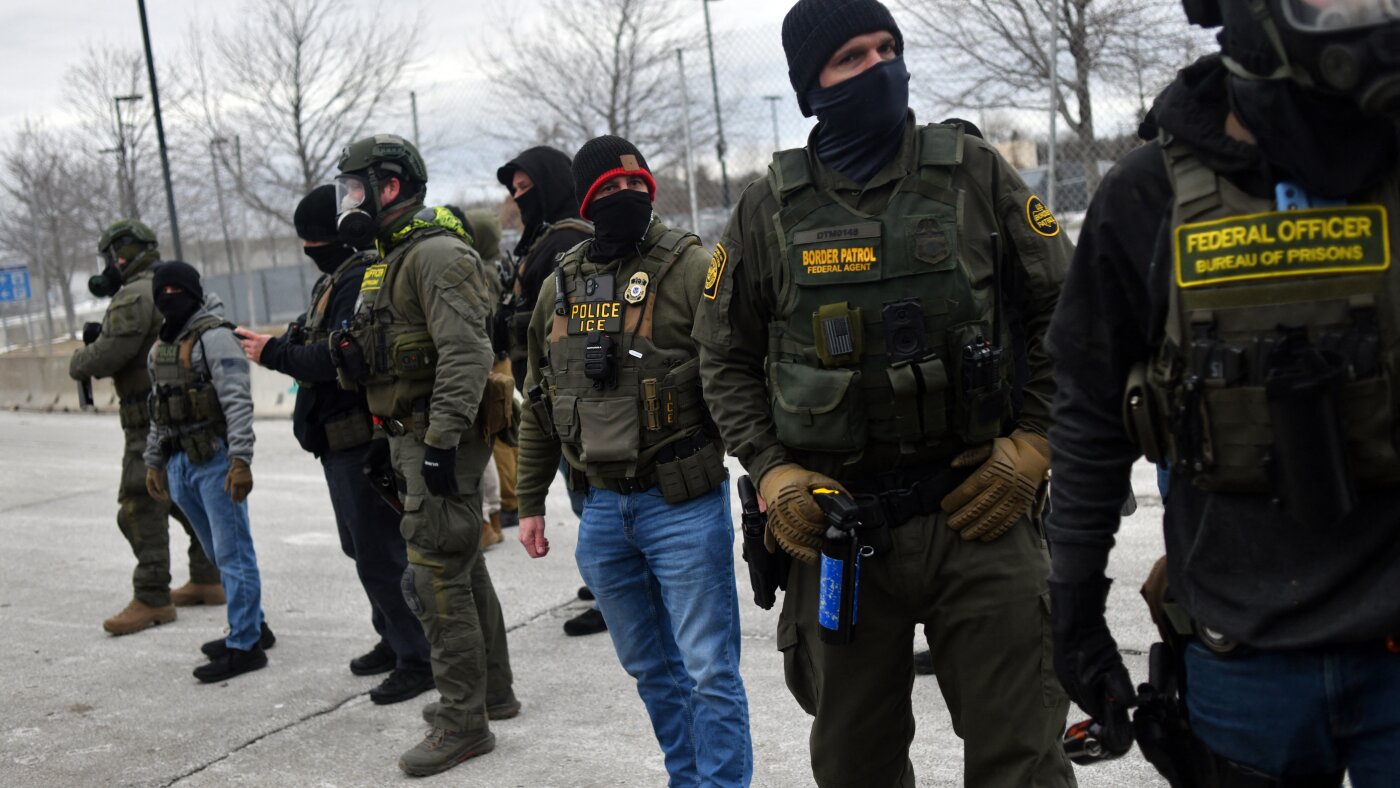
Federal law enforcement agents confront protesters during a demonstration outside the Bishop Whipple Federal Building in Minneapolis, Minnesota, on Thursday.

Octavio Jones/AFP via Getty Images


hide caption

toggle caption

Advertisement

Octavio Jones/AFP via Getty Images

Up to 1,500 U.S. active-duty troops in Alaska are on standby for possible deployment to Minnesota, a U.S. official who was not authorized to speak publicly has confirmed to NPR.

The move comes days after President Trump again threatened to invoke the Insurrection Act to control ongoing protests over the immigration enforcement surge in Minneapolis as well as clashes between federal agents and residents. Trump later walked back that threat.

The troops on standby are from the Army’s 11th Airborne Division, which specializes in cold weather operations, according to the division’s website.

Advertisement

Chief Pentagon spokesman Sean Parnell said Sunday in an emailed statement to NPR that the “Department of War is always prepared to execute the orders of the Commander-in-Chief if called upon.”

Over the weekend, Minnesota Gov. Tim Walz directed the Minnesota National Guard to prepare for possible deployment to assist local law enforcement and emergency management agencies, though they have not been deployed yet.

The Guard said in a Facebook post that these “Minnesota National Guardsmen live, work, and serve in our state, and are focused on protecting life, preserving property, and ensuring Minnesotans can safely exercise their First Amendment rights.” If activated, members would wear yellow reflective vests to “help distinguish them from other agencies in similar uniforms.”

The developments follow days of rising tensions, confrontations and violence stemming from what the Department of Homeland Security has described as its largest operation in history, involving thousands of federal agents, including those from Immigration and Customs Enforcement (ICE).

Minneapolis Mayor Jacob Frey told NBC’s Meet the Press on Sunday that it would be a “shocking step” if Trump sent the military into the city, too.

Advertisement

“To those that are paying attention, you’ve got to understand how wild this is right now,” Frey said. “In Minneapolis, crime is dramatically down. We don’t need more federal agents to keep people safe. We are safe.”

Joseph Nunn, an attorney at the Brennan Center’s Liberty and National Security Program, said the Insurrection Act is a “break-glass-in-case-of-emergency type of tool.” It is meant to be used when civilian authorities are overwhelmed by a crisis, he said, and not simply to quell protests — even violent protests.

“It would be a flagrant abuse of the Insurrection Act” if Trump invoked it now, Nunn said, “unlike anything that’s ever happened before in the history of the country.”

Continue Reading

Trending