News
In a rural small town, a group of locals steps up to support senior health


Don Fitterer, 81, sits for a portrait at his home in Glen Ullin, N.D., on May 23. Fitterer is a participant in the Western Morton County Aging in Community program, which connects older adults in the medically underserved area of western Morton County with a variety of resources that can improve their quality of life.
Tim Evans for NPR/
hide caption
toggle caption
Tim Evans for NPR/
GLEN ULLIN, N.D. — When small rural towns get smaller, the challenges for those who remain get bigger.
It’s especially true for older residents and those who care for them in this shrinking North Dakota town.
Adults age 65 and older make up a third of Glen Ullin’s roughly 700 residents. The town’s retired teachers, accountants and health care workers are making every effort to age at home, but one big obstacle for them is the ability to access medical care — without it, they are often forced to move to a larger city.
Rural health care has been facing a crisis for years. But in rural towns such as Glen Ullin, older adults are getting help to manage, thanks to the handful of community members working to fill the gaps.

A welcome sign stands alongside Highway 49, leading into Glen Ullin on May 24.
Tim Evans for NPR/
hide caption
toggle caption
Tim Evans for NPR/
Each person plays a separate role — from keeping lonely older adults company to springing into action when a health emergency arises. In rural towns experiencing a loss of people, jobs and resources, this network of support can make a big difference.
NPR visited some of them to see what obstacles they encounter when trying to make sure the community’s older adults have the care they need.
The program coordinator, a jack-of-all-trades

Kyla Sanders, the program coordinator for the Western Morton County Aging in Community program, helps program participant Leona Staiger, 94, set up a medical alert device at her home in Hebron, N.D., on May 23. Sanders wears many hats in her role.
Tim Evans for NPR/
hide caption
toggle caption
Tim Evans for NPR/
It typically starts with a concerned neighbor.
“They’ll say, ‘I haven’t seen him outside for six weeks,’ or something like that, and I’ll go tap on their door,” said Kyla Sanders, a coordinator for the Aging in Community program in western Morton County, where Glen Ullin is located.
It’s a pilot program at North Dakota State University Extension to support older people living alone in rural areas. The idea behind the initiative is that older adults living alone are at the greatest risk of struggling under the radar. They are also the most likely to move out of town to be closer to resources.

Sanders helps deliver meals to a resident at the Marian Manor senior apartments in Glen Ullin on May 23.
Tim Evans for NPR/
hide caption
toggle caption
Tim Evans for NPR/
There’s no catch-all term for the work Sanders does. A former nurse and lifelong farmer, Sanders has the official title “program coordinator,” but her list of responsibilities changes every day — from setting up internet at an older person’s home to leading a flower arrangement class for a group of seniors to helping an older adult apply for Medicaid.
She’s a firm believer that there are small, affordable ways to keep older people aging at home and that they don’t have to relocate to a large town or city to thrive.

Sanders helps deliver meals to residents at Marian Manor on May 23. She says there are small, affordable ways to help older adults age at home.
Tim Evans for NPR/
hide caption
toggle caption
Tim Evans for NPR/
There are about 150 older adults whom Sanders visits or talks with regularly on the phone. According to Sanders, more than half the program’s participants don’t have family members living nearby or able to help. She suspects even more seniors are living alone in the greater region, and she hopes to expand the program out to 200 miles — about five times more than the distance she typically travels now.
“I think it’s such a treasure to be able to have older adults stay in place and that it just can’t be overlooked,” she said.

Sanders helps Don Fitterer, 81, fill out a health directive for local EMTs at his home in Glen Ullin. According to Sanders, many of the Western Morton County Aging in Community program’s participants don’t have family members living nearby or able to help.
Tim Evans for NPR/
hide caption
toggle caption
Tim Evans for NPR/
The nurse practitioner, aka the primary care provider
Rhonda Schmidt’s official title is “nurse practitioner.” But like in many small rural communities, she’s Glen Ullin’s main primary care provider.
On a regular day, Schmidt sees somewhere between 15 and 20 patients. Her core staff is made up of two other people — a nurse’s aide and a receptionist. Another nurse practitioner fills in once a week. Together, they handle medication refills and acute infections. But the clinic could do so much more if it had the staff, Schmidt said.

A quiet downtown Glen Ullin is seen reflected in the window of the town’s pharmacy on May 24.
Tim Evans for NPR/
hide caption
toggle caption
Tim Evans for NPR/
For instance, X-ray tests can help identify pneumonia, a disease common in adults over 65. The clinic has the X-ray equipment but no technician to run the machine, according to Schmidt. A doctor from an affiliated hospital used to help fill that gap, but that is no longer the case.
CT scans are another service that’s limited at the clinic. Staff members who operated a mobile CT scanner used to visit once a week, according to Schmidt. Now, they come once a month.

A rainstorm skirts the horizon near Glen Ullin on May 25. Inclement weather and long travel distances to medical providers are barriers to health care access for older people in Glen Ullin and many parts of the rural United States.
Tim Evans for NPR/
hide caption
toggle caption
Tim Evans for NPR/
In North Dakota, only six out of 53 counties are considered to have enough health care workers, according to the Rural Health Information Hub.
Schmidt was born and raised in Glen Ullin. Of her four siblings, she’s the only one still in town, and she lives on the same dairy farm that she grew up on.
“I just feel it’s my job to make sure they get what they need,” she said of her patients. “If I can’t figure out how to see them, they’re going to have to drive or find a driver.”
The volunteer EMT crew

Glen Ullin Ambulance Service EMTs Wade Kottre (from left), Lori Kottre, Dwight Kuntz and Rita Wallin pose for a portrait on a county road in Glen Ullin on May 25. The ambulance service is staffed entirely by volunteers and provides an essential service for Glen Ullin and the surrounding area.
Tim Evans for NPR/
hide caption
toggle caption
Tim Evans for NPR/
Lori Kottre may work 9 to 5 as the office manager at Glen Ullin’s nursing home, but she serves around the clock as the town’s emergency responder.
“I have my pager on 24/7,” she said. “And if I’m gone from the office three or six hours a day, I make up my time here so that my job here isn’t neglected.”

Glen Ullin Ambulance Service EMT Dwight Kuntz, who has been on the crew for 48 years, drives the team’s vehicle through Glen Ullin on May 25.
Tim Evans for NPR/
hide caption
toggle caption
Tim Evans for NPR/

Son and mother Wade and Lori Kottre, both Glen Ullin Ambulance Service EMTs, are pictured in Glen Ullin. Many of the ambulance volunteers are older adults themselves and have been on EMT crews for decades, but some younger locals have stepped up to join the team in recent years.
Tim Evans for NPR/
hide caption
toggle caption
Tim Evans for NPR/
Kottre has worked as a volunteer EMT for nearly 30 years, alongside her son, daughter, daughter-in-law and five others. Like Kottre, all of them have day jobs. In the U.S., more than half of rural EMS agencies are staffed by volunteers, compared with 14% in urban areas.
The ambulance squad receives 120 to 150 calls a year — a majority of which involve older adults, Kottre said. This means that the calls the EMTs receive are almost always serious, such as cardiac arrest and strokes. But they are limited in how they can help.
The ambulance carries aspirin, EpiPens and medications to help treat chest pain and asthma. But with no paramedic on the squad, there is no one certified to insert an IV or place a breathing tube. In those cases, the EMT crew calls the ambulance service in Bismarck, North Dakota’s capital, to meet on the highway, typically about 17 miles out of town, and take over.
According to Kottre, the EMT crew wouldn’t be able to afford a paramedic. Many rural communities face that challenge as a result of a national paramedic shortage.
“They don’t stick around the small towns,” she said.
Still, Kottre tries to do the best with what she has.
“I feel more responsible for trying to take care of the patients as good I can, because we know all of them — we know all of their children, all of their grandchildren,” she said.
The priest making home visits

The Rev. Gary Benz offers Holy Communion to Marianne and Jim Schaaf, both in their 90s, at their home in Glen Ullin on May 24. Benz works to support homebound, often socially isolated older adults who are dealing with health concerns by offering them Communion and an opportunity to connect with someone each week.
Tim Evans for NPR/
hide caption
toggle caption
Tim Evans for NPR/
When he’s not at church, the Rev. Gary Benz spends his weekdays traveling to the homes of his aging parishioners who are too ill or weak to attend services. He makes about seven to nine trips a week. Initially, the purpose was to bring them Holy Communion, but he quickly learned that they needed something else — connection.
“They say, ‘Father, this illness or condition is weighing on me and it just takes away my joy,’ or ‘It gets lonely being alone here all day,’” he said. “Some of them have family and friends who come visit, which is good, but some, they’re the only person in their house.”
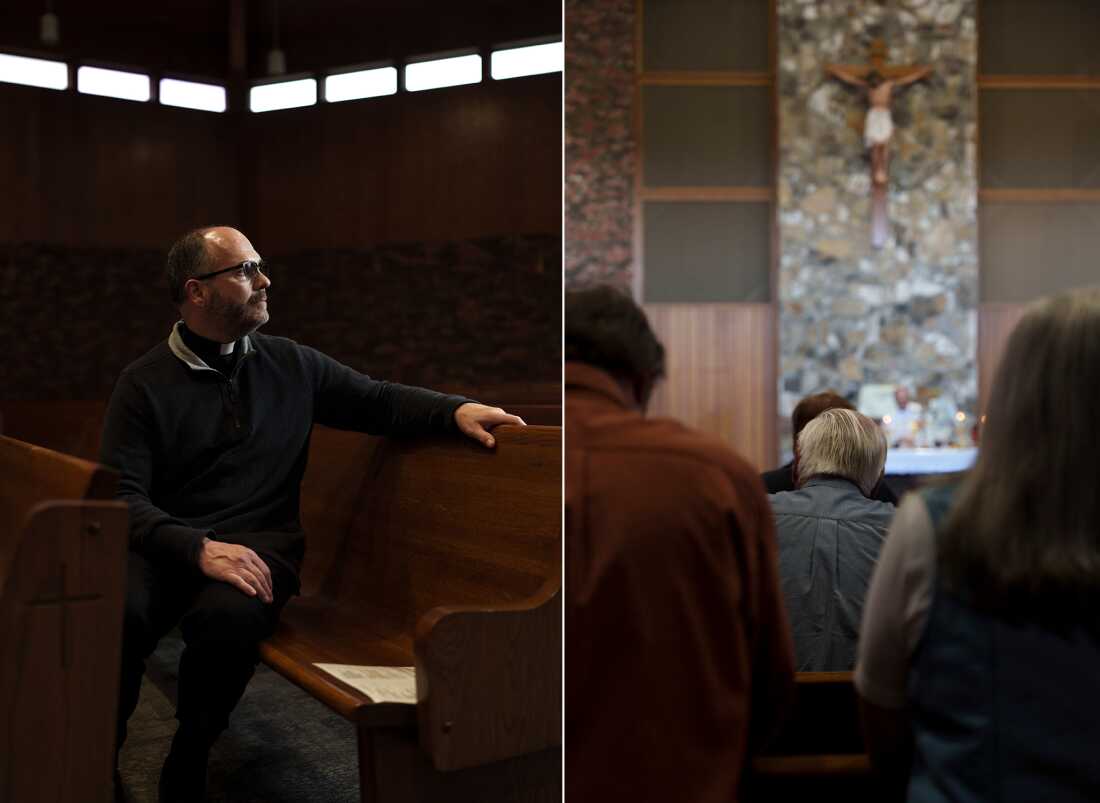
Benz poses for a portrait at the Sacred Heart Catholic Church in Glen Ullin on May 24.
Tim Evans for NPR/
hide caption
toggle caption
Tim Evans for NPR/
Rural towns are often celebrated for their tight-knit communities and close bonds between neighbors. But even in areas where that holds true — like Glen Ullin — they face unique barriers to social connection, like distance, neighbors moving away and few opportunities to gather. According to the University of Minnesota Rural Health Research Center, older adults in rural areas report being lonelier than their counterparts in urban areas.
Loneliness can have detrimental effects on physical health, including increased risk of heart disease, stroke and dementia, according to a report from the U.S. surgeon general.

Benz bids farewell to Viola Weinhardt, 94, at her home in Glen Ullin on May 24.
Tim Evans for NPR/
hide caption
toggle caption
Tim Evans for NPR/
Benz, who leads three congregations in neighboring counties, sees the need firsthand. It’s why home visits are important to him. On top of daily Mass and confessionals and leading the youth ministry, Benz rarely misses a home visit or room visits with nursing home residents.
“These people — it’s not just a euphemism — they become part of my family,” he said.

Benz greets parishioners after a Saturday afternoon Mass at the Sacred Heart Catholic Church on May 24. Benz leads three congregations in neighboring counties but says he rarely misses a home visit.
Tim Evans for NPR/
hide caption
toggle caption
Tim Evans for NPR/
This story was supported by the Pulitzer Center on Crisis Reporting.

News
Family-owned company prepares to put on the largest fireworks display in history: “It is the biggest show that we’ve ever done”

Washington — There are fireworks, and then there’s what’s in store for Saturday in Washington, D.C.
When the sun goes down on Independence Day, the skies of Washington are expected to fill with a record-setting 850,000 individual fireworks for a 40-minute spectacle like no one has seen before.
A company called Pyrotecnico will attempt the biggest fireworks show in history, using five generations of family know-how and a background in Super Bowls and large musical acts to help America celebrate its 250th birthday with a bang.
“I mean, it is the biggest show that we’ve done,” Rocco Vitale, president of Pyrotecnico, told CBS News. “…My earliest memories of fireworks displays and doing the Fourth of July was here.”
Pyrotecnico has been planning this year’s show since January, using computers to simulate the display. But now it’s time for the real thing.
Vitale gave CBS News an exclusive look at his not-so-secret weapons: eight barges out on the Potomac River, each one ready to light up the night sky.
“Each firing location has a communication device, and its all set on GPS. And once the time of the show is put into the system, it goes at that time,” Vitale explained.
According to Freedom 250, the organizer of the “Salute to America 250 Celebration & Fireworks” on the National Mall, President Trump will deliver remarks at 9:45 p.m. Eastern Time, and the fireworks display will get underway at 10:45 p.m. The event is expected to draw hundreds of thousands of people.
Join CBS for “The Great American Block Party 250,” a primetime special on Saturday, July 4, hosted by CBS Evening News anchor Tony Dokoupil and Entertainment Tonight’s Nischelle Turner, featuring live musical performances, celebrations around the country, and the largest fireworks show in history in the skies over the nation’s capital. Tune in July 4 at 8 p.m. ET on CBS and stream it on Paramount+ and CBS News 24/7.

A national physician staffing firm tried to take over the contract held by Eugene Emergency Physicians to work in local hospitals. The local physicians used a new state law to oppose the move.
sorbetto/Digital Vision Vectors/Getty Images
hide caption
toggle caption
sorbetto/Digital Vision Vectors/Getty Images
For the latest stories on the science of healthy living, subscribe to NPR’s Health newsletter.
In between shifts in the emergency room, Dr. Dan McGee was in an Oregon courtroom. He was fighting for his practice — Eugene Emergency Physicians (EEP). The group of more than 40 doctors and physician assistants work at multiple emergency departments; it was being replaced by a national company.
“This was big time, David and Goliath stuff,” McGee said. “You see 14 of their lawyers sitting there and you see three of ours.”
Those lawyers argued that ApolloMD, the national company, violated Oregon’s corporate practice of medicine law. The 2025 law bans corporations from taking control of a medical practice’s operations and finances.
The case garnered national interest because Oregon’s new law targets the loopholes large staffing firms have been employing to circumvent state corporate medicine laws.

Money for control
Most states have laws requiring that doctors own medical practices, not corporations. These rules aim to put patient interests ahead of profit motives. Over the last several years, companies have used a model where a doctor technically owns the local practice, but as Erin Fuse Brown, a professor at Brown University, explains, those physician owners are often not involved in care and cede hiring, firing and other operational functions to the corporation.
Fuse Brown said these arrangements are attractive to hospitals because these companies often promise more revenue and take over the responsibilities that come with running an ER.
“There’s worry that these investors or these corporate management companies should not be totally controlling the operations and the clinical decisions of those who are trained to deliver patient care,” Fuse Brown said.
The connection to patient care concerned Dr. Jonas Pologe, who works for Eugene Emergency Physicians, in the Eugene, Ore., area. ApolloMD offered local doctors jobs, but Pologe worried that if he pushed back on decisions ApolloMD made, he could lose work hours.
“There’s certainly a chance that if you make enough of a stink, you think that something needs to change, they can just stop giving you shifts,” said Pologe.

ApolloMD’s CEO, Dr. Yogin Patel, said the group doesn’t infringe on the way its doctors practice. He says the company is being unfairly lumped in with broader concerns over physicians’ feelings of disempowerment at the hands of corporate medical takeovers.
A closely watched experiment
Fuse Brown, policy experts and independent physicians theorized that updating state corporate medicine laws could be a fix to limit the control management companies can exert over medical doctors.
Oregon’s the first state to try this, and the case brought by the Eugene doctors group is the first test of that law. McGee, who leads the Eugene physicians group, says colleagues at other hospitals around the state were literally tuning in to their case.
“You could hear it almost like background music on an elevator,” McGee says he was told. “At key moments, all of a sudden the nurses would break out in a cheer.”
Before any ruling, the hospital system dropped its plan to work with ApolloMD and struck a deal to stick with McGee’s local group of doctors.
“This is a big victory for independent physician groups over corporate medicine,” McGee said. “This is a game changer.”
The American Academy of Emergency Medicine (AAEM) supported the Eugene doctors as part of the organization’s strategy to protect independent practices. The AAEM president, Dr. Vicki Norton, said Oregon has the strongest law in the country.
“This signals that that law works and we need it replicated in other states to really strengthen their corporate practice laws,” said Norton.
California and Vermont have passed similar legislation to Oregon, and lawmakers in other states, including Rhode Island and New Mexico, are considering related bills.
In Virginia, an independent group of ER doctors who were replaced by a large staffing firm is meeting with state legislators to try to change their laws.
Impact on Oregon physicians
Back in Oregon, the open question is about how the law may impact the physician practice market.
A few of the largest companies, Envision Healthcare, TeamHealth and USACS, declined to answer NPR’s questions about whether this case or the new law changed their outlook on investing in Oregon practices.
Opponents of the legislation warned lawmakers that many physician groups depend on outside investment to survive.

In an exclusive interview with CBS News on Thursday, Treasury Secretary Scott Bessent said he doesn’t believe the recent disclosure of President Trump’s billions in crypto earnings is problematic for the president.
“I don’t think there’s an appearance problem,” Bessent told CBS News anchor and MoneyWatch correspondent Kelly O’Grady regarding Mr. Trump’s earnings.
According to a financial disclosure released earlier this week, Mr. Trump has earned approximately $1.4 billion from his crypto ventures since beginning his second term. Those include his “meme coin” $TRUMP and earnings from World Liberty Financial, a cryptocurrency company backed by the president and his family.
Congressional Democrats have criticized Mr. Trump’s crypto windfall, arguing it presents a conflict of interest since his administration has sought to loosen regulations on cryptocurrency.
“This is an innovation presidency,” Bessent told CBS News. “So whether it’s digital access, whether it’s AI, whether it’s everything that is going on in the tech ecosystem that, you know, all Americans are benefiting from that.”
White House spokesperson Anna Kelly told CBS News on Tuesday that “there are no conflicts of interest” in the disclosure.
In his interview with CBS News, Bessent also touched on the latest developments with the tax-deferred Trump Accounts and his outlook for the U.S. economy as it grapples with the impacts of the Iran war.
Economic relief is coming for American families, Bessent believes
The Treasury secretary said his message to Americans who are experiencing strain at the grocery store and at the pump wrought by the Iran war is that “we’re going to get to the other side of this.”
Since the war began in late February, halts to shipping traffic in the critical Strait of Hormuz, which handles roughly 20% of the world’s global oil supply, have led to rising gas prices, which have in turn accelerated inflation and raised costs more broadly. In May, the annual inflation rate rose to 4.2%, according to the Labor Department, its highest level since April 2023.
The average price of a gallon of regular gasoline on Thursday was $3.83, according to AAA. At the height of the war, gas prices topped $4.50 a gallon, but have steadily declined in recent weeks as oil prices return to near prewar levels and the U.S. and Iran negotiate over a more permanent end to the war.
Bessent said he is hopeful that the average drops to $3 a gallon by Labor Day.
“Gasoline prices are a little stickier on the way down,” Bessent said. “We’re trying to give the gasoline retailers a little bit of a nudge. We’re telling them we’re watching them. We’ve had some good uptake from some of the bigger retailers from some of the bigger retailers in terms of what they want to do for consumers.”
Thursday’s jobs report from the Bureau of Labor Statistics showed that U.S. employers added 57,000 jobs in June, far below what economists had predicted, but the unemployment rate held steady, dipping slightly to 4.2% from 4.3% the month before. However, the report found that annual wage growth was 3.5%, below the rate of inflation.
Bessent described the discrepancy between wage gains and inflation as a “short-term spike,” and said he expects to see oil and energy prices continue to drop.
“I would expect, perhaps, as soon as this month, we’re going to see real wage gains,” Bessent said.
Asked whether the stock market’s strong performance in recent months, or the real-world pressure facing many Americans, is a more realistic view of the state of the U.S. economy, Bessent said he believes the market’s strong performance will be predictive of the direction the economy takes.
“The stock market lives in the future. So what the stock market is telling us is, presumably, what I am saying today, that we’ll get to the other side of this,” Bessent said. “Rates will come down and then we will be back up to real wage gain. So both can be true.”
Trump Accounts a tool to create “financial literacy,” Bessent says
The White House announced this week that beginning on July 4, Americans can begin contributing to Trump Accounts, a federal program launched earlier this year designed to help children under 18 invest money in the stock market and build savings before they reach adulthood, similar to how adults save for retirement.
“Thirty-eight percent of American households have no investment in our great equity markets, and we want everyone to share, you know, in the bounty that is the U.S.,” Bessent said. “In our innovation and our capital markets, and, you know, the economic engine, greatest in the history of the world. So, you know, over time, I would think that that 38% number would move toward zero. And then the other thing too is financial literacy.”
According to Bessent, more than 6 million Trump Accounts have been opened so far, and there are approximately 70 million children in the U.S. eligible for them.
On July 4, the federal government will begin contributing $1,000 to accounts for eligible children who are born between Jan. 1, 2025, and Dec. 31, 2028. The Trump Accounts were part of the White House’s “big, beautiful bill” legislation passed last year.
Bessent noted how wealthy philanthropists, organizations and states can also donate to the accounts, even by contributing public stock. Last year, Michael Dell, who founded Dell Technologies, and his wife Susan Dell announced they would donate $6.25 billion to the accounts, or $250 per person.
“I would expect that we are going to see, again from these philanthropic families and institutions and companies, I would expect that we would see the lower-income profile families, actually the accounts will be topped up more,” Bessent said.
Bessent said the accounts could also build throughout adulthood and be rolled into an individual retirement account.
“We want them to really understand the power of long-term compounding,” Bessent said of the families who take part in the program. “That you’ll own a share of a company, that many people have – bank deposits. They’re used to getting interest, they’re used to paying interest. So what we want them to understand is, what does a piece of the action feel like?”
-

 Movie Reviews9 minutes ago
Movie Review: ‘Minions & Monsters’ is a very yellow mash note to Hollywood – Sentinel Colorado
-

 World24 minutes ago
Dear Americans, How Well Do You Know Canada?
-
 Lifestyle1 hour ago
After weeks of speculation, Taylor Swift, Travis Kelce wed in New York
-

 Technology1 hour ago
While you’re watching the World Cup, the feds may be watching you
-

 World1 hour ago
Conservative Keiko Fujimori officially declared winner of Peru’s presidential runoff election
-

 Politics1 hour ago
Trump hails America as ‘most exceptional nation ever to exist’ in Mount Rushmore speech
-

 Health1 hour ago
Scientists discover possible link between 9/11 and accelerated aging
-

 Sports2 hours ago
Messi, Argentina avoid a shocking upset in wild knockout stage match against Cape Verde

