News
Harris, Walz holding campaign event in Detroit: How to watch


DETROIT (FOX 9) – Vice President Kamala Harris and her running mate, Minnesota Gov. Tim Walz, will hold a campaign event in Detroit, the day after they held a rally in Detroit.
How to watch
Harris and Walz are expected to deliver remarks at 2:10 p.m. CT. You can watch this live in the player above, on FOX LOCAL and on FOX 9’s YouTube channel.
Dig deeper
Harris and Walz are on a battleground state tour this week. They visited Philadelphia on Tuesday, where they kicked off their campaign together, before traveling to Eau Claire, Wisconsin, and Detroit on Wednesday.
They will then head to Phoenix on Thursday evening for another campaign event. You can watch that event here.
JD Vance, Harris, Walz hold rallies in Eau Claire
JD Vance held a campaign event inside an Eau Claire factory while Vice President Kamala Harris and Minnesota Gov. Tim Walz rallied at an outdoor venue in the city’s event district.



The Justice Department has fired at least four prosecutors who were involved in prosecutions under the FACE Act during the Biden administration, a government official familiar with the firings told CBS News.
Among those fired Monday is Sanjay Patel, a longtime federal prosecutor in the Civil Rights Division’s criminal section who was placed on administrative leave last month, sources told CBS News at the time. The terminations occurred at about the same time a report on the FACE Act and the Biden Justice Department was being finalized.
Congress passed the FACE Act in 1994 to address rising concerns about threats and intimidation that women were facing at reproductive health clinics. Nonviolent and first-time offenses of the law are misdemeanors, while repeat offenses or violations that result in bodily injury or death can be treated as felonies.
The FACE Act report is being drafted by the Justice Department’s “weaponization working group,” established in the first days of former Attorney General Pam Bondi’s tenure.
A Justice Department spokesperson said in a statement that the department “has terminated the employment of personnel responsible for weaponizing the FACE Act who still remained at the department.”
The Trump administration has repeatedly alleged without citing evidence that the Civil Rights Division under former Attorney General Merrick Garland used the Act to intentionally target conservative Christians who are morally opposed to abortion.
Although the Justice Department also pursued criminal charges against abortion rights activists who were accused of trying to scare volunteers and workers at a crisis pregnancy clinic that counseled on alternatives to abortion, excerpts of a draft the report reviewed by CBS News said the total number of such cases were minimal compared to those targeting conservative anti-abortion Christians.
Early in his second term, President Trump pardoned many of the FACE Act defendants convicted during the Biden administration. The Justice Department also dismissed several other FACE Act cases and ordered prosecutors to put the brakes on future FACE Act investigations.
At the same time, however, the current Justice Department has allowed the remaining FACE Act cases involving abortion rights activists to proceed without interference, with one Florida-based defendant receiving a 120-day prison term in March 2025.
Many of the other former federal prosecutors who handled FACE Act cases have since left the Justice Department.
MS NOW was first to report that Patel had been placed on administrative leave.

Izzy Johnson, left, and Jack Beatson are first-year students at Sterling College in Craftsbury Common, Vt. The college has announced that it will close at the end of this semester.
Oliver Parini for The Hechinger Report
hide caption
toggle caption
Oliver Parini for The Hechinger Report
CRAFTSBURY COMMON, Vt. — More than a dozen newborn lambs cavorted around a fenced-in yard beneath the scrutiny of their mothers and a few watchful students taking turns attending to them.
The lambs’ successful births have been a needed bright spot at tiny Sterling College, which uses a 130-acre farm to teach agriculture and other disciplines in a part of northeastern Vermont so isolated there’s no cell service and it’s rare to see a passing car.
LillyAnne Keeley, a senior, likes that remoteness. “We have a beautiful view,” said Keeley, in the barn where she’s come for her turn checking on the lambs. “There are beautiful sunsets here. I kind of take it for granted every day.”

She and her classmates have started taking such experiences less for granted now, since Sterling has announced that it will close in May at the end of this semester.
They’re not the last students around the country who will suffer such disruption. A new estimate projects that 442 of the nation’s 1,700 private, nonprofit four-year colleges and universities, with a combined 670,000 students, are at risk of closing or having to merge within the next 10 years.

LillyAnne Keely holds a newborn lamb in the barn at Sterling College, which focuses on agriculture and related disciplines.
Oliver Parini for The Hechinger Report
hide caption
toggle caption
Oliver Parini for The Hechinger Report
More than 120 institutions are at the very highest risk, according to the forecast by Huron Consulting Group, which helps clients in industries including higher education formulate business strategies. For its assessment, the company analyzed enrollment trends, tuition revenue, assets, debt, cash on hand and other measures.
Many are, like Sterling, small and rural. “Now that this might be gone, I just really worry about some students out there that are going to have less and less choices,” Keeley said.
It’s a crisis whose magnitude has been overshadowed by political and culture-war attacks on higher education and is propelled by the simple law of supply and demand after a long decline in the number of Americans who are going to college.
“We have too many seats. We have too many classrooms,” Peter Stokes, a managing director at Huron, said of U.S. colleges and universities. “So over the coming five to 10 years, this shakeout is going to take place.”
Sterling — the seventh private college in Vermont to close since 2016 — offers a rare glimpse into the human impact of this trend. That’s because it gave students a final semester to stay and complete their degrees or transfer, rather than locking the doors with hardly any notice, as many other colleges have done.
Fewer than half of students at colleges that close continue their educations, according to the most comprehensive study of the issue, produced by the State Higher Education Executive Officers Association, or SHEEO. Of those who do, many lose credits they’ve already earned and paid for, and fewer than half eventually earn degrees.
Twenty-year-old Izzy Johnson has already been buffeted by this. The college he originally wanted to attend closed the month before he graduated from high school. So he enrolled as a freshman in the fall at Sterling — only to learn a few months later that it would also close.

Student Lew Collet works on his tractor skills at Sterling.
Oliver Parini for The Hechinger Report
hide caption
toggle caption
Oliver Parini for The Hechinger Report
“Having to pick up everything and find a new place to settle down is really miserable,” said Johnson, who studies agricultural and food systems — the process by which food is produced and consumed — and is weighing where to go next.
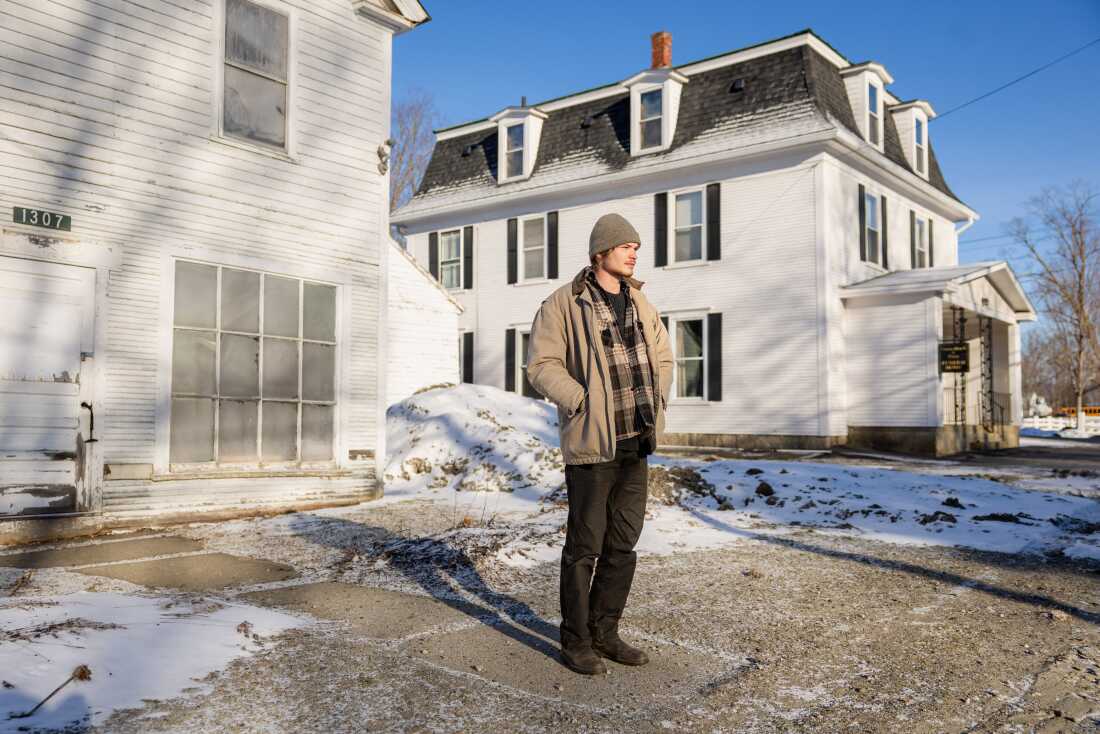
Started in 1958 as a prep school for boys, the remote rural college was never very large. Its enrollment peaked at 120 and fell to about 40 students this year, spread around a few white clapboard buildings indistinguishable from the houses of the surrounding farm town of about 1,300 people.
Those numbers weren’t sustainable, even at one of the nation’s nine so-called “work colleges,” whose undergraduates combine work and learning. At Sterling, they do this by pitching in on the farm and in the dorms and kitchen, said the college’s president, Scott Thomas. Though financial documents show Sterling had been breaking even, margins were thin.
In its last semester, the campus appeared surprisingly upbeat. At a weekly community meeting, students, faculty and staff lugged tables to the edge of the dining hall and formed a circle to talk about routine business, including warnings of bears coming out of hibernation and a reminder to provide contact information so everyone could stay in touch after commencement in May.
Students have decided “that we’re just going to have a really good last semester and go out on a really positive note,” said Keeley. Like several of her classmates, she is cramming to earn the credits needed to graduate this spring. “And I feel like we’ve been really able to do that so far, but it’s still really sad.”
Most said they were drawn here precisely because of the college’s small size and far-flung location.
“I don’t think I would have done well at a big, traditional college,” said Jack Beatson, a first-year student from California. “I just sort of get freaked out in a big space like that.”
As more small colleges close, said Keeley, it’s getting harder for students to find this kind of an alternative to what she called “the larger, monotonous type of education.”
Impact on the community
People around town are equally concerned — not only for the loss of jobs and spending, but an end to the pipeline through which many graduates have stayed to work or start businesses of their own.
“We always joke that Sterling kids stick around. But it’s true, they do, and they contribute to the community,” said Liz Chadwick, who moved from New Jersey in 2013 to finish her bachelor’s degree at the college, where she now teaches food systems. “They build families here.”
Losing colleges like Sterling “leaves craters in the small rural communities that they have been a part of for, in some instances, decades or a century,” said Thomas.

Liz Chadwick came to Sterling College as a student and, like many alumni, settled in the area; she now teaches food systems at the college. Graduates “build families here,” she says.
Oliver Parini for The Hechinger Report
hide caption
toggle caption
Oliver Parini for The Hechinger Report
There are about 3,700 two- and four-year public and private degree-granting colleges and universities in the United States. That’s already down from a peak of 4,726 in 2012. Almost all that have closed since then were private, for-profit schools, which enjoyed a brief boom before crashing under the weight of consumer discontent and increased regulation.
Many converging reasons explain why private, nonprofit colleges and universities, too, are now under existential strain.
There are already 2.3 million fewer students than there were in 2010. A drop in the birthrate that began around the same time means there is about to be a further downward slide in the number of 18-year-olds through at least 2041.
Among the other factors:
- The proportion of high school graduates who go on to college is also down, from 70% in 2016 to 61% in 2023, the most recent year for which the figure is available.
- The number of visas issued for new full-tuition-paying international students coming to the United States plummeted by nearly 100,000 this year, or 36%.
- And looming caps on federal loans for graduate study, which take effect in July, threaten to reduce demand for yet another crucial revenue source.
While higher education institutions previously weathered short-lived declines in enrollment and increases in costs, today “every major revenue stream and expense category is under pressure at the same time,” the higher education consulting firm EAB warns in a new analysis.
Eighty-six percent of college and university leaders are worried about their schools’ long-term financial viability, according to a survey in December by the American Council on Education, the principal industry association. A fifth of college and university presidents say they’ve had serious discussions about merging with another university or college, a separate survey by Hanover Research and the industry news site Inside Higher Ed found.
Signs of strain are spreading
And nearly a third of private, nonprofit colleges and universities nationwide posted deficits in 2024, according to research by Robert Kelchen, director of the Department of Educational Leadership and Policy Studies at the University of Tennessee, Knoxville.
And it’s not just small schools that are affected.
Even public universities and colleges are facing deepening financial problems, reports the Fitch bond-rating agency, citing slowing economic growth and federal policy changes.
The University of Southern California has sent pink slips to more than 900 employees. Stanford University, Northwestern University, and Depaul University have also seen layoffs.
And, as part of what its president called a “broader strategy to strengthen GW’s long-term financial health,” George Washington University announced in March that it had sold a satellite science and technology campus in Virginia for what the student newspaper reported was $427 million.
Community colleges, too — which enroll nearly 5.6 million students — are suffering financial squeezes that leave them less able to adapt or respond to change, according to Daniel Greenstein, former chancellor of the Pennsylvania State System of Higher Education, who now tracks financial exposure in the industry.
In the case of community colleges, wrote Greenstein, “The risk is not a sudden collapse of the sector. The risk is a slow erosion of capacity in precisely the institutions on which communities rely most.”
Still, after two and a half decades in which the price of tuition has increased faster than inflation, for a payoff many consumers no longer think is worth the money, higher education often gets little sympathy for its predicament — and even less after years of political and culture war attacks on the ideological leanings of faculty and leadership.
“Free market wins!” quipped one commenter on social media, in response to Sterling College’s announcement that it would close. “They woked themselves right out of business,” wrote another. Added a third: “Now where will they teach all the 20 year olds to protest and whine?”
Among its students, however, Sterling elicits something increasingly rare among higher education institutions: gratitude.
“I’m so glad I got to spend at least a year here,” said first-year student Jack Beatson. “Just feeling like you’re really part of something, and other people depend on you — that’s very important to young people especially, and today especially.”
Samuel Stover goes to Sterling College, which his mother also attended. He likes the size of the small school, where he has teachers “who I feel like I really connect with on a deeper level than just, ‘I’m a student and I hand in papers.’”
Oliver Parini for The Hechinger Report
hide caption
toggle caption
Oliver Parini for The Hechinger Report
Beatson is transferring to another small college in upstate New York. But even after Sterling closes, he said, “We’ll all take this place with us, wherever we end up.”
This story was produced by The Hechinger Report, a nonprofit, independent news organization focused on inequality and innovation in education. Contact writer Jon Marcus at 212-678-7556, jmarcus@hechingerreport.org or jpm.82 on Signal.

WASHINGTON (AP) — Fellow Democrats are abandoning Eric Swalwell’s campaign for California governor in droves after allegations surfaced that he sexually assaulted a former staffer, with a growing number urging the congressman both to quit the race and resign his seat in Congress.
Swalwell has denied the allegations, which he has said “are absolutely false.” They surfaced after he became a leading contender in the race for California governor to replace outgoing Democratic Gov. Gavin Newsom.
Over the weekend, with Swalwell’s gubernatorial campaign already teetering, Democrats in Congress began to call for his resignation from the House. Some even said they would support the rare step of expelling him should he refuse to step aside.
Fellow California Reps. Jared Huffman, Ro Khanna and Sam Liccardo said Swalwell should resign, as did Reps. Teresa Leger Fernández of New Mexico and Pramila Jayapal of Washington state.
“This is not a partisan issue,” Jayapal said Sunday. “This cuts across party lines. And it is depravity of the way that women have been treated.”
Swalwell’s gubernatorial campaign did not immediately respond to an email from The Associated Press seeking comment
It all added to the mounting political pressure on Swalwell, who has already seen his most prominent supporters, including Sen. Adam Schiff and powerful labor unions, pull their endorsements and call for his exit from the race. Rep. Jimmy Gomez, D-Calif., who helped run Swalwell’s campaign, said he was immediately ending his role.
With the House returning to session Tuesday, the question of whether to expel Swalwell could come to a head quickly. Rep. Anna Paulina Luna, R-Fla., said Saturday that she would be filing a motion to start the process.
Expulsion votes in the House are rare and require a two-thirds majority, but there is recent precedent for taking the step. Republican George Santos of New York in 2023 became just the sixth member in House history to be ousted by colleagues for his conduct.
Huffman, Jayapal and Leger Fernández said they would vote to expel Swalwell from the House, though they said they also support expelling Rep. Tony Gonzales, R-Texas, who admitted to an affair with a former staff member who later died by suicide.
Republican Rep. Byron Donalds of Florida, who is running his own campaign for governor, said both Swalwell and Gonzales “need to go home” and that he would vote to expel them both.
Khanna also indicated support for congressional action against both lawmakers.
“So, it depends on if it’s worded in a fair way,” Khanna said. “But this shouldn’t be about politics. Anyone who abuses young girls and staffers should not be in the United States Congress.”
The San Francisco Chronicle reported Friday about allegations that Swalwell sexually assaulted a woman in 2019 and 2024. The woman said she did not go to police at the time of the assaults because she was afraid she would not be believed.
The woman worked for Swalwell when the first alleged assault occurred in 2019, while the 2024 assault allegedly occurred at a charity gala, the Chronicle reported. In both cases the woman said she was too intoxicated to consent to sex.
The paper didn’t name the woman, and The Associated Press has not been able to independently verify her account and identity. Her lawyer declined to comment.
The alleged 2024 incident occurred in New York, and the Manhattan District Attorney’s Office said Saturday that it was investigating. That office urged anyone with knowledge to contact its special victims division.
After the allegations surfaced, Swalwell said Friday in a video on social media that he would spend the weekend with family and friends and share an update “very soon.” He is not running for reelection for his House seat.
“These allegations of sexual assault are flat false. They’re absolutely false. They did not happen, they have never happened, and I will fight them with everything that I have,” the congressman said.
Democratic Rep. Nancy Pelosi, the former House speaker who remains a dominant force in California politics, said the “serious allegations” must be investigated. She said she spoke to Swalwell and suggested that be done “outside of a gubernatorial campaign.”
House Democratic leader Hakeem Jeffries of New York and his leadership team also called for an investigation and for Swalwell to end his campaign for governor.
Jayapal and Donalds appeared on NBC’s “Meet the Press,” and Khanna was interviewed on “Fox News Sunday.”

Detroit Chinatown Vision Committee discusses Detroit Chinatown

Bay Area bike program pays commuters to ditch their cars

TxDOT Dallas Seeks Input on Proposed Widening of FM 740/FM 548

Man seriously hurt in Dorchester crash – Boston News, Weather, Sports | WHDH 7News

Historic 84-year-old Bonnie Brae gas station in Denver officially listed for sale by family

Florida High School Football Rankings: Top 25 teams – Oct. 21

How old is Bo Nix? What to know about Oregon quarterback ahead of 2024 NFL Draft

Cleary's 21 help Le Moyne down Central Connecticut State 69-64 in OT

99th annual Pony Swim held in Virginia

Indiana Members Credit Union announced as new anchor tenant at Bottleworks District

Embattled Rep Tony Gonzales announces plans to resign amid sexual misconduct allegations

UN experts slam attacks on Gaza shelters, forced displacement in West Bank

DOJ fires at least 4 prosecutors involved in FACE Act cases during Biden administration

Melania Trump’s Epstein remarks turn up the heat on DOJ, Acting AG Todd Blanche to do more
Newsletter: Cautious optimism in Brussels as Orbán ousted in landslide Hungarian opposition win
-

 Atlanta, GA1 week ago
1 teenage girl killed, another injured in shooting at Piedmont Park, police say
-

 Georgia7 days ago
Georgia House Special Runoff Election 2026 Live Results
-

 Arkansas4 days ago
Arkansas TV meteorologist Melinda Mayo retires after nearly four decades on air
-

 Pennsylvania1 week ago
Parents charged after toddler injured by wolf at Pennsylvania zoo
-
 Milwaukee, WI1 week ago
Potawatomi Casino Hotel evacuated after fire breaks out in rooftop HVAC system
-

 Technology1 week ago
Anthropic essentially bans OpenClaw from Claude by making subscribers pay extra
-

 Austin, TX6 days ago
ABC Kite Fest Returns to Austin for Annual Celebration – Austin Today
-

 World1 week ago
Zelenskyy warns US-Iran war could divert critical aid from Ukraine