News
Black Lives Matter Plaza Is Gone. Its Erasure Feels Symbolic.


This week, government workers near the White House, on two blocks lined with luxury hotels and union headquarters, used a jackhammer and a pickax to tear up a mural that read “Black Lives Matter,” painted on the road during the long hot summer of 2020.
The symbolism was potent.
The erasure of the bold yellow letters of Black Lives Matter Plaza, installed on 16th Street after the murder of George Floyd by a Minneapolis police officer, was a concession from Washington’s mayor, Muriel Bowser, who faced threats from congressional Republicans to cut off federal funds to the capital city if the words were not removed. But to Black Americans grappling with a fierce resurgence of forces that they believe are beating back the causes of social justice and civil rights, it felt like much more.
That plaza was “spiritual,” said Selwyn Jones, an uncle of Mr. Floyd. “But them taking the time to destroy it, that’s making a statement, man. That’s making a statement, like we don’t care.”
Even those who did not put much faith in the mural to begin with were taken aback.
“Bowser caving immediately to the faintest hint of pressure on the name of the plaza is somehow even more cynical than the move to name it Black Lives Matter Plaza in the first place,” said Olúfẹ́mi O. Táíwò, a Black associate professor of philosophy at Georgetown.
“We saw the largest protest movement in our nation’s history, a unique and powerful moment where it seemed anything was possible, and you had the numbers to do anything,” lamented Samuel Sinyangwe, executive director of the nonprofit Mapping Police Violence, without exaggeration.
The millions of dollars that flowed to groups with “Black Lives Matter” in their titles have slowed to a trickle, forcing some to retrench, others to close shop. The Black Lives Matter Foundation Inc., for instance, raised a staggering $79.6 million in fiscal year 2021. The next year, that figure was down to almost $8.5 million. By 2023, it was about $4.7 million, with expenses of $10.8 million, according to records tracked by the nonprofit journalism organization ProPublica.
As it recedes, Mr. Trump has sought to bury it. In two short months, his administration has moved to end diversity, equity and inclusion as goals of the federal government and pressured private industry to do the same. It shut down the National Law Enforcement Accountability Database, which tracked the misconduct records of federal law enforcement officers.
Words with even a hint of racial, ethnic or gender sensitivities are being struck from federal websites and documents. Just this week, the Environmental Protection Agency moved to eliminate offices responsible for addressing the disproportionately high levels of pollution facing poor communities, often with predominantly minority residents.
The billionaire White House adviser Elon Musk has even said pardoning George Floyd’s killer was “something to think about.”
Beyond Washington, journalists and academics who vaulted to stardom a half decade ago on their reinterpretations of history, their views on racism and their valorizing of the African American experience find themselves sometimes marginalized, and often under attack.
“I feel we are going backwards,” Mr. Jones said.
Given the swift change of circumstances, some in the Black Lives Matter movement say they must answer an existential question: How do they pursue racial justice amid so fierce a backlash?
“Folks got sold a bag of goods under this idea of racism and xenophobia,” said Addys Castillo, a social justice organizer and law student in Connecticut.
But, she said, the administration’s policies will hurt all those who aren’t wealthy, “so if there was ever a time to have a multiracial, cross cultural movement, this would be the time.”
James Forman Jr., a former public defender, an author and a fierce critic of the criminal justice system and its effects on people of color, said persuading all Americans that a system that has harmed Black Americans has harmed them too is difficult — but crucial.
“It’s always been hard to be able to get people to see two things at the same time: the ways in which these institutions disproportionately harm Black people, and the way that these institutions harm all people,” he said.
Ms. Bowser, who is Black, told laid-off federal workers earlier this month that the mural was a significant part of the city’s history, but circumstances have changed. “Now our focus is on making sure our residents and our economy survive,” she said.
Observers say the racial justice movement that crescendoed after Mr. Floyd, an unarmed Black man, was murdered by a Minneapolis police officer in May 2020 had some successes, at least in raising public awareness about structural racism and police violence.
Protesters and Black activists pressed people to evolve from support for civil rights as “mere etiquette” to “an understanding that actual institutions, political institutions, criminal justice institutions had to be challenged to work differently,” Mr. Táíwò said.
But the movement must mature, said Representative Wesley Bell, a Missouri Democrat who rose to prominence after the police shooting of a Black teenager, Michael Brown, in the St. Louis suburb of Ferguson. Mr. Bell, who is Black, defeated one of the most demonstrative Black progressives in the House, Cori Bush, in a heated primary last year, promising voters to bring Greater St. Louis a more sober, effective leadership.
“Some folks think it’s just about getting out and protesting,” said Mr. Bell, who advocates moving the social justice cause from the streets to the corridors of power. “The best protesters do not make the best politicians, and the best politicians don’t make the best protesters.”
Black Lives Matter began as an online hashtag after the 2013 acquittal of George Zimmerman in the shooting death of Trayvon Martin, an unarmed Black teenager. But the phrase coalesced into a movement after the killing of Michael Brown the following year.
From the beginning the phrase drew attacks.
“When you say ‘Black lives matter,’ that’s inherently racist,” the former New York City mayor Rudolph W. Giuliani said in 2016. “Black lives matter. White lives matter. Asian lives matter. Hispanic lives matter.”
Four years later, as he campaigned unsuccessfully for re-election, Mr. Trump accused supporters of Black Lives Matter of “spreading violence in our cities” and “hurting the Black community.”
But in the summer of 2020, millions of Americans took to the streets from all walks of life. Conservative voices, like the president of the Heritage Foundation and Mr. Trump’s former ambassador to the United Nations, Nikki Haley, lamented Mr. Floyd’s murder.
Some of the protests turned violent. A Minneapolis police station was burned to the ground. The calls for incremental police reform became drowned by the rallying cry, “defund the police.”
And that gave Mr. Trump his most potent line of attack against the movement. He reframed a cause that hoped to protect Black lives as a lawless assault on police officers. In his telling, the leaders of the movement were avatars for every left-wing cause in his sights.
Because of the Black Lives Matter movement’s decentralized structure, many groups were lumped together and faced intense scrutiny, often with negative consequences for the movement as a whole.
“Any strategic or tactical misstep for the movement is going to produce more severe and swift negative consequences,” Mr. Forman said.
The Black Lives Matter Global Network Foundation, for instance, faced criticism that it misused funds, including the purchase of a $6 million California home.
“I’m not particularly happy with the organization Black Lives Matter, because of their shenanigans,” said Mr. Jones.
“Black Lives Matter, they are not a perfect organization,” said Angela Harrison, an aunt of Mr. Floyd. “They probably made mistakes. Everyone makes mistakes. But their intention was for the good.”
But mistakes added up. The movement to examine historical ways racism has shaped current disparities in areas such as housing and wealth creation gave way to the opposite. Conservative activists successfully pushed state governments to ban teachings that they said made people feel inherently responsible for actions committed in the past.
Corporations that once made a show of racial, ethnic and gender sensitivities have begun rolling back their diversity initiatives, seemingly more afraid of the conservative activists fighting them than the social justice activists who had supported them, said Damon Hewitt, president and executive director of the Lawyers’ Committee for Civil Rights Under Law.
That, he said, “could certainly suggest that maybe the belief isn’t strongly held, but also more of a sense of resignation.”
Mr. Sinyangwe is taking a long view and sees parallels and patterns with many historical movements for social justice.
“This movement has followed the trajectory that freedom struggles in the United States have always tended to follow,” he said.
A marginalized community pushes back against injustice. Some of its demands are met, but others don’t materialize. So they push for more transformative changes only to be met with backlash. “And that’s sort of how America does business,” he said. “That’s not the fault of anyone’s slogan.”
In June 2020, after Mr. Trump marshaled federal law enforcement and the military to violently confront protesters outside the White House, Ms. Bowser announced that she was renaming a street just off the protest site “Black Lives Matter Plaza,” complete with 48-foot letters on the pavement.
The mayor’s decision to remove the letters with Mr. Trump’s return to power has been met with ambivalence. Some agree that Ms. Bowser has more pressing concerns, such as budget cuts and the slashing of the federal work force in her city.
“The painting ain’t saving any of us,” said Ms. Castillo.
Others are gearing up for a fight that will outlive any one presidency.
“I don’t believe we’ll ever be in a place where there won’t be a fight,” Mr. Bell said. “But I will say this — I don’t think that President Trump can stop progress either.”



By Hamed Aleaziz, Sutton Raphael, Thomas Vollkommer, Gilad Thaler, Whitney Shefte and Alexandra Ostasiewicz
March 27, 2026

Seth Bodnar, the former president of the University of Montana, is now running for Senate as an independent
Kirk Siegler/NPR
hide caption
toggle caption
Kirk Siegler/NPR
BUTTE, Mont. – It’s long been an adage in Montana politics that if you’re running for office, you’d better have a float in the Butte St. Paddy’s Day Parade, which draws thousands to the mining city’s historic uptown, soaking up the nostalgia – and the Guiness.
Here, you’re just steps from the towering old mining headframes and the one mile long and half mile wide Berkeley Pit. Now shuttered, it was once one of the world’s largest copper deposits.
Larry Carden, in a Notre Dame sweatshirt, never misses the parade.
“You’ll see a lot more boos for the Republicans than you will the Democrats, I can guarantee you that,” he says.
That’s a nod to Butte’s long history of Democratic politics and a strong labor movement going back to around 1900, when the “Copper King” mine owners ruled Montana business and media, and bribed their way into political office. Today, Carden, who’s retired, is worried that the mega rich are again influencing politics here, and how expensive life is in his home state.
“Between health care and gas and food, and you go to the store the other day, there’s rib steaks $19.99 a pound, you know,” Carden says.
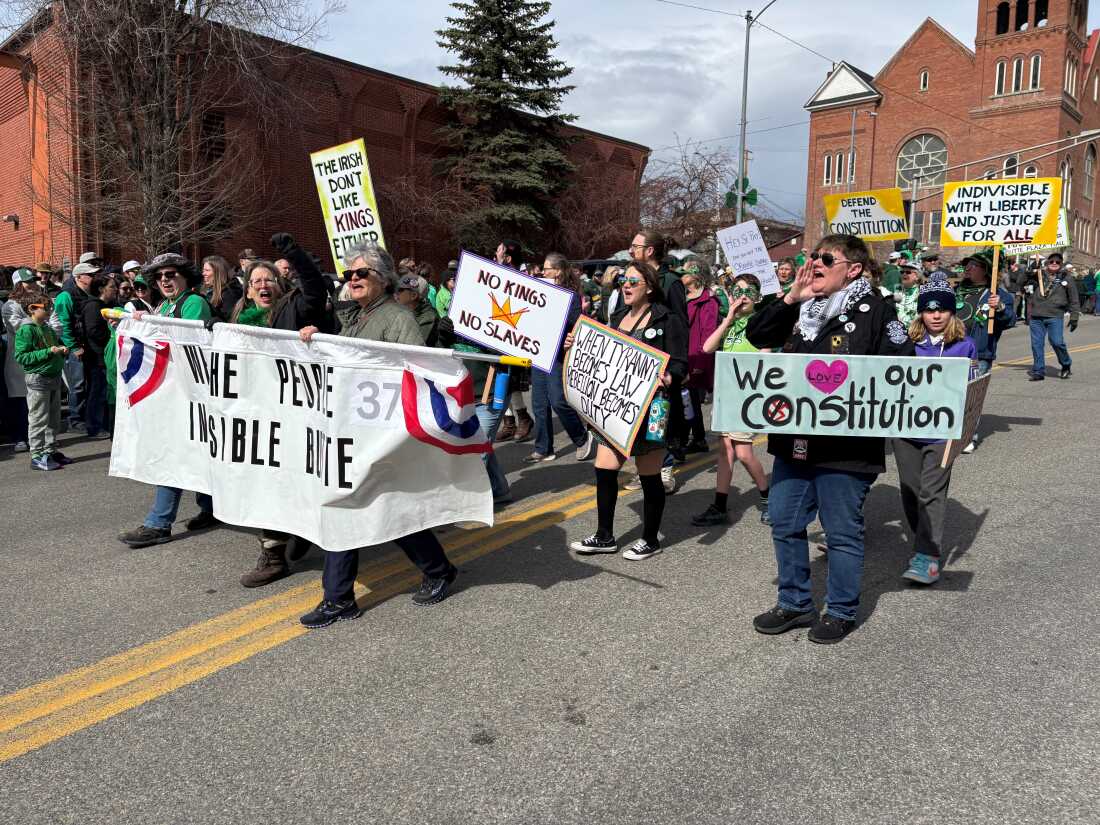
A political group marches in the St. Patrick’s Day parade in Butte, Montana, March 17 2026
Kirk Siegler/NPR
hide caption
toggle caption
Kirk Siegler/NPR
This year’s parade followed an unusually turbulent few days in Montana’s political scene – half of its congressional delegation abruptly retired. Despite the state’s recent tilt from purple to deep red, the races for their seats could be more in play now because of the way Senator Steve Daines and Congressman Ryan Zinke, both Republicans, gave up them up and chose their successors. In Daines’ case, he withdrew his candidacy just minutes before the filing deadline.
Like a lot of people in Butte, Carden is a longtime Democrat. But he says he’s grown disillusioned with party politics.
“I would rather everything be independent where there is no party designation and then you have to pay more attention to who the person actually is,” Carden says.
New Candidate opts to go independent
That’s exactly what Seth Bodnar, a former Green Beret running for U.S. Senate, is trying to capitalize on. He joined other candidates mixed in with Irish dancing troupes and fire department floats, as he walked the parade route along Park Street shaking the occasional hand and tossing candy.
In an interview with NPR earlier in Missoula, Bodnar, who recently resigned his post as University of Montana president, pitched what he says would be his bi-partisan appeal.
“I’m an independent,” Bondar says. “When I raised my right hand at the age of 18 and I swore an oath to this Constitution when I joined the military, not to a political party.”.
Person over party used to be the playbook in Montana, which some call just one long Main Street. It’s how former Senator Jon Tester used to win despite being a Democrat as the state got redder.
The day after Bodnar formally announced he was gathering signatures to get on the ballot, his long shot bid got taken a lot more seriously.
Sen. Steve Daines, who was elected to the Senate in 2014, sent shockwaves through the state’s political scene when he announced in a video posted to X that he’d decided not to seek reelection.
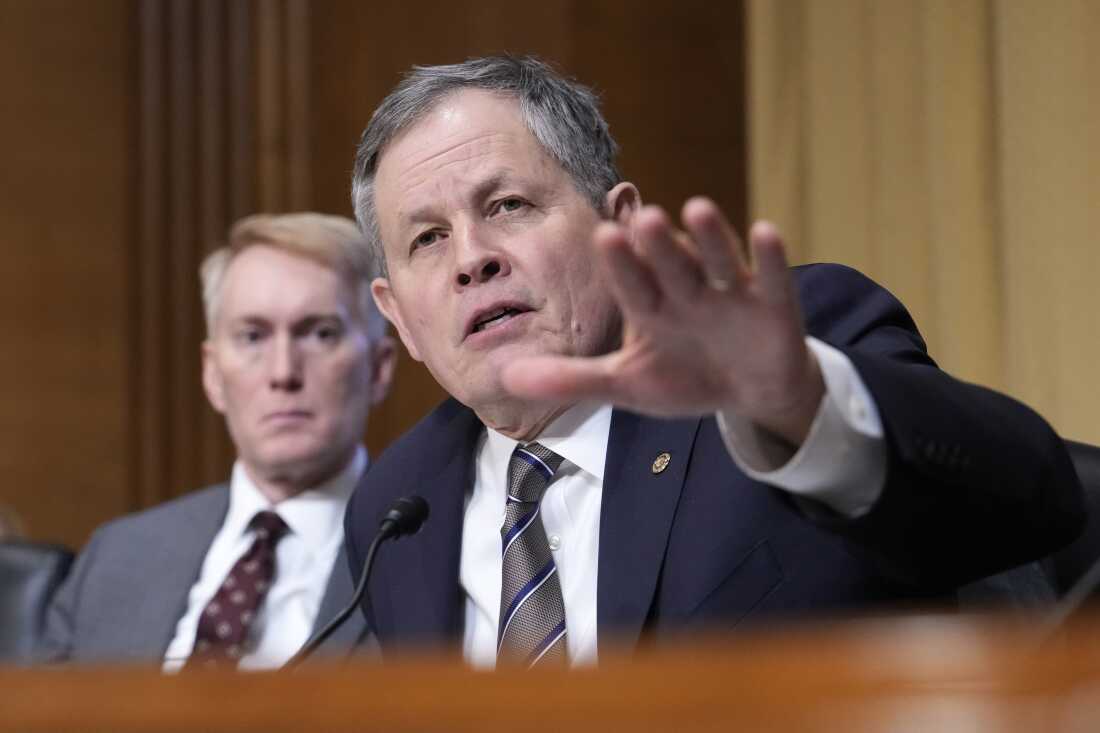
Sen. Steve Daines, R-Mont., speaks at the Senate Finance Committee confirmation hearing for Scott Bessent, President-elect Donald Trump’s choice to be Secretary of the Treasury, at the Capitol in Washington, Thursday, Jan. 16, 2025.
Ben Curtis/AP/AP
hide caption
toggle caption
Ben Curtis/AP/AP
“I’m also very thankful to have served alongside President Trump and my colleagues in the Senate,” Daines said in the video. “Together we built a conservative majority on the Supreme Court, we delivered the largest tax cut in U.S. history, we unleashed American energy dominance and secured our southern border.”
Daines’ late hour withdrawal presumably clears the way for his chosen successor, Kurt Alme, the U.S. Attorney for Montana until he declared his candidacy for Daines’ seat. Daines later said withdrawing earlier could have enticed a prominent Democrat like Tester to enter the race.
Independent Seth Bodnar says it reminds him of the Montana of old.
“We have direct election of senators in the United States in part because of political corruption in this state 125 years ago, Copper Kings trying to buy U.S. Senate seats,” Bodnar says. “That didn’t work back then and it’s not going to work right now.”
But Democrats say Bodnar’s entry as an independent will just split the liberal vote.
The GOP base is angry too
“Montanans are getting very indignant about what they see as out and out dishonesty,” says Roger Koopman, a former Republican legislator and Montana Public Service commissioner from Bozeman.
Koopman says the party establishment’s backroom dealing is a gift to Democrats and especially Seth Bodnar, who he says is a liberal running as an independent.
“They’re going to say, ‘hey, I’m over these Republicans playing games with me, you can’t do that and expect me to vote for you, I’m not going to vote Democrat, but here’s this guy out here who says he’s independent, let me give him a try,’” Koopman says.
Alme has been keeping a low profile. Political pundits say that might be by design. A campaign spokesperson sent NPR this statement: “Anyone could run for this seat. Kurt is running on his record as the Trump-endorsed candidate of common sense who knows how to be tough on violent crime, dismantle drug cartels, and deliver historic tax relief. Voters will decide, and Kurt is confident in his work serving Montana and helping President Trump put America First.”
At Montana State University, political science department chair Eric Austin says he expects party tensions will cool and Republicans will rally around their nominee by November.
“I think in part that speaks to the changes in the electorate in the state,” Austin says. “As the state has become more red, people have more strongly affiliated themselves with the Republican Party and less as independents.”
However, Austin says the midterms will be a referendum on President Trump and there’s growing economic anxiety in Montana. Farmers are getting hurt by Trump’s tariffs. His Iran War has sent fertilizer prices soaring, raised interest rates and the cost of gas.
Back in Butte, at the St. Paddy’s Day parade, longtime Democratic activist Evan Barrett says there’s a resurgence in populist resentment in Montana.

Longtime Montana Democratic party activist Evan Barrett at the St. Patrick’s Day parade in Butte, Montana, March 17 2026
Kirk Siegler/NPR
hide caption
toggle caption
Kirk Siegler/NPR
“It’s almost like a repetition of the past,” says Barrett, a one time economic aide to former Governor Brian Schweitzer.
Ducking into an old storefront to take a break from the spectacle of the parade, Barrett told NPR there’s a feeling in the electorate that a lot of outside money is coming into influence politics, but not staying in Montana and being invested into things like schools.
“So this is a really wild and different year,” Barrett says. “Anybody that tells you they know what’s gonna happen, well, be a bit skeptical.”
President Trump has endorsed last minute Senate candidate Kurt Alme but it’s not clear what kind of effect that might have on voters in November.

new video loaded: Savannah Guthrie Says She Believes Her Mother Was Taken for Ransom
transcript
transcript
Savannah Guthrie Says She Believes Her Mother Was Taken for Ransom
Savannah Guthrie spoke on the “Today” show in her first interview since her mother, Nancy Guthrie, was abducted from her home near Tuscon, Ariz.
-
“The ransom note, notes for ransom requests came. Did you believe those to be real?” “The two notes that we received that we responded to — I tend to believe those are real.” “Really?” “We still don’t know. Honestly, we don’t know anything. We don’t know anything. So I don’t know that it’s because she’s my mom. But yeah, that’s probably — which is too much to bear to think that I brought this to her bedside, that it’s because of me. And I just say, I’m so sorry, Mommy. I’m so sorry. We need answers. We cannot be at peace without knowing. And someone can do the right thing. And it is never too late to do the right thing.”
By Christina Kelso
March 26, 2026

Retired Detroit sergeant faces new sexual assault charge involving 14-year-old victim from 2002

Trump floats sending federal agents to San Francisco to tackle crime

Dallas ISD will offer free pre-K starting next school year

Norwegian Cruise Line offers a first look at Luna, new cruise ship setting sail from PortMiami – WSVN 7News | Miami News, Weather, Sports | Fort Lauderdale

Live: CPAC 2026 Day 2

Florida High School Football Rankings: Top 25 teams – Oct. 21

How old is Bo Nix? What to know about Oregon quarterback ahead of 2024 NFL Draft

Cleary's 21 help Le Moyne down Central Connecticut State 69-64 in OT

99th annual Pony Swim held in Virginia

Indiana Members Credit Union announced as new anchor tenant at Bottleworks District
Live: CPAC 2026 Day 2

Video: Will ICE Change Under Its New Leader?

DHS shutdown breakthrough comes at cost for Republicans as funding fights nears end

Rubio joins crucial G7 talks as Iran war set to dominate second day
A surprise resignation could open the door for an independent to win a Montana Senate seat
-

 Detroit, MI1 week ago
Drummer Brian Pastoria, longtime Detroit music advocate, dies at 68
-

 Science1 week ago
How a Melting Glacier in Antarctica Could Affect Tens of Millions Around the Globe
-

 Movie Reviews1 week ago
‘Youth’ Twitter review: Ken Karunaas impresses audiences; Suraj Venjaramoodu adds charm; music wins praise | – The Times of India
-

 Sports6 days ago
IOC addresses execution of 19-year-old Iranian wrestler Saleh Mohammadi
-

 New Mexico5 days ago
Clovis shooting leaves one dead, four injured
-
 Business1 week ago
Disney’s new CEO says his focus is on storytelling and creativity
-

 Technology5 days ago
YouTube job scam text: How to spot it fast
-

 Tennessee4 days ago
Tennessee Police Investigating Alleged Assault Involving ‘Reacher’ Star Alan Ritchson