News
How the federal government is painting immigrants as criminals on social media

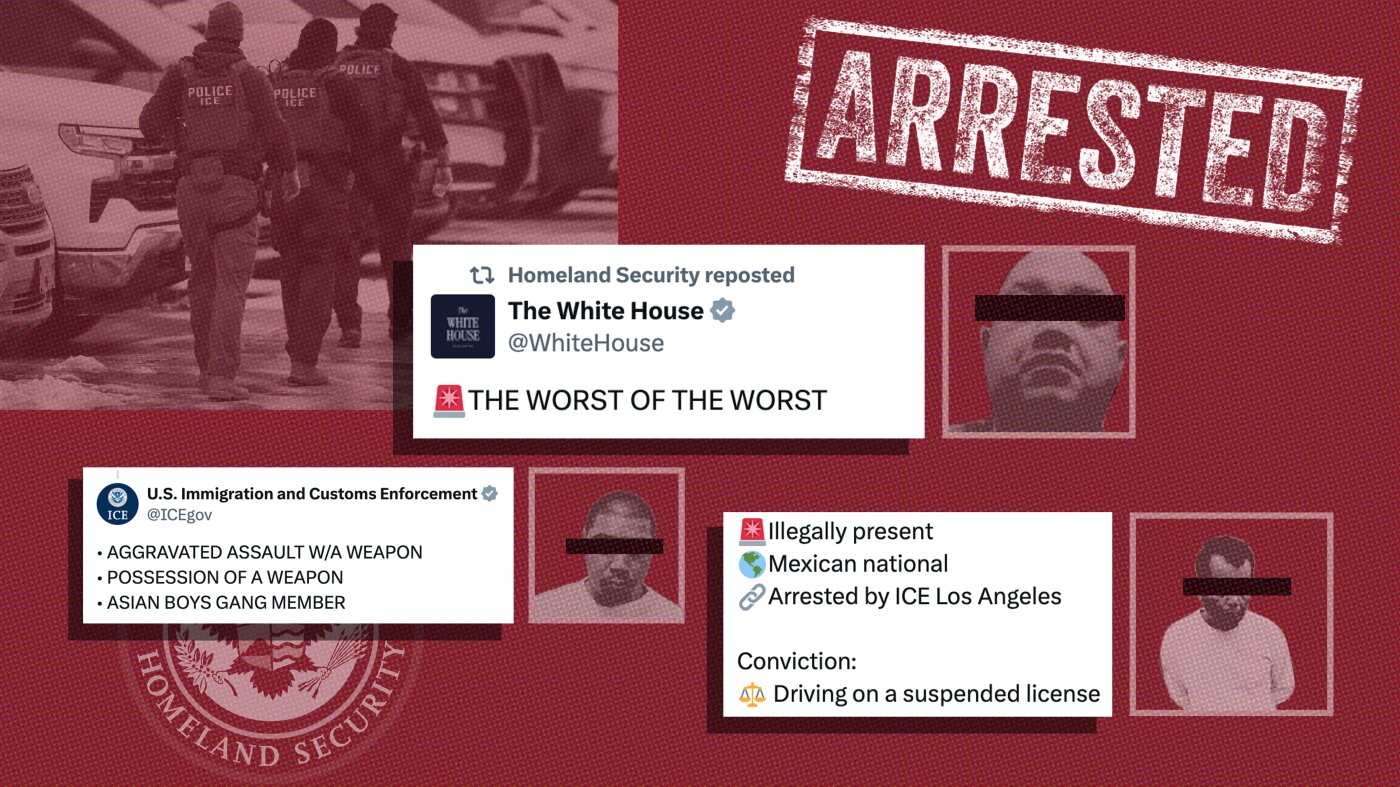
Getty Images, Dept. of Homeland Security and The White House via X/Collage by Emily Bogle/NPR
Two days after At Chandee, who goes by Ricky, was arrested by U.S. Immigration and Customs Enforcement, the White House’s X account posted about him, calling the 52-year-old the “WORST OF WORST” and a “CRIMINAL ILLEGAL ALIEN.”
Except that the photo the White House posted was of a different person. The post also incorrectly claimed Chandee had multiple felony convictions — he has one, for second-degree assault in 1993 when he was 18 years old. He shot two people in the legs and served three years in prison.

At “Ricky” Chandee with his wife, Tina Huynh-Chandee.
Via the Chandee family
hide caption
toggle caption
Via the Chandee family
Chandee, who came to the U.S. as a child refugee, was ordered to be deported back to his home country, Laos. But Laos had not been accepting all of the people the U.S. wanted it to, so the federal government determined that it was likely infeasible to deport him, his lawyer Linus Chan told NPR. Chandee therefore was granted permission to stay in the U.S. and work so long as he checked in with immigration authorities periodically. He has not missed a check-in in over 30 years and has not had another criminal incident.
People who know Chandee do not see him as “worst of the worst.”
After Chandee completed his prison sentence, he finished school and became an engineering technician. He worked for the City of Minneapolis for 26 years, became a father, and his son grew up to join the military.
In his free time, Chandee enjoys hiking and foraging for mushrooms, Minnesota Public Radio reported.
“We are proud to work alongside At ‘Ricky’ Chandee,” said Tim Sexton, Director of Public Works for the City of Minneapolis in a statement. “I don’t understand why he would be a target for removal now, why he was brutally detained and swiftly flown to Texas, or how his removal benefits our city or country.” Chandee is petitioning for his release in federal court.
Chandee’s case is not unique
Social media accounts from the White House, the Department of Homeland Security and other immigration agencies have spent much of the past year posting about people detained in the administration’s immigration crackdown, typically portraying them as hardened, violent criminals. That’s even as over 70% of the people detained don’t have criminal records according to ICE data.
NPR’s research of cases in Minnesota shows that while many of the people who have been highlighted on social media do have recent, serious criminal records, about a quarter are like Chandee, with decades-old convictions, minor offenses or only pending criminal proceedings. Scholars of immigration, media and criminal law say such a media campaign is unprecedented and paints a distorted picture of immigrants and crime.
A year into President Trump’s second term, the X accounts of DHS and ICE have posted about more than 2,000 people who were targets of mass deportation efforts. Starting late last March, DHS and ICE began posting on X on a near daily basis, often highlighting apprehensions of multiple people a day, an NPR review of government social media posts show.
Among the 2,000 people highlighted by the agencies, NPR identified 130 who were arrested by federal agents in Minnesota and tried to verify the government’s statements about their criminal histories.
In most of the social media posts, the government did not provide the state where the conviction occurred or the person’s age. Public court records do not tend to include photos so definitive identification can be a challenge.
NPR derived its findings from cases where it was able to locate a name and matching criminal history in the Minnesota court and detention system, in nationwide criminal history databases, sex offender databases, and in some cases, federal courts and other state courts.
In 19 of the 130 cases, roughly 1-in-7, public records show the most recent convictions were at least 20 years ago.
Seventeen of the 19 cases with old convictions did include violent crimes like homicide and first-degree sexual assault. ICE provided some of those names to Fox News as key examples of the agency’s accomplishments. “It’s the most disturbing list I’ve ever seen,” said Fox News reporter Bill Melugin on X, highlighting the criminal convictions of each person on the list.
For seven people, their only criminal history involved driving under the influence or disorderly conduct.

ICE agents approach a house before detaining two people in Minneapolis on Jan. 13.
Stephen Maturen/Getty Images
hide caption
toggle caption
Stephen Maturen/Getty Images
Six of the 130 Minnesota cases highlighted by the administration involved people with no criminal convictions. The government’s social media posts for those six instead rely upon the charges and arrests as evidence of their criminality, even though arrests don’t always lead to charges and charges can be dismissed.
In yet another case, the government highlighted a criminal charge even while noting it had been dismissed. (The person did have other existing convictions.)
For 37 of the 130 people, NPR was unable to confirm matching criminal history after consulting the databases and news coverage. Some of the names turned up no criminal history at all. The government said these people committed crimes ranging from homicide and assault to drug trafficking, and cited one by name to Fox News. NPR tried to reach out to all 37 people and their families for comment but did not receive a response from any.
In a statement to NPR, DHS’s chief spokesperson Lauren Bis did not dispute NPR’s findings or provide documentation where NPR wasn’t able to confirm matching criminal history.
“The fact that NPR is defending murderers and pedophiles is gross,” Bis wrote. “We hear far too much about criminals and not enough about their victims.” before listing four of the people with old convictions of homicide and sexual assault, underlining the date of deportation order for three of them.
Images designed to trigger emotion
The stream of social media posts with photos of mostly nonwhite people are meant to draw an emotional response, says Leo Chavez, an emeritus professor of anthropology at the University of California, Irvine. They “have been used repeatedly over and over to get people to buy into, really drastic, drastic and draconian actions and policies,” he said.
Chavez, whose most recent book is The Latino Threat: How Alarmist Rhetoric Misrepresents Immigrants, Citizens, and the Nation, recalls how political campaigns in past decades presented images of Latinos — often men — without context. “Just by showing their image, showing brown people, particularly brown men, it’s supposed to be scary.”
The fact that the government’s social media posts come with statements about criminal history as well as photos reinforces that emotional response, Chavez said. DHS has previously acknowledged inaccuracies on their website. But even if the department issues corrections, Chavez said, “the goal was actually achieved, which was to reinforce the criminality and the visualization.”
CNN’s analysis of DHS’s “Arrested: Worst of the Worst” website showed that for hundreds out of about 25,000 people posted on the website, the crimes listed were not violent felonies. Instead, DHS listed people with records that included traffic offenses, marijuana possession or illegal reentry. DHS said the website had a “glitch” that it will fix but also that the people in question “have [committed] additional crimes.”
“I’ve never seen anything like this when it comes to immigration enforcement in the modern era,” said Juliet Stumpf, a professor at Lewis & Clark Law School who studies the intersection of immigration and criminal law. She said the drumbeat of social media posts focused on specific individuals was like “FBI’s most wanted posters” or “like reality TV shows.”
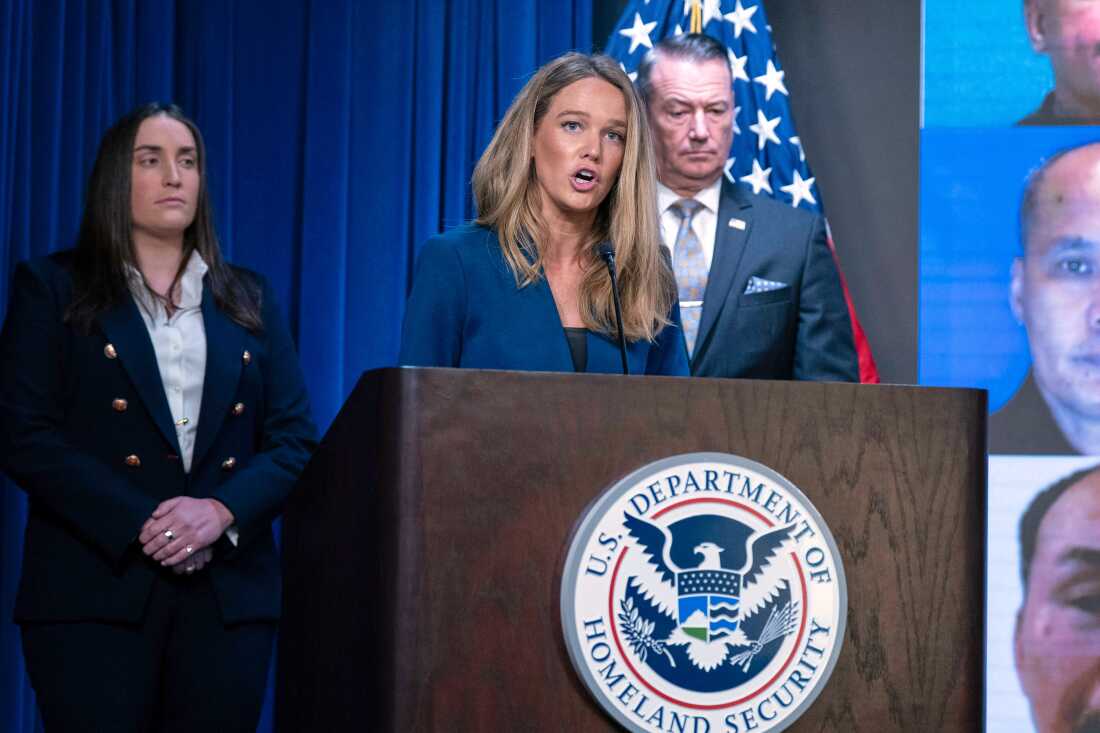
Then-DHS Assistant Secretary for Public Affairs Tricia McLaughlin, flanked by deputy director of U.S. Immigration and Customs Enforcement Madison Sheahan (left), and Acting director of U.S. Immigration and Customs Enforcement Todd Lyons, speaks during a news conference at ICE Headquarters, in Washington, D.C., on May 21, 2025.
Jose Luis Magana/AP
hide caption
toggle caption
Jose Luis Magana/AP
Stumpf drew a parallel with an incident from the 1950s when the U.S. government deported two permanent residents suspected of being communists. “The government was kind of proclaiming and celebrating their deportation because getting rid of these communists was making the country safer,” said Stumpf, “Maybe that’s comparable to something like [this].”
An analysis by the Deportation Data Project shows a dramatic increase in arrests of noncitizens without criminal records during President Trump’s current term compared to President Biden’s term.
“If you look at research, immigrants actually tend to commit fewer crimes than even U.S. citizens do. And that’s true of immigrants who have lawful status here and immigrants who don’t,” said Stumpf. “If we have a number of social media posts that are painting immigrants as the worst of the worst…it’s actually really putting out a distorted version of reality about who immigrants actually are.”
Some claims are disputed by other authorities
In some posts, DHS and ICE have also used photos of people and statements about their criminal histories to burnish the federal government’s accomplishments, defend their agents and criticize states like Minnesota. State and local authorities have in turn pushed back, and some of the federal government’s claims about the people it has detained have been met with setbacks in the courts.
DHS accused Minnesota’s Cottonwood County of not honoring detainers, written requests by ICE to hold prisoners in custody for a period of time so ICE can pick them up. In one post, the agency identified a person who was charged with child sexual abuse, writing “This is who sanctuary city politicians and anti-ICE agitators are defending.”
The Cottonwood County sheriff’s office said DHS’s post “misrepresented the truth” in their own post on Facebook. According to their account, the county did honor the detainer but ICE said it was unable to pick up the person before the order expired and the county had to release the suspect.
The Minnesota Department of Corrections wrote in a blog post that dozens of people DHS listed on its “Worst of the Worst” website were not arrested as DHS described, but were transferred to ICE by the state because they were already in state custody. The Corrections Department has since launched a page dedicated to “correct the Department of Homeland Security’s (DHS) repeated false claims.”
The “Worst of the Worst” website has some overlap with the department’s social media posts, but it contains a much larger number of people — over 30,000 nationally. It included a Colombian soccer star who was extradited to the U.S., tried in Texas, convicted of drug trafficking and served time in federal prison. The website incorrectly describes him as being arrested in Wisconsin. The soccer player, Jhon Viáfara Mina, recently finished his sentence early and returned to Colombia, according to Spanish newspaper El Diario Vasco.
In some instances, DHS and ICE wrote about incidents where they ran into conflict when carrying out arrests. In those posts, they named the arrestees and posted their photos. But in one case where the incident went to court, the government’s account of the events shifted. After a federal agent shot Julio C. Sosa-Celis in Minneapolis in January, DHS claimed he was lodging a “violent attack on law enforcement.” Assault charges against Sosa-Celis fell apart in court as new evidence surfaced, and the officers involved were put on leave.
Despite the fact that the charges were dropped, DHS’s post profiling Sosa-Celis remains online.

The U.S. Supreme Court
Tasos Katopodis/Getty Images
hide caption
toggle caption
Tasos Katopodis/Getty Images
The Supreme Court Tuesday upheld the long-established right of children born on U.S. soil to automatic American citizenship, regardless of their parents’ immigration status. In so doing, the court rejected President Trump’s most aggressive attempt to limit immigration in the United States.
Writing for the court majority, Chief Justice John Roberts traced birthright citizenship back to the founding of the nation. Just as the colonists demanded “the rights of Englishmen” more than 250 years ago, he said, Congress, after the Civil War, amended the Constitution to specify automatic citizenship for any child born on U.S. soil.
“Citizenship then and now was the right to have rights”—and the framers of the 14th amendment extended that promise to every free born person in this land. He concluded: “We keep that promise today.”
The vote was 6-to-3, depending on how you count it. Altogether, five justices signed on to the Roberts’ majority opinion. A sixth, Justice Brett Kavanaugh, agreed only that federal legislation enacted in the 1950s grants automatic citizenship for children born in the U.S.
Justice Clarence Thomas wrote the lead dissent, a 91-page opus that agreed with Trump’s assertion that the 14th amendment only applied to former slaves and their descendants. The Thomas dissent added ominously that he “was not sure that “today’s opinion will stand the test of time.” The dissent was joined by Justice Neil Gorsuch, with Justice Samuel Alito writing a separate dissent.
Justice Ketanji Brown Jackson, who, like Thomas is African American, responded to some of the themes in the Thomas dissent.
“Despite his longstanding endorsement of a colorblind society,” she wrote, “Justice Thomas now surprisingly suggests that the citizenship clause was a race-conscious remedial measure relating only to freed slaves.”
Cecillia Wang, legal director of the ACLU, who successfully argued the case at the Supreme Court, said President’s Trump failed attempt to limit birthright citizenship was transparent.
“A majority of the court saw through what the president was trying to do in spinning birthright citizenship as something that can flex and retract and expand depending on what the administration in power thinks about immigration policy,” she said.
Wang sees birthright citizenship as “much more fundamental than that.”
“It is part of how our country rejected caste distinctions and championed freedom and equality,” she said.
Yale law professor Akhil Amar called the court’s opinion a classic example of the court sticking to the original meaning of the Constitution. The text of the 14th Amendment, he said, “is about the child. It doesn’t say anything about parents.”
University of Virginia law professor Amanda Frost, however, was surprised and saddened that the court was so closely divided.
“The very length of the opinion,” she told NPR, plus “the fact that you had four justices say the Constitution does not require near universal birthright citizenship, which had been the understanding, that suggests that this is a fringe argument that the Trump administration has succeeded in moving into the mainstream, even though it has not succeeded in the end of the result.”
The issues in the birthright case focused in large part on the longstanding, and as of Tuesday, still standing, meaning of the 14th Amendment, which was enacted after the Civil War. It guarantees birthright citizenship to almost all persons born or naturalized in the United States. Chief Justice Roberts pointedly said the only exceptions written into the amendment were for certain Indian tribes, which were not subject to the laws of the United States at the time, and the children of foreign diplomats. That understanding was so well accepted that even in World War II, when Japanese citizens were confined to internment camps, their children, born in those camps, were automatically deemed to be American Citizens.
The Supreme Court’s decision Tuesday was the second time the justices have upheld birthright citizenship. The court’s previous decision came in 1898 in the case of Wong Kim Ark, born in the U.S. to Chinese parents. His great grandson, Norman Wong, issued a statement today saying, “My great grandfather, Wong Kim Ark, never set out to become a symbol. He was one man, only a cook, and yet he stood up for what was right, and I believe that it has made a difference. As a result, he stood up for the rights of all of us Americans – it just so happens that I am related to him. Today’s ruling shows that his victory remains as important now as it was in 1898.”
The high court also issued opinions in two other cases on Tuesday. In a 6-to-3, ideologically divided vote, the court upheld state laws that prevent transgender athletes from playing on women’s sports teams. Writing for the conservative majority, Justice Brett Kavanaugh said that the laws violate neither federal statutes nor the 14th Amendment. States, he said, have a legitimate interest in protecting the safety of sports, which he suggested could be compromised if transgender girls or women are allowed to play on female teams. Similarly, he said transgender athletes could also compromise fairness in athletic competition.
Sitting in the court chambers Tuesday when Kavanaugh summarized his opinion were not only his wife and mother, but his two daughters, whose athletic teams their father has long coached.
Justice Sonia Sotomayor, joined by her liberal colleagues, issued a partial dissent. She agreed with the majority that the benefits of sports are “immense,” but she wrote that these laws unconstitutionally deny transgender athletes the opportunity to play with their peers.
In a third ideologically divided case Tuesday, the Court struck down decades-long limits on the amount of money political parties can spend on candidates. The limits were challenged by the Republican National Committee. The decision may well increase by millions of dollars the amount of money that will pour into campaigns.

Rep. Thomas Kean Jr., R-N.J., arrives at the U.S. Capitol with his wife Rhonda Kean on June 30.
Anna Moneymaker/Getty Images
hide caption
toggle caption
Anna Moneymaker/Getty Images
New Jersey Republican Thomas Kean Jr. said it was struggles with depression that kept him away from Congress for nearly four months with no explanation to his constituents.
Kean last voted on March 5th, missing numerous votes and other appearances on Capitol Hill since. In April, House Speaker Mike Johnson told reporters he had spoken to Kean and that he was dealing with an undisclosed medical issue. Kean was not spotted until recently at his New Jersey home.
Speaking from the House floor on Tuesday, the second term lawmaker said he had checked into a hospital for testing several months ago after health concerns, and was subsequently diagnosed with depression.
“Talking about myself has never come naturally,” Kean said. “But I believe that I owe an explanation to the people of New Jersey’s seventh district, to my colleagues in this chamber and to the American people for my absence.”
Kean said he originally did not think his diagnosis would result in a long-term absence. Doctors recommended he remain in the hospital to address the illness, and it was his fastest route to recovery, he said.
“It is physical. It is emotional,” he said. “And until you experience it yourself, it is difficult to fully understand how powerful this illness could be.”
Kean said he miscalculated how long he would be away, estimating it would be a matter of weeks. However, he said like the roughly 48 million Americans who have battled the illness, he learned there is no timeline for recovery.
“I am grateful that I accepted help,” Kean said. “Today I stand before you healthier, stronger and excited to return to the work that I love.”
Kean’s absence proved a struggle for House Republicans, who contend with a razor thin majority to pass party priorities. For weeks, Kean and his office declined to share additional details on why he was away, feeding rumors and speculation and raising interest in a member known for his privacy.
Despite his absence, Kean won the GOP primary earlier this month to defend his seat in Congress in this fall’s midterm elections. He will face Democrat Rebecca Bennett, a former U.S. Navy helicopter pilot and healthcare executive.
Bennett has targeted Kean’s absence in her campaign. Democrats have said Kean’s 7th congressional district is a top target to flip in their pursuit of taking back the majority.
“Tom Kean Junior, wherever you are, you have failed this district,” Bennett told supporters at an event last week.
In a statement after Kean’s remarks on Tuesday, Bennett said she was relieved he was well and wished him good health.
“But let’s be clear: I got into this race because Tom Kean Jr. was failing our community long before this absence,” she said.
Kean is not the first member of Congress in recent years to speak publicly about their struggles with depression. Sen. John Fetterman, D-Pa., took leave from the Capitol in 2023 after he was diagnosed with the illness. In Fetterman’s case, his office announced the news within days of his starting treatment.
Kean was elected to Congress for his first term beginning in 2023, flipping a district that was represented by former Democratic Congressman Tom Malinowski.
He comes from a long line of politicians: His father, former New Jersey Gov. Thomas Kean Sr., was appointed by former President George W. Bush as a chair of the 9/11 Commission. Kean’s grandfather and great grandfather also served in Congress.

Members of the National Guard stand in front of a large image of U.S. President Donald Trump that hangs from the the Robert F. Kennedy Department of Justice Building on May 18, 2026 in Washington, D.C.
Andrew Harnik/Getty Images North America
hide caption
toggle caption
Andrew Harnik/Getty Images North America
WASHINGTON, D.C. — In a strongly worded letter to the head of Michigan’s National Guard, Gov. Gretchen Whitmer reiterated troops from her state are only to be used for operations surrounding America 250 celebrations in Washington, D.C., and not for President Trump’s long-running — and controversial — joint task force to fight crime. She said that she would pull her troops from the city if that is not the case, in the letter obtained by NPR.
“Please take all necessary measures to ensure the Michigan National Guard is only supporting the narrow and limited America 250 Mission and is in no way supporting the D.C. Safe and Beautiful Mission,” wrote Gov. Whitmer, referencing the official name for the federal task force.
Trump deployed hundreds of troops to Washington, D.C., in August of 2025, in what experts said was a stunning departure from governing norms. He said he did so to address rampant crime, despite declining crime rates at the time. The number of troops in the city has increased over time to more than 4,800 from Washington, D.C. and almost two dozen states, which until recently were exclusively Republican-led.
Michigan — which has 161 guard members currently in the city — is one of four Democratic-led states that sent members of their National Guard to D.C. in recent weeks, ahead of an influx of tourists for America 250 celebrations. North Carolina and Kentucky each sent one member of their guard, while Minnesota sent more than a hundred last week.
Kentucky confirmed to NPR Monday that it had recalled its one guard member over the weekend, after that member was “diverted to the task force by the federal government without the knowledge or consent of Gov. Beshear of the Kentucky Guard,” Scottie Ellis, a spokesperson for Gov. Beshear, wrote to NPR in an email.
When contacted by NPR, spokespeople for each respective Democratic governor’s office made it clear that their guard members were sent to help specifically with America 250, not for law enforcement purposes as part of the larger ongoing federal joint task force operation. All four states have been clear about their opposition to the Trump administration’s ongoing deployment of National Guard troops to D.C., filing an amicus brief in support of litigation challenging it as recently as May.
But in recent days, a video of troops identifying themselves as Michigan National Guard members patrolling the Georgetown waterfront — an upscale neighborhood more than a mile away from any official America 250 celebrations — began circulating on social media. NPR has authenticated the video. Whitmer’s office did not immediately respond to NPR’s request to verify that the troops were Michigan members.
All state guard members are currently in D.C. under Title 32 status, which essentially means that the federal government pays for the deployment, but the state governors maintain control and command of their troops. But former National Guard officials say it’s impractical for states to play a role in day-to-day activities in a complex national mission like what’s happening in D.C.
“If the National Guard has defined the America 250 Mission to extend beyond direct support for events celebrating the nation’s 250th anniversary, please let me know so we can ensure the Michigan National Guard’s efforts are carefully limited,” Gov. Whitmer’s letter reads.
It goes on to say that if that can’t be ensured, then Gov. Whitmer will “end Michigan’s support for the America 250 mission.”
Legal experts, like those at the Brennan Center for Justice who have closely been watching Trump’s ongoing deployment to D.C., worry that drawing a distinction between the America 250 celebration and the general mission of the joint task force in the city will prove difficult. The joint task force is largely carrying out high visibility presence patrols in residential neighborhoods, public parks and metro stations.
Troops from all four Democratic-led states are listed as part of the official federal joint task force numbers released to the public. Gov. Whitmer said the Michigan troops should not be included in that count.
The offices for other Democratic governors NPR reached out to about that list also said their guard members shouldn’t be included.
When asked about the confusion, a spokesperson for the joint task force told NPR that it is overseeing all guard members in D.C. for organizational purposes, but being on the list “does not change their specific mission.” The joint task force did not immediately respond to NPR’s request for comment as to why Michigan guard members were apparently in Georgetown, and if that was part of the America 250 operations.
-
 Lifestyle21 minutes ago
How does the Kennedy Center board make decisions? This legal filing sheds some light
-

 Technology31 minutes ago
Meta is adding ridiculous ‘rate limits’ and a soft paywall to its smart glasses
-

 World35 minutes ago
Boy, 2, pulled alive from rubble six days after Venezuela’s devastating twin earthquakes
-

 Politics37 minutes ago
Socialism goes west as DSA-backed challenger ousts longtime Democrat
-

 Health43 minutes ago
Americans are giving up multivitamins for a different daily health habit, study finds
-

 Sports46 minutes ago
2026 World Cup Quarterfinal Odds: Which Squads Will Make Final 8?
-

 Technology51 minutes ago
Warehouse robots move packages without human handoff
-
 Business58 minutes ago
Disneyland to offer $59 evening tickets next month

