Hours after a bitter feud between the Pentagon and Anthropic ended with the Trump administration cutting off the artificial intelligence startup, Anthropic CEO Dario Amodei told CBS News in an exclusive interview Friday night he wants to work with the military — but only if it addresses the firm’s concerns.
“We are still interested in working with them as long as it is in line with our red lines,” he said.
The conflict centers on Anthropic’s push for guardrails that explicitly prevent the military from using its powerful Claude AI model to conduct mass surveillance on Americans or to power autonomous weapons. The Pentagon wants the ability to use Claude for “all lawful purposes,” and says it isn’t interested in either of the uses that Anthropic was concerned about.
The military gave Anthropic a Friday evening deadline to either meet its demands or get cut off from its lucrative Defense Department contracts. With the two sides still seemingly still far apart, President Trump on Friday ordered federal agencies to “immediately” stop using Anthropic’s technology. Then, Defense Secretary Pete Hegseth declared the company a “supply chain risk,” directing military contractors to also stop working with the AI startup.
In his interview later Friday, Amodei stood by the guardrails sought by Anthropic, which is the only company whose AI model is deployed on the Pentagon’s classified networks.
Advertisement
“Our position is clear. We have these two red lines. We’ve had them from day one. We are still advocating for those red lines. We’re not going to move on those red lines,” Amodei later said. “If we can get to the point with the department where we can see things the same way, then perhaps there could be an agreement. For our part and for the sake of U.S. national security, we continue to want to make this work.”
Amodei told CBS News that Anthropic has sought to deploy its AI models for military use because “we are patriotic Americans” and “we believe in this country.” But the company is worried that some potential uses of AI could clash with American values, he said.
Mass surveillance is a risk, Amodei argued, because “things may become possible with AI that weren’t possible before,” and the technology’s potential is “getting ahead of the law.” He warned that the government could buy data from private firms and use AI to analyze it.
In theory, artificial intelligence could also be used to power fully autonomous weapons that select targets and carry out strikes without any human input. Amodei said his company isn’t categorically opposed to those kinds of weapons, especially if U.S. adversaries develop them, but “the reliability is not there yet” and “we need to have a conversation about oversight.”
The Free Press:Will AI Doom Us All? The Market Can’t Decide
Advertisement
Since AI technology is still unpredictable, Amodei is concerned that autonomous weapons could target the wrong people by mistake. And unlike with human-powered weaponry, it’s not clear who is responsible for the decisions made by fully autonomous weapons.
“We don’t want to sell something that we don’t think is reliable, and we don’t want to sell something that could get our own people killed or that could get innocent people killed,” he said.
Amodei called the guardrails around surveillance and autonomous weapons “narrow exceptions,” and said the company has no evidence that the military has run into either of them.
The Pentagon’s position is that federal law already prevents it from surveilling Americans en masse, and fully autonomous weapons are already restricted by internal military policies, so there is no need to put restrictions on those uses of AI in writing.
Emil Michael, the Pentagon’s chief technology officer, told CBS News in an interview Thursday: “At some level, you have to trust your military to do the right thing.”
Advertisement
“But we do have to be prepared for the future. We do have to be prepared for what China is doing,” Michael said, referring to how U.S. adversaries use AI. “So we’ll never say that we’re not going to be able to defend ourselves in writing to a company.”
As a compromise, Michael said the military had offered written acknowledgements of the federal laws and military policies that restrict mass surveillance and autonomous weapons — though Anthropic said that offer was “paired with legalese” that allowed the guardrails to be ignored.
As the conflict between Anthropic and the Pentagon escalated this week, top military officials accused the company and Amodei of trying to impose their values onto the government. Hegseth called Anthropic “sanctimonious” and arrogant, Michael said that Amodei has a “God-complex” and Mr. Trump called the AI startup a “radical left, woke company.”
“Their true objective is unmistakable: to seize veto power over the operational decisions of the United States military. That is unacceptable,” Hegseth alleged.
Said Mr. Trump: “Their selfishness is putting AMERICAN LIVES at risk, our Troops in danger, and our National Security in JEOPARDY.”
Advertisement
Asked if weighty questions about AI guardrails should be left up to Anthropic rather than the government, Amodei told CBS News that “one of the things about a free market and free enterprise is, different folks can provide different products under different principles.”
He also said: “I think we are a good judge of what our models can do reliably and what they cannot do reliably.”
In the long run, he said, Congress should probably weigh in on AI safeguards.
“But Congress is not the fastest moving body in the world. And for right now, we are the ones who see this technology on the front line,” said Amodei.
With Anthropic and the Pentagon unable to reach a deal by Friday, the military is now expected to phase out its use of Anthropic’s AI technology within six months and transition to what Hegseth called “a better and more patriotic service.”
Advertisement
Hegseth also labeled Anthropic a “supply chain risk” and said all companies that do business with the military are now expected to cut off “any commercial activity with Anthropic.”
Amodei called that an “unprecedented” move for an American firm rather than a foreign adversary, and he said the government’s statements have been “retaliatory and punitive.” And he argued that Hegseth doesn’t have the legal authority to bar all military contractors from working with Anthropic, and can only stop them from using Anthropic for government contracts.
He also said that Anthropic hasn’t formally received any information from the Pentagon informing it of a supply chain risk designation, but “when we receive some kind of formal action, we will look at it, we will understand it and we will challenge it in court.”
Asked if he has a message for the president, Amodei said “everything we have done has been for the sake of this country” and “for the sake of supporting U.S. national security.”
“Disagreeing with the government is the most American thing in the world,” he said. “And we are patriots. In everything we have done here, we have stood up for the values of this country.”
Former U.S. Olympian David Hearn (left) walks with his attorney Norman Eisen to speak to reporters and protesters gathered after his arraignment at the Superior Court of the District of Columbia in Washington, D.C. on Thursday.
Finn Gomez/Getty Images
hide caption
toggle caption
Advertisement
Finn Gomez/Getty Images
Former U.S. Olympic canoeist David Hearn pleaded not guilty to damaging the Lincoln Memorial Reflecting Pool in D.C. Superior Court Thursday morning.
Federal prosecutors charged Hearn with a single count of destruction of property causing more than $1,000 in damage to the pool.
Hearn has previously claimed, which his attorneys repeated during a short press conference outside the court, that he simply touched the water in the pool out of curiosity.
Advertisement
The Trump administration had just completed a $14 million renovation of the pool.
But shortly after the work finished, peeling paint and algae gathered in the water. The remodel has been largely criticized as a massive failure and waste of taxpayer dollars.
Superior Court Judge Carmen McLean released Hearn on his own recognizance. His next hearing is scheduled for Aug. 5.
Norm Eisen, one of Hearn’s attorneys, spoke to reporters outside of court following the hearing. He said the administration is using Hearn as a “scapegoat … for their own failures.”
“It is not a crime to touch the reflecting pool, to touch water in the United States of America,” he said.
Advertisement
Prosecutors say there is a host of evidence against Hearn.
Three more people have been criminally charged with destruction of property at the Lincoln Memorial Reflecting Pool.
Officers say they detained Cameron Thiers, Sophie Dennison-Gibby and Justin Carreno one Saturday afternoon in June and described in court documents witnessing them peeling and removing pieces of blue paint from the Reflecting Pool.
One officer “witnessed Carreno reach down into the reflecting pool and pull up a piece of the blue paint,” according to the court documents.
The officer who detained Dennison-Gibby “found 1 additional piece of the reflecting pool liner” in her purse, the documents said.
All three incidents were recorded on the officers’ body worn cameras, they said in the court documents.
Advertisement
Several “partnering law enforcement agencies assigned to the Reflecting Pool” working with US Park Police were involved in detaining the two men and one woman — including officers from Texas, Oklahoma, Montana and California.
One of the officers said in court documents that Thiers “admitted to removing a piece of blue sealant from the Reflecting Pool and still had it in his hand when I made contact with him.”
The three defendants were arraigned in court Wednesday and pleaded not guilty to the misdemeanor charges of destruction of property with a value less than $1,000. The judge ordered them to stay away from the Reflecting Pool.
Lawyers for Thiers and Dennison-Gibby declined to comment. CNN has reached out to Carreno’s attorney.
If found guilty of destruction of property, the defendants could be fined up to $1,000 and face a maximum of 180 days behind bars.
Advertisement
The New York Times first reported that three additional people had been charged with damaging the Reflecting Pool.
President Donald Trump has repeatedly claimed that vandals caused major damage to the pool by gashing the lining after his administration spent more than $14 million on renovations, though he has not provided evidence to support that claim. The officers who charged Carreno, Thiers and Dennison-Gibby did not accuse them of gashing the lining.
Former Olympic canoeist David Hearn was indicted by a grand jury in Washington, DC, last week for allegedly damaging the Reflecting Pool. Hearn — unlike Carreno, Thiers and Dennison-Gibby – was charged with destruction of property with a value of more than $1,000 which carries a maximum penalty of 10 years in prison, if convicted. He is set to be arraigned in court Thursday.
Crews began draining the Reflecting Pool over the weekend to make repairs, according to Interior Secretary Doug Burgum, for the second time in three months.
The move comes after weeks of problems – algae blooms, green-hued water, a chipping bottom and the administration’s allegations of vandalism – that have plagued the iconic landmark, making its woes the subject of national interest.
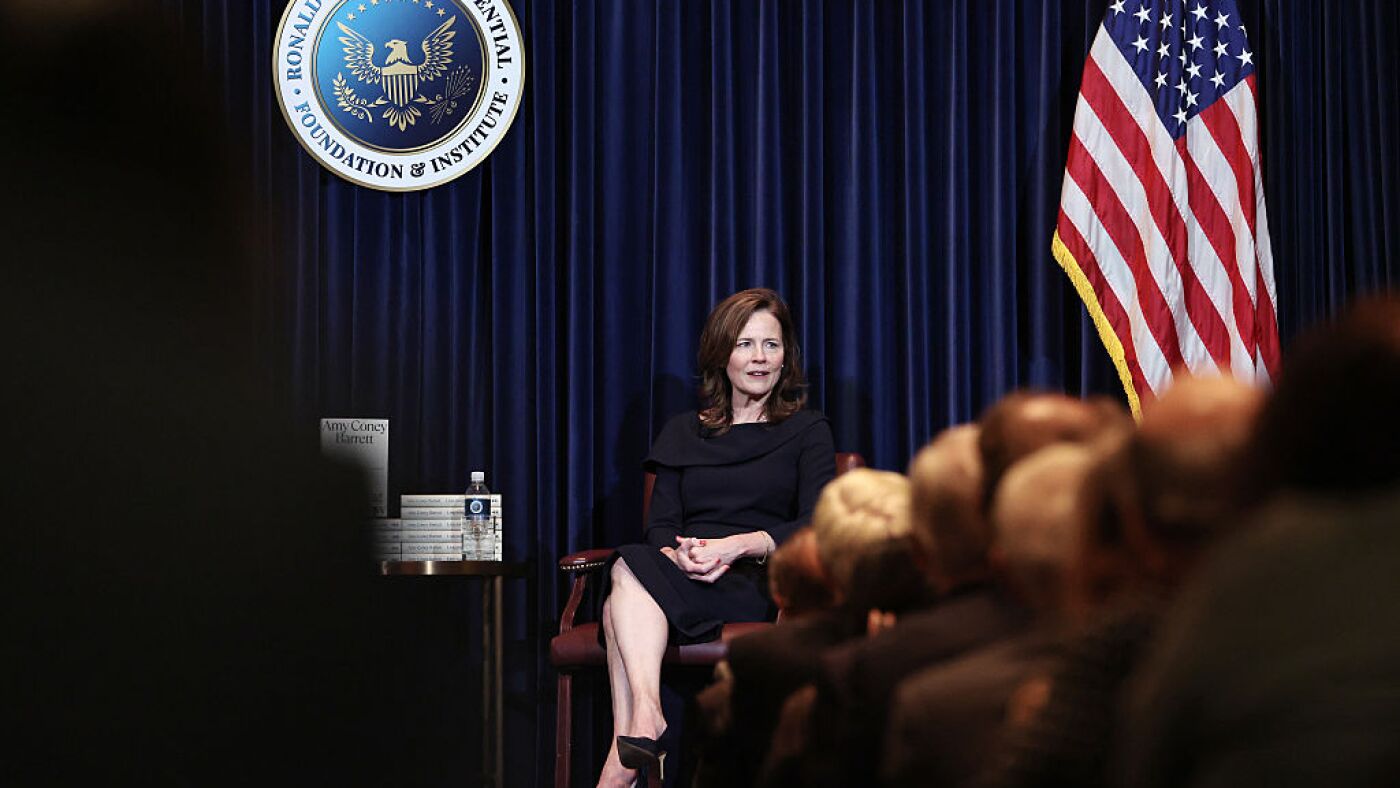
Supreme Court Justice Amy Coney Barrett speaks at the Reagan Library on Sept. 9, 2025, in Simi Valley, Calif. Barrett discussed and signed copies of her new book, Listening to the Law: Reflections on the Court and Constitution.
Mario Tama/Getty Images
hide caption
toggle caption
Advertisement
Mario Tama/Getty Images
Even as the Supreme Court was handing down one legal thunderbolt after another last week, the justices were quietly releasing their annual financial reports. Justice Samuel Alito was the only sitting justice to request an extension, which he has done for 15 years. The disclosures do not give a complete account of the justices’ total income and wealth, but they give insights into their concertgoing, guest professorships and even their involvement in youth sports.
In addition to their salaries, much of the justices’ reported income came from their book deals. Justice Ketanji Brown Jackson led the pack earning more than $1.1 million last year for a total of roughly $4 million since her memoir, Lovely One, was published in 2024.
Justices Sonia Sotomayor, Neil Gorsuch, Amy Coney Barrett and retired Justice Anthony Kennedy also reported income from published books. Earnings from their books ranged from $849,000 for Barrett, to $300,000 for Gorsuch and $88,000 for Sotomayor, whose books include her 2013 autobiography and five children’s books. Justice Clarence Thomas, who previously earned $1.5 million for his 2007 memoir, listed no publisher payments last year, and Justice Brett Kavanaugh, one of 13 co-authors of a 2016 legal treatise, also received no payments last year. Kavanaugh is said to be working on a memoir but he listed no payments for the anticipated book. Alito does have a book coming out in the fall, but with his financial report still outstanding, there is no data on how much he was paid for the work in 2025.
Advertisement
The only two sitting justices who have not written books are Chief Justice John Roberts and Justice Elena Kagan.
Many justices also earned income from teaching at law schools. Roberts reported income from New England Law, located in Boston, and Gorsuch reported teaching income from George Mason University in Virginia. Thomas taught classes at Catholic University in Washington, D.C., and Barrett and Kavanaugh taught at Notre Dame Law School. Barrett graduated from the school and began teaching there 23 years ago; Kavanaugh has family connections to Notre Dame.
The disclosures also report gifts, travel, food and lodging that the justices received in 2025. Jackson and Sotomayor were the only two to report gifts. Jackson was given a painting for her chambers valued at $2,500, and Sotomayor reported a trip to Kansas City to watch the opening of a musical based on her children’s book, Just Ask.
In addition, she reported receiving free tickets worth $4,333 while on “a private trip to Puerto Rico.” The tickets were from the record label that represents Bad Bunny, and her trip coincided with the artist’s months-long concert series in San Juan. Sotomayor’s parents were from Puerto Rico, and she has spent much time there over the years.
Advertisement
The justices also disclosed significant reimbursements for travel throughout 2025. Thomas’ travel, food and lodging expenses were paid for by the Hoover Institution for speaking at a celebration of conservative economist Thomas Sowell.
Sotomayor, Gorsuch, Barrett and Jackson were reimbursed for international travel, where they gave speeches, spoke about their books or taught. Roberts was the only sitting member of the court not to report any gifts or travel reimbursements.
The annual filings also shed some light on the justices’ activities off the bench. Kavanaugh reported that in addition to his duties as a Supreme Court justice, he serves as a coach to multiple D.C.-area Catholic Youth Organization girls’ basketball teams. Coach K, as he is known by his players, wrote the court’s June decision declaring that states can ban transgender women and girl athletes from playing on women’s and girls’ sports teams.
The justices’ salaries are established by law. The chief justice earns the most, at $320,700 per year. The eight associate justices earn $306,600 per year. While that is a lot of money to most Americans, the justices and even their law clerks could earn more the minute they leave their Supreme Court jobs for large law firms.
Roberts was the only member of the court to report investing in individual stocks. Alito in the past has also owned shares of individual stocks, but his report is not due for three months when his extension runs out. For the most part, the justices do not own individual stocks, but do invest in index funds, mutual funds and other such investment programs in order to both make money and limit potential conflicts of interest that would require their recusal from certain cases.
Advertisement
However — and this is a big however — the financial reporting forms the justices are required to fill out are so unspecific and the reporting ranges for investment earnings are so broad that it is impossible to determine any justice’s overall wealth. In addition, the current value of the justices’ homes isn’t reported. Neither is their spouses’ income, which in the case of the chief justice, for instance, likely far exceeds his take-home pay.