Connect with us

News

Biden rules out quitting at start of make-or-break trip to battleground states

Published

on

Biden rules out quitting at start of make-or-break trip to battleground states

Joe Biden said he was “completely ruling out” ending his re-election bid on Friday at the start of a make-or-break weekend of public appearances intended to quell calls from within his party to drop out of the presidential race.

Biden sat for his first television interview since his disastrous performance in last week’s presidential debate, which sparked panic in the Democratic party.

In a clip of the interview released by ABC News, Biden said the debate was a “bad episode”, claiming he was “exhausted” and “sick” on the night.

But amid reports that members of Biden’s family are blaming his top campaign staff for the president’s halting performance, he said his appearance on the debate stage was “nobody’s fault but mine”.

The interview came shortly after Biden delivered a defiant speech in Wisconsin, a swing state, telling a crowd of supporters that he would not bow to the mounting pressure on him to quit.

Advertisement

“Guess what? They’re trying to push me out of the race. Let me say this as clearly as I can: I’m staying in the race. I’ll beat Donald Trump.”

But Biden’s bullishness was undercut by a report that an influential Democratic senator was attempting to assemble a group of the party’s senators to urge the president to drop his re-election bid.

Mark Warner, a senator from Virginia, told colleagues that Biden could no longer remain in the race for the White House, The Washington Post reported on Friday. A spokesperson for Warner did not respond to a request for comment. When Biden was later asked by a reporter about Warner, the president said the senator was “the only one considering that”.

Separately, Maura Healey, the Democratic governor of Massachusetts, became the first state governor to suggest Biden step aside. Healey was among governors who met the president for emergency talks at the White House this week.

She issued a statement on Friday afternoon saying she was “deeply grateful” for Biden’s leadership, but urged him to “listen to the American people and carefully evaluate whether he remains our best hope to defeat Donald Trump”.

Advertisement

But Biden brushed aside the concerns again on Friday evening, telling reporters that he was “completely ruling . . . out” leaving the race. When a reporter asked him if he was the best candidate to beat Trump, Biden replied: “I did it before.” When the reporter asked a follow-up, he replied: “You’ve been wrong about everything so far. You were wrong about 2022 . . . you were wrong about 2023 . . . so look, we’ll see.”

Reporters travelling with Biden noted several people standing outside the venue where he spoke in Wisconsin holding signs urging him to “bow out” and “pass the torch”. Another sign read: “Give it up, Joe,” while one said: “Pres Biden — serve your country — not your ego.”

On Sunday, Biden will make a campaign stop in another swing state, Pennsylvania. The trip through critical states comes as he battles to quell deep discontent in his party about his determination to stay in the race. Despite Democratic governors publicly voicing support for Biden this week, scores of lawmakers, party operatives and influential donors are now agitating for him to be replaced with a younger candidate.

The pre-recorded interview with ABC News’s George Stephanopoulos, a former adviser to Democratic president Bill Clinton, was being billed as a chance for the president to allay concerns about his mental acuity.

But White House press secretary Karine Jean-Pierre sought to downplay the significance of the interview, telling reporters on Air Force One on Friday that Biden was preparing for the conversation “like he does with any other interview”.

Advertisement

Some donors have pushed California Governor Gavin Newsom and Michigan Governor Gretchen Whitmer to replace the president as the Democratic candidate, the Financial Times reported on Thursday. Vice-president Kamala Harris is in pole position to replace Biden if he drops out.

A handful of Democratic lawmakers have come out publicly in recent days calling for Biden to end his re-election bid. An increasing number of megadonors — including media heiress Abigail Disney and Hollywood agent Ari Emanuel — have said they would not give Biden any more money.

Biden has also been weakened by damaging public opinion polls that show him trailing Trump by several points both nationwide and in the battleground states that are likely to determine the outcome of November’s election.

But Biden and his campaign have refused to blink in the face of the pressure. His campaign on Friday said it would spend another $50mn on advertising in the month of July, including for ad spots that would run during this month’s Republican National Convention and the Olympics.

Harris, Newsom and Whitmer have remained publicly loyal to the president’s campaign. At a July 4 celebration at the White House on Thursday evening, Biden joined hands with his vice-president as some people in the crowd chanted, “four more years”.

Advertisement

But other prominent Democrats are more reluctant to share the stage with the president. When Biden visited Wisconsin on Friday, he was joined by the state’s Democratic governor, Tony Evers — but not Tammy Baldwin, the state’s Democratic senator, who is polling far ahead of the president.

The latest FiveThirtyEight polling average shows Trump leading Biden by just shy of two points in Wisconsin.

Trump has kept a relatively low profile since the debate, allowing media attention to remain on Biden’s difficulties and Democratic disarray.

But the former president has slammed Harris in recent days, and on Thursday night challenged Biden to another “no holds barred” debate. A second debate between them is already scheduled for September.

“What a great evening it would be, just the two of us, one on one, in a good, old fashioned debate, the way they used to be,” Trump said in a post on his Truth Social platform. “ANYTIME, ANYWHERE, ANYPLACE!!!”.

Advertisement

Biden said on Friday that he remained “committed” to attending the September debate.

Have your say

Joe Biden vs Donald Trump: tell us how the 2024 US election will affect you

News

Trump claims US stockpiles mean wars can be fought ‘forever’; Kristi Noem testifies before Congress – US politics live

Published

on

Trump claims US stockpiles mean wars can be fought ‘forever’; Kristi Noem testifies before Congress – US politics live

Trump says US stockpiles mean “wars can be fought ‘forever’”

In a late night post on Truth Social, Donald Trump said that the US munitions stockpiles “at the medium and upper medium grade, never been higher or better”.

He added that the US has a “virtually unlimited supply of these weapons”, meaning that “wars can be fought ‘forever’”.

This comes after Trump said that the US-Israel war on Iran could go beyond the four-five weeks that the administration initially predicted. The president also did not rule out the possibility of US boots on the ground in Iran during an interview with the New York Post on Monday.

Advertisement

“I rebuilt the military in my first term, and continue to do so. The United States is stocked, and ready to WIN, BIG!!!,” he wrote.

Share

Key events

During his opening remarks, Senate judicicary committee chairman, Chuck Grassley, blamed Democrats for the ongoing shutdown Department of Homeland Security (DHS) but highlighted four agencies: the Secret Service, Federal Emergency Management Agency (FEMA), the Transportation Security Administration (TSA), and the Coast Guard.

Democrats are demanding tighter guardrails for federal immigration enforcement, but a sweeping tax bill signed into law last year conferred $75bn for Immigration and Customs Enforcement (ICE), which means the agency is still functional amid the wider department shuttering.

Share
Continue Reading

News

Supreme Court blocks redrawing of New York congressional map, dealing a win for GOP

Published

on

Supreme Court blocks redrawing of New York congressional map, dealing a win for GOP

The Supreme Court

Win McNamee/Getty Images


hide caption

toggle caption

Advertisement

Win McNamee/Getty Images

The Supreme Court on Monday intervened in New York’s redistricting process, blocking a lower court decision that would likely have flipped a Republican congressional district into a Democratic district.    
  
At issue is the midterm redrawing of New York’s 11th congressional district, including Staten Island and a small part of Brooklyn. The district is currently held by a Republican, but on Jan. 21, a state Supreme Court judge ruled that the current district dilutes the power of Black and Latino voters in violation of the state constitution.  
  
GOP Rep. Nicole Malliotakis, who represents the district, and the Republican co-chair of the state Board of Elections promptly appealed to the U.S. Supreme Court, asking the justices to block the redrawing as an unconstitutional “racial gerrymander.” New York’s congressional election cycle was set to officially begin Feb. 24, the opening day for candidates to seek placement on the ballot.  
  
As in this year’s prior mid-decade redistricting fights — in Texas and California — the Trump administration backed the Republicans.   
 
Voters and the State of New York contended it’s too soon for the Supreme Court to wade into this dispute. New York’s highest state court has not issued a final judgment, so the voters asserted that if the Supreme Court grants relief now “future stay applicants will see little purpose in waiting for state court rulings before coming to this Court” and “be rewarded for such gamesmanship.” The state argues this is an issue for “New York courts, not federal courts” to resolve, and there is sufficient time for the dispute to be resolved on the merits. 
  
The court majority explained the decision to intervene in 101 words, which the three dissenting liberal justices  summarized as “Rules for thee, but not for me.” 
 
The unsigned majority order does not explain the Court’s rationale. It says only how long the stay will last, until the case moves through the New York State appeals courts. If, however, the losing party petitions and the court agrees to hear the challenge, the stay extends until the final opinion is announced. 
 
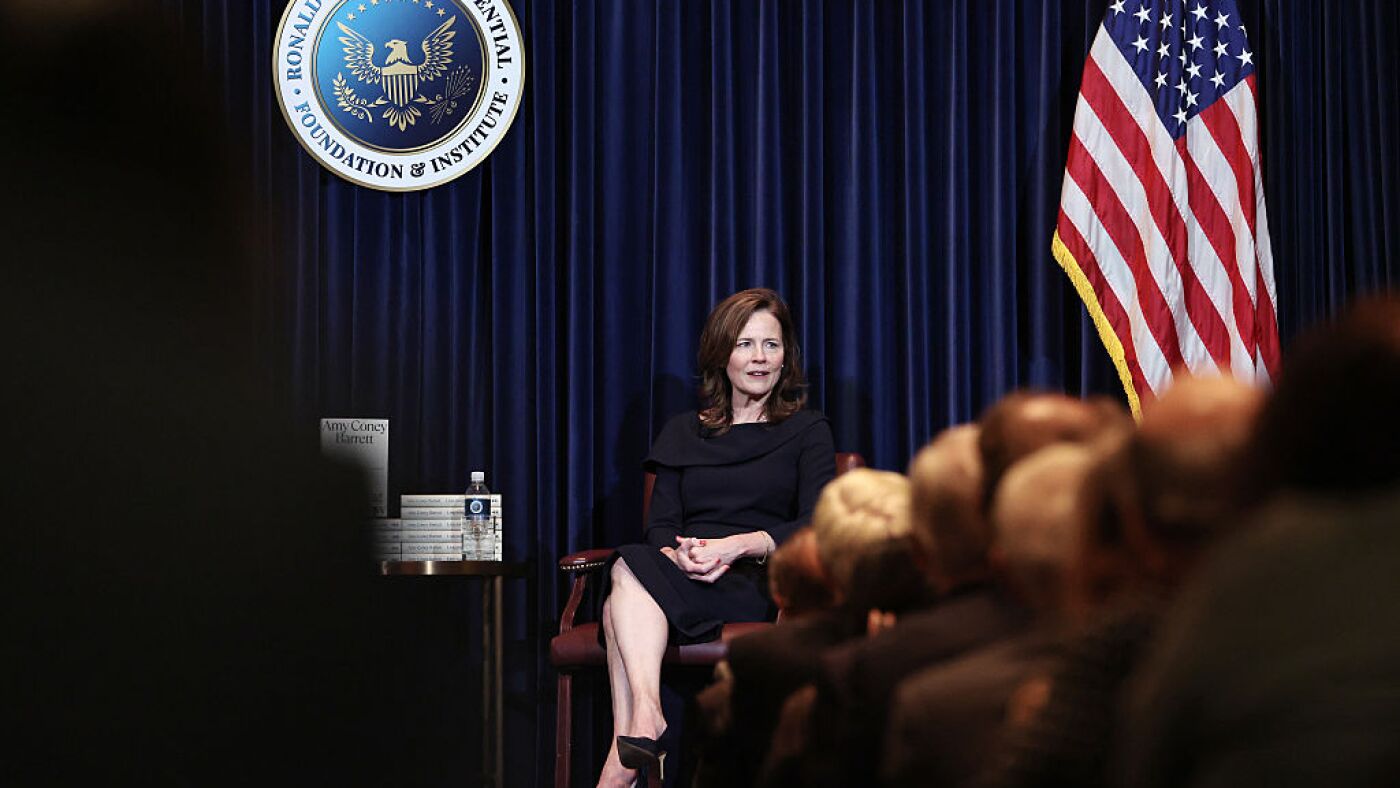
Dissenting from the decision were Justices Sonia Sotomayor, Elena Kagan, and Ketanji Brown Jackson. Writing for the three, Sotomayor  said that  if nonfinal decisions of a state trial court can be brought to highest court, “then every decision from any court is now fair game.” More immediately, she noted, “By granting these applications, the Court thrusts itself into the middle of every election-law dispute around the country, even as many States redraw their congressional maps ahead of the 2026 election.” 

Monday’s Supreme Court action deviates from the court’s hands-off pattern in these mid-term redistricting fights this year. In two previous cases — from Texas and California — the court refused to intervene, allowing newly drawn maps to stay in effect.  
  
Requests for Supreme Court intervention on redistricting issues has been a recurring theme this term, a trend that is likely to grow.  Earlier last month  the high court allowed California to use a voter-approved, Democratic-friendly map.  California’s redistricting came in response to a GOP-friendly redistricting plan in Texas that the Supreme Court also permitted to move forward. These redistricting efforts are expected to offset one another.     
   
But the high court itself has yet to rule on a challenge to Louisiana’s voting map, which was drawn by the state legislature after the decennial census in order to create a second majority-Black district.  Since the drawing of that second majority-black district, the state has backed away from that map, hoping to return to a plan that provides for only one majority-minority district.    
     
The Supreme Court’s consideration of the Louisiana case has stretched across two terms. The justices failed to resolve the case last term and chose to order a second round of arguments this term adding a new question: Does the state’s intentional creation of a second majority-minority district violate the constitution’s Fourteenth and Fifteenth Amendments’ guarantee of the right to vote and the authority of Congress to enforce that mandate?    
Following the addition of the new question, the state of Louisiana flipped positions to oppose the map it had just drawn and defended in court. Whether the Supreme Court follows suit remains to be seen. But the tone of the October argument suggested that the court’s conservative supermajority is likely to continue undercutting the 1965 Voting Rights Act.   

Advertisement
Continue Reading

News

Map: Earthquake Shakes Central California

Published

on

Map: Earthquake Shakes Central California

Note: Map shows the area with a shake intensity of 3 or greater, which U.S.G.S. defines as “weak,” though the earthquake may be felt outside the areas shown.  All times on the map are Pacific time. The New York Times

A minor earthquake with a preliminary magnitude of 3.5 struck in Central California on Monday, according to the United States Geological Survey.

The temblor happened at 7:17 a.m. Pacific time about 6 miles northwest of Pinnacles, Calif., data from the agency shows.

As seismologists review available data, they may revise the earthquake’s reported magnitude. Additional information collected about the earthquake may also prompt U.S.G.S. scientists to update the shake-severity map.

Source: United States Geological Survey | Notes: Shaking categories are based on the Modified Mercalli Intensity scale. When aftershock data is available, the corresponding maps and charts include earthquakes within 100 miles and seven days of the initial quake. All times above are Pacific time. Shake data is as of Monday, March 2 at 10:20 a.m. Eastern. Aftershocks data is as of Monday, March 2 at 11:18 a.m. Eastern.

Advertisement
Continue Reading
Advertisement

Trending