News
Amid election-year push on reproductive rights, Senate to hold test vote on access to contraception


WASHINGTON — In an election-year effort to put Republicans on record on reproductive rights issues, Senate Democrats are holding a vote Wednesday to move forward with legislation designed to protect women’s access to contraception.
The test vote comes as the Senate has abandoned hopes for doing serious bipartisan legislation before the election and as Senate Majority Leader Chuck Schumer and Democrats are trying to instead spotlight issues that they believe can help them win the presidency and keep the Senate in November. A similar vote on ensuring nationwide access to in vitro fertilization could come as soon as next week.
Neither bill is likely to pass the Senate, where Democrats would need 60 votes, much less the Republican-led House. But Schumer said Tuesday that Democrats will “put reproductive freedoms front and center before this chamber, so that the American people can see for themselves who will stand up to defend their fundamental liberties.”
The effort comes as Democrats worry that reproductive rights will be further threatened after the Supreme Court overturned the nationwide right to an abortion two years ago and as they continue to see that access as one of their most potent election-year issues. President Joe Biden’s campaign sees reproductive rights as a key path to winning undecided voters, especially women.
Minority Republicans scoffed, saying the political messaging votes were unserious distractions from legislation they would like to vote on. “I expect we will see a lot more show votes this summer,” said South Dakota Sen. John Thune, the No. 2 Senate Republican, on Tuesday.
Still, Wednesday’s vote on whether to move forward with the legislation could put some GOP senators in a tough spot. While most Republicans would oppose any restrictions on contraception, they are unlikely to back Democrats’ political push.
Maine Sen. Susan Collins, one of the few Republican senators who supports abortion rights, said Monday that she is likely to vote to move forward on the legislation but that she would want the bill to be amended to include more religious liberty protections. “It is clearly a messaging attempt and not a serious attempt in itself,” she said.
The Senate push on reproductive access this year differs from bipartisan legislation passed in 2022 that would protect same-sex marriage amid concerns that the court could go after the Obergefell v. Hodges decision that legalized gay marriage nationwide. A vote on that bill was delayed until after that year’s midterm elections to try and avoid political complications, and 12 Republicans eventually supported it, sending it to Biden’s desk.
Since Republicans took the House majority last year, though, Congress has moved on few legislative items that were not immediately urgent or that did not face deadlines for expiration. Schumer has said repeatedly that he would like to move on bills to improve rail safety, lower the cost of prescription drugs and improve online safety for children, among other bipartisan legislation. But most of those bills have stalled in the divided Congress as some Republicans and Democrats have been less willing to work together in an election year.
Instead, Schumer has focused the Senate on judicial nominations and political messaging bills, including a repeat vote last month on a border security bill that Republicans had already rejected in February after months of bipartisan negotiations. Democrats who have faced intense criticism over the border issue have hoped that they can blunt that issue somewhat by highlighting that legislation. But Republicans have said it did not go far enough.
Democrats seized on the contraception issue after former President Donald Trump, the presumptive GOP nominee, said in an interview last month that he was open to supporting restrictions on birth control. He quickly reversed course and said that he “has never and never will” advocate to restrict that access.
Contraception has been increasingly entangled in the abortion debate in some conservative states, however. In Missouri, a women’s health care bill was stalled for months over concerns about expanding insurance coverage for birth control after some lawmakers falsely conflated birth control with medication abortion. In Arizona, Republicans unanimously blocked a Democratic effort to protect the right to contraception access. Tennessee Republicans blocked a bill that would have clarified that the state’s abortion ban would not affect contraceptive care or fertility treatments.
And in Virginia, Republican Gov. Glenn Youngkin vetoed bills from the Democratic-controlled Legislature that would have protected the right to contraception earlier this year. He said he supports the right to birth control but that “we cannot trample on the religious freedoms of Virginians.”
The Senate bill would make it federal law that an individual has the right to obtain contraceptives and to “engage in contraception,” and that health providers can provide them.
The legislation designed to protect in vitro fertilization comes after Alabama’s Supreme Court ruled frozen embryos can be considered children under state law earlier this year, causing several clinics to suspend IVF treatments. The state later enacted a law providing legal protections for IVF clinics, but Democrats have argued that Congress should act to guarantee nationwide access to reproductive care to try and prevent courts from making those decisions.
Washington Sen. Patty Murray, the Democratic chairwoman of the Senate Health, Education, Labor and Pensions Committee, said that she believes Americans “will be watching closely” as Democrats force Republicans to vote on contraception Wednesday.
“Senate Democrats believe every woman has a right to contraception — whether it’s the pill, Plan-B, or an IUD — what could be more common sense and more uncomplicated?” Murray said on Tuesday. “So tomorrow, every single Senate Republican will be put on the record about where they stand.”
___
Associated Press writer Stephen Groves contributed to this report.



U.S. President Donald Trump pumps his fist after touring the inside of the newest aircraft in the presidential fleet at Andrews Air Force Base on June 19, 2026 at Joint Base Andrews, Maryland.
Alex Wong
/Getty Images
hide caption
toggle caption
Alex Wong
/Getty Images
The newest Air Force One jet, gifted to President Trump from the Qatari government, arrived ahead of schedule on Friday to Joint Base Andrews in Maryland.
On Friday afternoon, Trump toured the luxury Boeing 747 plane that initially stirred controversy. The plane was one of the biggest foreign gifts ever received by the U.S. government and raised legal and ethical questions after Qatar offered to replace the presidential jet last year. Trump said last May he’d be “stupid” not to accept the offer. Industry groups originally said the plane could be worth approximately $400 million.
Trump also spoke standing in front of the plane, thanking the Emir of Qatar.

The president praised the workmanship of the plane, describing it as the “world’s most luxurious plane.” He also called it the “largest Air Force One ever built,” adding “it flies further and faster than any Air Force One.”
“This plane was transformed into a flying White House at a level of luxury that nobody’s ever seen before, probably even almost outside of an airplane,” Trump said. “Nobody’s ever seen anything like this, and in only 10 months, a timeframe no one thought possible.”

The exterior of the jet is no longer light blue, silver, and white – a fixture since the Kennedy administration. Trump unveiled the new red, white and blue color scheme.
“It was time for a change. … Everything was designed good. It was my taste,” Trump said saying that he approved the new color scheme, which reflects the American flag.
The VC-25B Bridge aircraft will now undertake its commissioning flights, what the Air Force calls a “final exam” for the plane. The plane was modified after serving the Qatari Head of State.
“Once these flights are successfully completed, the aircraft is officially ‘commissioned’ into the active executive airlift fleet and becomes available for presidential missions,” an Air Force press release said.

The aircraft from Qatar will “serve as a bridge until the [long-term] VC-25B is delivered,” according to earlier communications from the Air Force. The plane was delivered well before expectations. The Air Force originally estimated the plane would be delivered in 2028 but said by modifying requirements it could deliver the first aircraft in 2027. The modifications “were carefully crafted to prioritize mission over aesthetics, leaving much of the previous head of state interior layout minimally changed,” the Air Force said.
Air Force Chief of Staff Gen. Ken Wilsbach praised the delivery.
“Many thought it could not be done, but the United States Air Force was able to execute and provide a secure, reliable airborne command post on an accelerated timeline,” he said.

Algae turns the newly repainted Lincoln Memorial Reflecting Pool green on the National Mall on Tuesday in Washington, DC.
Chip Somodevilla/Getty Images
hide caption
toggle caption
Chip Somodevilla/Getty Images
WASHINGTON — The Lincoln Memorial reflecting pool is once again making headlines, this week for turning green.
The Washington, D.C. landmark was refilled with water earlier this month after President Trump had its neutral grey bottom repainted “American flag blue.” The multi-million dollar project produced subtle results in the eyes of many observers, even as Trump and Secretary of the Interior Doug Burgum — whose agency managed the renovation — touted its success.

In recent days, however, the pool has taken on a verdant hue — the result of algae blooms that experts say are to be expected in these conditions.
“It’s called ‘New Pond Syndrome,’” says Steve Goodale, a Canadian swimming pool specialist known online as “Swimming Pool Steve.” “It’s a known thing that happens when you take a natural, clear body of water like this that sits in an open air environment and you try to start it up, very often you end up with green water almost immediately.”
Goodale says the process took longer — a matter of days — to unfold in this case likely due to the sheer size of the pool, which measures 2,030 feet long and has a surface area of approximately 338,000 square feet.
“Excellent conditions” for algae growth
Rosalina Stancheva Christova, a professor of aquatic ecology at George Mason University in Virginia, took water samples from the pool on Tuesday. She confirmed the algae belongs to the genus Desmodesmus, which she said is “growing in excessive amounts” but is not toxic or harmful.
Christova says this kind of common green algae is found all over the region, especially this time of year. The reflecting pool in particular provides “excellent conditions” for algae growth, she said: shallow, stagnant water, strong sunlight and no shade.
“It could happen every single summer,” she added. “But it seems that the disturbance of the pond during the renovations [is] accelerating this process.”

Christova said last month’s renovations may have affected the balance of nutrients in the pool, potentially accelerating the algae blooms. Goodale similarly views the resurfacing as one of several contributing factors.
“The new, darker interior surface is going to absorb more sunlight,” Goodale says. “It is going to result in water that’s warmer, and that ultimately is going to lead to more prolific algae growth.”

A microscopic slide shows the Desmodesmus algae that quickly turned the Reflecting Pool’s water green. The new dark blue paint of the pool’s lining makes the water warmer and friendlier to the algae growth.
Rosalina Stancheva Christova, PhD.
hide caption
toggle caption
Rosalina Stancheva Christova, PhD.
The Trump administration has said the algae came from residual material in supply lines that had lain dormant for weeks. Their growth was likely exacerbated by the extreme temperatures that hit D.C. last week, bringing heat index values to 95 degrees and above.
Algae has resurfaced in the reflecting pool periodically over the years — including immediately after it reopened from its last major renovation in 2012, forcing the National Park Service to drain it, refill it and recalibrate its ozone level. And in 2019, crews had to drain four million gallons from the pool to fix a broken water line that had algae growing in it.
An Interior Department spokesperson told NPR over email that algae and other contaminants have “long plagued the Reflecting Pool since 1922,” pointing to the Obama-era renovation as an example.
“Unlike under Obama and Biden, the National Park Service is actually maintaining the beautifully completed Reflecting Pool,” they added.
Responding with tiny bubbles and big vacuums
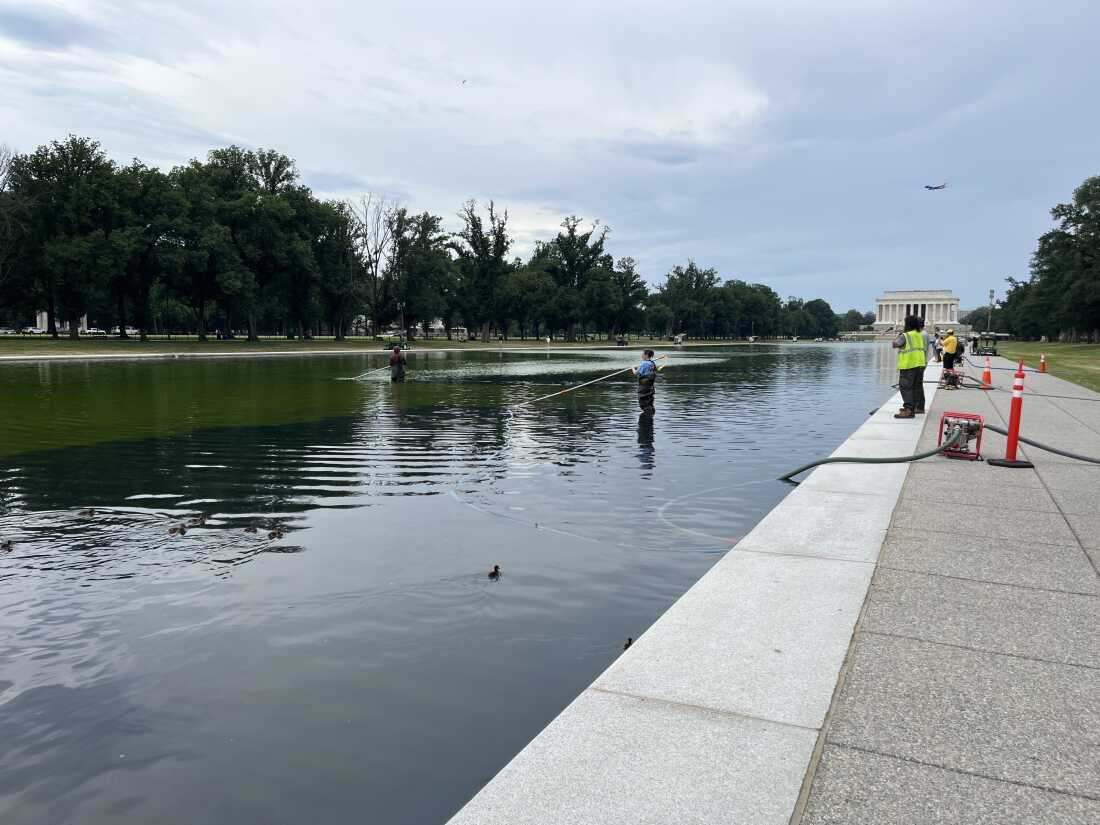
Workers battle the fast-growing common algae in the Lincoln Memorial Reflecting Pool on Thursday.
Rachel Treisman/NPR
hide caption
toggle caption
Rachel Treisman/NPR
The Trump administration is using a mix of mitigation strategies, including pouring hydrogen peroxide into the water to kill the algae.
The Interior Department says hydrogen peroxide is a “milder treatment than chlorine and is used in spas and specialty pools like natural swimming pools,” adding “there are no harmful side effects to marine life or to the environment.”
Workers are also deploying what the department calls “high-tech nanobubble ozone technology” to neutralize algae and other pathogens in the pool. The department says that approach is validated by several universities and the National Oceanic & Atmospheric Administration.
Those ozone bubbles are so tiny the human eye can’t even see them, Goodale says.
“The best way to describe it is that the bubbles are neutrally buoyant, so they won’t just rise to the surface and disappear readily,” he explains. “They can last for weeks, if not months in the water, doing their oxidizing thing and keeping the algae at bay.”
‘A monumental effort’
Goodale says it’s more complicated than treating the average backyard swimming pool, since the reflecting pool — despite its name — is actually more akin to a “manmade shallow lake.” He says it’s hard to predict just how long it will take to completely solve the algae problem, calling it “a monumental effort, literally.”
The Interior Department posted on X Wednesday that the nanobubble technology had “very effectively killed the algae,” and National Park Service crews would spend several days vacuuming up the dead algae from the bottom of the pool.
But as of Thursday morning, much of the pool — especially in the center — was still bright green.
Work continued on both ends of the pool. Nanobubble machines deposited their tubes into the water, as mobile vacuuming systems known as “trash pumps” hummed loudly from the shore. Handfuls of workers stood either in the pool or on the edge maneuvering long-handled vacuums back and forth. Their contents, including pistachio-colored water, poured out of hoses laying in the nearby grass.
The work zones were marked off by orange cones, but passersby walking the length of the pool appeared relatively unfazed. Some stopped to peer down and snap pictures of the water itself — including sections of paint that had visibly peeled off — while others were more focused on getting a photo of the Washington Monument in the background.
Loay Hidmi was walking deliberately along the edge of the pool closest to the Lincoln Memorial, hands clasped behind his back, looking over the ledge. The relatively new D.C. resident is a civil engineer who specializes in water treatment, and has been coming by the pool all week to see the progress for himself. He estimates it’s about 80% of the way there.
“I’m taking pictures of it … for the last week and I can see the gradual change,” he said. “So I’m hopeful. But we’ll have to see if it gets sustained.”
What happens next?
Hidmi worries that the algae could come back, given the favorable conditions posed by the sunny, shallow pool.
He acknowledges that’s mostly an aesthetic concern, given how much the administration has just spent on repainting the pool, but says it also raises questions about their process.
“In water systems, when you fix something, you need to look at the step before it and the step after,” he said.
Goodale agrees. He says that when a water system is taken offline, the pipes still remain full of water — “they don’t just gravity-drain away” — and need to be flushed out before any refilling. And he says eliminating algae is no substitute for dealing with underlying filtration issues.
“That’s like the equivalent of mowing the lawn when perhaps it needs to be something else that addresses the source nitrates and phosphorus, so that it’s more like pulling the weeds out by the root,” he says.

The algae doesn’t bother the ducklings swimming in the Reflecting Pool. Experts say the hydrogen peroxide used to get rid of the algae is safe for them, too.
Rachel Treisman/NPR
hide caption
toggle caption
Rachel Treisman/NPR
In the meantime, Christova, the algae expert, would like to see the water monitored weekly.
“If we don’t have any control over algal growth, we don’t know what is growing,” she said, adding that not all types of algae are as harmless as the one currently blooming in the pool.
When asked about plans for maintenance and algae prevention, White House spokesperson Taylor Rogers told NPR: “Thanks to President Trump, new lining and industrial grade materials will permanently seal the Reflecting Pool, which previously leaked 16 million gallons per year and wasted countless taxpayer dollars.”
Even after the Obama-era renovation, the reflecting pool suffered from broken pipes and water leaks requiring costly refills, according to a Department of the Interior report from fiscal year 2023. It called for new expansion joints, supply and return lines with thicker walls, saying “an improved distribution system will ensure the water can be circulated through the treatment plant, filtered, and treated with ozone.”
This latest renovation does not appear to have addressed the pipe problems, even though it did involve replacing failing expansion joints, resealing the pool, removing truckloads of garbage and “fixing the water system, drainage and so much more,” as Trump wrote on Truth Social in May.
Along the way, the cost of the project grew from Trump’s initial $2 million price tag to at least $14 million. Federal contract records show the government is paying $1.7 million to an Ohio-based company for the nanobubble technology alone.
“The scope of the Project has been greatly enlarged as we became involved because we realized how important it would be to Washington, D.C., and the record number of visitors coming to our now very safe Capital for all of the upcoming events in celebration of our 250th Anniversary,” Trump wrote.

The National Mall is hosting a number of semiquincentennial events on and around July 4, including a weekslong state fair that kicks off Wednesday evening.

Three San Francisco couples set out Monday for their annual road trip to Ashland, Ore., for the town’s famous Shakespeare festival. They drove separately and planned to meet at 6:30 p.m. on the terrace of their favorite Japanese restaurant there.
They had booked a table for six, but only four showed up for dinner.
Judith and Wylie Sheldon were found dead in their running car on the side of the road to Oregon, shocking their friends and family and leaving a hole in San Francisco’s arts and film world.
Ms. Sheldon, 84, was the daughter of William Wyler — who won three Oscars for best director — and chaired the board of the San Francisco Silent Film Festival. Mr. Sheldon, 86, was a prominent lawyer.
David Smith, who had befriended the couple more than 40 years ago, said in an interview that he and the others at the dinner table had grown nervous as time ticked on and their friends did not answer repeated calls to their cellphones. They learned they had not checked into their hotel either.
The friends eventually learned from one of the couple’s sons that the California Highway Patrol had found the couple at 5:46 p.m., both dead inside their running Jeep Compass. It was parked on the side of Interstate 5, north of Redding, Calif., more than 100 miles from their destination, the authorities said. Ms. Sheldon was driving, while Mr. Sheldon was in the passenger seat, according to the authorities.
The Redding area on Monday was under an extreme heat warning issued by the National Weather Service. Temperatures reached 109 degrees, according to the Weather Service.
Mr. Smith said he learned from the son that the couple had been found without any water or other liquids in the car. The fan was on high, but the air conditioning was not working, meaning they might have been blasted with hot air, Mr. Smith said. The windows were rolled down. The car had plenty of gas, and there were no signs of mechanical failure or foul play, Mr. Smith said the son told him.
“They didn’t crash. They stopped. They both just died there,” Mr. Smith said. “The entire thing is so bizarre. We’re still in a state of shock.”
The circumstances and cause of the couple’s death is under investigation but “appears to be medically related,” the Highway Patrol said in a statement.
Whether the heat contributed to the couple’s death “may be determined” by an autopsy, a spokesman for the Shasta County Sheriff’s Office said, adding that one had not been scheduled yet and could take several weeks to complete.
“We’ll just have to see,” the spokesman, Tim Mapes, said.
The Sheldons met at Stanford University and had two sons. They lived in a large home in San Francisco’s upscale Pacific Heights neighborhood that had views of the bay from the front and a garden out back.
They hosted many parties there on behalf of the San Francisco Silent Film Festival and sometimes let revelers pose for photos with Mr. Wyler’s Oscar statuettes. Ms. Sheldon fell in love with silent movies after first seeing those created by her father — before his better known blockbusters like “Ben-Hur” and “Roman Holiday” — only about 30 years ago, said Anita Monga, artistic director of the festival.
Stacey Wisnia, the festival’s executive director, said the couple was generous, delightful and unassuming.
Back in Ashland, Ore., Mr. Smith said the four remaining friends had distracted themselves from their grief by attending plays, including “A Midsummer Night’s Dream” and “Come From Away.” They were able to give away their friends’ tickets.
Ms. Monga had last seen Ms. Sheldon just last month at the film festival, which was held at the newly remade Castro Theater.
“This is such a shock,” Ms. Monga said of the deaths. “Also because it’s still a mystery.”
-
 Science5 minutes ago
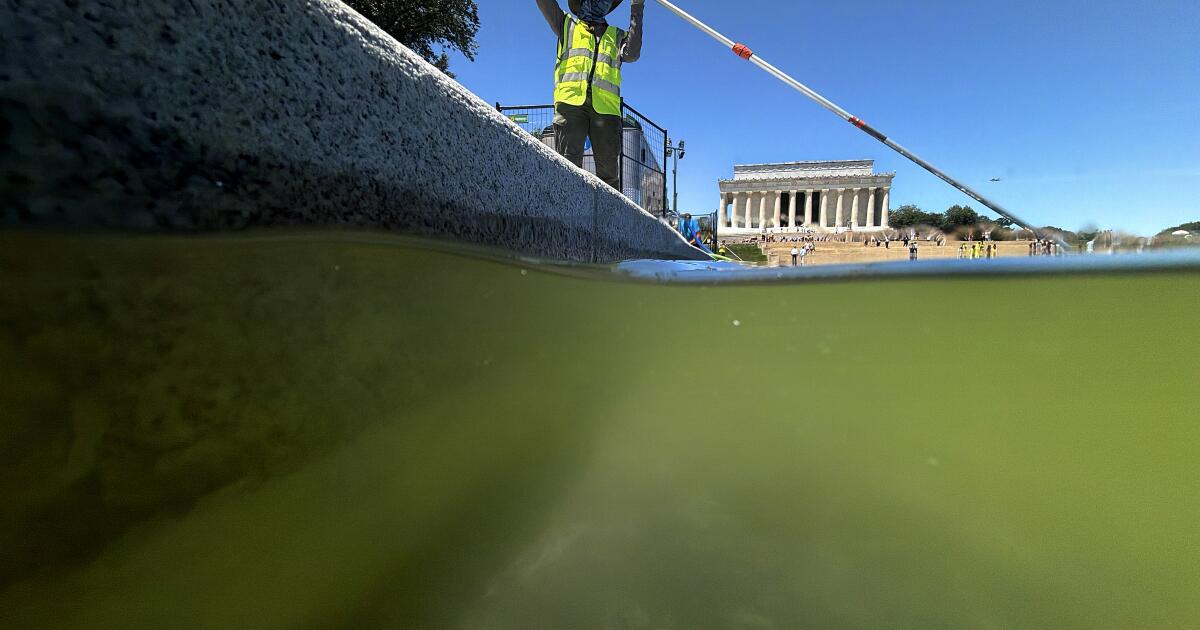
Here’s why the Lincoln Memorial Reflecting Pool went green so fast
-
 Sports8 minutes ago
Shohei Ohtani out of Dodgers’ lineup vs. Orioles for birth of his second child
-

 World20 minutes ago
Lebanese influencer organises World Cup event amid Israel’s attack on Leban
-
News43 minutes ago
Air Force One, gifted to Trump from Qatar, arrives at Joint Base Andrews
-

 New York2 hours ago
Video: Fans Show Up to the Parade in Their Best Knicks-Themed Attire
-

 Los Angeles, Ca2 hours ago
Victims sought after man allegedly points gun at passing cars in Santa Clarita Valley
-

 Detroit, MI2 hours ago
Best barbershop in Metro Detroit: Finalists for this year’s Vote 4 The Best
-

 San Francisco, CA3 hours ago
How to watch San Francisco Giants vs. Miami Marlins

