Students and staff members from the University of the Arts in Philadelphia are scrambling to figure out their next steps after the school’s abrupt closure last week and are calling on the university to answer questions about why it shut down so quickly.
The university announced it would be shutting its doors in a statement on May 31, after news had already begun to leak about an hour and a half earlier, saying in part that it “has been in a fragile financial state, with many years of declining enrollments, declining revenues, and increasing expenses.”
The nearly 150-year-old university, a longtime home for artists of all kinds, shut down a week later on June 7, leaving its more than 1,000 students and hundreds of faculty and staff confused and anxious.
Among them is Owen Spaloss, who walked across the stage at the university’s graduation in May, but still needs to complete a three-credit summer internship to receive his degree in creative writing. The unexpected shutdown has put his once imminent degree completion at least temporarily out of reach.
“A lot of these universities don’t have a creative writing major, and even if they do, there’s no guarantee that they would accept all of my credits or that they would accept scholarships,” Spaloss said.
Advertisement
“The only reason I can afford to go to the University of the Arts is because of the donors and the scholarships that I’ve gotten. I couldn’t financially afford this on my own.”
Protests at the University of the Arts in Philadelphia on June 3, the day of a town hall.Owen Spaloss
News of the University of the Arts’ closure has led to protests on campus by students and staffers alike who question why the university didn’t alert its community sooner or better prepare for its financial failure. The university did not respond to requests for comment.
Krista Apple, who has worked at the university for more than 10 years and was serving as the director of the bachelor of fine arts in acting program, said she didn’t initially believe the school was closing after learning about it first in a Philadelphia Inquirer article.
“I thought it was a joke, or I thought the Inquirer had gotten something wrong. I thought maybe somebody was pranking me,” Apple said.
Students and staff said the Inquirer article made the rounds on social media, group texts and emails before the university released a statement. Some community members said they first heard about the closure on TikTok.
Advertisement
“It continues to be disorienting and heartbreaking. This is a massive loss of community for all of us who taught and worked together for many years. It’s also a massive loss for the city of Philadelphia,” Apple said. “Our students really were one of a kind, both in terms of the cohort of humans that they were, but also individually.”
The university said in the statement announcing its closure that it had “worked hard this year alongside many of you to take steps that would secure the University’s sustainability. The progress we made together has been impressive.”
“Unfortunately, however, we could not overcome the ultimate challenge we faced: with a cash position that has steadily weakened, we could not cover significant, unanticipated expenses. The situation came to light very suddenly. Despite swift action, we were unable to bridge the necessary gaps.”
The university’s accreditation was withdrawn June 1, three days after the school notified its accrediting body that it would close, the Middle States Commission on Higher Education said in a news release on May 31.
The Philadelphia City Council voted June 6 to hold hearings to examine the university’s sudden closure and its impact on the city’s higher education system and the school’s current students and staff.
Advertisement
Pennsylvania Attorney General Michelle Henry’s office confirmed to NBC News that it is “reviewing the circumstances of the closure and any transfer or loss of assets.”
DJay Jean, a rising sophomore who was studying vocal performance at the University of the Arts, said attending college has been a personal milestone.
“I’m a first-generation American, let alone I’m a first-generation student. My dad did not finish high school. My mom didn’t go to college,” Jean said.
“I grew up with just my father and it wasn’t a great upbringing. I eventually ended up in foster care at 16,” Jean said. “College never felt like an option to me financially.”
Jean was able to attend the university after receiving several scholarships, taking out loans and working part-time jobs. But now, they are unsure of what’s next and said they feel trapped after signing an apartment lease in Philadelphia.
Advertisement
“I spent so much money to go to this school, and I put so much trust in the faculty and the board. It’s an investment,” Jean said.
“You would think that after putting so much more money into something when it’s going away, the people responsible would want to inform you, and they’d want to let you know, ‘Here’s what’s going on.’ But they weren’t interested in that. And it made me feel very disrespected and made me feel like I wasted my money,” they added.
The university is facing criticism from students and staff about what they say has been a lack of communication and transparency from the administration.
Several students sent videos to NBC News showing demonstrations, performances and marches at the school.
Protests at the University of the Arts in Philadelphia on June 7, the day it closed.Owen Spaloss
They also said community members had been locked out of Hamilton Hall, one of the main buildings on campus, at one point during the demonstrations.
“They shut off the power to Hamilton Hall. … They didn’t want us to demonstrate. They closed their bathrooms to us and they shut off the power,” Jean said.
Advertisement
The university scheduled a virtual town hall on June 3 with a cap of 500 attendees, but it was canceled minutes before it was scheduled to start, according to several students. The university’s president, Kerry Walk, resigned the next day.
On the university’s official last day, June 7, campus community members who had been protesting and camping out in front of Hamilton Hall organized a “Last Jam” event to show their frustration and process the shocking news together.
Apple said staff were also called into a virtual meeting on the school’s final day.
“We were effectively fired en masse via Zoom by a member of the management team that had been hired, someone we had never met before,” she said.
“Based on the brief information they shared, I have reason to believe that I will receive at least my next paycheck, which is due at the end of June. But I’ll be honest, I’m not holding my breath,” Apple said.
Advertisement
Krista Apple, second from left in the front row, who was the director of the bachelor of fine arts in acting program, on June 7, the last day of teaching.Courtesy Krista Apple
Apple said she wants those who had been charged with making decisions about the university’s fate to face consequences for its closure.
“I would like to see some accountability, not just from the most recent administration, but also from the board of directors and also from the previous administration too, that was working really closely with this budget,” Apple said. “Because I just keep wondering at what point was it clear that this university’s finances were not salient, and I can’t fathom the notion that it was just two weeks ago, on May 29, that someone looked at our books and went, ‘Oh, no, we can’t keep going.’”
The board’s chair did not respond to a request for comment.
This week, the university announced a call center and support email for the campus community.
Students have also received an email confirming that any payments made for the summer or fall semesters will be refunded. Meanwhile, a Temple spokesperson said the university is exploring a potential merger with the school.
“The amount of support and care from our education and arts community across the country is one of the things that gives me hope. And it just proves to me that artists are incredibly resilient. And no matter how much funding we don’t have, we are not going away,” Apple said.
Advertisement
Originally founded in 1876, the University of the Arts is just the latest arts institution to shut down in Pennsylvania.
The Pennsylvania Academy of the Fine Arts closed its doors in January, with some of its students enrolling in the University of the Arts.
Last year, at least 14 colleges and universities shut down or merged according to Inside Higher Ed, amid lower college enrollment rates and the pressure of inflation.
According to the National Center for Education Statistics, college enrollment fell from about 18 million in 2010 to about 15.8 million in 2023.
Despite the chaos and confusion, several students have found solace with those in the extended arts community.
Advertisement
“If nothing else, we are showing that we are committed to each other in our community. We’re showing that we are not willing to just go quietly into the night. We are going to stand strong and show what we stand for, because as artists it’s already hard enough to make it in the world,” Spaloss said.
“Our schools are closing down, but that doesn’t mean our community shuts down, too,” Jean added.
Mexico has begun filing criminal complaints with state prosecutors in the United States over the deaths of its citizens in U.S. immigration custody and during enforcement operations, the foreign mini
Aida Pelaez Fernandez and Natalia Siniawski | Reuters
Maine ICE shooting caught on security camera
Surveillance footage from two local businesses shows a white car driving in circles at a street intersection.
Advertisement
MEXICO CITY, July 13 (Reuters) – Mexico has begun filing criminal complaints with state prosecutors in the United States over the deaths of its citizens in U.S. immigration custody and during enforcement operations, the foreign ministry said on Tuesday.
More: Maine voices outrage after deadly immigration enforcement shooting
Mexico’s government has also sent cease-and-desist letters to U.S. detention centers where Mexican nationals have died, the ministry added in a statement.
More: ICE fatally shoots Mexican immigrant in Houston
The filings follow the deaths of at least 14 Mexican nationals in ICE custody and several others during arrest operations, including the recent fatal shooting of a Mexican citizen by an ICE agent in Houston.
Advertisement
President Claudia Sheinbaum announced Mexico’s intention to escalate its response to the deaths last Friday, as she claimed that the government “cannot turn a blind eye to the Mexicans who have died.”
In addition to the measures in the U.S., Mexico’s foreign minister also contacted the United Nations High Commissioner for Human Rights regarding the deaths of Mexican nationals in ICE custody.
Mexico expects the U.N. office to gather information from U.S. authorities, analyze the events and “refer the case to the relevant special procedures of the Human Rights Council,” the statement added.
This much is undisputed: On Nov. 2, 2023, a guard and a prisoner at a federal penitentiary in California got into it over a straw sunhat that the officer had confiscated. The man — identified in court records by his initials, J.M. — walked out of the office, as Officer Sandra Munagay followed him. When he stopped and turned around, Munagay “cocked back … and punched me in my face,” he said in an interview. That is on camera. Munagay admitted to the assault and pleaded guilty this January to falsifying records about it.
But the more severe harm came after, J.M. said, in a hallway without security cameras. As Munagay kicked and hit him, she shouted to other officers that J.M.had attacked her. According to a lawsuit, at least three other guards then rushed in, forced him into a blind spot, and pinned him face-first to a wall. With J.M.’s hands cuffed, he says an officer then sexually assaulted him with an unknown object.
Advertisement
That night, J.M. was transferred to another prison, where a nurse noted bleeding and tenderness in his rectum, medical records show. That gave J.M. more proof than most people behind bars in his situation.
But guards still had near-total control over whether he could file a complaint, or someday sue over what happened to him. J.M. knew they could destroy his paperwork, claim it got lost, or simply deny him the forms he needed. And like he had experienced in other federal prisons, he says, they might punish him for even trying to speak out.
It’s the same dilemma presented to anyone who faces violence in federal prison: Try to file an administrative grievance and risk opening yourself up to retaliation — or stay quiet, endure the abuse, and forgo your chance to someday bring your case to court.
Under federal law, people in prison must go through the facility’s own grievance process before they can attempt to sue. That gives prison staff a “chokehold over access to the courts,” said Colin Prince, a civil rights attorney and former federal defender who is representing J.M. in his lawsuit.
Advertisement
“The guards functionally have power over whether a prisoner can sue them for their own misconduct,” he said. “The entire system is layer upon layer of bureaucratic insulation against accountability. It simply prevents prisoners from getting access to the courts.”
An attorney for Munagay said he and his client declined to comment. A spokesperson for the Bureau of Prisons, Randilee Giamusso, said she could not discuss individual cases or ongoing litigation.
An investigation by The Marshall Project and NPR found that less than 2% of grievances filed in federal prison in 2023 were granted. A majority were rejected for procedural errors or “administratively closed” for other reasons. The findings were based on a federal database, published by the Data Liberation Project, containing nearly 1 million federal prison grievance cases dating back to 2000.
But that data only includes instances where incarcerated people were able to file a complaint at all. An unknown number of cases, especially those involving physical and sexual violence, go unreported, as the same officers accused of abuse can silence those trying to seek help, according to court records, lawsuits, and interviews with attorneys, incarcerated people, advocates and former bureau officials. A recent report by the Government Accountability Office found that fear of retaliation was a major impediment to reducing and reporting sexual abuse in federal prisons.
Advertisement
Prison officials said bureau policy prohibits retaliation of any kind, and that they review and investigate allegations of abuse. In an email, Giamusso wrote that the remedy system is “a safeguard intended to foster resolution within the system, not a barrier to court access.” She noted that remedies related to sexual abuse can be submitted in other ways, such as “third-party reporting and [Prison Rape Elimination Act]-specific channels.”
But many prisoners disagree. “The grievance system is a joke,” said Jimmy Hodge, who was released from federal prison in early 2025. Hodge says he was abused in multiple federal penitentiaries, but was frequently blocked from filing complaints about it. “If you’re grieving over abuse, they’re going to harass you, they’re going to assault you, but you’re never going to get relief.”
Since the passage of the Prison Litigation Reform Act 30 years ago, which required incarcerated people to file grievances before attempting to sue, the rate of civil rights cases filed from prison has dropped significantly.
Lawmakers at the time were concerned about “frivolous” lawsuits from prisons overwhelming federal courts. Politicians pointed to one case where a person had allegedly sued over whether he received chunky or creamy peanut butter. (The case was actually about not getting a $2.50 refund for peanut butter returned to the commissary, which is the equivalent of hours of prison labor.)
“People talk a lot about prisoners filing frivolous lawsuits,” said professor Margo Schlanger of the University of Michigan Law School, who has studied prison litigation across the U.S. “But a huge number of prisoner cases are about really, really serious matters. They’re about abysmal medical care and awful conditions and failures to protect them from harm by staff or by other prisoners. They’re about sexual violations.”
Advertisement
Attempts to significantly reform the law have gone nowhere, Schlanger said. “Having a system that stands in the way and says, ‘You know what, because you filed that grievance after three days instead of after two, you are out of luck and out of court’ — that is a shocking betrayal of justice.”
People who are blocked from filing grievances can sometimes convince a court that the remedy system was unavailable and their lawsuit should proceed. But that is a high bar that may require documentation and the help of an attorney, which many people filing from prison don’t have.
As is, the law fails to account for all the ways prison staff can thwart someone’s attempts to follow the remedy process, attorneys say.
To submit a complaint, someone must obtain a form from their counselor or another prison employee and then return the completed form to staff. According to bureau rules, an incarcerated person must file on their own behalf, unless it is regarding sexual abuse — whether they are in the infirmary or solitary confinement or have a disability. They can receive assistance with their filing from “trained inmate aides,” someone on the outside or a staff member, Giamusso wrote.
For people in isolation, filing a complaint is even harder. “You can’t just walk over to a box on the wall that says grievances and put it in the slot,” said attorney John Boston, co-author of the “Prisoners’ Self-Help Litigation Manual.” “You’ve got to hand it to the correctional officer. And that right there is a prescription for mischief.”
Advertisement
Multiple people in federal prison said officers refused to provide the forms they needed. “I have had difficulty in obtaining the initial grievance form because the unit counselor who issues the forms was friends with the officer whom the complaint was about,” wrote Erick Hobbs, now incarcerated in federal prison in North Carolina. According to Giamusso, if someone can’t get a form, they can ask for help from any staffer, “proceed to the next step in the remedy process, or report concerns through alternative channels.”
Even if you can get a form, there’s no guarantee the paperwork will be filed. “I have had officers doing a ‘random shakedown’ of a cell, and remedy papers go missing,” wrote William Batton, from a federal prison in Massachusetts. Many said prisoners were often transferred to a new facility and lost their paperwork in the process. That halts a case, as any appeal requires copies of every previous response and filing.
People in federal prison have just 20 days after an incident to file a complaint. Those regarding sexual abuse are supposed to be exempt from deadlines, under the federal Prison Rape Elimination Act. There is no such exemption for physical violence.
“People who are the most hurt are often the least equipped to describe it and file a grievance promptly,” Schlanger said. “Requiring them to very speedily figure out exactly what they’re complaining about can be a very, very high hurdle.”
By the time J.M. was assaulted in California, he had served time in some of the country’s most notorious federal prisons. In 2020, he was held at Big Sandy penitentiary in Kentucky, where officers had an unofficial policy: If someone requested protective custody because they feared other prisoners, guards would beat the person asking for help. Then the guards worked together to cover up the attacks, according to court records. Six staff members at Big Sandy were convicted for their role in the abuse.
Advertisement
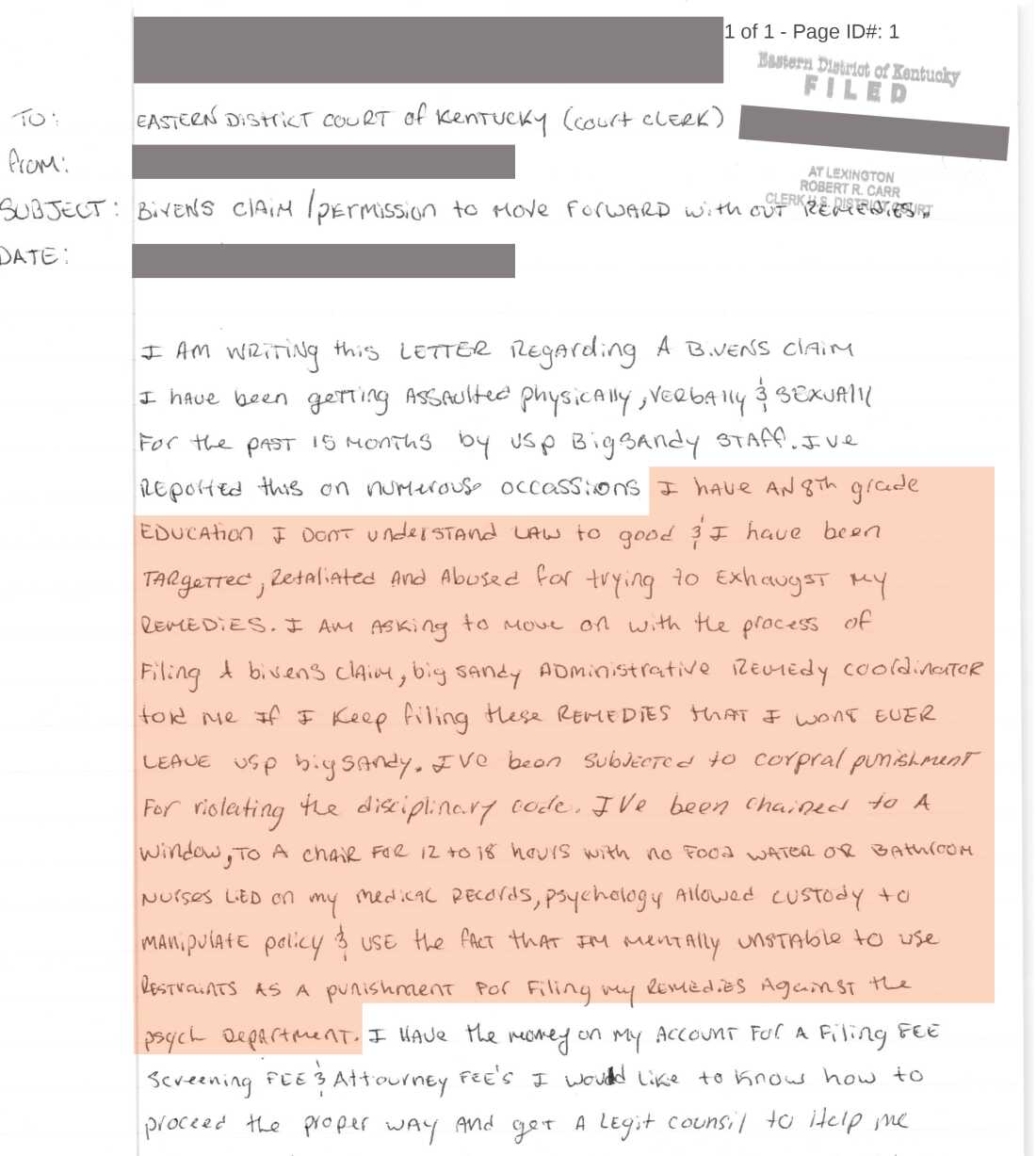
J.M. tried to report the abuse he received at Big Sandy penitentiary in 2020 to the Eastern District Court of Kentucky. The highlighting and redactions were done by The Marshall Project.
PACER
hide caption
toggle caption
PACER
Advertisement
When J.M. tried to report the abuse he said he suffered at the hands of Big Sandy staff, it only brought more mistreatment. “I have an 8th-grade education, I don’t understand law,” he wrote to a federal court in 2020. “I have been targeted, retaliated and abused for trying to exhaust my remedies. Big Sandy [staff] told me if I keep filing these remedies that I won’t ever leave.” In his letter, J.M. described being chained to a chair for 12 to 18 hours at a time with no “food water or bathroom.”
“Nobody should get chained to no bed for … hours for filing a piece of paper, no matter what,” J.M. said in a recent interview.
His plea to the court, like several others filed from Big Sandy at that time, went nowhere.
In one case reviewed by The Marshall Project, an incarcerated man reported being pepper-sprayed, choked, beaten with a baton and repeatedly called racial slurs by Kentucky officers who were later convicted. He tried multiple times to file grievances about the attacks but received no response before he was transferred to another prison, according to a legal complaint. When he sued in court, his case was thrown out: He hadn’t completed the final two levels of the bureau’s remedy process.
Advertisement
By 2021, J.M. was transferred from Big Sandy to Thomson penitentiary in Illinois, then one of the most violent federal prisons in the country. Bureau officials closed the high-security Special Management Unit there in 2023, after an investigation by The Marshall Project and NPR exposed a culture of abuse and multiple homicides.
In his legal complaint, J.M. said officers at Thomson also refused to provide him with grievance forms. In a survey of over 120 people who had been held at Thomson, conducted by legal advocacy group The Washington Lawyers’ Committee, many reported the same interference. “I’m gonna break your fucking hands since you like to write us up,” one man said he was told, after an officer confiscated his stamps and legal documents.
There are supposed to be other avenues for incarcerated people to report their abuse. But in a setting where no communication is truly anonymous, and the fear of retaliation is prevalent, even reaching out to the Inspector General felt risky, J.M. said. And it was hard to trust another government agency. “It’s like being in a house, and your mother or father is abusing you,” he explained. “And then you go and try and tell your mother or father, ‘Y’all abusing me.’ It didn’t make sense.”
In the U.S. Government Accountability Office report, published in May, investigators found that most surveyed prisoners said they could experience retaliation from staff if they reported sexual abuse. Less than half said they would feel comfortable reporting to the warden or a corrections officer. And many of the surveyed people didn’t know they had other options to report a sexual assault, like calling a rape crisis center or asking a family member to report on their behalf. The bureau agreed with the recommendations laid out in the report.
Advertisement
Fear of being targeted can hide systemic problems. At FCI Dublin in California, which closed in 2024 over widespread sexual abuse, officers frequently punished people for trying to file complaints, said Aron Laureano, who spent two years at the facility.
“They made it literally impossible for anybody to say anything,” she said. The first time Laureano filed a grievance, an officer came to her cell and quoted from her written complaint in front of everyone. “And that’s why they got away with it for so long.”
According to a federal lawsuit, officers retaliated against Laureano by placing her in solitary confinement, taking away her visits and phone calls, and confiscating her property. In one bizarre form of punishment, Laureano said, an officer made her walk around the prison yard, gather the eggs and baby hatchlings of geese who were roosting on the grounds, and stuff them in a trash bag.
Laureano came home from prison in 2024. “You went from one monster to another,” she said of navigating her time at Dublin. “You didn’t have anywhere to go. And I think that’s the worst feeling in the world. I told myself I would never put myself in a predicament like that again, ever.”
After the 2023 assault at Atwater penitentiary in California, J.M. was transferred to a different federal facility and locked in solitary confinement for making threats, insolence, and refusing to obey an order. In her official retelling of the incident, Officer Munagay had claimed that J.M. “walked toward me in an aggressive way” and that she “feared for [her] life.”
Advertisement
What happened with Munagay and the other officers followed J.M. to the new facility. “Everybody knew about the situation, it was funny to them,” he said of the guards there. “I had officers come and tell me, ‘Hey, drop the case, she’s got three kids.’” Staff also began threatening him, according to J.M.’s complaint. They told other prisoners he was a snitch, he said, and locked him in four-point restraints for hours, where each limb was chained to a concrete slab.
It wasn’t just the guards he was worried about. J.M. had seen employees turn prisoners against each other, he said, as payback for writing someone up. “If I file a remedy … my unit team is going to come … take everybody’s stuff, trash everybody’s cells, and say, ‘We’re doing this because [J.M.] complained,’” he said. “Now the other inmates are mad, ‘Oh, it’s your fault.’ Your life is in danger.”
Federal prison policy required J.M. to file his complaint at the institution level first, unless it was regarding a “sensitive” issue. Then he could mail a claim directly to the regional director. J.M. didn’t have enough postage, so he fashioned a fishing line out of plastic wrappers, and used it to trade food for stamps with other men on the tier.
His grievance was rejected. The bureau did not consider his issue “sensitive,” according to a federal database, and required him to file again at the prison level. When J.M. went to file an appeal, prison staff seized and destroyed his paperwork, his lawsuit says.
“He had been assaulted, isolated, trapped, and could not tell anyone who would listen,” his complaint states. “By mid-January 2024 … JM was expressing ‘suicidality’ to the mental-health department because he could not ‘participate’ in the ‘Administrative Remedy Process.’”
Advertisement
Nearly six months after his attack, prison staff dropped the disciplinary charges against J.M., as video footage showed Munagay had punched him. Federal prosecutors filed criminal charges against Munagay six months later. In June, she was sentenced to four months in prison. J.M.’s lawsuit is ongoing.
No charges have been filed regarding the sexual assault J.M. says he experienced. In 2024, there were 32 allegations of sexual abuse by staff reported at Atwater penitentiary.
J.M. has since been moved to another federal penitentiary out of state. His struggles with the grievance system continue. He’s trying to appeal a grievance he filed about not receiving his allotment of postage stamps, but he doesn’t have enough stamps to mail the paperwork.
“I’m resilient. I’m not going to give up just because other people failed,” he said about his commitment to keep trying to use the system. “I’m going to keep filing no matter how small or big the situation is, and hopefully something will change. These are the rules I gotta follow. This is the only way I got to fight.”
A person was killed Monday in an ICE-involved shooting in Biddeford, Maine, according to the state’s speaker of the house — just days after a federal agent fatally shot a Mexican immigrant during a traffic stop in Houston, sparking mass protests and demands for transparency and accountability.
“A person was killed. ICE was involved. State Police and the Department of Public Safety are now on scene to gather details and would expect the FBI to investigate as well,” Maine House Speaker Ryan Fecteau said in a statement on Facebook. “These are the details that I have at this time. I will provide further updates, as they are relayed to me.”
CNN has reached out to Immigration and Customs Enforcement and the Department of Homeland Security for comment.
Biddeford police told CNN there was a “police incident” in the area, about 18 miles south of Portland, and said there is no threat to the public at this time, but declined to provide additional details.
Maine Democratic US Rep. Chellie Pingree said she was “disturbed and angry” upon hearing the news of the shooting. She called for an investigation into the incident, adding a question directed at ICE officers: “Why are you in Maine?”
Advertisement
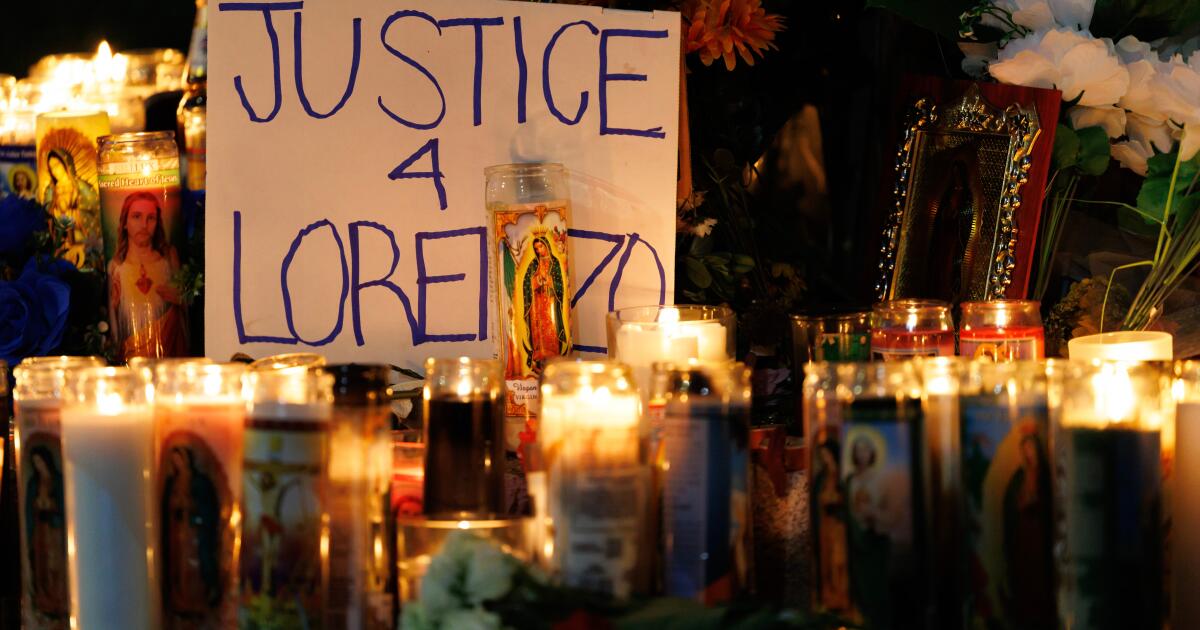
The incident comes less than a week after a man on his way to work in Houston was shot and killed by an ICE agent. Lorenzo Salgado Araujo was killed during a traffic stop in what ICE initially described as a targeted enforcement operation, though a source later said Salgado Araujo was not the target of the operation.
The shooting has reignited calls for accountability among ICE agents, which reached a fever pitch earlier this year after 37-year-old mother Renee Good and 37-year-old ICU nurse Alex Pretti were killed by federal immigration agents during the Trump administration’s operation in Minneapolis.
The administration dubbed a similar surge in immigration enforcement across Maine in January “Operation Catch of the Day.” The ACLU and other advocates filed a lawsuit against federal immigration agents for “abducting a lawful immigrant” during the surge.
Some community groups and advocates that rallied against the surge earlier this year have already started to organize in response to Monday’s shooting. The group “Maine Resists” has planned an emergency community rally in the city at noon. The racial justice and immigrant rights group Project Relief said it is in touch with the victim’s family.